Furamag
Ukraine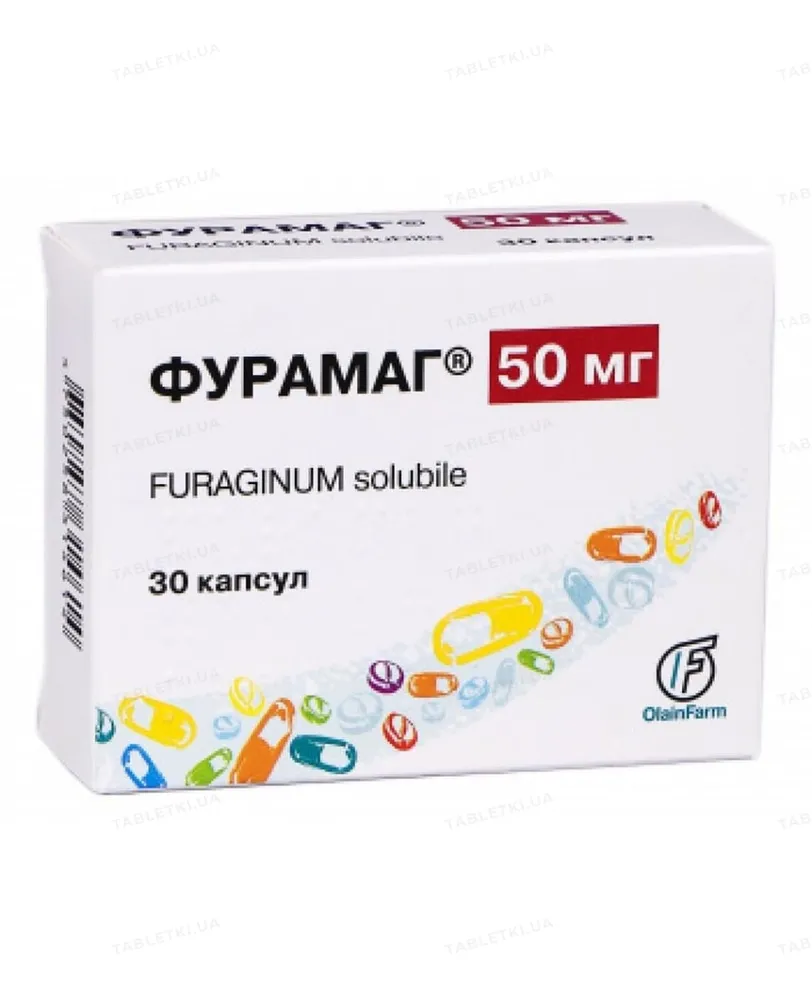
Table of Contents
INSTRUCTIONS for medical use of the medicinal product FURAMAG® (FURAMAG)
Composition:
Active substance: furazidin soluble;
1 capsule contains 25 mg of soluble furazidin;
Excipients: magnesium hydroxycarbonate, potassium carbonate, talc; capsule shell: titanium dioxide (E 171), iron oxide yellow pigment (E 172), gelatin.
Medicinal form. Capsules.
Main physicochemical characteristics: hard gelatin capsules size № 4 (color brownish-yellow/brownish-yellow), containing powder ranging from orange-brown to red-brown. The presence of particles of white, yellow, orange, and orange-brown colors is permissible.
Pharmacotherapeutic group.
Antibacterial agents for systemic use. Nitrofuran derivatives. ATC code J01XE.
Pharmacological Properties
Pharmacodynamics
Furamag® is a complex compound of soluble furazidine and magnesium hydroxycarbonate in a 1:1 ratio, which has fundamentally different pharmacological properties compared to plain furazidine (after administration, in the acidic environment of the stomach, soluble furazidine is not converted into poorly soluble furazidine, thus the bioavailability of Furamag® is 3 times higher than that of conventional furazidine).
The drug has a broad antibacterial spectrum of activity against both gram-positive and gram-negative microorganisms. Furamag® is effective against gram-positive cocci (streptococci and staphylococci) and gram-negative rods (Escherichia coli, Salmonella, Shigella, Proteus, Klebsiella, Enterobacter). It is also active against protozoa (Giardia lamblia). Compared to other nitrofurans, Furamag® demonstrates higher activity against staphylococci, Escherichia coli, Aerobacter aerogenes, Bact. Citrovorum, Proteus mirabilis, Proteus morganii, as well as greater efficacy against Enterococcus faecalis and Staphylococcus spp. compared to other groups of antimicrobial agents.
Microbial resistance to soluble furazidine develops slowly and does not reach clinically significant levels.
Furamag® does not alter the pH of urine and circulates in high concentrations in the kidneys.
The bacteriostatic concentration of furazidine against most microorganisms ranges from 1:100,000 to 1:200,000. Due to the action of nitrofurans, microorganisms produce fewer toxins, which means improvement in the patient's general condition may occur even before pronounced inhibition of microbial growth. The bactericidal concentration is approximately twice as high. Under the influence of nitrofurans, microorganisms experience inhibition of cellular respiration and the Krebs cycle, as well as suppression of other biochemical processes, leading to disruption of the cell wall or cytoplasmic membrane. Unlike many other antimicrobial agents, nitrofurans do not suppress the body's immune system; on the contrary, they activate it (increase complement titers and enhance leukocyte phagocytic capacity). At therapeutic doses, nitrofurans stimulate leukopoiesis.
Pharmacokinetics
After oral administration of Furamag® capsules, in the acidic environment of the stomach, soluble furazidine is not converted into furazidine, thereby significantly enhancing the bacteriostatic and bactericidal effects. After absorption from the gastrointestinal tract (mainly from the small intestine via passive diffusion) into the portal venous system, a bacteriostatic concentration of the drug is achieved.
Absorption of nitrofurans from the distal segment of the small intestine exceeds absorption from the proximal and middle segments by 2 and 4 times, respectively. Nitrofurans are poorly absorbed in the large intestine.
Clinically significant high concentrations of the active substance are found in lymph (which helps prevent the spread of infection via lymphatic pathways). The drug concentration in bile is several times higher than in blood serum, while in cerebrospinal fluid (CSF), it is several times lower than in blood serum. The concentration of soluble furazidine in saliva amounts to 30% of its concentration in blood serum. The concentration of soluble furazidine in blood and tissues is relatively low due to its rapid elimination. However, its concentration in urine is significantly higher than in blood. Maximum blood concentration persists from 3 to 8 hours; the drug appears in urine 3–4 hours after administration. Elimination of soluble furazidine by the kidneys occurs via glomerular filtration and tubular secretion (85%), with partial tubular reabsorption. A smaller portion undergoes biotransformation (less than 10%) in the liver and kidneys. When renal excretory function is impaired, the intensity of metabolism increases. At low concentrations of soluble furazidine in urine, filtration and secretion predominate; at high concentrations, secretion decreases and reabsorption increases.
Four hours after administration, the concentration of the drug in urine is significantly higher than after administration of an equivalent dose of furazidine. Absorption of Furamag® is notably improved when taken after food.
Clinical characteristics.
Indications.
Infections caused by microorganisms sensitive to Furagin soluble: urogenital infections (acute and chronic cystitis, urethritis, pyelonephritis, prostatitis), gynecological infections.
For the prevention of urinary tract infections recurrence.
For the prevention of infectious complications during urological surgeries, cystoscopy, and catheterization.
Contraindications.
- Hypersensitivity to furazidin, nitrofuran derivatives, or to any excipients of the drug;
- severe renal impairment (creatinine clearance less than 30 mL/min);
- severe hepatic impairment;
- polyneuropathy (including diabetic);
- glucose-6-phosphate dehydrogenase deficiency (risk of hemolysis);
- porphyria (diseases caused by impaired metabolism of hemoglobin breakdown products);
- undergoing hemodialysis or peritoneal dialysis.
Interaction with other medicinal products and other types of interactions.
Agents that alkalinize urine reduce the therapeutic effect of Furamag® (accelerate the excretion of Furamag® with urine).
Agents that acidify urine (acids, including ascorbic acid, as well as calcium chloride) increase the concentration of Furamag® in urine, enhancing the therapeutic effect of the drug, but at the same time increasing the risk of toxicity.
Concomitant use with chloramphenicol, lincomycin, and sulfonamides enhances suppression of hematopoiesis.
In vitro, nitrofurans are antagonists of quinolones (nalidixic acid, oxolinic acid, norfloxacin). However, in vivo clinical significance of this interaction has not been studied; therefore, simultaneous use with quinolones should be avoided.
The use of probenecid and sulfinpyrazone reduces the excretion of furazidin, increasing the risk of adverse reactions and toxicity.
Concomitant use of Furamag® and antacids (containing magnesium trisilicate) reduces the absorption of Furamag®.
In renal impairment, concomitant use of Furamag® with aminoglycosides is not recommended.
The antibacterial effect of Furamag® is significantly enhanced when used concomitantly with antibiotics (penicillins and cephalosporins), and it combines well with tetracycline and erythromycin.
Alcohol consumption is prohibited during treatment, as alcohol may intensify adverse effects (increased heart rate, chest pain, headache, nausea, vomiting, seizures, decreased blood pressure, fever, anxiety).
Special precautions for use.
The drug should be used with caution in the following cases:
- Renal function impairment (contraindicated in severe renal insufficiency);
- Anemia;
- Deficiency of B-group vitamins and folic acid;
- Lung diseases.
The use of Furamag® is not recommended in cases of urosepsis and parenchymal kidney infection.
Peripheral neuropathy (pain, sensory disturbances in the area of the affected nerve) may develop during prolonged use of Furamag®.
Experimental studies and clinical observations in patients have shown that nitrofurans adversely affect testicular function, manifested as decreased sperm and ejaculate volume, reduced sperm motility, and pathological changes in sperm morphology.
In patients with diabetes mellitus, the drug may cause polyneuropathy.
If symptoms of neuropathy occur, the drug should be discontinued.
During prolonged use of prophylactic doses of Furamag®, clinically significant microbial resistance does not develop.
There have been no reports of pseudomembranous colitis associated with Furamag® treatment, although such cases have been reported with nearly all antibacterial agents, including nitrofuran derivatives. The possibility of this adverse effect should be considered in patients who develop diarrhea during antibacterial therapy due to suppression of the normal rectal microflora. Unlike antibiotics, Furamag® practically does not alter intestinal microflora. In mild cases of pseudomembranous colitis, discontinuation of the antibacterial agent is usually sufficient.
Laboratory testing in patients taking Furamag® has shown that the drug may cause false-positive results for glucose in urine when the copper reduction method is used. Furamag® does not affect the results of glucose testing in urine when the enzymatic method is employed.
During prolonged use of the drug, monitoring of renal and liver function parameters is required, as well as monitoring of lung function, especially in patients over 65 years of age.
To prevent neuritis, concomitant administration of antihistamines and B-group vitamins (nicotinamide, thiamine) is advisable.
Use during pregnancy or breastfeeding.
Do not use during pregnancy or breastfeeding.
Ability to affect reaction rate when driving or operating machinery.
The drug usually does not affect reaction speed when driving or operating machinery. However, patients who experience dizziness, drowsiness, or other central nervous system side effects during treatment should exercise caution when driving or operating machinery.
Administration and Dosage
The medication should be taken after meals, with a large amount of water.
Adults: 50–100 mg (2–4 capsules) three times daily.
The maximum daily dose for adults is 300 mg.
Children aged 3 to 10 years (with body weight up to 30 kg): up to 5 mg/kg of body weight per day, divided into three doses.
Children aged 10 years and older (with body weight of 30 kg and above): 50 mg three times daily.
The treatment course lasts from 5 to 10 days. If necessary, the course may be repeated after 10–15 days (as prescribed by a physician).
For recurrence prevention of urinary tract infections, adults and children should take 1⁄3–1⁄4 of the daily dose at night for 3–6 months.
For prophylaxis of infection during urological surgeries, cystoscopy, catheterization, etc., the medication should be administered as follows: adults – 50 mg three times daily; children – 25 mg three times daily.
If a dose is missed, the next dose should be taken as soon as the patient remembers.
Do not take a double dose to make up for a missed dose.
Children
The medication is indicated for children aged 3 years and older.
Overdose
Symptoms: In case of overdose, neurotoxic symptoms such as ataxia and tremor may occur.
Treatment: In case of poisoning, discontinue the medication and drink plenty of fluids. If acute symptoms develop, antihistamine drugs should be administered. For prevention of neuritis, vitamins of group B (thiamine bromide) may be prescribed.
Adverse reactions.
Blood and lymphatic system disorders: blood dyscrasias (agranulocytosis, thrombocytopenia, aplastic anemia).
Immune system disorders: hypersensitivity reactions, including pruritus, rash, urticaria, angioedema.
Nervous system disorders: headache, dizziness, drowsiness, peripheral neuropathy, neuritis, polyneuritis.
Eye disorders: visual disturbances.
Ear and labyrinth disorders: tinnitus.
Respiratory, thoracic and mediastinal disorders: acute and chronic pulmonary hypersensitivity reactions. Skin rash, pruritus, urticaria, angioedema, and myalgia have been reported concurrently with acute pulmonary reactions. Acute pulmonary reaction is a hypersensitivity reaction that may develop within several hours, rarely minutes, and is characterized by fever, eosinophilia, cough (with or without sputum), chest pain, and severe dyspnea. Acute pulmonary reaction usually resolves upon discontinuation of the drug.
Chronic pulmonary reactions may occur over a prolonged period after discontinuation of nitrofuran therapy and are characterized by progressively worsening dyspnea, tachypnea, fever, eosinophilia, progressive cough, interstitial pneumonia, and/or pulmonary fibrosis.
Nasal disorders, hoarseness.
Gastrointestinal disorders: nausea, flatulence, vomiting, anorexia, diarrhea, dyspepsia, constipation, abdominal pain, pancreatitis. The incidence of gastrointestinal adverse effects decreases when the drug is taken with food.
Skin and subcutaneous tissue disorders: papular eruptions, pruritus, angioedema, urticaria, exfoliative dermatitis, erythema multiforme, reversible alopecia.
Musculoskeletal and connective tissue disorders: arthralgia, rib pain, cramps.
Vascular disorders: mild intracranial hypertension.
Hepatobiliary disorders: cholestatic jaundice, hepatitis, right upper quadrant pain, liver function abnormalities.
General disorders and administration site conditions: fever, weakness, foreign body sensation in the throat.
Investigations: albuminuria, erythrocyturia.
To reduce adverse effects, it is recommended to take vitamin B complex (in case of polyneuropathy), antihistamines (in case of allergic reactions), and to consume large amounts of fluids.
In case of severe adverse effects, the dose should be reduced or the drug discontinued.
Furamag® may turn urine dark yellow or brown.
If adverse reactions not listed in this instruction occur during Furamag® treatment, a physician should be informed.
Shelf life. 3 years.
Storage conditions.
Store in a dry, protected from light place at a temperature not exceeding 25°C.
Keep out of reach of children.
Packaging.
10 capsules in a blister pack. 3 blisters per cardboard box.
Prescription category. Prescription only.
Manufacturer.
JSC "Olfa" / Olpha AS.
Manufacturer's name and address of the place of business.
5 Rupnicu Street, Olaine, Olaine region, LV-2114, Latvia / Rupnicu iela 5, Olaine, Olaines novads, LV-2114, Latvia.