Phthalazol
Ukraine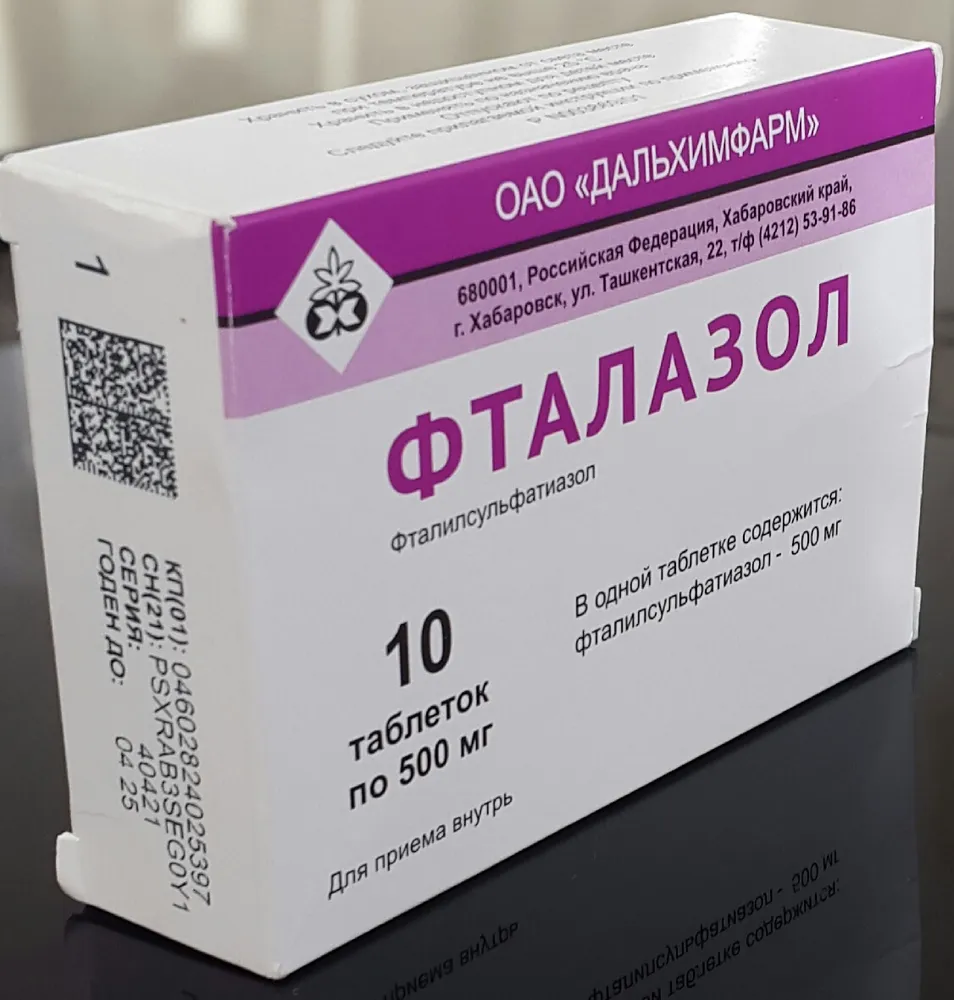
Table of Contents
INSTRUCTIONS FOR MEDICAL USE OF THE MEDICINAL PRODUCT FTHALAZOL
Composition:
Active substance: phthalylsulfathiazole;
1 tablet contains phthalylsulfathiazole 500 mg;
Excipients: potato starch, calcium stearate.
Dosage form. Tablets.
Main physico-chemical properties: intact, regular, round cylindrical tablets with flat upper and lower surfaces, beveled edges, a dividing line, white or white with a slightly yellowish tint.
Pharmacotherapeutic group.
Antimicrobial agents used in intestinal infections. Sulfonamides.
ATC code A07AB02.
Pharmacological Properties.
Pharmacodynamics.
Phthalazole is a broad-spectrum antimicrobial sulfanilamide agent containing the active substance phthalylsulfathiazole.
The drug is active against Gram-positive and Gram-negative microorganisms that are causative agents of intestinal infections. It exhibits a bacteriostatic effect due to inhibition of microbial growth factors—folic acid and dihydrofolic acid—required for synthesis of purines and pyrimidines in microorganisms.
It also exerts anti-inflammatory action, attributed to its ability to limit leukocyte migration, reduce the total number of migrating cellular elements, and partially stimulate glucocorticoid production.
Pharmacokinetics.
Phthalylsulfathiazole is practically not absorbed from the gastrointestinal tract; its bioavailability is 5–10%. The majority remains in the intestine, where the active sulfanilamide component—sulfathiazole—is cleaved. The absorbed portion is acetylated in the liver and excreted in urine. High intestinal concentrations of sulfathiazole, combined with the drug's specific bacteriostatic activity against intestinal microflora, ensure high efficacy of phthalylsulfathiazole in intestinal infections.
Clinical characteristics.
Indications.
Acute dysentery (shigellosis), chronic dysentery in the phase of exacerbation, colitis, enterocolitis, gastroenteritis; prevention of infectious complications during intestinal surgery.
Contraindications.
Increased individual sensitivity to phthalsulfathiazole, sulfonamide drugs, and/or to other components of the drug. Basedow's disease, blood disorders, acute hepatitis, chronic renal failure, glomerulonephritis, intestinal obstruction.
Interaction with other medicinal products and other types of interactions.
If the patient is taking any other medicinal products, it is necessary to consult a physician regarding the possibility of using Phthalazol.
Depending on the nature of the disease, Phthalazol may be used in combination with antibiotics (an enhanced antimicrobial effect is observed). Concurrently with the drug, it is advisable to prescribe sulfonamides that are well absorbed (sulfadimethizine, ethazol, ethazol-sodium).
Incompatible with para-aminosalicylic acid, salicylates, diphenin (increased toxic effect of phthalsulfathiazole), oxacillin (reduced activity of oxacillin), nitrofurans (increased risk of anemia and methemoglobinemia), preparations of male and female sex hormones (suppression of gonadal function), calcium chloride and vitamin K (reduced blood coagulation).
Phthalazol must not be used simultaneously with enterosorbents and laxatives.
Myelotoxic medicinal products enhance the manifestations of hematotoxicity of the drug.
The use of phthalsulfathiazole with acids and acid-reacting drugs, hexamethylenetetramine, and adrenaline solution is not advisable due to chemical incompatibility.
When phthalsulfathiazole is used concurrently with preparations containing esters of para-aminobenzoic acid (adrenaline, procaine, benzocaine, tetracaine), the antibacterial activity of sulfonamides is inactivated due to a competitive mechanism.
Special precautions.
Before taking the medication, consult a physician!
The drug should be administered with caution to patients with nephrosis or nephritis.
Vitamins of group B should be used concomitantly with Phthalazol, since suppression of intestinal bacilli growth reduces the synthesis of these vitamins.
If symptoms of the disease do not begin to subside, or, on the contrary, the patient's condition worsens or adverse reactions occur, administration of Phthalazol must be discontinued and a physician should be consulted regarding further use of the medication.
Use during pregnancy or breastfeeding.
Do not use during pregnancy.
Phthalsulfathiazole penetrates into breast milk and may cause kernicterus in infants, as well as hemolytic anemia in infants with glucose-6-phosphate dehydrogenase deficiency; therefore, Phthalazol is contraindicated during breastfeeding.
Ability to influence reaction rate when driving or operating machinery.
Since undesirable effects such as headache and dizziness may occur during therapy with Phthalazol, caution should be exercised when driving, operating machinery, or engaging in other potentially hazardous activities requiring increased attention and rapid psychomotor reactions.
Dosage and Administration
For oral use in adults and children aged 3 years and older.
Adults and children aged 12 years and older.
For acute dysentery, the following regimen is recommended:
- Days 1–2: 6 g daily (1 g every 4 hours)
- Days 3–4: 4 g daily (1 g every 6 hours)
- Days 5–6: 3 g daily (1 g every 8 hours)
The total course dose is 25–30 g.
Five to six days after completion of the first course, a second course may be administered:
- Days 1–2: 1 g every 4 hours (every 8 hours at night), total 5 g daily
- Days 3–4: 1 g every 4 hours (do not administer at night), total 4 g daily
- Day 5: 1 g every 4 hours (do not administer at night), total 3 g daily
The total course dose is 21 g (in mild cases, the total course dose may be reduced to 18 g).
Maximum doses: single dose – 2 g, daily dose – 7 g.
For treatment of other diseases, the drug is administered 1–2 g every 4–6 hours during the first 2–3 days, followed by 500 mg–1 g every 4–6 hours for the next 2–3 days.
For prophylaxis of purulent complications during intestinal surgery, adults are prescribed 1 g four times daily for the first 2–3 days, followed by 500 mg four times daily for the next 2–3 days. Treatment should be combined with administration of antibiotics.
Children aged 3 to 12 years.
For acute dysentery:
- Children aged 3 to 7 years: 500 mg per dose, 4 times daily
- Children aged 7 to 12 years: 500–750 mg per dose, 4 times daily
Treatment duration: up to 7 days.
For treatment of other diseases: on the first day, the dose is calculated as 100 mg/kg body weight per day, administered in equal doses every 4 hours with a nighttime break. In subsequent days, 250–500 mg every 6–8 hours. Treatment duration: up to 7 days.
If a child cannot swallow the tablet, it should be crushed and dissolved in a small amount of cooled boiled water.
Children.
The drug is contraindicated in children under 3 years of age.
Overdose.
Symptoms: macrocytosis and pancytopenia due to folic acid deficiency may occur. These effects can be prevented by administration of folic acid or calcium folinate. Typical adverse reactions may also occur.
Treatment: discontinue the drug, provide symptomatic therapy.
Adverse reactions.
The information on adverse reactions is presented according to the MedDRA organ system classification. The frequency of reactions is unknown (cannot be estimated based on available data).
Nervous system disorders: headache, dizziness, depressed mood.
Gastrointestinal disorders: nausea, vomiting, diarrhea, stomatitis, gingivitis, glossitis, gastritis, vitamin B complex deficiency (thiamine, riboflavin, nicotinic acid) due to suppression of intestinal microflora.
Hepatobiliary disorders: cholangitis, hepatitis.
Renal and urinary disorders: urolithiasis.
Respiratory, thoracic and mediastinal disorders: eosinophilic pneumonia.
Cardiovascular disorders: myocarditis, cyanosis.
Blood and lymphatic system disorders: leukopenia, thrombocytopenia, agranulocytosis, erythrocyte hemolysis, aplastic anemia. With prolonged use, anemia may develop due to deficiency of pantothenic acid and pteroylglutamic acid produced by microbial cells.
Skin and subcutaneous tissue disorders: skin manifestations of drug allergy ranging from various rashes to nodular and erythema multiforme; in individual cases—toxic epidermal necrolysis (Lyell's syndrome). In isolated cases, allergic swelling of lips and face, nodular periarteritis may occur.
Shelf life.
5 years.
Storage conditions.
Store in original packaging at a temperature not exceeding 25 °C.
Keep out of reach of children.
Packaging.
10 tablets in blisters;
10 tablets in a blister, 5 or 10 blisters per pack.
Dispensing category.
Over-the-counter – No. 10, No. 50.
By prescription – No. 100.
Manufacturer.
JSC "Lubnipharm".
Manufacturer's address and location of business activity.
16, Barvinkova Street, Lubny, Poltava Region, 37500, Ukraine.