Fthalazol-darnitsa
Ukraine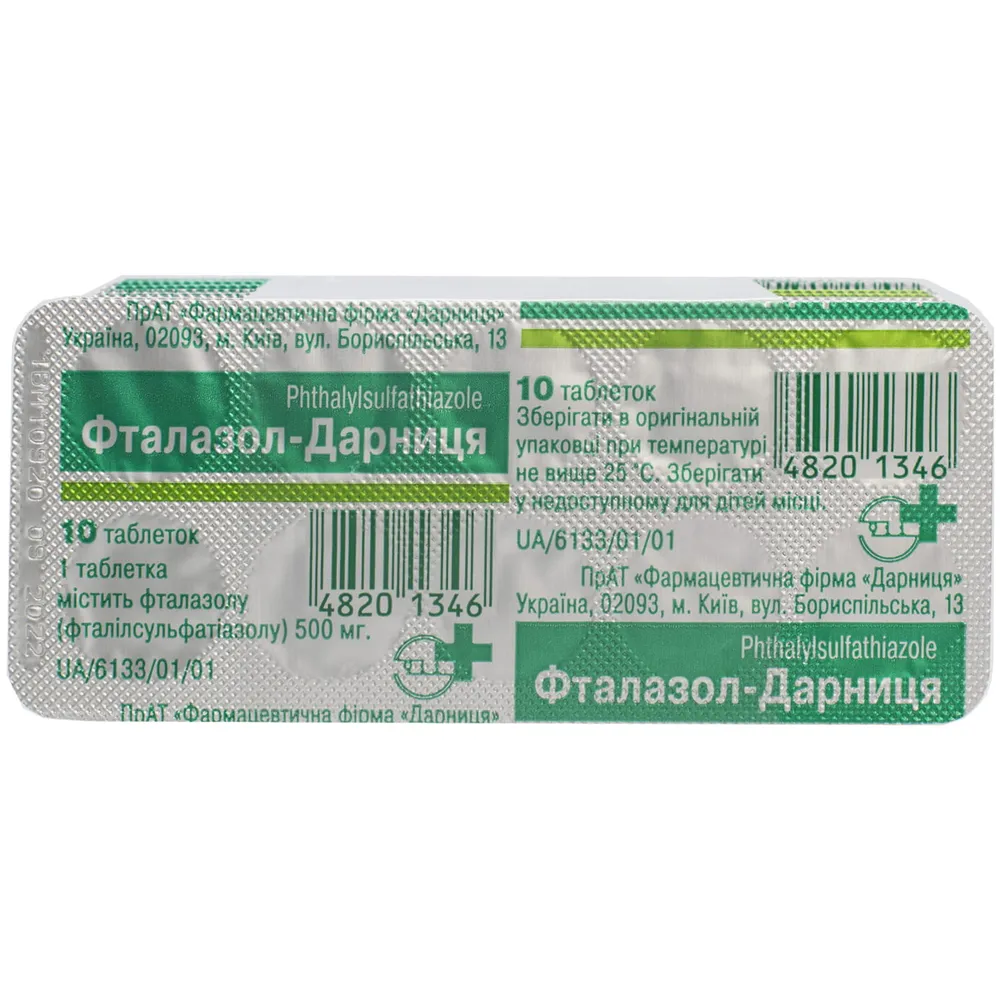
Table of Contents
INSTRUCTION FOR MEDICAL USE OF THE MEDICINAL PRODUCT PHTHALAZOL-DARNITSA (PHTHALAZOL-DARNITSA)
Composition:
active substance: phthalylsulfathiazole;
1 tablet contains phthalazol (phthalylsulfathiazole) 500 mg;
excipients: potato starch, povidone, colloidal anhydrous silicon dioxide, talc, calcium stearate.
Pharmaceutical form. Tablets.
Main physicochemical properties: white or white with a slightly yellowish tint tablets, flat cylindrical shape, with a score line and bevel.
Pharmacotherapeutic group. Antimicrobial agents used in intestinal infections. ATC code A07AB02.
Pharmacological properties.
Pharmacodynamics.
A sulfanilamide drug with a broad spectrum of activity, effective against both gram-positive and gram-negative microorganisms – causative agents of intestinal infections. It exerts a bacteriostatic effect, the mechanism of which is due to inhibition of synthesis of microbial growth factors – folic acid and dihydrofolic acid, essential for the synthesis of purines and pyrimidines.
Pharmacokinetics.
The drug is slowly absorbed from the gastrointestinal tract, with the majority of it remaining within the intestinal lumen. In the small intestine, it breaks down to form sulfathiazole (norsulfazole), which possesses high antimicrobial activity.
The high concentration of sulfathiazole achieved in the intestine, combined with its specific bacteriostatic activity against intestinal flora, determines the efficacy of phthalylsulfathiazole in intestinal infections.
Clinical characteristics.
Indications.
- Acute dysentery (shigellosis), chronic dysentery in the phase of exacerbation;
- colitis, enterocolitis, gastroenteritis;
- prevention of infectious complications during intestinal surgery.
Contraindications.
- Increased individual sensitivity to phthalylsulfathiazole, sulfanilamide drugs and/or other components of the drug;
- Basedow's disease;
- blood disorders;
- acute hepatitis.
Interaction with other medicinal products and other forms of interaction.
If the patient is taking any other medicinal products, it is mandatory to consult a physician regarding the possibility of using the drug.
Depending on the nature of the disease, Phthalazol-Darnitsia can be used in combination with antibiotics (an enhancement of antimicrobial action is observed). It is advisable to prescribe simultaneously with well-absorbed sulfanilamides (sulfadimethoxine, etazol, etazol-sodium, etc.). Incompatible with PAS (para-aminosalicylic acid), salicylates, diphenyl (increased toxic effect of phthalazol), oxacillin (reduced activity of oxacillin), nitrofurans (increased risk of anemia and methemoglobinemia), male and female sex hormones (suppression of gonadal function), calcium chloride and vitamin K (reduced blood coagulation).
Phthalazol-Darnitsia should not be used simultaneously with enterosorbents and laxatives.
Myelotoxic medicinal products enhance the manifestations of hematotoxicity of the drug.
Special precautions for use.
Consult a physician before taking the medication!
The drug should be administered with caution in patients with nephrosis or nephritis.
It is advisable to take vitamin B complex (thiamine, riboflavin, nicotinic acid) concomitantly with Phthalazol-Darnytsia, as suppression of Escherichia coli growth reduces the synthesis of these vitamins.
If symptoms do not begin to improve, or conversely, if the patient's condition worsens, or adverse effects occur, discontinue use of the medication immediately and consult a physician for further guidance.
Use during pregnancy or breastfeeding.
Phthalylsulfathiazole crosses the placental barrier, and adverse effects on the fetus have been observed in animal studies; therefore, the drug should not be used during pregnancy.
Phthalylsulfathiazole is excreted in breast milk and may cause kernicterus in infants, as well as hemolytic anemia in infants with glucose-6-phosphate dehydrogenase deficiency; therefore, the drug should not be used during breastfeeding.
Ability to influence reaction rate when driving or operating machinery.
The medication does not affect psychomotor reaction speed and may be used at recommended doses by individuals driving vehicles or operating machinery.
Dosage and Administration.
Do not use the medicinal product for longer than the specified period without consulting a physician!
Administer orally to adults and children aged 3 years and older.
Adults and children aged 12 years and older.
For acute dysentery: during the first 2 days of treatment – 6 g per day (1 g every 4 hours); on days 3–4 – 4 g per day (1 g every 6 hours); on days 5–6 – 3 g per day (1 g every 8 hours). The total course dose is 25–30 g.
Five to six days after completion of the first course, conduct a second course: days 1–2 – 1 g every 4 hours (at night – every 8 hours), total 5 g per day; days 3–4 – 1 g every 4 hours (not administered at night), total 4 g per day; day 5 – 1 g every 4 hours (not administered at night), total 3 g per day. The total course dose is 21 g (in mild cases, the course dose may be reduced to 18 g). Maximum doses: single dose – 2 g, daily dose – 7 g.
For treatment of other diseases, administer 1–2 g every 4–6 hours during the first 2–3 days, and 0.5–1 g every 4–6 hours during the following 2–3 days.
Children aged 3 to 12 years.
For acute dysentery: children aged 3 to 7 years – 500 mg per dose; children aged 7 to 12 years – 500–750 mg per dose, 4 times daily. Treatment duration – up to 7 days.
For treatment of other diseases: on day 1, administer at a dose of 100 mg/kg body weight per day, divided into equal doses every 4 hours, with a nighttime break. On subsequent days, administer 250–500 mg every 6–8 hours. Treatment duration – up to 7 days.
If a child cannot swallow the tablet, it should be crushed and dissolved in a small amount of cooled boiled water.
Children.
Phthalazole is contraindicated in children under 3 years of age.
Overdose.
Symptoms: macrocytosis and pancytopenia due to folic acid deficiency may occur. This can be prevented by administering folic acid or calcium folinate. Characteristic adverse reactions may also occur.
Treatment: discontinue the drug, symptomatic therapy.
Adverse reactions.
If any adverse events occur, consult a physician!
The medicinal product is generally well tolerated. Systemic adverse reactions typical of sulfonamides occur rarely due to minimal absorption of the active substance.
Possible adverse reactions:
Blood and lymphatic system disorders: agranulocytosis, aplastic anemia;
Immune system disorders: hypersensitivity reactions including allergic reactions, fever, rash, pruritus;
Other: vitamin B-group deficiency (thiamine, riboflavin, nicotinic acid) due to suppression of intestinal microflora.
Shelf life. 2 years.
Do not use the medicinal product after the expiry date stated on the packaging.
Storage conditions.
Store in the original packaging at a temperature not exceeding 25 °C.
Keep out of reach of children.
Packaging.
10 tablets in a blister pack, 1 blister pack in a carton; 10 tablets in blister packs.
Availability category. Over-the-counter.
Manufacturer. JSC "Pharmaceutical Company "Darnytsia".
Manufacturer's address and place of business.
13, Borispilska Street, Kyiv, 02093, Ukraine.