Freeway®
Ukraine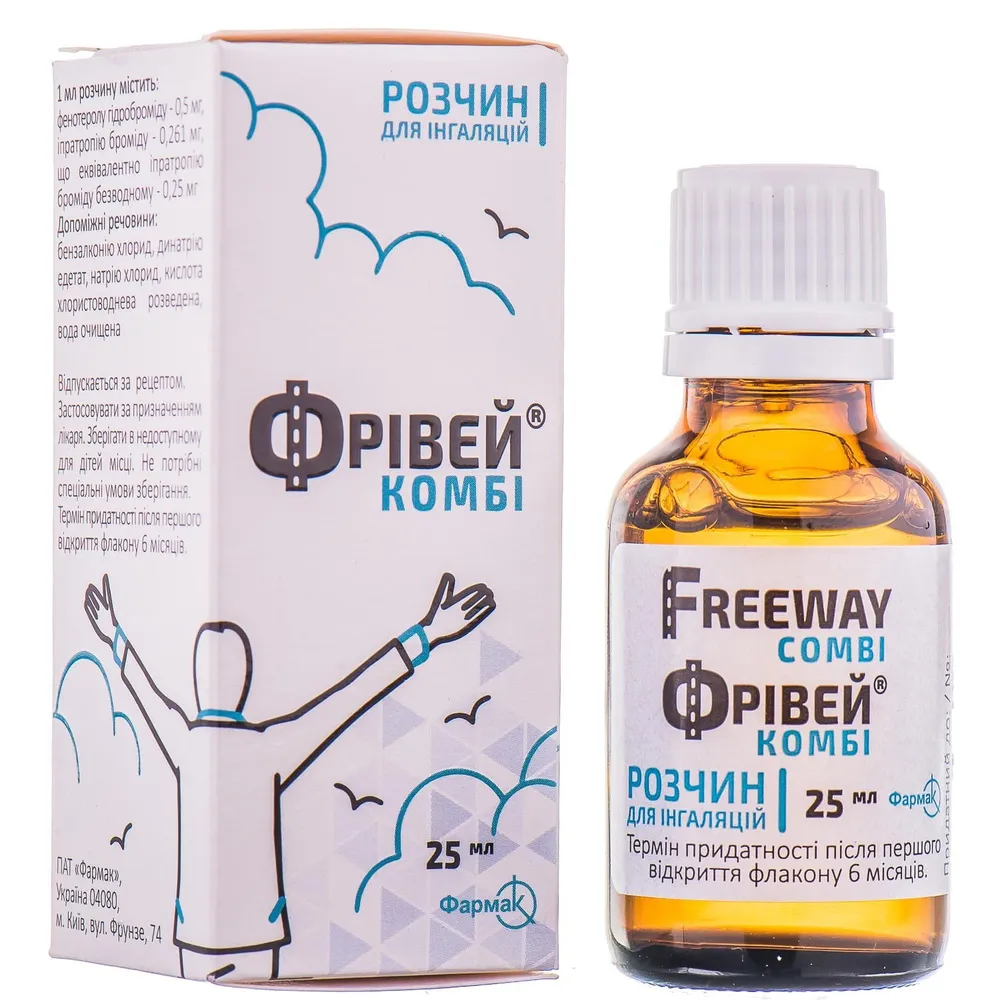
Table of Contents
INSTRUCTIONS for medical use of the medicinal product FRIVEY® (FREEWAY)
Composition:
Active substance: ipratropium bromide;
1 ml of solution contains ipratropium bromide – 0.261 mg, equivalent to anhydrous ipratropium bromide – 0.25 mg;
Excipients: benzalkonium chloride, disodium edetate, sodium chloride, 1 M hydrochloric acid prepared from concentrated hydrochloric acid, purified water.
Pharmaceutical form. Solution for inhalation.
Main physicochemical characteristics: clear, colorless liquid.
Pharmacotherapeutic group. Anticholinergic agents. ATC code R03B B01.
Pharmacological Properties
Pharmacodynamics
Frieve® is a medicinal product containing a quaternary ammonium compound with anticholinergic (parasympatholytic) properties. Preclinical studies have shown that ipratropium bromide inhibits vagal reflexes through antagonistic interaction with acetylcholine, the neurotransmitter responsible for signal transmission via the vagus nerve. Anticholinergic agents prevent the increase in intracellular calcium ion (Ca++) concentration. The effect of acetylcholine on muscarinic receptors of smooth muscle is mediated by a secondary messenger system composed of inositol triphosphate (IP3) and diacylglycerol (DAG).
Bronchodilation following inhaled administration of ipratropium bromide is primarily due to local rather than systemic effects of the drug.
There are no preclinical or clinical data indicating a negative effect of ipratropium bromide on mucus secretion in the respiratory tract, mucociliary clearance, or gas exchange.
Clinical Studies
In controlled 85- to 90-day studies involving patients with bronchospasm due to chronic obstructive pulmonary disease (chronic bronchitis and pulmonary emphysema), significant improvement in lung function was observed within 15 minutes, with maximum improvement occurring within 1–2 hours. The effect persisted for 4–6 hours.
Studies conducted in adults and children aged 6 years and older have demonstrated the bronchodilating effect of ipratropium bromide in the treatment of severe bronchospasm associated with asthma. In most of these studies, ipratropium bromide was administered in combination with inhaled beta-agonists.
Despite limited data, therapeutic efficacy of the medicinal product has been observed in the treatment of bronchospasm caused by infectious bronchiolitis and bronchopulmonary dysplasia in infants and young children.
Pharmacokinetics
Absorption.
The therapeutic effect of the medicinal product results from its local action on the respiratory tract. The duration of the therapeutic effect (bronchodilation) is not related to the pharmacokinetics of the active ingredient.
After inhalation, approximately 10–30% of the administered dose, depending on formulation and inhalation technique, deposits primarily in the respiratory tract. The majority of the dose is swallowed and passes through the gastrointestinal tract.
The portion of the dose that reaches the lungs is rapidly absorbed into the bloodstream (within several minutes). Total renal excretion (0–24 hours) of unchanged active substance was 46% of the dose after intravenous administration, less than 1% after oral administration, and approximately 3–13% after inhalation. Based on these data, the overall systemic bioavailability of ipratropium bromide is 2% after oral administration and 7–28% after inhalation. Thus, the swallowed portion of the dose does not significantly affect plasma concentrations of the active substance.
Distribution.
Pharmacokinetic parameters characterizing the disposition of ipratropium were calculated based on plasma concentration data following intravenous administration. A rapid biphasic decline in plasma concentration is observed. The steady-state volume of distribution (Vdss) is approximately 176 L (about 2.4 L/kg). The drug exhibits low plasma protein binding (less than 20%). Preclinical data indicate that the quaternary amine ipratropium does not cross the placental or blood-brain barrier.
Metabolism.
After intravenous administration, approximately 60% of the dose is metabolized, likely in the liver, via oxidation. Metabolites identified through hydrolysis, dehydration, or loss of the hydroxymethyl group from tropic acid show weak affinity for muscarinic receptors and are considered inactive.
Elimination.
The terminal elimination half-life is approximately 1.6 hours.
Total clearance of ipratropium is 2.3 L/min, with renal clearance accounting for 0.9 L/min. Approximately 40% of the systemic dose is excreted in urine, consistent with the experimentally determined renal clearance value of 0.9 L/min.
In a 6-day excretion balance study using radiolabeled drug, urinary excretion accounted for 72.1%, 9.3%, and 3.2% of the administered radioactive dose (as unchanged drug and metabolites) after intravenous, oral, and inhaled administration, respectively. Fecal excretion accounted for 6.3% after intravenous, 88.5% after oral, and 69.4% after inhaled administration. Elimination following intravenous administration, assessed using radiolabeled compound, occurs predominantly via the kidneys. The elimination half-life measured using isotope-labeled drug (for parent compound and metabolites combined) is 3.6 hours.
Clinical characteristics.
Indications.
Freevee® inhalation solution is intended for use as a bronchodilator in the maintenance treatment of bronchospasm associated with chronic obstructive pulmonary disease (COPD), including chronic bronchitis and pulmonary emphysema, as well as in bronchial asthma.
Contraindications.
Hypersensitivity to atropine and its derivatives (such as ipratropium bromide), or to any excipient.
Interaction with other medicinal products and other forms of interaction.
Long-term use of Freevee® together with other anticholinergic agents has not been studied. Therefore, long-term use of Freevee® in combination with these agents is not recommended.
Medicinal products affecting beta-adrenergic receptors and xanthine derivatives may enhance the bronchodilating effect.
Concomitant inhalation of ipratropium bromide and beta-mimetics may increase the risk of developing acute angle-closure glaucoma in patients with a history of closed-angle glaucoma.
Special precautions for use.
Hypersensitivity
Immediate-type hypersensitivity reactions may occur after administration of the medicinal product, as confirmed by rare cases of rash, urticaria, angioedema, mucosal swelling of the oral cavity and throat, bronchospasm, and anaphylaxis.
Paradoxical bronchospasm
Like other inhaled medicinal products, Frova® may cause paradoxical bronchospasm, which can be life-threatening. In the event of paradoxical bronchospasm, the medicinal product should be discontinued immediately and alternative treatment initiated.
Ocular complications
Use of the medicinal product in patients predisposed to developing angle-closure glaucoma should be performed with caution.
There have been rare reports of ocular complications (such as mydriasis, increased intraocular pressure, angle-closure glaucoma, eye pain) occurring as a result of aerosol containing ipratropium bromide alone or in combination with beta2-agonists entering the eye.
Eye pain or discomfort, blurred vision, appearance of halos around light sources, or colored halos before the eyes, accompanied by eye redness due to conjunctival hyperemia and corneal swelling, may be symptoms of acute angle-closure glaucoma. If any of the above symptoms occur in any combination, treatment with miotic agents should be initiated immediately and medical advice sought without delay.
Patients should be instructed on the correct use of Frova®.
Contact of the solution or aerosolized medication during inhalation with the eyes must be avoided. It is recommended to inhale the nebulized medication via a mouthpiece. If a mouthpiece is not available, the medication may be inhaled via an inhalation mask, but the mask must fit tightly against the face. Patients predisposed to glaucoma should take particular care to protect their eyes.
Effects on the kidneys and urinary system
Caution is recommended when administering the medicinal product to patients with urinary tract obstruction (e.g., prostatic hyperplasia or bladder neck obstruction).
Gastrointestinal motility disorders
Patients with cystic fibrosis may be more susceptible to gastrointestinal motility disorders.
Local effects
The medicinal product contains a preservative – benzalkonium chloride – and a stabilizer – disodium edetate. In patients with hypersensitive airways, these components may cause bronchospasm during inhalation.
The medicinal product contains 0.1 mg of benzalkonium chloride per ml of solution. The medicinal product may cause bronchospasm.
Use during pregnancy or breastfeeding
Pregnancy
The safety of using ipratropium bromide during pregnancy has not been established. The product may be used during confirmed or suspected pregnancy only if the expected benefit to the mother outweighs the potential risk to the fetus. Preclinical studies did not reveal embryotoxic or teratogenic effects of ipratropium bromide when administered via oral or intranasal inhalation at doses significantly exceeding those recommended for human use.
Breastfeeding
It is unknown whether the medicinal product passes into breast milk. It is unlikely that the medicinal product administered by inhalation would reach the infant in significant amounts. Frova® should be used with caution in women who are breastfeeding.
Fertility
Clinical data on the effect of ipratropium bromide on fertility are lacking. Preclinical studies conducted with ipratropium bromide showed no negative effect on fertility.
Ability to affect reaction speed when driving or operating machinery
Studies assessing the effect of the medicinal product on the ability to drive or operate machinery have not been conducted. However, patients should be warned that adverse effects such as dizziness, accommodation disorders, mydriasis, and blurred vision may occur during therapy with Frova®. Caution should be exercised when driving or operating machinery. If any adverse reaction occurs, patients should avoid potentially hazardous activities such as driving or operating machinery.
Dosage and Administration
Dosage
Dosage should be individually adjusted for each patient. During treatment, patients must remain under medical supervision. The recommended daily dose must not be exceeded.
Patients should be informed that if there is no therapeutic effect from using the medication, or if their condition worsens, they should consult their physician, who will adjust the treatment regimen. Immediate medical consultation is necessary in case of sudden onset or worsening of breathlessness (dyspnea).
Unless otherwise prescribed by a physician, the following dosages are recommended (20 drops = approximately 1 mL; 1 drop = 0.0125 mg of ipratropium bromide anhydrous).
Maintenance Therapy
Adults (including elderly patients) and children aged 14 years and older
2.0 mL (40 drops = 0.5 mg) 3–4 times daily.
Children aged 6 to 14 years
Due to insufficient data on use in this age group, inhalations at the dosage below should be performed under medical supervision:
1.0 mL (20 drops = 0.25 mg) 3–4 times daily.
Children under 6 years of age
Due to insufficient data on use in this age group, inhalations at the dosage below should be performed under medical supervision:
0.4–1.0 mL (8–20 drops = 0.1–0.25 mg) 3–4 times daily.
Administration of daily doses exceeding 2 mg in adults and children aged 14 years and older, and 1 mg in children under 14 years of age, must be performed under medical supervision.
Administration Method
The recommended dose of the medicinal product should be diluted with 0.9% sodium chloride solution to a final volume of 3–4 mL, poured into a nebulizer, and inhaled until the solution is completely used. The solution should be prepared immediately before each use; any unused diluted solution must be discarded.
The dosing regimen may depend on the inhalation method and characteristics of the nebulizer. The duration of inhalation can be controlled by adjusting the volume of dilution.
Inhalations using Freeway® solution can be performed with various nebulizer models available on the market. When using a centralized oxygen supply system, inhalation is best performed at a flow rate of 6–8 liters per minute.
The medicinal product may be used concomitantly with mucolytic agents that help liquefy and facilitate expectoration of mucus.
Do not use Freeway® and sodium cromoglicate simultaneously in the same nebulizer, as this may lead to precipitation.
Children
The medicinal product may be used in pediatric practice. For children under 6 years of age, administration should be under medical supervision.
Overdose
No symptoms characteristic of overdose have been reported. Given the wide therapeutic range and local administration of the drug, the occurrence of serious anticholinergic symptoms is unlikely. However, as with other anticholinergic agents, potential overdose symptoms may include dryness of the oral mucosa, accommodation disorders, and tachycardia.
Adverse Reactions
Many of the adverse effects listed below can be explained by the anticholinergic properties of ipratropium bromide. As with all inhaled medications, Freway® may cause local irritation. Data on adverse effects were obtained from clinical trials and post-marketing surveillance.
The most commonly reported adverse effects during clinical studies were: headache, throat irritation, cough, dryness of the oral mucosa, pharyngitis, gastrointestinal motility disorders (including constipation, diarrhea, and vomiting), nausea, and dizziness.
The frequency of adverse reactions is presented according to the MedDRA classification: very common (> 1/10); common (> 1/100 to <1/10); uncommon (> 1/1000 to <1/100); rare (> 1/10,000 to <1/1,000); very rare (<1/10,000); not known (frequency cannot be determined from available data).
Cardiovascular system
Uncommon: palpitations, supraventricular tachycardia.
Rare: atrial fibrillation, increased heart rate.
Nervous system
Common: headache, dizziness.
Eye disorders
Uncommon: blurred vision, mydriasis, increased intraocular pressure, glaucoma, eye pain, appearance of halos around light sources, conjunctival hyperemia, corneal edema.
Rare: accommodation disorders.
Respiratory, thoracic and mediastinal disorders
Common: throat irritation, cough.
Uncommon: bronchospasm, paradoxical bronchospasm, laryngospasm, throat mucosal edema, dry throat.
Gastrointestinal disorders
Common: dry mouth, nausea, gastrointestinal motility disorders.
Uncommon: diarrhea, constipation, vomiting, oral mucosal inflammation, oral cavity edema.
Renal and urinary disorders
Uncommon: urinary retention.
Skin and subcutaneous tissue disorders
Uncommon: skin rash, pruritus, angioedema.
Rare: urticaria.
Immune system disorders
Uncommon: hypersensitivity, anaphylactic reactions.
Reporting suspected adverse reactions
Reporting suspected adverse reactions after drug authorization is important. It allows ongoing monitoring of the benefit-risk balance of the medicinal product. Healthcare and pharmaceutical professionals, as well as patients or their legal representatives, should report all cases of suspected adverse reactions and lack of efficacy via the automated pharmacovigilance information system at the following link: https://aisf.dec.gov.ua.
Shelf life
2 years.
The shelf life after first opening of the bottle is 6 months.
Do not use the medication after the expiry date stated on the packaging.
Storage conditions
Store in the original packaging at a temperature not exceeding 30 ℃.
Keep out of reach of children.
Packaging
25 ml in a bottle with dropper. 1 bottle per carton.
Prescription status
Prescription only.
Manufacturer
JSC "Farmak".
Manufacturer's name and address of the place of business
74, Kyrylivska Street, Kyiv, 04080, Ukraine.