Fotil® forte
Ukraine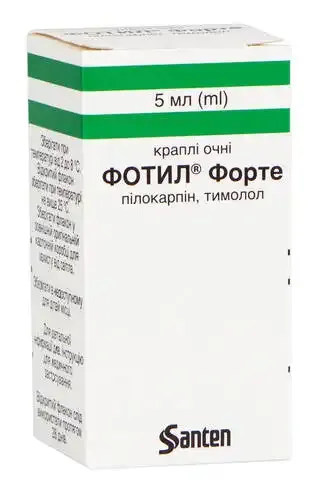
Table of Contents
INSTRUCTIONS FOR MEDICAL USE OF THE MEDICINAL PRODUCT FOTIL® FORTE (FOTIL® FORTE)
Composition:
Active substances: pilocarpine hydrochloride; timolol;
1 ml of eye drops contains pilocarpine hydrochloride 40 mg; timolol maleate equivalent to timolol 5 mg;
1 ml contains 36 drops;
1 drop contains timolol 0.14 mg, pilocarpine hydrochloride 1.11 mg;
Excipients: benzalkonium chloride; citric acid monohydrate; sodium citrate; hypromellose; water for injections.
Pharmaceutical form. Eye drops.
Main physicochemical properties: clear, colorless solution.
Pharmacotherapeutic group. Medicinal products used in ophthalmology. Anti-glaucoma and miotic agents. Pilocarpine combinations. ATC code S01EB51.
Pharmacological properties.
Pharmacodynamics.
Pilocarpine is a parasympathomimetic agent that, similar to acetylcholine, stimulates muscarinic receptors. When applied locally to the eye, pilocarpine causes a reduction in intraocular pressure, pupillary constriction, and accommodation spasm. The reduction in intraocular pressure is believed to result from contraction of the ciliary muscle and smooth muscles of the iris, which increases the anterior chamber angle and alters the configuration of the trabecular meshwork, thereby facilitating the outflow of aqueous humor. For a long time, pilocarpine has been used as a miotic agent to constrict the pupil and reduce intraocular pressure in almost all types of glaucoma.
The L-isomer of timolol in Fotil® Forte is a β-blocker that effectively blocks the binding of sympathomimetic neurotransmitters to β-1 and β-2 adrenergic receptors. Timolol has no significant sympathomimetic activity or local membrane-stabilizing effect. Timolol is also used in the treatment of elevated arterial pressure and angina pectoris, but its primary indication is glaucoma. The reduction in intraocular pressure occurs due to decreased production of aqueous humor. After topical application, the drug penetrates into the target tissue of the eye, specifically the ciliary body, where aqueous humor is produced. It is unknown whether timolol additionally affects blood vessels of the anterior segment of the eye, but there is evidence that retinal blood flow improves with reduced intraocular pressure. Like many other β-blockers, timolol exerts a prolonged post-receptor effect; the adrenergic receptor cannot mediate the agonist effect even after timolol has undergone its elimination phase.
Fotil® Forte ophthalmic drops do not cause dependence. Due to the low dose, withdrawal syndrome, which may occur during systemic β-blocker therapy, does not develop after discontinuation of Fotil® Forte ophthalmic drops.
Elevated intraocular pressure is the main risk factor in the pathogenesis of glaucomatous visual field defects. When pilocarpine and timolol are combined in a single preparation, an enhanced effect in reducing intraocular pressure is expected, as these agents have different mechanisms of action and affect different tissues. Timolol prolongs the residence time of pilocarpine in the eye by delaying its elimination. Fotil® Forte ophthalmic drops reduce both elevated and normal intraocular pressure in various types of glaucoma and ocular hypertension. The product contains a miotic agent and can therefore also be used to reduce intraocular pressure in angle-closure glaucoma.
Paediatric patients
There are only limited data on the use of timolol (0.25%, 0.5%, 1 drop twice daily) in children for treatment courses up to 12 weeks. One small, double-blind, randomized, published clinical study in 105 children (n=71 on timolol), aged from 12 days to 5 years, provides some evidence that timolol is effective in short-term treatment of primary congenital and primary juvenile glaucoma.
Pharmacokinetics.
When administered to the ocular surface, pilocarpine rapidly penetrates through the cornea. Accommodation spasm and pupillary constriction begin within 10 minutes after instillation, reaching maximum effect within one hour. Miosis and reduced intraocular pressure last for several hours, while accommodation spasm usually resolves within 2 hours. Pilocarpine is hydrolyzed in several tissues, such as blood and liver, but only to a minor extent in the eye. The plasma half-life is less than 30 minutes. The substance is eliminated from the anterior segment of the eye primarily via the flow of aqueous humor.
Timolol is a lipophilic substance and is well absorbed in the eye. It is also absorbed into the systemic circulation via the conjunctiva, nasal mucosa, and gastrointestinal tract. Maximum ocular effect is achieved 3–4 hours after instillation and may last up to 24 hours. In the eye, timolol binds to the surface of cells in various tissues, particularly pigment cells of the endothelium, iris, and ciliary processes. It is eliminated from the eye via the flow of aqueous humor. The half-life in ocular tissues is approximately 8 hours. Timolol is metabolized in the liver and converted into inactive metabolites, which are primarily excreted by the kidneys. After oral administration, the major metabolic pathway is first-pass metabolism in the liver. Bioavailability is approximately 50%. Plasma protein binding is moderate (60%). The volume of distribution averages 2.1 L/kg. The plasma half-life is approximately 4 hours.
A significant reduction in intraocular pressure after a single dose of Fotil® Forte ophthalmic drops is observed within 1 hour. The maximum effect is typically maintained for 3 hours.
Paediatric patients
As confirmed in studies conducted in adult patients, approximately 80% of the drug passes through the nasolacrimal system. The drug may be rapidly absorbed into the systemic circulation via the nasal mucosa, conjunctiva, nasolacrimal ducts, oropharynx, gastrointestinal tract, or through the skin due to excessive tearing.
Since children have a smaller blood volume than adults, higher systemic concentrations of Fotil® Forte are expected. In addition, neonates have underdeveloped metabolic enzyme pathways, which may lead to prolonged half-life and increased incidence of adverse effects.
Limited data indicate that plasma levels of timolol in children, especially infants, at concentrations above 0.25% significantly exceed those in adults above 0.5% and are believed to increase the risk of adverse effects such as bronchospasm and bradycardia.
Clinical characteristics.
Indications.
Treatment of open-angle, closed-angle glaucoma, aphakic and secondary glaucoma. As part of combination therapy for glaucoma, to reduce intraocular pressure after ophthalmic surgery, for treatment of glaucoma following cataract extraction, and to reduce elevated intraocular pressure in patients for whom monotherapy is insufficient.
Recommended for use only under medical prescription.
Contraindications.
Hypersensitivity to the active substances or to any excipient of the medicinal product. β-blockers (timolol) are contraindicated in patients with second- and third-degree atrioventricular block without a cardiac pacemaker, sinus bradycardia, sick sinus syndrome, sinoatrial block, overt heart failure, cardiogenic shock, reactive airway disease including severe bronchial asthma or history of severe bronchial asthma, and severe chronic obstructive pulmonary disease.
Cholinergic agents (pilocarpine) are contraindicated in acute iritis and in conditions where miosis should be avoided.
Paradoxical reaction to Fotil® Forte or pilocarpine in congestive glaucoma; acute inflammatory ocular diseases.
Miotics are contraindicated in the presence of iris neovascularization.
Interaction with other medicinal products and other forms of interaction.
Specific interaction studies of Fotil® Forte with other drugs have not been conducted.
There is a possibility of additive effects leading to hypotension and/or marked bradycardia when ophthalmic β-blocker drops are used concomitantly with oral calcium channel blockers, β-adrenergic blockers, antiarrhythmic agents (including amiodarone), digitalis glycosides, parasympathomimetics, or guanethidine. In addition, systemically administered α-blockers or agents that reduce catecholamine levels, such as reserpine, may cause additive effects, namely hypotension, bradycardia, atrioventricular conduction disturbances, left ventricular failure, dizziness, and syncope. Intravenous administration should be avoided in particular. Due to the risk of worsening adverse effects, antiarrhythmic agents of class I (e.g., lidocaine, quinidine) and clonidine should be used with special caution during treatment. The adverse effects of the drug on the central nervous system may be enhanced by concomitant use of barbiturates, analgesics, or ergot alkaloids. Potentiated systemic β-blockade (e.g., reduced heart rate, depression) has been reported during combined therapy with CYP2D6 inhibitors (e.g., quinidine, fluoxetine, paroxetine) and timolol. Rare cases of mydriasis development have been described due to concomitant use of ophthalmic β-blockers and adrenaline (epinephrine).
Special precautions for use
Before initiating treatment, the patient's health status should be evaluated (see section "Contraindications"). Since the effect of therapy, particularly with β-blockers, may vary, it is recommended to check the patient's intraocular pressure 2-4 weeks after starting treatment with Fotil® Forte eye drops. As with other glaucoma medications, the therapeutic effect of the drops may decrease with long-term use (over several years).
As with other topical ophthalmic preparations, the active ingredients of the drug are systemically absorbed. Although the dose is very small, topical application to the eye may cause adverse reactions similar to those occurring with systemic use of β-blockers and parasympathomimetics. Due to the presence of the β-adrenergic component, timolol may cause the same types of cardiovascular and pulmonary adverse reactions as systemic β-blockers. Systemic side effects occur less frequently with topical application than with systemic administration. For measures to reduce systemic absorption, see section "Dosage and administration".
Concomitant use with other β-blockers
When timolol is prescribed to a patient already taking β-blockers, its effect on intraocular pressure or known systemic β-blocking effects may be enhanced. Patients should be closely monitored during treatment. The use of two locally acting β-adrenergic blockers is not recommended (see section "Interaction with other medicinal products and other forms of interaction").
Cardiac disorders
Treatment with β-blockers in patients with cardiovascular diseases (e.g., coronary heart disease, Prinzmetal's angina, heart failure) and hypotension should be critically evaluated, and alternative therapies considered. Sympathetic nervous system stimulation may play a significant role in maintaining circulation in patients with reduced myocardial contractility, and its suppression via β-adrenergic receptor blockade may lead to decompensated heart failure. Patients with cardiovascular disorders should be monitored for signs of worsening disease and adverse reactions. If any signs or symptoms of heart failure occur, Fotil® or Fotil® Forte should be discontinued immediately.
Patients with first-degree heart block should be treated with β-blockers cautiously due to their negative effect on conduction time.
Vascular disorders
Patients with severe peripheral circulatory disorders (i.e., severe forms of Raynaud's disease or Raynaud's syndrome) should be treated with caution.
If any signs or symptoms of impaired cerebral circulation occur during treatment with Fotil® or Fotil® Forte, alternative therapy should be considered.
Respiratory disorders
Respiratory reactions, including fatal outcomes due to bronchospasm, have been reported in asthmatic patients after administration of certain ophthalmic β-blockers.
Fotil® or Fotil® Forte should be used with caution in patients with mild to moderate chronic obstructive pulmonary disease (COPD), and only if the potential benefit outweighs the potential risk.
Timolol may inhibit bronchodilation caused by endogenous or exogenous catecholamines.
Anaphylactic reactions
Patients with a history of atopy or severe anaphylactic reactions to various allergens may exhibit heightened sensitivity upon re-exposure to such allergens while taking β-blockers, and may not respond to the usual dose of adrenaline used to treat anaphylactic reactions.
Surgical anesthesia
Medicinal products containing β-blockers should be used with caution in patients scheduled for surgery under general anesthesia. Gradual discontinuation of the drug before surgery is recommended to avoid suppression of cardiac reflexes mediated by β-adrenergic activity, thereby reducing the risk of hypotension and cardiac arrest during anesthesia. Ophthalmic β-blockers may block the effects of systemic β-agonists, such as adrenaline. If a patient is taking timolol, the anesthesiologist must be informed.
Hypoglycemia/diabetes
β-blockers should be used cautiously in patients prone to spontaneous hypoglycemia or in those with labile diabetes, as β-blockers may mask the signs and symptoms of acute hypoglycemia.
Hyperthyroidism
β-blockers may mask the signs of hyperthyroidism.
Young patients with myopia
Pilocarpine should be used with caution in young patients with high myopia.
The drug should be used with caution in patients with acute heart failure, recent myocardial infarction, severe bradycardia, severe arterial hypotension, arterial hypertension, hyperthyroidism, epilepsy, urinary tract obstruction, vasomotor instability, or Parkinson's disease.
Myasthenia
Medicinal products containing timolol should be prescribed with caution to patients with a history of myasthenia gravis.
Retinal damage
Miotics should not be instilled into eyes with compromised retinal integrity.
Corneal disorders
Ophthalmic beta-blockers may cause dry eye. Patients with corneal disorders should be treated with caution.
Choroidal detachment (of the eye's vascular layer)
Choroidal detachment has been reported with the use of drugs that suppress aqueous humor (e.g., timolol, acetazolamide) following filtering surgeries.
Benzalkonium chloride
Fotil® Forte eye drops contain the preservative benzalkonium chloride, which has been reported to cause eye irritation, dry eye symptoms, and may affect the tear film and corneal surface. It should be used with caution in patients with dry eye disease or in those with potentially compromised corneas. Patients should be monitored during prolonged use.
Benzalkonium chloride may be absorbed by soft contact lenses and may alter the color of contact lenses. If contact lenses are worn during treatment with Fotil® Forte, they should be removed before using the medication and reinserted 15 minutes after administration.
Pediatric population
Solutions of timolol should generally be used with caution in young patients with glaucoma (see also section "Pharmacological properties"). It is important to inform parents about possible adverse effects so they can discontinue treatment immediately if necessary. Observable signs may include cough and wheezing. Due to the risk of dyspnea (difficulty breathing) and Cheyne-Stokes respiration, the drug should be used with extreme caution in newborns, infants, and young children. A portable apnea monitoring device may also be beneficial for newborns receiving timolol.
Use during pregnancy or breastfeeding
Pregnancy
Fotil® and Fotil® Forte should not be used during pregnancy except when absolutely necessary. To reduce systemic absorption, see section "Dosage and administration". Timolol crosses the placenta.
There are no adequate data on the use of timolol in pregnant women. Epidemiological studies have not shown an effect on fetal malformations, but have indicated a risk of intrauterine growth retardation with oral use of β-blockers. In addition, signs and symptoms of β-blockade (e.g., bradycardia, hypotension, respiratory distress, and hypoglycemia) have been observed in newborns whose mothers used β-blockers before delivery. If a pregnant woman has used Fotil® or Fotil® Forte before delivery, the newborn should be under close medical supervision during the first days of life.
Breastfeeding
β-blockers are excreted in breast milk. However, it is unlikely that the amount of timolol in breast milk following therapeutic doses of Fotil® and Fotil® Forte would be sufficient to cause clinical symptoms of β-blockade in the infant. Systemic absorption can be minimized (see section "Dosage and administration").
Ability to affect reaction speed when driving or operating machinery
Miosis usually impairs adaptation to darkness. Patients should be warned about driving at night. Timolol may lower blood pressure, which in some patients may cause temporary weakness and dizziness. Patients should be informed of this before starting treatment.
Dosage and Administration
Dosage
It is recommended to initiate treatment with 1 drop of Fotil® Forte in the affected eye twice daily. Further dose escalation generally does not result in additional reduction of intraocular pressure.
If intraocular pressure is not adequately controlled with the recommended dose of Fotil® Forte, combined therapy with dipivefrin and/or a carbonic anhydrase inhibitor may be considered.
Administration
Upon initiating treatment with Fotil® Forte, other anti-glaucoma medications should be discontinued, or Fotil® Forte eye drops should be administered the following day.
Systemic absorption can be minimized by occluding the nasolacrimal duct or by closing the eyelids for 2 minutes after instillation. This may reduce systemic side effects and enhance local efficacy.
Children
The safety and efficacy of Fotil® Forte eye drops in pediatric patients have not been established in adequate and well-controlled studies.
Due to limited data, the use of timolol in children may be considered only in cases of primary congenital glaucoma or primary juvenile glaucoma during the transitional period when surgical treatment has been decided upon, or following failed surgery while awaiting further intervention.
When considering timolol treatment in pediatric patients, physicians must carefully evaluate the risks and benefits. A detailed medical history and physical examination should be performed prior to initiating timolol therapy to identify any pre-existing systemic disorders.
A specific dosage recommendation cannot be made due to limited clinical data. However, if the benefit outweighs the risk, it is recommended to use the lowest possible concentration of the active ingredient once daily. If intraocular pressure cannot be effectively controlled, a cautious dose increase to 2 drops once daily in the affected eye may be considered. When administering twice daily, a 12-hour interval is preferred. Additionally, close monitoring in the physician’s office for 1–2 hours after the first dose is essential, especially in neonates, to promptly detect ocular and systemic adverse effects until surgery is performed. In pediatric use, a 0.1% concentration of the active ingredient may be sufficient.
Administration
To minimize potential adverse reactions, only 1 drop should be administered at a time. Systemic absorption of topically applied beta-blockers can be reduced by nasolacrimal occlusion or by keeping the eyes closed for as long as possible after instillation (e.g., 3–5 minutes) (see sections "Precautions" and "Pharmacokinetics").
Treatment Duration
For temporary treatment of children.
Overdose
The amount of timolol entering systemic circulation from one oral tablet (10 mg) is equivalent to approximately 30 drops of Fotil® Forte. However, because eye drops are rapidly absorbed through the ocular and nasal mucosa, only a few drops of Fotil® Forte may induce arrhythmia, transient bradycardia, hypotension, bronchospasm, or heart failure. Overdose should be treated symptomatically with adrenergic agonists such as isoprenaline, dobutamine, or possibly dopamine.
Side effects
Most of the expected adverse reactions to Fotil® Forte can be explained by its pharmacological action. The most common adverse reactions to Fotil® Forte eye drops are transient burning and stinging sensations.
Fotil® Forte eye drops are generally well tolerated. As with other ophthalmic medicinal products for local use, timolol is absorbed into the bloodstream and reaches systemic circulation. This may cause adverse effects similar to those observed with systemic administration of β-blockers. Systemic adverse effects occur less frequently with topical ophthalmic use than with systemic administration.
The adverse reactions listed below include those observed within the class of ophthalmic β-blockers.
Ocular
Common (from ≥1/100 to <1/10)
Pilocarpine: transient burning and stinging sensation in the eye, blurred vision, increased lacrimation, accommodative spasm, conjunctival redness, eye pain, itching and eye irritation, headache in the temporal or supraorbital area, reduced visual acuity in poor lighting (due to miosis, especially in patients with cataract), myopia or accommodation disorder, photophobia.
Uncommon (from ≥1/1,000 to <1/100):
Timolol: corneal sensitivity reduction, superficial punctate keratitis.
Rare (from ≥1/10,000 to <1/1,000):
Pilocarpine: retinal detachment, vitreous hemorrhage, iris rigidity, iris cysts, iris vessel dilation, eyelid contraction, anterior chamber narrowing, reversible opacification of the lens (with prolonged pilocarpine use).
Timolol: dry eye syndrome, blepharoconjunctivitis, visual disturbances, diplopia, ptosis, foreign body sensation in the eye.
Cardiac
Uncommon (from ≥1/1,000 to <1/100)
Timolol: bradycardia.
Rare (from ≥1/10,000 to <1/1,000)
Timolol: heart failure, arrhythmias.
Vascular
Uncommon (from ≥1/1,000 to <1/100)
Pilocarpine: hypotension.
Rare (from ≥1/10,000 to <1/1,000)
Timolol: hypotension, decreased peripheral and cerebral blood perfusion (cold extremities).
Nervous system
Common (from ≥1/100 to <1/10)
Timolol: headache.
Rare (from ≥1/10,000 to <1/1,000)
Timolol: dizziness.
Respiratory, thoracic and mediastinal disorders
Uncommon (from ≥1/1,000 to <1/100)
Timolol: dyspnea.
Rare (from ≥1/10,000 to <1/1,000)
Timolol: bronchospasm (particularly in patients with bronchospastic disorders such as asthma or heart failure), nasal congestion.
Psychiatric
Uncommon (from ≥1/1,000 to <1/100)
Timolol: depression.
Rare (from ≥1/10,000 to <1/1,000)
Timolol: anxiety, nightmares, confusion.
Gastrointestinal disorders
Uncommon (from ≥1/1,000 to <1/100)
Pilocarpine: nausea.
Rare (from ≥1/10,000 to <1/1,000)
Pilocarpine: vomiting, increased salivation, diarrhea.
Skin and subcutaneous tissue disorders
Rare (from ≥1/10,000 to <1/1,000)
Hypersensitivity reactions: rash, urticaria, alopecia.
Pilocarpine: sweating.
General disorders
Uncommon (from 1/1,000 to <1/100)
Timolol: weakness.
Rare (from ≥1/10,000 to <1/1,000)
Timolol: asthenia.
With prolonged use (over years), the glaucomatous eye may become resistant to pilocarpine and timolol.
In addition to the above, it has been reported that β-blockers administered into the eye may cause the following adverse effects, which may also occur during use of Fotil® or Fotil® Forte eye drops:
Immune system disorders:
Systemic allergic reactions, including angioneurotic edema (Quincke's edema), pruritus, anaphylactic reactions.
Metabolism and nutrition disorders:
Hypoglycemia.
Psychiatric disorders:
Insomnia, memory loss, hallucinations.
Nervous system disorders:
Syncope, acute cerebrovascular accident, cerebral ischemia, worsening of symptoms of myasthenia gravis, paresthesia.
Ocular disorders:
Signs and symptoms of eye irritation (e.g., burning, stinging, itching, lacrimation, redness), keratitis, blurred vision, choroidal detachment after filtration surgery (see section "Special precautions"), corneal erosion, eyelid dermatitis.
Cardiac disorders:
Chest pain, palpitations, edema, congestive heart failure, atrioventricular block, cardiac arrest.
Vascular disorders:
Raynaud's phenomenon.
Respiratory, thoracic and mediastinal disorders:
Cough.
Gastrointestinal disorders:
Dysgeusia, nausea, dyspepsia, diarrhea, dry mouth, abdominal pain, vomiting.
Skin and subcutaneous tissue disorders:
Psoriasiform rash or exacerbation of psoriasis.
Musculoskeletal and connective tissue disorders:
Myalgia.
Sexual disorders:
Sexual dysfunction, decreased libido.
Reporting suspected adverse reactions
Reporting of suspected adverse reactions after authorization of the medicinal product is important. It allows continued monitoring of the benefit-risk balance of the medicinal product. Healthcare professionals are encouraged to report any suspected adverse reactions.
Shelf life
3 years. An opened bottle should be used within 28 days.
Storage conditions
Store at 2 to 8 °C. After opening, store the bottle at a temperature not exceeding 25 °C. Keep out of reach of children. Store the bottle in its original outer cardboard packaging to protect from light.
Incompatibilities
Benzalkonium chloride may deposit on soft contact lenses.
Packaging
5 ml in a polyethylene dropper bottle. One bottle per cardboard box with an instruction leaflet for medical use.
Prescription category
Prescription only.
Manufacturer
Santen Oy / Santen AT
Manufacturer's address and place of business
Kelloportinkatu 1, Tampere, 33100, Finland / Kelloportinkatu 1, Tampere, 33100, Finland.