Focitan 0.66 mmol/ml
Ukraine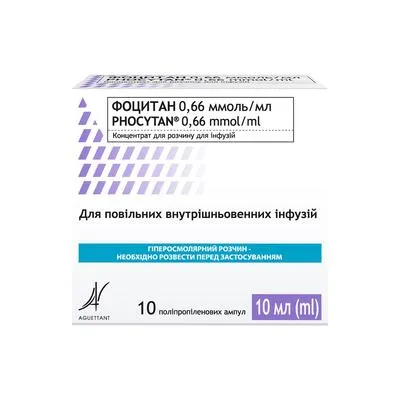
Table of Contents
INSTRUCTIONS FOR MEDICAL USE OF THE MEDICINAL PRODUCT PHOCYTAN® 0.66 mmol/ml
Composition:
Active substance: disodium glucose-1-phosphate tetrahydrate;
250.8 mg of disodium glucose-1-phosphate tetrahydrate per 1 ml of concentrate for solution for infusion;
1 ampoule (10 ml) contains 2508 mg of disodium glucose-1-phosphate tetrahydrate;
0.66 mmol/ml (20.46 mg/ml) phosphorus;
0.66 mmol/ml (118.8 mg/ml) glucose;
0.66 mmol/ml (62.7 mg/ml) phosphates;
1.33 mmol/ml (30.66 mg/ml) sodium;
osmolarity 1800 mosmol/l;
osmolality from 1525 to 1680 mosmol/kg;
density (20 °C) 1.126 g/cm³;
pH from 7.0 to 10.0.
Excipient: water for injections.
Pharmaceutical form. Concentrate for solution for infusion.
Main physicochemical properties: clear solution ranging from colorless to yellowish.
Pharmacotherapeutic group. Plasma substitutes and perfusion solutions. Additives for intravenous solutions.
ATC code B05XA09.
Pharmacological properties.
Pharmacodynamics. The phosphate ion is the main anion of intracellular fluids. It is present in the body in 80% bivalent form (HPO42-) and 20% monovalent form (H2PO4-).
The phosphate ion participates in several physiological processes: maintenance of intracellular calcium concentration, carbohydrate and lipid metabolism, as a buffer of intracellular fluid, in cellular metabolism and elimination of H+ ions in the kidneys.
Normal phosphate ion concentration in plasma ranges from 0.8 to 1.5 mmol/L.
Approximately 85% of phosphates present in the body are found in bones and teeth, while the remaining 15% are distributed in blood and soft tissues.
Phosphorus is involved in the function of the heart muscle and diaphragm, probably via intracellular ATP.
Phosphorus regulates hemoglobin's affinity for oxygen and thus participates in the regulation of oxygen delivery to tissues.
Knowledge of the probable causes of hypophosphatemia is the basis for implementing the most appropriate treatment.
Pharmacokinetics.
The phosphate ion is excreted by the kidneys.
The concentration of phosphate in glomerular ultrafiltrate is very close to its concentration in plasma. Filtered phosphate is predominantly reabsorbed by the proximal tubule (65–80%) and to a lesser extent by the distal tubule (5–10%). Net reabsorption becomes saturated and reaches a plateau as plasma phosphate concentration increases.
If kidney function is not impaired, 15 to 20% of the filtered phosphate load is excreted in urine.
Preclinical safety data.
To date, there are no relevant preclinical data on repeat-dose toxicity, genotoxicity, carcinogenicity, or reproductive function.
Clinical characteristics.
Indications.
The medicinal product FOCITAN 0.66 mmol/ml is used:
- for correction of moderate to severe hypophosphatemia when oral administration is not possible;
- as a phosphate component in parenteral nutrition.
Contraindications.
This product should not be administered in the following situations:
- Severe chronic renal insufficiency, except when phosphate levels are carefully monitored and there is a clear need for phosphate supplementation.
- Hyperphosphatemia.
- Hypercalcemia, due to the risk of calcium deposition in soft tissues.
- Pediatric age under 12 months.
Interaction with other medicinal products and other forms of interaction.
Combinations that should be considered
- Salicylates. Increased excretion of salicylates due to urinary alkalinization.
Special precautions for use
Be aware of the presence of sodium and glucose in the medicinal product.
This medicinal product contains 306.6 mg of sodium per ampoule, which corresponds to 15.33% of the WHO recommended maximum daily intake of 2 g of sodium for an adult. Caution should be exercised when administering to patients who are on a sodium-controlled diet.
Special warnings and precautions for use
Plasma electrolyte concentrations, and particularly serum calcium and phosphate levels, must be carefully monitored and checked every 12–24 hours.
Renal function should be monitored. The dose should be reduced in patients with impaired renal function.
Use during pregnancy or breastfeeding
If necessary, this medicinal product can be used during pregnancy and breastfeeding.
Effects on ability to drive and use machines
Data are lacking.
Method of administration and dosage.
Warning
HYPERTONIC SOLUTION – MUST BE DILUTED BEFORE USE.
FOCITAN 0.66 mmol/mL must be diluted taking into account the appropriate final osmolarity.
For example:
- From 10 mL to 30 mL of FOCITAN 0.66 mmol/mL may be diluted in 250 mL of 0.9% sodium chloride infusion solution;
- From 10 mL to 30 mL of FOCITAN 0.66 mmol/mL may be diluted in 250 mL of 5% glucose infusion solution.
The diluted solutions must be inspected prior to infusion for any changes in colour and/or for the presence of precipitate, insoluble complexes, or crystals.
Due to the various indications related to phosphate deficiency and the inability to accurately assess body phosphate stores from serum concentration, initiation of treatment remains empirical.
Dosage
Children
For parenteral nutrition, the recommended intake of phosphorus is:
- children from 12 months of age – 0.2 mmol (6 mg) of phosphorus/kg/day.
Adults
Parenteral nutrition
In general, the recommended intake during parenteral nutrition is 10 to 30 mmol of phosphorus (i.e. 310 to 930 mg of phosphorus) per day throughout the entire period of parenteral nutrition.
Correction of hypophosphatemia
The cumulative dose should be adjusted according to the patient's body weight and serum phosphate deficit. When indicated, the following doses may be administered over 6 hours:
| Hypophosphatemia |
40–60 kg |
61–80 kg |
81–120 kg |
| Severe (< 1.0 mg/dL, or 0.32 mmol/L) |
0.125 mmol P/kg/h |
0.095 mmol P/kg/h |
0.07 mmol P/kg/h |
| Moderate (1.0–1.7 mg/dL, or 0.32–0.55 mmol/L) |
0.083 mmol P/kg/h |
0.07 mmol P/kg/h |
0.055 mmol P/kg/h |
P – phosphorus
In the absence of renal function impairment and normal blood electrolyte levels, treatment may be continued with divided doses (the same dose may be repeated at 6-hour intervals) until serum phosphorus levels reach 2 mg/dL or 0.7 mmol/L. The total duration of treatment is usually several hours, but may last up to 3 days.
In adults, the usual infusion rate is up to 10 mmol/hour and may exceptionally reach 20 mmol/hour under intensive care conditions in cases of severe, life-threatening symptomatic hypophosphatemia.
Method of administration
Slow intravenous infusion.
Children.
Used in children aged 12 months and older.
Overdose.
Overdose or too rapid infusion may lead to hyperphosphatemia (see section "Adverse reactions"), hyperglycemia, and disturbances in water-electrolyte balance (sodium and water retention).
Treatment of overdose consists of immediate discontinuation of phosphorus administration and correction of water-electrolyte imbalances.
Special measures to reduce phosphate levels may be required, such as oral administration of a phosphate-binding chelating agent or renal dialysis.
Side effects
The frequency of adverse reactions is defined according to the following criteria: very common (≥ 1/10); common (≥ 1/100, < 1/10); uncommon (≥ 1/1000, < 1/100); rare (≥ 1/10000, < 1/1000); very rare (< 1/10000); and not known frequency (cannot be estimated from available data).
- Metabolism and nutrition disorders
Hyperphosphatemia: rare, except in the presence of conditions that reduce glomerular filtration of inorganic phosphate, thereby increasing its serum levels (e.g., renal insufficiency), shift intracellular phosphate into the extracellular space (e.g., lactic acidosis, hemolysis, rhabdomyolysis, tissue destruction), or lead to excessive gastrointestinal absorption and increased renal reabsorption (e.g., vitamin D intoxication, acromegaly).
- General disorders and administration site conditions
Hyperphosphatemia may lead to calcium phosphate salt deposition in soft tissues, resulting in ectopic calcification, and may cause hypocalcemia (frequency not known).
Reporting of suspected adverse reactions
Reporting suspected adverse reactions after authorization of the medicinal product is important. It allows continued monitoring of the benefit-risk balance of the medicinal product. Healthcare professionals and patients are encouraged to report any suspected adverse reactions and lack of efficacy of the medicinal product via the Automated Pharmacovigilance Information System at: https://aisf.dec.gov.ua/.
Shelf life. 3 years.
After opening and dilution: The physicochemical stability of the medicinal product diluted in infusion solutions mentioned in the section "Instructions for use/handling" has been demonstrated for 24 hours at 25°C. However, from a microbiological standpoint, the product should be used immediately after dilution. If not used immediately, the responsibility for storage duration and conditions lies solely with the user.
Storage conditions.
This medicinal product requires no special storage conditions.
Storage conditions after dilution of the medicinal product are described in the section "Shelf life."
Keep out of reach of children.
Incompatibilities.
Calcium salts.
Alkaline salts.
Since FOZITAN 0.66 mmol/ml has an alkaline pH, it should not be mixed with medicinal products incompatible with alkaline solutions (e.g., midazolam).
This medicinal product must not be mixed with other medicinal products except those specified in the section "Dosage and administration."
Packaging.
10 ml in a polypropylene ampoule; 10 ampoules (5 × 2) in a cardboard box.
Prescription status.
Prescription only.
Manufacturer.
Laboratoire Agetan, France.
Manufacturer's address and location of operations.
Le Doyen Chanteque, Champagne, 07340, France