Forlax
Ukraine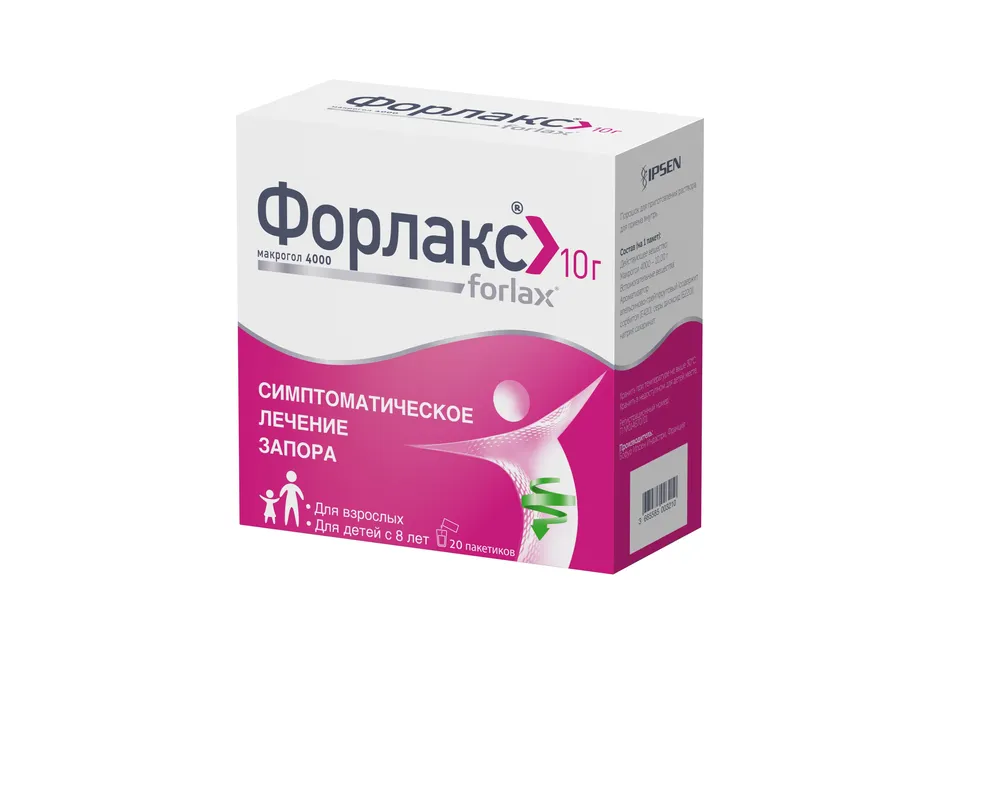
Table of Contents
INSTRUCTIONS FOR MEDICAL USE OF THE MEDICINAL PRODUCT FORLAX (FORLAX)
Composition:
Active substance: macrogol 4000;
1 sachet contains 10 g of macrogol 4000;
Excipients: sodium saccharin, orange and grapefruit flavoring (orange oil, grapefruit oil, concentrated orange juice, citral, acetaldehyde, linalool, ethyl butyrate, alpha-terpineol, octanal, beta-gamma hexenol, dextrin-maltose, acacia gum, sorbitol (E 420), butylated hydroxyanisole (E 320), sulfur dioxide (E 220)).
Pharmaceutical form. Powder for solution for oral use.
Main physicochemical properties: white or almost white powder, readily soluble in water, with an orange and grapefruit odor.
Pharmacotherapeutic group.
Laxatives. Osmotic laxatives. Macrogol.
ATC code A06AD15.
Pharmacological properties.
Pharmacodynamics
Macrogols with high molecular weight (4000) are long linear polymers that retain water molecules via hydrogen bonds. After oral administration, the volume of fluid in the intestine increases. The volume of non-absorbed fluid in the intestine is responsible for the laxative effect of the solution.
Pharmacokinetics
Pharmacokinetic studies confirm that macrogol 4000 is neither absorbed nor metabolized following oral administration.
Clinical characteristics.
Indications.
Symptomatic treatment of constipation in adults and children aged 8 years and older.
Contraindications.
- Severe inflammatory bowel disease (e.g., ulcerative colitis, Crohn's disease) or toxic megacolon.
- Perforation or risk of gastrointestinal tract perforation.
- Ileus or suspicion of intestinal obstruction, symptomatic strictures.
- Abdominal pain of unknown origin.
- Hypersensitivity to the active substance or to any of the excipients of the medicinal product.
Interaction with other medicinal products and other forms of interaction.
There is a possibility that the absorption of other medicinal products may be temporarily reduced when used concomitantly with the medicinal product Forlax®, particularly affecting medicinal products with a narrow therapeutic index or short elimination half-life, such as digoxin, antiepileptic agents, coumarins, and immunosuppressants, leading to reduced efficacy.
A potential interaction between the medicinal product Forlax® and starch-based food thickeners may occur. Polyethylene glycol (PEG) counteracts the thickening effect of starch, effectively liquefying preparations that should remain thick for individuals with swallowing difficulties.
Special precautions for use
Prior to initiating treatment, the absence of organic gastrointestinal disorders must be confirmed.
Forlax (10 g) is indicated for the temporary treatment of constipation as an adjunctive therapy, provided that appropriate hygiene and dietary measures are followed, with a maximum treatment duration in children of 3 months. If symptoms persist despite adherence to hygiene and dietary recommendations, underlying causes should be identified and addressed.
Treatment of constipation with any medicinal product is only an auxiliary therapy and should be accompanied by maintenance of a healthy lifestyle and bowel habits, specifically:
- increased fluid intake and dietary fiber,
- adequate physical activity and restoration of normal bowel function.
The medicinal product contains macrogol (polyethylene glycol). Hypersensitivity reactions (anaphylactic shock, angioneurotic edema, urticaria, rash, pruritus, erythema) to medicinal products containing macrogol have been reported; see section "Side effects".
The medicinal product contains sulfur dioxide, which may rarely cause severe hypersensitivity reactions and bronchospasm.
The medicinal product contains sorbitol. It is not recommended for patients with hereditary fructose intolerance (a rare genetic disorder).
Due to the potential risk of diarrhea, caution is advised in patients predisposed to disturbances in water and electrolyte balance (i.e., elderly patients, patients with hepatic or renal impairment, or patients taking diuretics); monitoring of electrolyte balance is also recommended.
Cases of aspiration have been reported following administration of large volumes of polyethylene glycol and electrolytes via nasogastric tube. Children with neurological disorders affecting speech and motor function are at particular risk of aspiration.
Patients with swallowing difficulties who require thickening agents to be added to solutions to improve swallowing should take this interaction into account (see section "Interaction with other medicinal products and other forms of interaction").
Forlax contains negligible amounts of sugar or polyols and may be used by patients with diabetes mellitus or those on a galactose-free diet.
Use during pregnancy or breastfeeding
Pregnancy
Animal studies do not indicate any direct or indirect toxic effect on reproductive function.
Data on the use of Forlax in pregnant women are limited (fewer than 000 pregnancy outcomes).
No adverse effects during pregnancy are expected, as the systemic exposure to Forlax is negligible. Forlax may be used during pregnancy.
Breastfeeding
There are no data on the excretion of Forlax into human breast milk.
No effects on breastfed newborns/infants are anticipated, as the systemic exposure to Forlax in breastfeeding women is negligible. Forlax may be used during breastfeeding.
Fertility
No studies on the effect of Forlax on fertility have been conducted. However, since macrogol 4000 is minimally absorbed, no effect on fertility is expected.
Ability to affect reaction speed when driving or operating machinery
Not established.
Method of Administration and Dosage
For oral use.
Dosage
The dosage is 1–2 sachets (10–20 g) per day, preferably taken once in the morning.
The daily dose is determined according to clinical response and may range from 1 sachet every other day (especially in children) to 2 sachets per day. The first effect of Forlax occurs within 24–48 hours after administration.
Children
The duration of treatment in children should not exceed 3 months due to the lack of clinical data on the use of the medicinal product for periods longer than 3 months.
Restoration of intestinal motility achieved during treatment should be maintained by following hygienic and dietary recommendations.
Method of Administration
The contents of each sachet should be dissolved in a glass of water immediately before use.
Children
The medicinal product can be used in children aged 8 years and older. The duration of treatment in children should not exceed 3 months.
Overdose
Diarrhea, abdominal pain, and vomiting have been reported. Diarrhea caused by overdose resolves when treatment is temporarily discontinued or the dose is reduced.
Excessive fluid loss due to diarrhea or vomiting may require correction of electrolyte imbalances.
Adverse Reactions
Undesirable reactions are classified as follows: very common (≥ 1/10); common (≥ 1/100 to < 1/10); uncommon (≥ 1/1000 to < 1/100); rare (≥ 1/10000 to < 1/1000); very rare (< 1/10000), not known (cannot be estimated from the available data).
Adults
The adverse reactions listed below have been reported during clinical trials (involving 600 adult patients) and post-marketing use. Overall, adverse reactions were mild and transient, and primarily involved the gastrointestinal system:
Gastrointestinal disorders
Common: abdominal pain, bloating, diarrhea, nausea.
Uncommon: vomiting, urgent bowel movements, involuntary defecation.
Metabolism and nutrition disorders
Not known: disturbances in water-electrolyte balance (hyponatremia, hypokalemia) and/or dehydration, particularly in elderly patients.
Immune system disorders
Not known: hypersensitivity (anaphylactic shock, angioneurotic edema, urticaria, rash, pruritus, erythema).
Children
The adverse reactions listed below have been reported during clinical trials (involving 147 children aged 6 months to 15 years) and post-marketing use. As in adults, adverse reactions were mostly mild and transient, and primarily involved the gastrointestinal system:
Gastrointestinal disorders
Common: abdominal pain, diarrhea*.
Uncommon: vomiting, bloating, nausea.
Immune system disorders
Not known: hypersensitivity (anaphylactic shock, angioneurotic edema, urticaria, rash, pruritus).
*Diarrhea may cause painful sensations in the perianal area.
Shelf life.
3 years.
Storage conditions.
Store at a temperature not exceeding 25 °C. Keep out of the reach and sight of children.
Packaging.
Each sachet contains 10.167 g of powder; 10 or 20 sachets in a cardboard box.
Classification.
Over-the-counter (without prescription).
Manufacturer.
BOFUR IPSEN INDUSTRIE / BEAUFOUR IPSEN INDUSTRIE.
Manufacturer's address.
Rue Ethe Virton 28100 DREUX, France.
Marketing authorization holder.
IPSEN CONSUMER HEALTHCARE Simplified Joint Stock Company.
Address of the marketing authorization holder.
65 Quai Georges Gorse, 92100 Boulogne-Billancourt, France.