Foksero
Ukraine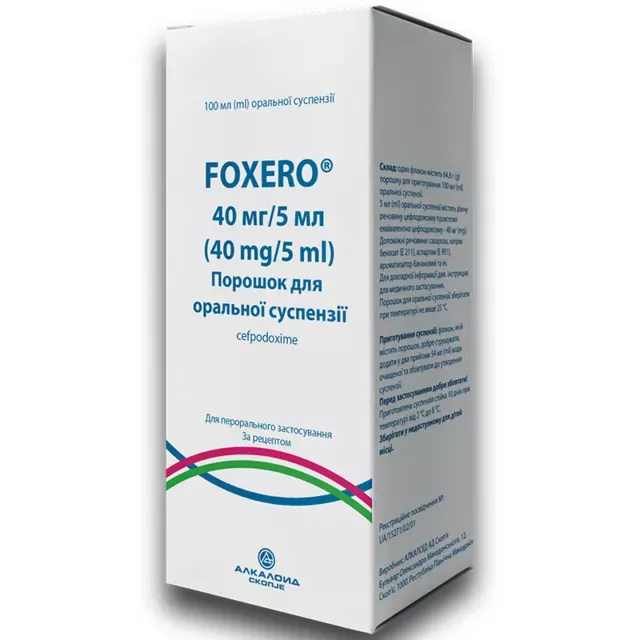
Table of Contents
INSTRUCTIONS FOR MEDICAL USE OF THE MEDICINAL PRODUCT FOKSERO® (FOXERO®)
Composition:
Active substance: cefpodoxime;
5 ml of oral suspension contains cefpodoxime proxetil equivalent to cefpodoxime - 40 mg;
Excipients: microcrystalline cellulose and sodium carmellose; anhydrous colloidal silicon dioxide; maize starch; hydroxypropylcellulose; sodium benzoate (E 211); anhydrous citric acid; aspartame (E 951); banana flavoring; yellow iron oxide (E 172); sucrose.
Pharmaceutical form. Powder for oral suspension.
Main physicochemical properties: powder from almost white to light yellow in color with a characteristic banana odor.
After preparation: suspension from almost white to light yellow in color with a characteristic banana odor.
Pharmacotherapeutic group. Antibacterial agents for systemic use. Other beta-lactam antibiotics. Third-generation cephalosporins.
ATC code J01D D13.
Pharmacological Properties
Pharmacodynamics
Cefpodoxime proxetil is an oral third-generation cephalosporin β-lactam antibiotic and is a prodrug of cefpodoxime.
The mechanism of action of cefpodoxime is due to inhibition of bacterial cell wall synthesis in microorganisms. It is stable against numerous β-lactamases.
In vitro, cefpodoxime exhibits bactericidal activity against a wide range of Gram-positive and Gram-negative bacteria.
Cefpodoxime is highly active against the following Gram-positive microorganisms: Streptococcus pneumoniae; Group A streptococci (S. pyogenes), Group B (S. agalactiae), Groups C, F, and G; other streptococci (S. mitis, S. sanguis, and S. salivarius); Propionibacterium acnes; Corynebacterium diphtheriae.
Cefpodoximed is highly active against the following Gram-negative microorganisms: Haemophilus influenzae (both β-lactamase-producing and non-producing strains); Haemophilus para-influenzae (both β-lactamase-producing and non-producing strains); Moraxella catarrhalis (both β-lactamase-producing and non-producing strains); Neisseria meningitidis; Neisseria gonorrhoeae; Escherichia coli; Klebsiella spp. (K. pneumoniae, K. oxytoca); Proteus mirabilis.
Moderately susceptible to cefpodoxime are methicillin-susceptible staphylococci, including both penicillinase-producing and non-producing strains (S. aureus and S. epidermidis).
Resistant to cefpodoxime are: Enterococci; methicillin-resistant staphylococci (S. aureus and S. epidermidis [negative]); Staphylococcus saprophyticus; Pseudomonas aeruginosa and Pseudomonas spp.; Clostridium difficile; Bacteroides fragilis and related species.
If possible, susceptibility should be determined by in vitro testing.
Pharmacokinetics
Absorption
Cefpodoxime proxetil is absorbed in the intestine and hydrolyzed to its active metabolite, cefpodoxime. After oral administration of cefpodoxime proxetil (tablet containing 100 mg of cefpodoxime) on an empty stomach, the absorption of the drug is 51.1%. Food intake prolongs the absorption period.
Distribution
Volume of distribution – 32.3 L. Maximum plasma concentration of cefpodoxime is reached within 2–3 hours after administration. Peak plasma concentrations are 1.2 mg/L after a 100 mg dose and 2.5 mg/L after a 200 mg dose. After administration at doses of 100 mg and 200 mg twice daily for 14.5 days, pharmacokinetic parameters of cefpodoxime in plasma did not change.
Protein binding in plasma is 40%, primarily to albumin. Protein binding of cefpodoxime is non-saturable.
Cefpodoxime penetrates into lung parenchyma, bronchial mucosa, pleural fluid, tonsils, interstitial fluid, and prostate tissues. Good diffusion of cefpodoxime has also been observed in renal tissue.
The drug is predominantly excreted in urine, where high concentrations are achieved.
Metabolism
Cefpodoxime proxetil is a prodrug of cefpodoxime. The majority of the absorbed drug undergoes pre-systemic de-esterification in the small intestine, converting into its active form. Cefpodoxime undergoes minimal metabolism and is excreted unchanged, primarily in urine.
Excretion
The main route of elimination is renal excretion, with approximately 80% of the drug excreted unchanged in urine. Elimination half-life – approximately 2.4 hours.
Children
Maximum plasma concentrations are achieved approximately 2–4 hours after administration. In children aged 4 to 12 years receiving a single dose of 5 mg/kg, maximum plasma concentrations were similar to those observed in adults receiving a 200 mg dose.
In patients under 2 years of age receiving repeated doses of 5 mg/kg every 12 hours, mean plasma concentrations 2 hours after dosing ranged from 2.7 mg/L (1–6 months) to 2.0 mg/L (7 months – 2 years).
In patients aged 1 month to 12 years receiving repeated doses of 5 mg/kg every 12 hours, trough plasma concentrations at steady state ranged from 0.2–0.3 mg/L (1 month – 2 years) to 0.1 mg/L (2–12 years).
Clinical characteristics.
Indications.
Infections caused by cefpodoxime-sensitive pathogens:
- Otorhinolaryngological infections (including acute otitis media, sinusitis, tonsillitis, pharyngitis); the drug should be prescribed for treatment of chronic or recurrent infections, as well as in cases of known or suspected resistance of the pathogen to antibiotics commonly used;
- Respiratory tract infections (including pneumonia, acute bronchitis or bronchiolitis complicated by bacterial superinfection);
- Uncomplicated infections of the upper and lower urinary tracts (including acute pyelonephritis and cystitis);
- Skin and soft tissue infections (abscesses, cellulitis, infected wounds, furuncles, folliculitis, paronychia, carbuncles, and ulcers).
Contraindications.
Hypersensitivity to cefpodoxime, other cephalosporins, penicillins, or to any component of the drug.
Phenylketonuria, as the drug contains aspartame.
Rare hereditary fructose intolerance, glucose-galactose malabsorption, or sucrase-isomaltase deficiency.
Interaction with other medicinal products and other types of interactions.
Histamine H2-receptor antagonists and antacid agents reduce the bioavailability of cefpodoxime. Probenecid reduces the excretion of cephalosporins. Cephalosporins may enhance the anticoagulant effect of coumarins.
Concomitant administration of cefpodoxime with agents that neutralize gastric pH or inhibit gastric acid secretion reduces bioavailability by approximately 30%. Therefore, such agents as mineral-type antacids and H2-blockers, such as ranitidine, which may increase gastric pH, should be taken 2–3 hours after cefpodoxime administration.
Bioavailability increases when the drug is taken with food.
A false-positive reaction for glucose in urine may occur when using Benedict's or Fehling's solutions or copper sulfate, but such a reaction has not been observed with tests based on enzymatic glucose oxidase reactions.
Special precautions for use.
Prior to prescribing cephalosporins, a careful history regarding allergy to penicillin should be obtained, as cross-allergic reactions to penicillins occur in 5–10% of cases.
Patients with a history of allergic reactions to other cephalosporins may be at risk of cross-allergic reactions to cefpodoxime. Cefpodoxime should not be administered to patients with a history of immediate-type hypersensitivity reactions to cephalosporins.
Allergic reactions (anaphylaxis) to β-lactam antibiotics can be severe and sometimes even fatal.
If any signs of hypersensitivity occur, treatment should be discontinued immediately.
In cases of severe renal impairment, dose adjustment may be necessary depending on creatinine clearance.
Cefpodoxime is not a first-line antibiotic for the treatment of staphylococcal pneumonia and should not be used in the treatment of atypical pneumonia caused by microorganisms such as Legionella, Mycoplasma, and Chlamydia.
Possible adverse effects include gastrointestinal disturbances such as nausea, vomiting, and abdominal pain. Antibiotics should be prescribed with caution to patients with a history of gastrointestinal disorders (particularly colitis).
Cefpodoxime may cause diarrhea, antibiotic-associated colitis, and pseudomembranous colitis. These adverse effects, which occur more frequently in patients receiving high doses over prolonged periods, should be considered potentially serious.
Testing for C. difficile should be performed. If colitis is suspected, treatment should be discontinued immediately. Sigmoidoscopy and rectoscopy should be performed, and if clinically indicated, alternative antibiotic therapy (e.g., vancomycin) should be initiated. Medications causing fecal retention should be avoided. When using broad-spectrum agents such as cephalosporins, the risk of developing pseudomembranous colitis is increased.
As with other β-lactam antibiotics, neutropenia may develop, and rarely agranulocytosis, particularly during prolonged therapy. If treatment lasts longer than 10 days, a blood test should be performed, and if neutropenia is detected, therapy should be discontinued.
Cephalosporins may adsorb to the surface of erythrocyte membranes and react with antibodies directed against the drug. This may induce a positive Coombs test and very rarely lead to hemolytic anemia. Such a reaction may result in cross-reactivity with penicillins.
When used concomitantly with potentially nephrotoxic agents such as aminoglycosides and/or potent diuretics (e.g., furosemide), renal function should be monitored.
Prolonged use of cefpodoxime proxetil may lead to overgrowth of non-susceptible microorganisms. Oral antibiotics may alter the normal microbial flora of the colon, leading to overgrowth of Clostridium and subsequent pseudomembranous colitis. Re-evaluation of the patient is necessary, and if superinfection occurs during therapy, appropriate measures should be taken.
The formulation contains sucrose 2465 mg/5 ml.
The formulation contains aspartame (E 951) 20 mg/5 ml.
Use during pregnancy or breastfeeding.
The drug is intended for use in children.
Ability to affect reaction rate when driving or operating machinery.
The drug is intended for use in children.
Administration and Dosage
The suspension is intended for use in pediatrics.
The medication should be taken orally with food for optimal absorption.
Instructions for reconstitution prior to administration can be found in the section "Preparation of the Suspension".
| Warning:
|
The recommended daily dose for children aged 6 months to 12 years is 8 mg/kg body weight, to be divided into two doses administered at 12-hour intervals.
Note the following: 5 ml of suspension contains 40 mg of cefpodoxime; 1 ml of suspension contains 8 mg of cefpodoxime.
| Using the graduated dosing syringe, measure the individual dose of the medicinal product (single dose) according to the child's body weight (from 5 to 25 kg). For example: mark 12 corresponds to the individual single dose prescribed for a child with a body weight of 12 kg. Two separate doses should be taken per day. |
Duration of treatment
The duration of treatment depends on the severity of the disease and is determined individually.
Hepatic impairment
Dose adjustment is not required for patients with hepatic impairment.
Renal impairment
Dose adjustment is not required for patients with renal impairment and a creatinine clearance of more than 40 ml/min/1.73 m². If creatinine clearance values are below this threshold, the dose should be adjusted accordingly (see Table).
Table
| Creatinine clearance (ml/min/1.73 m2) |
Recommended dose |
|
| 39-10 |
dose calculated according to body weight, single dose every 24 hours |
|
| < 10 |
dose calculated according to body weight, single dose every 48 hours |
|
| patients undergoing hemodialysis |
dose calculated according to body weight, single dose after each dialysis session |
|
Preparation of the suspension
The suspension is recommended to be prepared in a pharmacy as follows:
- Shake the bottle vigorously to loosen the powder from the bottom of the vial.
- Unscrew the cap by pressing and turning it simultaneously (safety lock).
- Remove the protective film.
- Fill the plastic graduated measuring cup with boiled cooled water up to the 27 ml mark.
- Pour the water from the measuring cup into the vial and shake vigorously to ensure no powder remains on the walls.
- Fill the plastic graduated measuring cup again with water up to the 27 ml mark.
- Pour the water from the measuring cup into the vial and shake vigorously until a homogeneous suspension is formed.
- Discard the plastic graduated measuring cup.
Shake well before each use.
Close the vial tightly after each use.
Store the prepared suspension in the refrigerator (2–8 °C) for up to 10 days.
The suspension should be measured using the dosing syringe provided in the package.
Children
The drug is indicated for children aged 6 months to 12 years.
The drug is contraindicated in children under 6 months of age.
Overdose
Symptoms: nausea, vomiting, abdominal pain, diarrhea. In cases of overdose, especially in patients with renal insufficiency, encephalopathy may develop. Encephalopathy is usually reversible and resolves upon reduction of cefpodoxime plasma levels.
Treatment: hemodialysis, peritoneal dialysis. Supportive and symptomatic therapy.
Adverse Reactions
Adverse reactions are classified by system organ class and frequency of occurrence: very common (>1/10); common (≥1/100 to <1/10); uncommon (≥1/1000 to <1/100); rare (≥1/10,000 to <1/1,000); very rare (<1/10,000); frequency not known (cannot be estimated based on available data).
Infections and infestations:
common – superinfection caused by Candida species not sensitive to cefpodoxime (see section "Special precautions for use");
superinfection: as with other antibiotics, use of cefpodoxime, especially prolonged use, may lead to overgrowth of non-susceptible organisms. Re-evaluation of the patient's condition is required. If superinfection occurs during therapy, appropriate measures should be taken;
very rare – colitis associated with antibiotic use.
Blood and lymphatic system disorders:
uncommon – thrombocytosis (usually reversible after discontinuation of treatment);
very rare – leukopenia, neutropenia, thrombocytopenia, agranulocytosis, decreased hemoglobin concentration, hemolytic anemia, eosinophilia, lymphocytosis, leukocytosis.
Immune system disorders:
rare – hypersensitivity reactions of all severity levels, from bronchospasm and angioedema to life-threatening shock;
very rare – anaphylactic reactions.
Metabolism and nutrition disorders:
rare – dehydration, gout, peripheral edema, weight gain.
Musculoskeletal and connective tissue disorders:
rare – myalgia.
Nervous system disorders:
uncommon – headache, dizziness, paresthesia;
rare – vertigo;
very rare – insomnia, somnolence, neurosis, irritability, nervousness, abnormal dreams, blurred vision, confusion, night terrors.
Respiratory, thoracic and mediastinal disorders:
rare – asthma, cough, epistaxis, rhinitis, wheezing, bronchitis, dyspnea, pleural effusion, pneumonia, sinusitis.
Gastrointestinal disorders:
common – diarrhea, abdominal distension, abdominal pain, nausea, vomiting, decreased appetite;
rare – thirst, tenesmus, dyspepsia, dry mouth, constipation, candidiasis of the mouth, anorexia, belching, gastritis, oral ulcers, pseudomembranous colitis, blood in stools, acute pancreatitis.
In case of severe persistent diarrhea occurring during or after treatment, pseudomembranous enterocolitis should be considered (see section "Special precautions for use").
Hepatobiliary disorders:
very rare – liver injury, cholestatic liver injury;
rare – acute hepatitis.
Skin and subcutaneous tissue disorders:
uncommon – rash, pruritus, urticaria, purpura;
rare – increased sweating, macular rash, fungal dermatitis, desquamation, dry skin, alopecia, vesicular rash, sunburn erythema, bullous reactions (including Stevens-Johnson syndrome), toxic epidermal necrolysis, erythema multiforme.
Renal and urinary disorders:
rare – acute renal failure, hematuria, urinary tract infections, metrorrhagia, dysuria, frequent urination, proteinuria, vaginal candidiasis.
Changes in kidney function have been reported with antibiotics of the same class as cefpodoxime, particularly when used concomitantly with aminoglycosides and/or potent diuretics.
Cardiovascular system disorders:
rare – congestive heart failure, migraine, tachycardia, vasodilation, hematoma, arterial hypertension or hypotension (see section "Special precautions for use").
Sensory organ disorders:
uncommon – tinnitus;
rare – taste disturbances, eye irritation.
General disorders and administration site conditions:
rare – discomfort, malaise, fatigue, asthenia, drug fever, chest pain (pain may radiate to the back), fever, generalized pain, candidiasis, abscess, allergic reaction, facial swelling, bacterial infections, parasitic infections.
Laboratory findings:
uncommon – bilirubinemia;
rare – increased levels in liver function tests (AST, ALT), alkaline phosphatase, urea, creatinine; false-positive Coombs test.
Shelf life
2 years.
Do not use after the expiry date stated on the packaging.
Storage conditions
Store the powder for oral suspension at a temperature not exceeding 25°C.
The reconstituted suspension is stable for 10 days when stored at 2°C to 8°C.
Keep out of reach and sight of children.
Packaging
64.8 g of powder for the preparation of 100 ml of oral suspension in a white, semi-transparent (HDPE) plastic bottle with a child-resistant closure cap.
One bottle, a measuring glass for dosing the water required for reconstitution, an oral dosing syringe (plastic) in a cardboard box.
Prescription status
Prescription only.
Manufacturer
ALKALOID AD Skopje /
ALKALOID AD Skopje.
Manufacturer's address and place of business
Boulevard Aleksandar Makedonski 12, Skopje, 1000, Republic of North Macedonia.