Fluanxol depot
Ukraine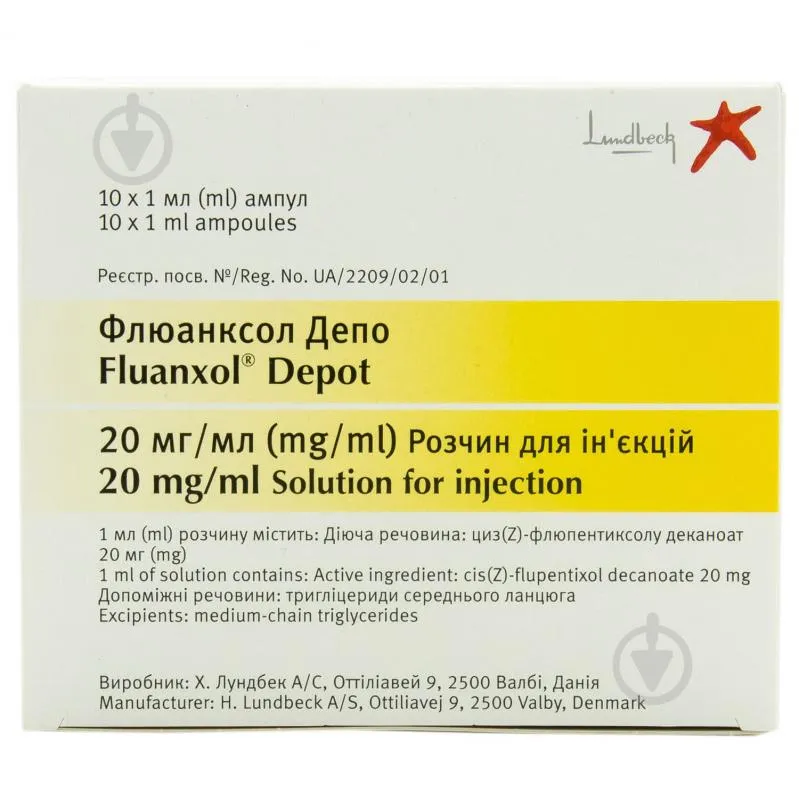
Table of Contents
INSTRUCTIONS FOR MEDICAL USE OF THE MEDICINAL PRODUCT FLUANXOLDEPOT (FLUANXOL® DEPOT)
Composition:
Active substance: flupentixol;
1 ml of injection solution contains 20 mg of cis(Z)-flupentixol decanoate;
Excipients: medium-chain triglycerides.
Pharmaceutical form. Injection solution.
Main physicochemical properties: clear, colorless to slightly yellowish oily solution, almost free from mechanical particles.
Pharmacotherapeutic group. Psycholeptics. Antipsychotic agents. Thioxanthene derivatives. Flupentixol.
ATC code N05AF01.
Pharmacological Properties
Pharmacodynamics
Flupentixol is a neuroleptic agent belonging to the thioxanthene group.
The antipsychotic effect of neuroleptics is associated with blockade of dopamine receptors, and possibly also involves blockade of 5-HT receptors. In vitro and in vivo, flupentixol exhibits high affinity for both dopamine D1 and D2 receptors. The atypical antipsychotic clozapine shows a similar affinity for D1 and D2 receptors as flupentixol, both in vitro and in vivo.
Flupentixol has high affinity for α1-adrenergic and 5-HT2 receptors, although somewhat lower than chlorprothixene, phenothiazines at high doses, and clozapine, but lacks affinity for cholinergic muscarinic receptors. It has weak antihistaminergic properties and does not exert blocking effects on α2-adrenergic receptors.
Flupentixol is a high-potency neuroleptic, as demonstrated in all behavioral studies of neuroleptic activity (ability to block dopamine receptors). At average daily doses and with oral administration for antipsychotic treatment, affinity for binding sites blocking the dopamine D2 receptor has been observed in both in vitro and in vivo models.
Perioral movements in rats depend on stimulation of D1 receptors or blockade of D2 receptors. These movements can be prevented by flupentixol. Similarly, studies in primates indicate that oral hyperkinesia is primarily related to stimulation of D1 receptors and to a lesser extent to D2 receptor hypersensitivity. This suggests that D1 activation is responsible for the development of such effects in humans, i.e., dyskinesia. Thus, blockade of D1 receptors may be beneficial in preventing the development of dyskinesia in humans.
Like most other neuroleptics, flupentixol increases serum prolactin levels.
Pharmacological studies have clearly demonstrated that the oily solution of flupentixol decanoate exerts a prolonged neuroleptic effect, and the amount of drug required to maintain a constant effect over a prolonged period is significantly lower with the depot formulation than with daily oral administration of flupentixol.
A very mild and short-lived increase in barbiturate-induced sleeping time in mice was observed only at high doses. Therefore, clinically significant interaction with anesthetics in patients receiving the depot formulation is unlikely.
Clinical Efficacy and Safety
Flupentixol decanoate is clinically indicated for maintenance treatment of chronic psychoses. The antipsychotic effect increases with dose escalation. At low and medium dose ranges (up to 100 mg every 2 weeks), flupentixol decanoate does not produce sedative effects, whereas some nonspecific sedative response may be expected at higher doses.
Flupentixol decanoate is particularly effective in treating patients with apathy, social withdrawal, depression, and lack of motivation.
Flupentixol decanoate enables continuous treatment, which is especially important for patients who are non-compliant with prescribed therapy. Thus, flupentixol decanoate helps prevent frequent relapses associated with interruption of oral medication by patients.
Pharmacokinetics
Absorption
Esterification with decanoic acid converts flupentixol into the highly lipophilic compound flupentixol decanoate. After administration, flupentixol decanoate undergoes enzymatic hydrolysis to release the active component, cis(Z)-flupentixol, and decanoic acid. Maximum serum concentration of flupentixol is reached at the end of the first week after injection. The elimination half-life is approximately 3 weeks (reflecting release from the depot), and steady-state concentrations are achieved after repeated administration over 3 months.
Distribution
The apparent volume of distribution (Vd)β is approximately 14.1 L/kg.
Metabolism
Flupentixol is metabolized via three main pathways: sulfoxidation, N-dealkylation of the side chain, and conjugation with glucuronic acid. The metabolites lack psychopharmacological activity. The pharmacological effect of unchanged flupentixol predominates over the influence of its metabolites on the brain and other tissues, as the metabolites of flupentixol are devoid of neuroleptic activity.
The elimination half-life (T1/2β) of cis(Z)-flupentixol is approximately 35 hours, and systemic clearance (Cls) is approximately 0.29 L/min.
Flupentixol is excreted predominantly in feces and to a lesser extent in urine. When tritium-labeled flupentixol was administered to humans, excretion in feces was approximately four times greater than in urine.
Plasma protein binding is approximately 99%.
Flupentixol passes into breast milk in small amounts. In women, the milk-to-serum concentration ratio averages 1.3.
Linearity
The pharmacokinetics are linear. The steady-state trough serum concentration of flupentixol prior to the next administration of flupentixol decanoate 40 mg every two weeks is approximately 6 nmol/L.
Pharmacokinetic studies in elderly patients have not been conducted. However, in a related thioxanthene derivative, zuclopenthixol, pharmacokinetic parameters are largely independent of patient age.
In renal impairment, no significant effect on plasma drug concentration is expected.
Data on the impact of hepatic impairment on the pharmacokinetic parameters of the drug are lacking.
Pharmacokinetic and Pharmacodynamic Interactions
The recommended serum (plasma) concentration range prior to injection is 1–3 ng/mL (2–8 nmol/L), with maximum/minimum fluctuations <2.5, proposed as the target range for maintenance treatment of patients with mild to moderate schizophrenia.
Pharmacokinetically, a dose of flupentixol decanoate 40 mg every 2 weeks is equivalent to a daily oral dose of 10 mg flupentixol.
Clinical characteristics.
Indications.
Supportive treatment of schizophrenia and other psychoses, particularly those with symptoms such as hallucinations, delusions, and thought disorders complicated by apathy, anergy, depression, and social withdrawal.
Contraindications.
Hypersensitivity to any component of the drug.
Circulatory collapse, central nervous system depression of any etiology (e.g., due to alcohol, barbiturate, or opioid intoxication), coma.
Not recommended for use in easily excitable patients or in patients experiencing nervous excitement.
Interaction with other medicinal products and other forms of interaction.
Combinations requiring caution
Flupentixol decanoate may enhance the sedative effects of alcohol, barbiturates, and central nervous system depressants. Flupentixol may potentiate the effects of general anesthetics and anticoagulants and prolong the duration of action of neuromuscular blocking agents.
Anticholinergic effects of atropine or other medicinal products with anticholinergic properties may be enhanced.
Neuroleptics may either enhance or diminish the effects of antihypertensive agents; the hypotensive effect of guanethidine and similarly acting agents is reduced.
Concomitant use of neuroleptics with lithium or sibutramine increases the risk of neurotoxicity.
Antipsychotics may enhance the cardiodepressant effects of quinidine and the absorption of corticosteroids and digoxin. The hypotensive effect of vasodilator antihypertensive agents such as hydralazine, α-blockers (e.g., doxazosin), or methyldopa may be enhanced.
Tricyclic antidepressants and neuroleptics mutually inhibit each other's metabolism, and glycemic control in diabetes may worsen.
Flupentixol decanoate may reduce the effects of levodopa, adrenergic agents, and anticonvulsants; combinations with metoclopramide, piperazine, and antiparkinsonian drugs increase the risk of extrapyramidal disorders such as tardive dyskinesia.
Prolongation of the QT interval associated with antipsychotic use may be exacerbated when used concomitantly with other agents capable of significantly prolonging the QT interval. Combinations with such agents should be avoided. Relevant classes include:
- Class Ia and III antiarrhythmics (e.g., quinidine, amiodarone, sotalol, dofetilide);
- Some antipsychotics (e.g., thioridazine);
- Some macrolide antibiotics (e.g., erythromycin);
- Some antihistamines (e.g., terfenadine, astemizole);
- Some quinolone antibiotics (e.g., gatifloxacin, moxifloxacin).
The above list is incomplete. Combinations with other individual agents capable of significantly prolonging the QT interval (e.g., cisapride, lithium) should also be avoided.
Agents that alter electrolyte balance, such as thiazide diuretics (causing hypokalemia), and agents that increase flupentixol concentration should also be used with caution, as they may increase the risk of QT interval prolongation and life-threatening arrhythmias.
Special precautions for use.
Caution should be exercised in patients with the following conditions: liver disease; heart disease or arrhythmias; severe respiratory disorders; renal insufficiency; epilepsy (and conditions predisposing to epilepsy, such as alcohol withdrawal or brain injury); Parkinson's disease; narrow-angle glaucoma; benign prostatic hyperplasia; hypothyroidism; hyperthyroidism; myasthenia gravis; pheochromocytoma; and patients who exhibit hypersensitivity to thioxanthenes or other antipsychotics.
The risk of developing neuroleptic malignant syndrome (hyperthermia, muscle rigidity, altered consciousness, autonomic dysfunction) exists with the use of any neuroleptic agent. The risk may be higher with more potent agents. Fatal cases have been observed primarily in patients with pre-existing organic brain syndrome, mental retardation, opioid or alcohol abuse.
Treatment: discontinue neuroleptic drugs, provide symptomatic and general supportive measures. Dantrolene and bromocriptine may be administered.
Symptoms may persist for a week or longer after discontinuation of oral formulations and somewhat longer after depot formulations.
Rare cases of blood count abnormalities, including thrombocytopenia, have been reported. If signs of persistent infection occur in a patient, complete blood counts should be performed.
Like other neuroleptics, flupentixol decanoate should be used with caution in patients with organic brain syndrome, seizures, or progressive liver disease.
Flupentixol decanoate at low-dose range is not recommended for treating easily agitated or overly active patients, as its activating effect may exacerbate these characteristics.
Like other antipsychotic agents, flupentixol decanoate may alter insulin and glucose profiles, necessitating adjustment of antidiabetic therapy in patients with diabetes mellitus.
Acute withdrawal symptoms, including nausea, vomiting, sweating, and insomnia, have been described following abrupt discontinuation of antipsychotics. Additionally, relapses of psychotic symptoms may occur, and cases of involuntary movement disorders (such as akathisia, dystonia, and dyskinesia) have been reported. Plasma concentrations of Fluanxol Depot injection and concentrate for injection gradually decrease over several weeks, making gradual withdrawal with stepwise dose reduction unnecessary.
When switching patients from oral antipsychotics to depot antipsychotics, the oral medication should not be abruptly discontinued; it should be tapered gradually over several days after the first depot injection.
During maintenance therapy, especially when high doses are used, patients should be carefully monitored, and the possibility of reducing the maintenance dose should be periodically evaluated.
Like other agents in the antipsychotic therapeutic class, flupentixol decanoate may cause QT interval prolongation. Pre-existing QT prolongation may increase the risk of life-threatening arrhythmias. Therefore, flupentixol decanoate should be used cautiously in patients predisposed to such conditions (e.g., hypokalemia, hypomagnesemia, or genetic predisposition), as well as in patients with a history of cardiovascular disorders, such as prolonged QT interval, marked bradycardia (<50 beats/min), recent myocardial infarction, uncompensated heart failure, or cardiac arrhythmia. Concomitant use with other antipsychotics should be avoided.
Venous thromboembolism (VTE) has been reported during antipsychotic therapy. Since patients receiving antipsychotics often have acquired VTE risk factors, all probable VTE risk factors should be identified before and during treatment with flupentixol decanoate, and preventive measures should be taken.
Cases of leukopenia, neutropenia, and agranulocytosis have been reported with antipsychotic agents, including flupentixol decanoate. Long-acting depot forms of antipsychotics should be used cautiously in combination with other agents with myelosuppressive potential, as these forms cannot be rapidly eliminated from the body if necessary.
Elderly patients
Elderly patients require careful monitoring, as they are particularly susceptible to adverse effects such as sedation, orthostatic hypotension, confusion, and disturbances in body temperature regulation.
Cerebrovascular disorders
In randomized, placebo-controlled studies of some atypical antipsychotics in patients with dementia, the risk of cerebrovascular adverse events was approximately threefold higher. The mechanism of this increased risk is unknown. An increased risk cannot be excluded with other antipsychotics or in other patient populations. Flupentixol decanoate should be used with caution in patients at risk of stroke.
Increased risk of mortality in elderly patients with dementia
Clinical data indicate that elderly patients with dementia treated with antipsychotics have a slightly higher risk of death compared to those not receiving these agents. Data are insufficient to precisely define this risk, and the reason for the increased risk is unknown.
Flupentixol decanoate is not indicated for the treatment of behavioral disorders associated with dementia.
Suicide / suicidal thoughts or clinical worsening
Depression is associated with an increased risk of suicidal thoughts, self-harm, and suicide (suicide-related events). This risk persists until significant remission occurs. Since improvement may not occur during the first few weeks of treatment or later, careful monitoring of patients is required until such improvement is achieved.
Clinical experience generally indicates that the risk of suicide may increase in the early stages of recovery. Other psychiatric disorders for which flupentixol is prescribed may also be associated with an increased risk of suicide-related events. Moreover, these disorders may coexist with major depressive disorder. Therefore, the same precautions should be taken when treating patients with other psychiatric disorders as when treating patients with major depressive disorder. It is known that patients with a history of suicide-related events and those with pronounced suicidal ideation before treatment initiation are at increased risk of developing suicidal thoughts or suicide attempts, and such patients should be closely monitored during treatment. A meta-analysis of placebo-controlled clinical trials of antidepressant drugs in adult patients with psychiatric disorders demonstrated an increased risk of suicidal behavior with antidepressant treatment compared to placebo in patients under 25 years of age.
Pharmacological treatment in such patients, especially those at high risk, should be accompanied by close monitoring, particularly in the early stages of treatment and after dose adjustments. Patients (and caregivers) should be warned to monitor for any signs of clinical worsening, suicidal behavior or thoughts, or unusual changes in behavior, and to seek immediate medical help if such symptoms occur.
Use during pregnancy or breastfeeding
Since the safety of this drug during pregnancy has not been established, flupentixol decanoate should not be used during pregnancy, especially during the first and third trimesters, unless the expected benefit to the patient outweighs the theoretical risk to the fetus.
Newborns whose mothers have taken antipsychotics (including flupentixol decanoate) during the third trimester of pregnancy may be at risk of adverse effects, including extrapyramidal symptoms and/or withdrawal symptoms, which may vary in severity and duration after birth. Cases of agitation, hypertonia, hypotonia, tremor, somnolence, respiratory distress, or feeding difficulties have been reported. Therefore, newborns require careful monitoring.
Animal studies have shown reproductive toxicity.
Lactation
Flupentixol is excreted in breast milk. If the use of Fluanxol Depot is considered absolutely necessary, breastfeeding mothers should be advised to discontinue breastfeeding.
Fertility
Cases of hyperprolactinemia, galactorrhea, amenorrhea, decreased libido, erectile dysfunction, and absence of ejaculation have been reported (see section "Adverse reactions"). These conditions may negatively affect sexual function in women and/or men and fertility.
If possible, the dose should be reduced or the drug discontinued in the event of clinically significant hyperprolactinemia, galactorrhea, amenorrhea, or sexual dysfunction. These disorders resolve after discontinuation of the drug.
In preclinical studies on the effect of the drug on fertility in rats, flupentixol had a minor effect on pregnancy rate in female rats. Effects were observed at doses significantly exceeding those used in clinical practice.
Ability to affect reaction speed when driving or operating machinery
Fluanxol Depot is a non-sedating agent at low to medium dose ranges (up to 100 mg/2 weeks). However, patients receiving psychotropic drugs, or after alcohol consumption, may experience some reduction in general attention and concentration and should be warned about the possible effect of the drug on their ability to drive or operate machinery.
Patients should not drive if they experience blurred vision.
Dosage and Administration
Adults
The dosage and injection intervals are determined individually to achieve maximum suppression of psychotic symptoms with minimal adverse effects.
Flupentixol decanoate, 20 mg/mL
For maintenance therapy, the usual dosage range is 20–40 mg (1–2 mL) every 2–4 weeks. Higher doses or shorter intervals between injections may be required for some patients. Flupentixol decanoate is not suitable for the treatment of patients requiring sedation.
When switching from oral flupentixol to maintenance therapy with flupentixol decanoate, the following conversion should be applied:
Oral daily dose (mg) × 4 = dose of flupentixol decanoate (mg) every 2 weeks.
Oral daily dose (mg) × 8 = dose of flupentixol decanoate (mg) every 4 weeks.
Patients should continue taking oral flupentixol during the first week after the first injection, but at a reduced dose.
When switching from other depot antipsychotics to flupentixol decanoate, the following equivalences should be considered:
40 mg flupentixol decanoate corresponds to 25 mg fluphenazine decanoate, 200 mg zuclopenthixol decanoate, or 50 mg haloperidol decanoate.
Subsequent doses and injection intervals should be adjusted according to the patient's clinical response.
Elderly patients. Lower doses are recommended.
Renal impairment. Flupentixol decanoate should be administered at usual doses in patients with renal impairment.
Hepatic impairment. Therapeutic doses should be carefully determined, and, if possible, serum drug levels should be monitored.
Route of administration. Flupentixol decanoate is administered by deep intramuscular injection into the upper outer quadrant of the gluteal muscle. Injections exceeding 2 mL should be divided and administered at two separate sites. Local tolerance is good.
Children.
Use is not recommended due to insufficient clinical experience.
Overdose.
Due to the depot formulation, overdose is unlikely.
Symptoms: Drowsiness, coma, extrapyramidal symptoms, seizures, arterial hypotension, shock, hypothermia or hyperthermia.
When overdose occurs concomitantly with drugs affecting cardiac function, cases of ECG changes, QT prolongation, torsades de pointes, cardiac arrest, and ventricular arrhythmias have been reported.
Treatment: Symptomatic and supportive. Measures should be taken to maintain respiratory and cardiovascular function.
If necessary, the following specific interventions may be applied:
- Administration of anticholinergic antiparkinsonian agents in case of extrapyramidal symptoms
- Sedation (with benzodiazepines) in the unlikely event of nervous excitement, emotional agitation, or seizures
- Intravenous infusion of noradrenaline in saline solution in case of shock
Epinephrine (adrenaline) should not be used, as it may cause further lowering of arterial blood pressure. Seizures can be controlled with diazepam, and extrapyramidal symptoms with biperiden.
Adverse Reactions
Cases of suicidal thoughts and suicidal behavior have been reported during therapy with flupentixol or in the early period after its discontinuation.
Adverse effects are in most cases dose-dependent. Their frequency and severity are most pronounced at the beginning of therapy and decrease with continued treatment.
Extrapyramidal disorders may occur, particularly during the first few days after injection and in the initial phase of treatment. In most cases, adverse effects are managed by reducing the dosage and/or using anti-parkinsonian agents. Routine prophylactic use of such agents is not recommended. Anti-parkinsonian drugs do not eliminate tardive dyskinesia and may even exacerbate it. Dose reduction or, if possible, discontinuation of flupentixol therapy is recommended. In cases of persistent akathisia, treatment with a benzodiazepine or propranolol is recommended.
The frequency of the adverse reactions listed in the table below is defined as:
very common (≥1/10), common (≥1/100 to <1/10), uncommon (≥1/1000 to <1/100), rare (≥1/10,000 to <1/1000), very rare (<1/10,000), or not known (cannot be estimated from available data).
| System, organ, class |
Frequency |
Reaction |
| Cardiac disorders |
Common |
Tachycardia, palpitations. |
| Uncommon |
QT interval prolongation on ECG. |
|
| Blood and lymphatic system disorders |
Uncommon |
Thrombocytopenia, neutropenia, leukopenia, agranulocytosis. |
| Nervous system disorders |
Very common |
Somnolence, akathisia, hyperkinesia, hypokinesia. |
| Common |
Tremor, dystonia, dizziness, headache, impaired concentration. |
|
| Uncommon |
Dyskinesia, parkinsonism, speech disorders, seizures. |
|
| Rare |
Tardive dyskinesia. |
|
| Very rare |
Malignant neuroleptic syndrome. |
|
| Eye disorders |
Common |
Accommodation disorder, visual disturbance. |
| Uncommon |
Nystagmus. |
|
| Respiratory, thoracic and mediastinal disorders |
Common |
Dyspnea. |
| Gastrointestinal disorders |
Very common |
Dry mouth. |
| Common |
Increased salivation, constipation, vomiting, dyspepsia, diarrhea. |
|
| Uncommon |
Abdominal pain, nausea, flatulence. |
|
| Renal and urinary disorders |
Common |
Urinary disorders, urinary retention. |
| Pregnancy, puerperium and perinatal period |
Not known |
Withdrawal syndrome in newborns. |
| Skin and subcutaneous tissue disorders |
Common |
Hyperhidrosis, pruritus. |
| Uncommon |
Rash, photosensitivity reactions, dermatitis. |
|
| Musculoskeletal and connective tissue disorders |
Common |
Myalgia. |
| Uncommon |
Muscle rigidity. |
|
| Endocrine disorders |
Rare |
Hyperprolactinemia. |
| Metabolism and nutrition disorders |
Common |
Increased appetite, weight gain. |
| Uncommon |
Decreased appetite. |
|
| Rare |
Hyperglycemia, glucose intolerance. |
|
| Vascular disorders |
Uncommon |
Arterial hypotension, flushing. |
| Very rare |
Vein thromboembolism. |
|
| Immune system disorders |
Rare |
Hypersensitivity, anaphylactic reaction. |
| Hepatobiliary disorders |
Uncommon |
Abnormal liver function tests. |
| Very rare |
Jaundice. |
|
| Reproductive system and breast disorders |
Uncommon |
Anejaculation, erectile dysfunction. |
| Rare |
Gynecomastia, galactorrhea, amenorrhea. |
|
| Psychiatric disorders |
Common |
Insomnia, depression, anxiety, restlessness, decreased libido. |
| Uncommon |
Confusional states |
|
| Not known |
Suicidal thoughts, suicidal behaviour |
|
| General disorders and administration site conditions |
Common |
Asthenia, increased fatigue. |
| Uncommon |
Injection site reaction. |
There have been reports of rare cases of QT prolongation, ventricular arrhythmias, ventricular fibrillation, ventricular tachycardia, torsade de pointes, and sudden death associated with the use of medicinal products belonging to the therapeutic class of antipsychotics, including flupentixol decanoate.
Sudden discontinuation of flupentixol decanoate may lead to withdrawal symptoms, the most common of which are nausea, vomiting, anorexia, diarrhea, rhinorrhea, increased sweating, myalgia, paresthesia, insomnia, restlessness, anxiety, and agitation. Patients may also experience dizziness, fluctuating sensations of heat or cold, and tremor. Symptoms usually begin within 1–4 days after discontinuation and gradually subside within 7–14 days.
Shelf life. 4 years.
Storage conditions. The medicinal product does not require special storage conditions. Keep ampoules in the original cardboard packaging to protect from light.
Incompatibility. Flupentixol decanoate must not be mixed with depot formulations containing sesame oil, as their combination alters the pharmacokinetic properties of these agents.
Packaging. 10 ampoules of 1 ml in a cardboard box.
Prescription status. Prescription only.
Manufacturer. H. Lundbeck A/S.
Manufacturer's address. Ottiliavej 9, 2500 Valby, Denmark.