Fluticasone-zdorovya
Ukraine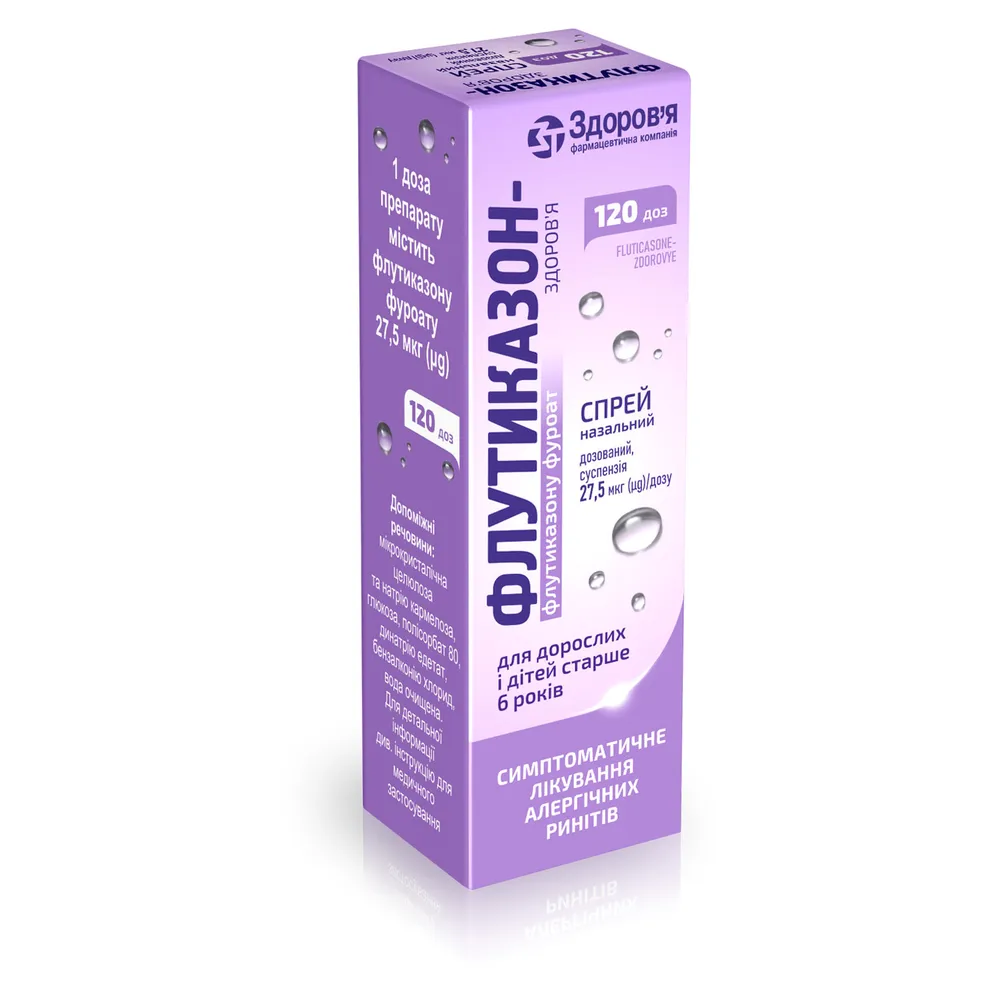
Table of Contents
INSTRUCTION FOR MEDICAL USE OF THE MEDICINAL PRODUCT FLUTICASONE-ZDOROVYE (FLUTICASONE-ZDOROVYE)
Composition:
Active substance: fluticasone furoate;
1 dose of the preparation contains fluticasone furoate – 27.5 mcg;
Excipients: microcrystalline cellulose and sodium carmellose, glucose, polysorbate 80, disodium edetate, benzalkonium chloride, purified water.
Pharmaceutical form. Nasal spray, metered, suspension.
Main physicochemical properties: homogeneous white suspension.
Pharmacotherapeutic group. Anti-inflammatory and other drugs for local use in diseases of the nasal cavity. Corticosteroids. ATC code R01AD12.
Pharmacological properties.
Pharmacodynamics.
Fluticasone furoate is a synthetic fluorinated corticosteroid with a very high affinity for glucocorticoid receptors and potent anti-inflammatory activity.
Pharmacokinetics.
Fluticasone furoate undergoes extensive first-pass metabolism and incomplete absorption in the liver and intestine, resulting in minimal systemic exposure. Following intranasal administration of 110 μg once daily, plasma concentrations of the drug are typically below measurable levels (< 10 pg/mL). The absolute bioavailability of fluticasone furoate following administration of 880 μg three times daily (total daily dose – 2640 μg) is 0.5%.
Plasma protein binding of fluticasone furoate exceeds 99%. The drug is widely distributed, with a mean volume of distribution of 608 L.
Fluticasone furoate is rapidly cleared (total plasma clearance – 58 L/h) from systemic circulation, primarily via hepatic metabolism mediated by the CYP3A4 isoenzyme of cytochrome P450, forming an inactive 17β-carboxylic acid metabolite (GW694301X). The primary metabolic pathway is hydrolysis of the S-fluoromethyl carborthioate to the 17β-carboxylic acid metabolite. Following oral and intravenous administration, the drug is excreted mainly in feces, with evidence of biliary excretion of fluticasone furoate and its metabolites. After intravenous administration, the elimination half-life is 15.1 hours. Renal excretion accounts for approximately 1% and 2% of the dose following oral and intravenous administration, respectively.
Clinical characteristics.
Indications.
Symptomatic treatment of allergic rhinitis.
Contraindications.
Hypersensitivity to any component of the medicinal product.
Interaction with other medicinal products and other forms of interaction.
Fluticasone furoate is rapidly eliminated by extensive first-pass metabolism in the liver via cytochrome P450 3A4 (CYP3A4).
Based on findings with another glucocorticoid – fluticasone propionate – which is also metabolized by CYP3A4, concomitant use with ritonavir is not recommended due to increased systemic exposure to fluticasone furoate.
Fluticasone furoate should be used with caution in combination with strong CYP3A4 inhibitors, including products containing cobicistat, due to an increased risk of systemic adverse reactions. Such combinations should be avoided except when the expected benefit outweighs the potential increased risk of systemic corticosteroid side effects. In such cases, patients should be monitored for the development of systemic adverse effects.
In a clinical drug interaction study of fluticasone furoate with the strong CYP3A4 inhibitor ketoconazole, a greater number of subjects had measurable plasma concentrations of fluticasone furoate in the ketoconazole group compared to the placebo group. This minor increase in systemic exposure did not result in a statistically significant difference in 24-hour serum cortisol levels between the two groups.
Data from enzyme induction and inhibition studies suggest that there is no reason to expect metabolic interactions between fluticasone furoate and other cytochrome P450 metabolizing agents at intranasal doses used clinically.
Therefore, clinical studies investigating interactions between fluticasone furoate and other medicinal products have not been conducted.
Special precautions for use.
Systemic effects may occur with the use of intranasal corticosteroids, especially when high doses are used over prolonged periods. The likelihood of such effects is lower than with oral corticosteroids and varies depending on the specific corticosteroid and individual patient response. Potential systemic effects may include Cushing's syndrome, Cushingoid features, adrenal suppression, growth retardation in children and adolescents, cataract, glaucoma, and, more rarely, psychological or behavioral effects such as psychomotor hyperactivity, sleep disturbances, anxiety, depression, or aggression (particularly in children).
The use of intranasal corticosteroids at doses higher than recommended may lead to clinically significant adrenal suppression. During periods of stress or elective surgery, consideration should be given to the need for additional systemic steroid therapy if there are signs of intranasal corticosteroid use above the recommended doses.
Administration of fluticasone furoate at a dose of 110 mcg once daily has not been associated with suppression of the hypothalamic-pituitary-adrenal (HPA) axis in adults or children. However, the dose of intranasal fluticasone furoate should be reduced to the lowest effective dose that controls allergic rhinitis symptoms. As with other intranasal corticosteroids, when any other forms of steroid therapy are used concomitantly, their total systemic effect should be taken into account.
Patients showing any signs of adrenal insufficiency should be transferred from systemic corticosteroid therapy to intranasal fluticasone furoate with caution.
Visual disturbances.
Visual disturbances may occur with both systemic and local administration of corticosteroids. If a patient develops symptoms such as blurred vision or other visual disturbances, they should be referred to an ophthalmologist for evaluation of possible causes, including cataract, glaucoma, or rare conditions such as central serous chorioretinopathy, which has been reported after systemic and local corticosteroid use.
When treating children with intranasal corticosteroids at recommended doses, cases of growth retardation have been observed. Treatment with fluticasone furoate at a dose of 110 mcg once daily for one year (see section "Adverse reactions") was associated with a reduction in growth velocity. Therefore, children should be treated with the lowest effective dose necessary to maintain adequate control of disease symptoms (see section "Dosage and administration").
Regular monitoring of growth in children receiving long-term treatment with intranasal corticosteroids is recommended. If a child's growth slows, therapy should be re-evaluated with the aim of reducing the dose, if possible, to the lowest effective dose controlling disease symptoms. Consideration should also be given to referring the patient for evaluation by a pediatrician.
Concomitant use of this medicinal product with ritonavir is not recommended due to an increased risk of systemic effects of fluticasone furoate.
The medicinal product contains benzalkonium chloride, which may cause irritation or local reactions.
Use during pregnancy or breastfeeding.
Pregnancy.
There is insufficient data on the use of this medicinal product during pregnancy. In animal studies, glucocorticoids have caused fetal malformations, including cleft palate and intrauterine growth retardation. It is unlikely that these effects are relevant to humans when the recommended doses are used, resulting in minimal systemic exposure.
Fluticasone furoate should be used during pregnancy only if the potential benefit to the mother outweighs the potential risk to the fetus or child.
Breastfeeding.
It is unknown whether fluticasone furoate passes into human breast milk following intranasal administration. Fluticasone furoate should be used during breastfeeding only if the expected benefit to the mother outweighs the potential risk to the fetus/child.
Fertility.
There are no data available on the effect on human fertility.
Ability to affect reaction speed when driving or operating machinery.
The medicinal product has no effect or has a negligible effect on the ability to drive or operate machinery.
Method of Administration and Dosage.
The medicinal product should be administered only by intranasal use.
Adults and children aged 12 years and older: the recommended initial dose is 2 sprays (27.5 mcg per spray) into each nostril once daily (total daily dose – 110 mcg).
After achieving control of rhinitis symptoms, the maintenance dose may be reduced to 1 spray into each nostril once daily (total daily dose – 55 mcg).
Children aged 6 to 11 years: the recommended initial dose is 1 spray into each nostril once daily (total daily dose – 55 mcg).
If symptoms of rhinitis are not adequately controlled with 1 spray into each nostril once daily (total daily dose – 55 mcg), the dose may be increased to 2 sprays into each nostril once daily (total daily dose – 110 mcg).
After achieving control of rhinitis symptoms, the dose should be reduced to 1 spray into each nostril once daily (total daily dose – 55 mcg).
Elderly patients: use the same dosage as for adults.
Patients with renal impairment: dose adjustment is not required.
Patients with hepatic impairment: dose adjustment is not required.
To achieve full therapeutic effect, the product must be used regularly.
Onset of action occurs within 8 hours after the first dose, but maximum therapeutic effect is achieved after several days of treatment. Therefore, patients should be informed that treatment benefits will be observed with regular use of the product. The duration of treatment should be limited to the allergen exposure period.
Administration.
If the patient is using the bottle for the first time, shake the bottle well for 10 seconds without removing the cap. This is important because the medicinal product is a thick suspension that becomes more fluid upon shaking.
Administration is possible only after the suspension becomes fluid.
The nasal spray bottle should always be kept closed when not in use. This helps prevent dust from entering and avoids clogging of the nozzle. When the protective ring is in place on the bottle, the spray pump cannot be accidentally pressed. Before each use, remove the protective ring and cap.
Do not attempt to clean the nozzle opening with a needle or other sharp objects. This may damage the device.
Preparation for Use.
The nasal spray bottle must be prepared before first use, or if the cap has been off for 5 days, or if the intranasal device has not been used for 30 or more days.
Proper preparation ensures that the correct dose of medication is delivered. Follow these steps:
- Without removing the cap and protective ring, shake the bottle well for 10 seconds.
- Remove the cap and protective ring.
- Hold the nasal spray bottle vertically, then tilt and turn the spray pump away from you.
- Press down on the spray pump. Perform at least 6 actuations until a fine mist is released into the air.
Administration of Nasal Spray.
- Shake the nasal spray bottle vigorously without removing the cap and protective ring.
- Remove the cap and protective ring.
- Clear the nasal passages, then slightly tilt the head forward.
- Insert the spray pump into the nostril. Direct the tip of the spray pump toward the outer wall of the nose, not toward the nasal septum. This ensures proper delivery of the medication.
- Press down on the spray pump while inhaling through the nose.
- Remove the spray pump from the nostril and exhale through the mouth.
- If directed by a physician to administer 2 sprays into each nostril, repeat steps 4–6.
- Repeat steps 4–7 for the second nostril.
- Replace the cap and protective ring on the bottle.
After each use, wipe the spray pump and cap with a clean, dry cloth. Do not use water to clean the device.
Avoid getting the spray into the eyes. If this occurs, rinse the eyes with water.
Children. The use of this medicinal product is not recommended in children under 6 years of age, as the efficacy and safety of the product in this age group have not been established.
Overdose.
According to clinical trial data, no adverse effects were observed with intranasal administration of up to 2640 mcg per day for more than 3 days. Acute overdose is unlikely to require any treatment other than medical observation.
Side effects.
Side effects are categorized by frequency as follows: very common (≥ 1/10), common (≥ 1/100 to <1/10), uncommon (≥ 1/1,000 to <1/100), rare (≥ 1/10,000 to <1/1,000), very rare (<1/10,000), frequency not known (cannot be estimated from available data).
Respiratory system.
Very common: epistaxis (nosebleeds).
Common: development of nasal ulcers.
Epistaxis was usually mild or moderate in severity. In adults and adolescents, nosebleeds occurred more frequently with long-term use (more than 6 weeks) than with use for up to 6 weeks. In pediatric clinical trials lasting up to 12 weeks, the incidence of epistaxis was similar in the group treated with fluticasone furoate and the placebo group.
Uncommon: nasal pain, discomfort (including burning, irritation, soreness in the nose), nasal dryness.
Very rare: nasal septum perforation.
Frequency not known: dysphonia, aphonia.
Immune system.
Rare: hypersensitivity reactions, including anaphylaxis, angioedema, rash, and urticaria.
Nervous system.
Common: headache.
Frequency not known: dysgeusia, ageusia, anosmia.
Eye organs.
Frequency not known: transient visual disturbances, blurred vision.
Children.
Musculoskeletal and connective tissue.
Frequency not known: growth retardation.
According to a 1-year clinical study assessing growth in prepubertal children receiving 110 mcg of fluticasone furoate once daily, a difference in growth rate of -0.27 cm per year was observed compared to the placebo group.
Systemic effects.
Systemic effects may occur, especially with prolonged use of high doses (see section "Special precautions"). Cases of growth suppression have been reported in children treated with intranasal corticosteroids.
Shelf life. 2 years. Shelf life after first opening — 2 months.
Storage conditions.
Store in the original packaging at a temperature not exceeding 25 °C.
Do not store in the refrigerator.
Do not freeze.
Keep out of reach and sight of children.
Packaging.
30 doses or 120 doses in a bottle with a spray pump, protective ring, and cap, in a box.
Prescription status. Prescription only.
Manufacturer.
LIMITED LIABILITY COMPANY "CORPORATION "ZDOROVIYA".
Manufacturer's location and address of its business activity.
Ukraine, 61013, Kharkiv Oblast, Kharkiv, Shevchenko Street, 22.
(quality control, batch release)
Ukraine, 08301, Kyiv Oblast, Boryspil, Shevchenko Street, 100, lit. B-II (Building 4).
(all manufacturing stages, batch release)