Flumibact® is
Ukraine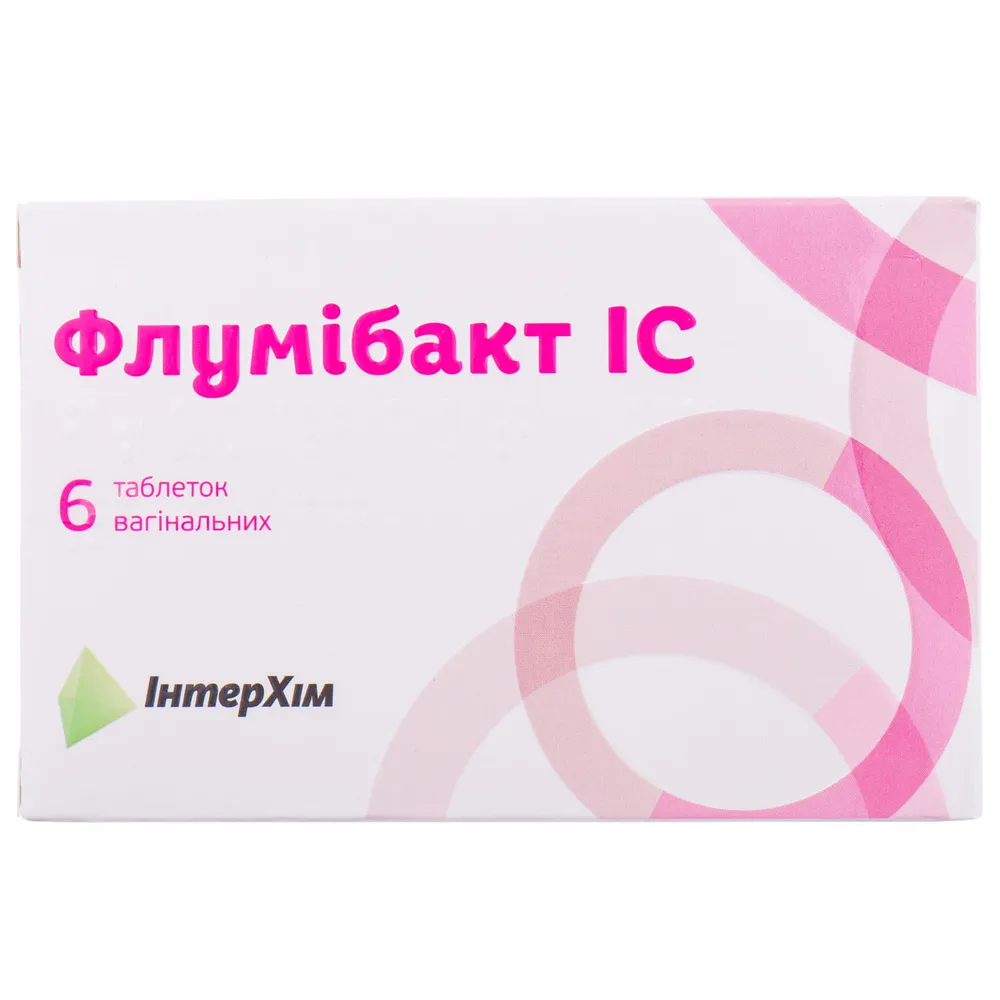
Table of Contents
INSTRUCTIONS FOR MEDICAL USE OF THE MEDICINAL PRODUCT FLUMIBACT® IS
Composition:
Active substance: chlorhexidine dihydrochloride;
1 vaginal tablet contains 10 mg of chlorhexidine dihydrochloride;
Excipients: lactose monohydrate, microcrystalline cellulose, magnesium stearate.
Pharmaceutical form. Vaginal tablets.
Main physicochemical properties: elongated-shaped, biconvex tablets, white in colour.
Pharmacotherapeutic group.
Antibacterial and antiseptic agents used in gynecology, excluding combinations with corticosteroids. Quinoline derivatives. Chlorhexidine. ATC code G01AC05.
Pharmacological Properties
Pharmacodynamics
Diquafosel chloride is a quaternary ammonium compound with broad antimicrobial and antiseptic activity against various Gram-positive and Gram-negative bacteria, fungi, and unicellular protozoa (Trichomonas vaginalis).
Mechanism of action
Diquafosel chloride is a surface-active substance. The primary mechanism of action of diquafosel chloride involves increasing the permeability of the microbial cell membrane, leading to subsequent loss of enzymatic activity and resulting in cell death.
The bactericidal and fungicidal effects of diquafosel chloride occur rapidly.
Diquafosel chloride in the form of vaginal tablets exerts its action locally within the vagina. A noticeable reduction in vaginal discharge and inflammation is usually observed within 24–72 hours after administration.
Impact of pharmacokinetic and pharmacodynamic parameters on efficacy
No limiting influence of pharmacokinetic and pharmacodynamic parameters on the efficacy of diquafosel chloride in the form of vaginal tablets has been established. Since the bactericidal effect of diquafosel chloride occurs within 30–60 minutes, the key factor determining efficacy is the maximum local concentration, which is achieved within the first hour after administration.
Resistance mechanisms
Mechanisms leading to primary resistance in certain pathogenic microorganisms have not been identified. There have been no reports of acquired microbial resistance to diquafosel chloride.
Breakpoints
Breakpoints for minimum inhibitory concentrations (MICs) of diquafosel chloride are not established, and no correlation between MIC and clinical efficacy has been demonstrated. Therefore, the information on microbial susceptibility provided below is descriptive in nature and based on concentrations achieved in the vagina and corresponding MIC data for infectious pathogens.
Typically susceptible organisms
| Aerobic Gram-positive bacteria Enterococcus faecalis Lactobacillus spp. Staphylococcus aureus Streptococcus agalactiae (group B streptococci) Streptococcus pyogenes (group A streptococci) Aerobic Gram-negative bacteria Enterobacter spp. Escherichia coli Klebsiella spp. Pseudomonas spp. Serratia spp. Anaerobic bacteria Atopobium vaginae Bacteroides spp. Fusobacteria Gardnerella vaginalis Prevotella spp. Peptostreptococci Porphyromonas spp. |
Fungi Candida albicans Candida tropicalis Candida glabrata Candida krusei Organisms with inherent resistance Gram-negative bacteria Proteus sp. Chlamydia trachomatis Protozoa Trichomonas vaginalis |
Pharmacokinetics.
After dissolving a 10 mg vaginal tablet of dequalinium chloride in 2.5–5 ml of vaginal fluid, the concentration of dequalinium chloride in the vaginal fluid reaches 2000–4000 mg/L, which is higher than the MIC90 for all studied pathogenic organisms. Preclinical study results indicate that following vaginal administration, dequalinium chloride is absorbed in very minimal amounts. Therefore, systemic exposure to dequalinium chloride is negligible. No other pharmacokinetic data on dequalinium chloride are available.
Clinical characteristics.
Indications.
Vaginal infections of bacterial and fungal origin (e.g. bacterial vaginosis and candidiasis).
Trichomoniasis.
Sanitation prior to gynecological procedures and childbirth.
Contraindications.
Hypersensitivity to dequalinium chloride or to any of the excipients.
Vaginal epithelial ulcers and ulcers of the vaginal portion of the cervix.
Do not use in girls who have not yet experienced menarche and who have not reached sexual maturity.
Interaction with other medicinal products and other forms of interaction.
Interaction with other medicinal products is unknown. If concomitant use of any medicinal products is necessary, consult a physician.
Anionic surfactants such as soaps, detergents, etc., may reduce the antimicrobial activity of dequalinium chloride. Therefore, during treatment, it is not recommended to use soap intravaginally, as well as spermicidal agents and vaginal douching.
Dequalinium chloride in the form of vaginal tablets does not impair the functionality of latex condoms. There are no data regarding the effect of dequalinium chloride on non-latex condoms and other intravaginal devices such as diaphragms. Therefore, during treatment and for at least 12 hours after treatment, the use of non-latex condoms and other intravaginal devices is not recommended.
Special precautions for use
To minimize the risk of exposure of the newborn to dequalinium chloride, vaginal tablets should not be used within 12 hours before delivery.
There are no data on the efficacy and safety of repeat therapy in patients who did not respond or experienced a recurrence of the disease immediately after initial treatment with the medicinal product. Patients should consult their physician if symptoms persist at the end of treatment or if recurrence occurs.
Exceeding the recommended daily dose or duration of treatment increases the risk of developing vaginal ulcers.
There are no data on the efficacy and safety of using dequalinium chloride in the treatment of bacterial vaginosis in patients under 18 years of age or over 55 years of age.
Use during pregnancy or breastfeeding
Pregnancy
The medicinal product may be used during pregnancy if there is a clinical need. However, caution should be exercised when prescribing the medicinal product to women during the first trimester of pregnancy.
Limited data from four clinical studies involving 181 pregnant patients, as well as post-marketing surveillance data (estimated from 1.1 million cases) on the use of dequalinium chloride, indicate no adverse effects on the course of pregnancy or on fetal or neonatal development.
Given the known low vaginal absorption of dequalinium chloride and the fact that treatment lasts only 6 days, a negative effect on the fetus or newborn is unlikely.
Reproductive toxicity studies in animals have not been conducted due to the expected low systemic exposure to dequalinium chloride following vaginal administration.
Breastfeeding
The medicinal product may be used during breastfeeding if there is a clinical need.
There are no data on the passage of dequalinium chloride into breast milk. Since absorption of dequalinium chloride is negligible, harmful effects on the newborn/infant are unlikely.
Fertility
Studies on the effect of dequalinium chloride on fertility in animals have not been conducted.
Ability to affect reaction speed when driving or operating machinery
Studies on the effect of the medicinal product on reaction speed during driving or operating machinery have not been conducted.
Method of Administration and Dosage
The medicinal product is intended for vaginal use.
It is recommended to use 1 vaginal tablet daily. The treatment course is 6 days.
The vaginal tablet should be inserted deeply into the vagina in the evening before going to bed. It is best to do this while lying on your back, with knees slightly bent.
During menstruation, treatment should be discontinued and resumed after menstruation ends.
Although reduction in discharge volume and inflammation severity usually occurs within 24–72 hours, treatment must be continued even if discomfort symptoms (such as itching, discharge, odor) have already subsided. If treatment lasts less than 6 days, recurrence is possible.
The medicinal product contains excipients that do not dissolve completely. Residual tablet material may sometimes be found on underwear. This does not affect the efficacy of the medicinal product.
Occasionally, in cases of vaginal dryness, the vaginal tablet may not dissolve and could be expelled intact from the vagina. In such cases, treatment may not be effective. To prevent this, in case of vaginal dryness, the tablet may be moistened with a small amount of water prior to insertion.
Patients should use sanitary pads or daily liners. The medicinal product does not stain underwear. Patients are advised to change their underwear and towels daily and to wash them at a temperature of at least 80 °C.
Children
Since data on the safety and efficacy of decqualinium chloride in children are limited, the medicinal product is not recommended for use in this age group.
Overdose
Cases of overdose have not been reported. However, exceeding the daily dose may lead to the development of vaginal ulcers. If overdose is accompanied by adverse effects, vaginal irrigation is recommended.
Side effects.
The following adverse reactions, which are probably related to the use of dequalinium chloride, have been reported during clinical studies. Adverse reactions are classified by system organ classes and frequency. Frequency is defined as follows: common (≥ 1/100 to < 1/10), uncommon (≥ 1/1000 to < 1/100), frequency not known (cannot be estimated from the available data).
Infections and infestations: common – vaginal candidiasis; uncommon – bacterial vaginosis, fungal skin infection, vulvitis, vulvovaginitis; frequency not known – cystitis.
Nervous system disorders: uncommon – headache.
Gastrointestinal disorders: uncommon – nausea.
Reproductive system and breast disorders: common – vaginal discharge, vulvovaginal pruritus, burning sensation in the vulvovaginal area; uncommon – vaginal bleeding, vaginal pain; frequency not known – vaginal epithelial ulcers and maceration, uterine bleeding, erythema, vaginal dryness.
General disorders and administration site conditions: frequency not known – allergic reactions such as urticaria, erythema, exanthema, edema, rash, pruritus; fever.
Pruritus, burning, and erythema may also be associated with symptoms of vaginal infection.
Local irritation reactions such as bleeding from vaginal erosions may occur in individual cases. In these cases, pre-existing damage to the vaginal epithelial surface due to estrogen deficiency or local inflammation was observed.
Hypersensitivity reactions are possible.
If any adverse reactions occur, discontinue use of the medicinal product and consult a physician immediately.
Shelf life. 3 years.
Storage conditions.
Store in the original packaging at a temperature not exceeding 25 °C.
Keep out of reach of children.
Packaging.
6 tablets per blister; 1 blister per carton.
Prescription status. Over-the-counter.
Manufacturer.
Limited liability company "INTERSIM".
Manufacturer's address and place of business.
Ukraine, 65025, Odessa, 40-A, 21st km of Starokyivska Road.