Flumazenil-vista
Ukraine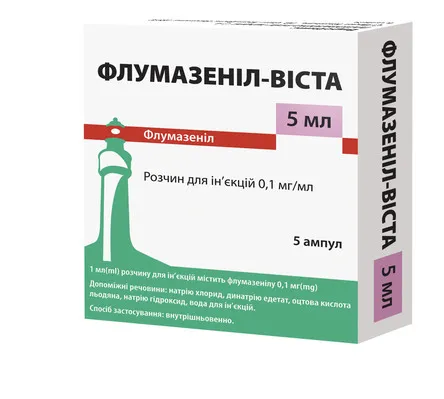
Table of Contents
INSTRUCTIONS FOR MEDICAL USE OF THE MEDICINAL PRODUCT FLUMAZENIL-VISTA (FLUMAZENIL-VISTA)
Composition:
Active substance: flumazenil;
1 ml of solution contains flumazenil 0.1 mg;
Excipients: sodium chloride, edetate disodium, glacial acetic acid, sodium hydroxide, water for injections.
Pharmaceutical form. Injection solution.
Main physicochemical properties: clear, colorless solution.
Pharmacotherapeutic group. Other therapeutic agents. Antidotes. ATC code V03AB25.
Pharmacological Properties
Pharmacodynamics
Mechanism of action. Flumazenil is a benzodiazepine antagonist, an imidazobenzodiazepine derivative, which specifically blocks the effects of substances acting at the benzodiazepine receptor in the central nervous system (CNS) through competitive interaction. Neutralization of paradoxical reactions to benzodiazepines has been reported.
Pharmacodynamic effects. Animal studies have shown that flumazenil does not block the effects of benzodiazepine receptor agonists such as barbiturates, gamma-aminobutyric acid (GABA) mimetics, or adenosine receptor antagonists. Flumazenil blocks the action of non-benzodiazepine agonists such as cyclopyrrolones (zopiclone) and triazolopyridazines. The hypnotic-sedative effects of benzodiazepines rapidly disappear (within 1–2 minutes) after intravenous administration of flumazenil. Depending on the difference in elimination time between agonist and antagonist, effects may recur over several hours. Flumazenil may have minimal agonist activity (e.g., anticonvulsant).
Clinical efficacy and safety. Animal studies have shown that prolonged treatment with flumazenil may lead to a withdrawal syndrome, including seizures.
Pharmacokinetics
Distribution. Flumazenil is a weak lipophilic base. It binds to approximately 50% of plasma proteins, of which two-thirds bind to albumin. Flumazenil is extensively distributed into the extravascular space. During the distribution phase, plasma concentration of flumazenil decreases with a half-life of 4–5 minutes. The volume of distribution at steady state is 0.9–1.1 L/kg.
Metabolism. Flumazenil undergoes extensive hepatic metabolism. The main inactive metabolite in plasma (in free form) and urine (in free and conjugated forms) is carboxylic acid. Pharmacological testing has shown that this metabolite has no agonistic or antagonistic benzodiazepine activity.
Excretion. Flumazenil is almost completely excreted in urine. This indicates complete breakdown of the active substance in the body. Radiolabeled drug studies showed that complete elimination occurs within 72 hours: 90–95% via urine and 5–10% via feces. Elimination is rapid, as evidenced by the short elimination half-life (40–80 minutes). Total clearance of flumazenil is 0.8–1.0 L/h/kg, with metabolism occurring predominantly in the liver.
In patients with moderate or severe hepatic impairment, the elimination half-life of flumazenil is prolonged (by 70–210%), and total clearance is reduced (by 57% to 74%) compared to data from studies in healthy volunteers.
Flumazenil pharmacokinetics are dose-proportional within the therapeutic dose range not exceeding 100 mg. Food intake during intravenous infusion increases its clearance by 50%, likely due to increased hepatic blood flow.
Clinical characteristics.
Indications.
The medicinal product is used for partial or complete reversal of central sedative effects of benzodiazepines in adults and children aged 1 year and older. It may be used in anesthesia and intensive care.
Anesthesia:
- to terminate the hypnotic-sedative effect of benzodiazepines during general, induced and/or maintained anesthesia in hospitalized patients;
- to reverse the sedative effect of benzodiazepines during short-term diagnostic and therapeutic procedures in both outpatient and hospitalized patients;
- to reverse the sedative effect of benzodiazepines in children aged 1 year and older.
Intensive care:
- for specific reversal of central effects of benzodiazepines with the aim of restoring spontaneous respiration;
- for diagnosis and treatment of intoxication or overdose with benzodiazepines alone or predominantly.
Contraindications.
- Hypersensitivity to the active substance or to any of the components of the medicinal product.
- Treatment with benzodiazepines of potentially life-threatening conditions (e.g., control of intracranial pressure or epileptic status).
- Severe intoxication caused by cyclic antidepressants (seizures, focal convulsions, QRS prolongation, arrhythmia, mydriasis, anticholinergic symptoms). In mixed intoxications caused by benzodiazepines and cyclic antidepressants, the toxicity of antidepressants may be masked by the protective effect of benzodiazepines. Therefore, in the presence of autonomic (anticholinergic), motor, or cardiac symptoms of severe intoxication with tricyclic/tetracyclic antidepressants, flumazenil should not be used to reverse the effects of benzodiazepines.
Interaction with other medicinal products and other forms of interactions.
Interaction studies have been conducted only in adult patients. Flumazenil antagonizes central effects of benzodiazepines by competitive inhibition at the receptor level. It also blocks the action of non-benzodiazepine agonists (e.g., zopiclone, triazolopyridazines) at benzodiazepine receptors. However, flumazenil does not block the action of medicinal products that do not act via this mechanism. No interaction has been observed with other CNS depressants. Flumazenil should be used with particular caution in cases of overdose, as along with reduction of benzodiazepine effects, the toxic effects of other psychotropic substances (especially tricyclic antidepressants) administered concomitantly may become unmasked.
When flumazenil is used concomitantly with midazolam, flunitrazepam, and lormetazepam, no changes in pharmacokinetics occur.
There is also no pharmacokinetic interaction between ethyl alcohol and flumazenil.
Special precautions for use.
Monitoring. When using flumazenil to reverse benzodiazepine-induced sedation, prolonged monitoring of the dose, vital signs (electrocardiogram [ECG]), pulse, oximetry, patient's attention level, and other vital parameters such as heart rate [HR], respiratory rate, and blood pressure) as well as the duration of action of the benzodiazepine used is required to detect symptoms of resedation, respiratory depression, or other signs of residual benzodiazepine effects. Since drug action may be delayed in patients with impaired liver function, an extended observation period is necessary. Generally, flumazenil has a shorter duration of action than benzodiazepines; therefore, resedation may occur, and the patient's clinical status must remain under continuous surveillance. The patient should remain in an intensive care unit until the effect of flumazenil has subsided.
If the patient does not emerge from sedation. The antagonistic effect of flumazenil is specific to benzodiazepines. Therefore, if the patient does not emerge from sedation, other causes should be considered.
Anesthesia. When anesthesia is used at the end of surgery, flumazenil should only be administered after it has been confirmed that the activity of peripheral muscle relaxants has decreased and there is no longer any opioid-induced respiratory depression (reversed with naloxone).
Special patient groups. The benefits of benzodiazepine sedation and the risks of rapid awakening should be carefully weighed in critically ill patients. For some patients (e.g., those with cardiac conditions), maintaining a certain level of sedation in the early postoperative period may be preferable to full consciousness.
Patients with epilepsy. Flumazenil-Vista is not recommended for patients with epilepsy who have been receiving long-term benzodiazepine therapy. Although flumazenil has minimal intrinsic activity, sudden withdrawal of the protective effect may provoke seizures in epileptic patients.
Patients with severe head injury. Flumazenil should be used with caution in patients with severe head injury (and/or unstable intracranial pressure), as flumazenil antagonizes the effects of benzodiazepines and may cause increased intracranial pressure, changes in cerebral perfusion, or seizures.
Withdrawal symptoms. Rapid administration of high doses (more than 1 mg) of flumazenil should be avoided in patients who have previously received high doses and/or long-term benzodiazepine therapy (up to several weeks prior to flumazenil administration). In such cases, rapid injection may precipitate withdrawal symptoms, including tachycardia, agitation, anxiety, emotional lability, confusion, and sensory disturbances. If a patient has received high-dose benzodiazepines for a prolonged period, the benefits of flumazenil administration should be weighed against the risk of withdrawal symptoms. If withdrawal symptoms occur despite careful dose titration, an individually adjusted dose of 5 mg diazepam or 5 mg midazolam should be administered by slow intravenous injection.
Particular caution is required in patients with dependence, chronic benzodiazepine overdose, or mixed intoxication of unknown origin. For such patients, the recommended administration interval (1 minute) should be extended, as the full effect of a single dose may take up to 10 minutes. In most cases, the smallest effective dose should be used to avoid potential dependence symptoms or seizures. Especially in cases of mixed intoxication with benzodiazepines and cyclic antidepressants, the use of flumazenil may unmask certain toxic effects of cyclic antidepressants—such as seizures and cardiac arrhythmias—that are normally suppressed by the concomitant administration of benzodiazepines.
Anxiety. Flumazenil dosing should be carefully titrated in patients suffering from preoperative anxiety or with a history of chronic or episodic anxiety.
Postoperative pain. Postoperative pain should be taken into account. It may be preferable to maintain the patient in a sedated state.
Use in pediatrics. Due to the risk of resedation and respiratory depression, children who have experienced sedation following midazolam administration should be closely monitored for at least 2 hours after flumazenil administration. When other sedative benzodiazepines are used, the monitoring period should be adjusted according to their expected duration of action. Due to limited experience, flumazenil should be used with caution in the following situations:
- for reversal of sedation in children under 1 year of age;
- for treatment of overdose in children;
- for neonatal resuscitation;
- for reversal of sedative effects of benzodiazepines used for anesthesia in children.
Until sufficient data are available, flumazenil should not be used in children under 1 year of age unless the risk to the patient (especially in cases of accidental overdose) outweighs the risks of treatment. Due to the lack of data from controlled studies, flumazenil is not recommended for use in children and adolescents for any indication other than reversal of benzodiazepine-induced sedation. The same applies to children under 1 year of age.
Benzodiazepine dependence. The medicinal product Flumazenil-Vista is not recommended for the treatment of benzodiazepine dependence or prolonged benzodiazepine withdrawal syndromes.
Panic disorders. Cases of panic attacks have been reported following administration of flumazenil in patients with a history of panic disorders.
History of dependence. Flumazenil-Vista should be used with caution in patients with frequent benzodiazepine use, alcoholism, drug dependence, or other substance dependence.
Hepatic impairment. Elimination of flumazenil may be delayed.
Important information on excipients.
The medicinal product Flumazenil-Vista contains approximately 9 mg of sodium per 1 mL of injection solution. Caution is advised when administering this medicinal product to patients on a sodium-restricted diet.
Use during pregnancy or breastfeeding.
Pregnancy
Although animal studies have not shown any direct or indirect harmful effects on pregnancy, embryonic/fetal development, parturition, or postnatal development, the safety of flumazenil during pregnancy has not been established. The benefit-risk ratio should be carefully evaluated due to the lack of data on flumazenil use during pregnancy. The effect of flumazenil on the fetus has not been studied in animals.
Breastfeeding
It is unknown whether flumazenil is excreted in human milk. Breastfeeding should be discontinued for 24 hours after administration of Flumazenil-Vista.
Ability to affect reaction speed when driving or operating machinery.
Although patients regain consciousness after flumazenil administration, they should be advised not to engage in hazardous activities requiring full mental alertness (such as operating machinery or driving a vehicle) for 24 hours after drug administration, as the effects of the previously administered benzodiazepine may recur.
Method of Administration and Dosage
The medicinal product Flumazenil-Vista must be administered by an anesthesiologist or a physician experienced in anesthesiology. It is administered intravenously.
Flumazenil-Vista may be administered undiluted or diluted. When administering flumazenil by infusion, it should be diluted prior to administration with 0.9% sodium chloride solution, 5% glucose solution, or Ringer's solution (8.6 g sodium chloride, 0.3 g potassium chloride, and 0.33 g calcium chloride per 1 L).
Compatibility between flumazenil and other injectable solutions has not been established. Flumazenil-Vista may be used concomitantly with other resuscitation measures. The medicinal product is intended for single use only.
Prior to administration, the solution should be visually inspected; only clear solution free from foreign particles should be used.
Adults
Anesthesia
Recommended initial dose: 0.2 mg intravenously over 15 seconds. If the desired effect is not achieved within 60 seconds, a subsequent dose of 0.1 mg should be administered, and administration may be repeated every 60 seconds as needed up to a maximum dose of 1.0 mg. The usual dose ranges between 0.3 and 0.6 mg and may be adjusted depending on the patient's condition and the benzodiazepine used.
Intensive Care
Recommended initial dose: 0.2 mg intravenously over 15 seconds. If the desired effect is not achieved within 60 seconds, a subsequent dose of 0.1 mg should be administered, and administration may be repeated every 60 seconds as needed up to a maximum dose of 2.0 mg or until the patient emerges from sedation. If sedation recurs, repeat bolus injections may be given. Additionally, intravenous infusion at a rate of 0.1–0.4 mg/min may be used. The dosage and infusion rate should be adjusted to achieve the desired level of consciousness. Infusion may be supplemented with bolus injections up to a maximum total dose of 2 mg.
If no clear effect on consciousness and respiration is observed after multiple administrations, benzodiazepine-related intoxication should be ruled out. Infusion should be interrupted every 6 hours to assess whether resedation occurs. To avoid withdrawal symptoms in patients who have received high doses of benzodiazepines for prolonged periods in intensive care units, flumazenil should be administered cautiously, with individualized dosing and slow injection.
Elderly Patients
In the absence of specific data on flumazenil use in elderly patients, it should be considered that this population may be more sensitive to drug effects; therefore, Flumazenil-Vista should be administered with caution.
Children and Adolescents (aged 1 to 17 years)
Dosing for Reversal of Conscious Sedation
Recommended initial dose: 0.01 mg/kg (up to a maximum of 0.2 mg), administered intravenously over 15 seconds. If the required level of consciousness is not achieved within 45 seconds, a subsequent injection of 0.01 mg/kg (up to 0.2 mg) may be given at intervals of up to 60 seconds (maximum of 4 injections), up to a maximum total dose of 0.05 mg/kg or 1 mg, whichever is lower. Dosing should be adjusted according to the patient's response. There is insufficient data on the safety and efficacy of repeated administration of flumazenil in children in case of resedation.
Patients with Hepatic Impairment
Flumazenil is predominantly metabolized in the liver. In patients with impaired liver function, elimination of flumazenil may be delayed; therefore, careful dose titration is recommended.
Children
There is insufficient data on the use of flumazenil in children under 1 year of age. Therefore, Flumazenil-Vista should be administered to this age group only if the anticipated benefit outweighs the potential risk.
Overdose.
Symptoms. Even when administered at doses higher than recommended (up to 100 mg of flumazenil), no overdose symptoms have been observed.
In cases of mixed intoxications, particularly when combined with tricyclic antidepressants, toxic effects (such as seizures and cardiac arrhythmias) may occur upon recurrence of benzodiazepine effects. Experience with acute flumazenil overdose is very limited.
Treatment. There is no specific antidote for flumazenil. Management of flumazenil overdose should consist of general supportive measures, including monitoring of vital signs and clinical observation of the patient.
Side effects.
All side effects are listed by system organ class and frequency: very common (≥1/10), common (≥1/100 to <1/10), uncommon (≥1/1,000 to <1/100), rare (≥1/10,000 to <1/1,000), very rare (<1/10,000), frequency not known (cannot be estimated from the available data).
| Immune system disorders |
|
| common |
hypersensitivity reactions, anaphylactic shock |
| Psychiatric disorders |
|
| common |
anxiety*, insomnia, drowsiness, emotional lability |
| uncommon |
fear* |
| frequency not known |
psychiatric changes, euphoria, fatigue, pathological crying, aggressive reactions, panic attacks**; withdrawal syndrome: agitation*, anxiety*, emotional lability, confusion, sensory disturbances |
| Nervous system disorders |
|
| common |
headache, vertigo, agitation*, tremor, dry mouth, rapid breathing, speech disorders, paresthesia |
| uncommon |
seizures (mainly in patients with epilepsy, severe hepatic insufficiency, particularly after treatment with benzodiazepines or in case of overdose with multiple drugs) |
| frequency not known |
involuntary movements |
| Eye disorders |
|
| common |
diplopia, strabismus, increased lacrimation |
| Ear and labyrinth disorders |
|
| uncommon |
hearing disturbances |
| Cardiac disorders |
|
| common |
palpitations*, flushing, hypotension, orthostatic hypertension, transient hypertension (on awakening) |
| uncommon |
tachycardia or bradycardia, extrasystoles |
| Respiratory, thoracic and mediastinal disorders |
|
| uncommon |
dyspnea, cough, nasal congestion, chest pain |
| Gastrointestinal disorders |
|
| very common |
nausea (during anesthesia, especially when used concomitantly with opioids) |
| common |
vomiting (during anesthesia, especially when used with opioids), hiccups |
| Skin and subcutaneous tissue disorders |
|
| common |
increased sweating |
| uncommon |
pallor |
| frequency not known |
facial flushing |
| General disorders and administration site conditions |
|
| common |
fatigue, pain at injection site |
| uncommon |
tremor |
| frequency not known |
increased pain sensation, weight gain, chills |
* After rapid injection; treatment is usually not required.
In patients who have been receiving benzodiazepines for prolonged periods, flumazenil may precipitate a withdrawal syndrome. Symptoms may include tension, agitation, anxiety, emotional lability, confusion, sensory disturbances, hallucinations, tremor, and seizures. Rapid administration of high doses (more than 1 mg) of flumazenil should be avoided in patients previously receiving high doses and/or long-term benzodiazepine therapy (up to several weeks prior to flumazenil administration). In such cases, rapid injection may cause withdrawal symptoms, including tachycardia, agitation, anxiety, emotional lability, confusion, and sensory disturbances.
** In patients with a history of panic disorders, flumazenil may provoke panic attacks.
Pediatric population
Overall, the adverse effect profile in children does not differ significantly from that in adults. When flumazenil is used to reverse conscious sedation in children, abnormal crying, agitation, and aggressive reactions may additionally occur.
Reporting of suspected adverse reactions
Reporting suspected adverse reactions after authorization of the medicinal product is important. It allows continued monitoring of the benefit-risk balance of the medicinal product. Healthcare professionals are required to report any suspected adverse reactions via the national reporting system.
Shelf life 3 years.
Storage conditions. No special storage conditions are required for this medicinal product. Keep out of the reach of children.
Packaging. 5 ml in an ampoule; 5 or 10 ampoules in a cardboard box.
Prescription status. Prescription only.
Manufacturer.
LABORATORIO REIG JOFRE, S.A.
Address of the manufacturer and location of its business operations.
C/Gran Capitan, 10, Sant Joan Despi, Barcelona, 08970, Spain