Fluimucil
Ukraine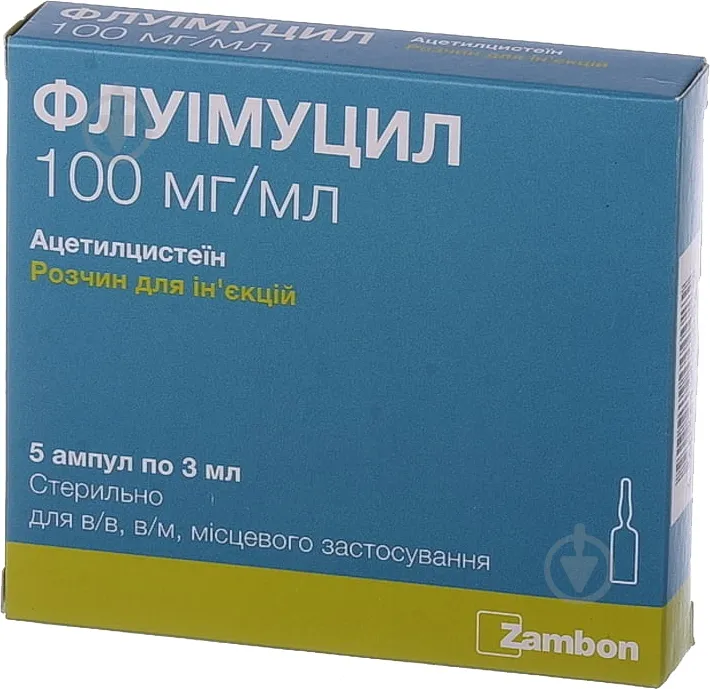
Table of Contents
INSTRUCTION FOR MEDICAL USE OF THE MEDICINAL PRODUCT FLUIMUCIL
Composition:
Active substance: acetylcysteine;
1 ml contains acetylcysteine 100 mg;
Excipients: sodium hydroxide, disodium edetate, water for injections.
Pharmaceutical form. Injection solution.
Main physicochemical characteristics: clear, colorless solution with a slight sulfurous odor.
After opening the ampoule, a faint pink-violet tint may appear upon prolonged exposure to air.
Pharmacotherapeutic group.
Mucolytic agent. ATC code R05CB01.
Pharmacological Properties.
Pharmacodynamics.
Acetylcysteine liquefies sputum. The sulfhydryl groups in the acetylcysteine structure facilitate the breakdown of disulfide bonds in acidic mucopolysaccharides of sputum, leading to depolymerization of mucoproteins and reduction in mucus viscosity. The drug retains its activity in the presence of purulent sputum.
Acetylcysteine exerts an antioxidant effect due to the presence of a nucleophilic thiol (SH) group, which readily donates hydrogen and neutralizes oxidative radicals.
The protective mechanism of acetylcysteine is based on the ability of its reactive sulfhydryl groups to bind free radicals.
Acetylcysteine readily penetrates into cells, where it is deacetylated to L-cysteine, which is used for the synthesis of intracellular glutathione.
Glutathione is a highly reactive tripeptide and a potent antioxidant and cytoprotector that captures endogenous and exogenous free radicals and toxins. Acetylcysteine prevents depletion and promotes increased synthesis of intracellular glutathione, which participates in cellular redox processes, thereby supporting the detoxification of harmful substances.
Pharmacokinetics.
After intravenous administration of 600 mg of acetylcysteine, the maximum plasma concentration reaches 300 mmol/L, and the elimination half-life from plasma is 2 hours. Total clearance is 0.21 L/h/kg, and the volume of distribution at steady state is 0.34 L/kg. Acetylcysteine penetrates into the extracellular space and is distributed predominantly in the liver, kidneys, lungs, and bronchial secretions. Acetylcysteine and its metabolites are primarily excreted by the kidneys.
Clinical characteristics.
Indications.
Acute and chronic respiratory tract diseases associated with increased mucus production.
Contraindications.
Hypersensitivity to acetylcysteine or to any of the other components of the medicinal product, active gastric or duodenal ulcer, haemoptysis, pulmonary haemorrhage.
Interaction with other medicinal products and other forms of interaction.
Studies on interactions with other medicinal products have been conducted only in adults.
Concomitant administration of nitroglycerin and acetylcysteine may lead to pronounced hypotension and vasodilation of the temporal artery. If concomitant use of nitroglycerin and acetylcysteine is necessary, the patient should be under medical supervision for the development of hypotension, which may be severe. The patient should be warned about the possibility of headache.
Acetylcysteine should not be administered simultaneously with antitussive agents, since suppression of the cough reflex may enhance bronchial secretion retention.
Fluimucil may be used concomitantly with common bronchodilators, vasoconstrictors, etc.
Available information on the interaction between antibiotics and acetylcysteine comes from in vitro studies and indicates reduced antibiotic activity after mixing the two substances. Therefore, mixing antibiotics with acetylcysteine solution is not recommended.
Laboratory parameters
Acetylcysteine may interfere with the quantitative colorimetric determination of salicylates and with the determination of ketones in urine.
Special precautions for use
Fluimucil should be administered with special caution to patients with a history of peptic ulcer, especially when concomitantly taking other medications that irritate the gastric mucosa.
Administration of acetylcysteine may initially liquefy bronchial gland secretions and increase their volume. If the patient is unable to effectively expectorate sputum, postural drainage or bronchoaspiration should be performed to prevent sputum accumulation.
The drug must be administered intravenously under strict medical supervision. Adverse reactions following intravenous administration of acetylcysteine may occur more frequently if the drug is administered too rapidly or in high doses. Therefore, it is recommended to strictly follow the instructions provided in the section "Dosage and method of administration".
Bronchial asthma
There is evidence that patients with a history of atopy and asthma may have an increased risk of developing anaphylactoid reactions.
Patients with bronchial asthma should be under medical supervision during treatment with Fluimucil. If bronchospasm occurs, administration of acetylcysteine should be immediately discontinued and appropriate treatment initiated.
Histamine intolerance
Acetylcysteine may moderately affect histamine metabolism. Therefore, caution should be exercised when prescribing the drug for long-term therapy in patients with histamine intolerance, considering the possibility of intolerance symptoms.
Anaphylactoid reactions
Anaphylactoid reactions/hypersensitivity reactions may occur during administration of acetylcysteine. During this period, patients should be closely monitored for signs of anaphylactoid reactions.
Children and adolescents
The same warnings and precautions described for adults apply to children and adolescents.
Information on excipients
Fluimucil contains 43 mg of sodium (a main component of table salt) per ampoule (1.9 mmol), which corresponds to 2.15% of the WHO recommended maximum daily intake of 2 g of sodium for adults. This should be taken into account for patients on a sodium-restricted diet.
The sulfurous odor that appears upon opening the Fluimucil ampoule is characteristic of the active substance and in no way affects the possibility of using the drug.
The acetylcysteine solution, when stored in opened ampoules or transferred into nebulization equipment, may rarely develop a slight violet coloration, which does not affect the efficacy or tolerability of the drug.
Use during pregnancy or breastfeeding
Pregnancy
There are limited clinical data on the use of acetylcysteine in pregnant women.
Animal studies do not indicate a direct or indirect harmful effect on reproductive function.
Before administering the drug during pregnancy, the potential risks to the fetus should be weighed against the expected benefits to the mother.
Breastfeeding
There is no information available on the excretion of the drug and its metabolites in human breast milk.
A risk to the infant cannot be excluded. A decision should be made whether to discontinue breastfeeding or to discontinue/stop treatment with Fluimucil, taking into account the benefits of breastfeeding for the infant and the benefits of therapy for the woman.
Fertility
There are no data on the effect of acetylcysteine on human fertility. Animal studies do not indicate a harmful effect on human fertility when administered at recommended doses.
Ability to influence the speed of reactions while driving or operating machinery
There are no data confirming an effect on reaction speed.
Method of Administration and Dosage
Local application
Inhalation administration: for adults – 1 ampoule 1–2 times daily as prescribed by a physician for 5–10 days; for children aged 6 years and older – up to 1 ampoule 1–2 times daily as prescribed by a physician for 5–10 days.
Endobronchial administration: for adults and children aged 6 years and older – up to 1 ampoule 1–2 times daily.
Systemic application
Intramuscular administration
For adults – 1 ampoule of 300 mg administered 1–2 times daily by deep intramuscular injection.
Intravenous administration
The medicinal product should be administered slowly by infusion in 0.9% sodium chloride solution or 5% glucose solution.
For adults – 1 ampoule of 300 mg 1–2 times daily.
Children.
For intramuscular and intravenous administration, the drug is not used in children. For local application, the medicinal product may be prescribed to children aged 6 years and older.
Overdose.
Intravenous administration
Symptoms
Symptoms of overdose are similar to adverse reactions but more severe in intensity.
Treatment
Treatment requires immediate discontinuation of the drug and initiation of symptomatic therapy and resuscitation measures. There is no specific antidote. Dialysis is effective.
Local application
Symptoms
Cases of overdose have not been reported. High doses of the drug may induce excessive production of bronchopulmonary secretions, potentially leading to airway obstruction.
Treatment
Bronchoaspiration should be performed.
Adverse reactions
During post-marketing use, the following adverse reactions have been reported; their frequency is unknown (cannot be estimated based on available data):
Inhalation use
| System organ class |
Side effects |
| Immune system disorders |
Hypersensitivity reactions |
| Respiratory, thoracic and mediastinal disorders |
Bronchospasm, rhinorrhea, bronchial obstruction |
| Gastrointestinal disorders |
Stomatitis, vomiting, nausea |
| Skin and subcutaneous tissue disorders |
Urticaria, rash, pruritus |
Parenteral administration
| System organ class |
Side effects |
| Immune system disorders |
Anaphylactic shock, anaphylactic reactions, anaphylactoid reactions, hypersensitivity |
| Cardiac disorders |
Tachycardia |
| Respiratory, thoracic and mediastinal disorders |
Bronchospasm, dyspnea |
| Gastrointestinal disorders |
Nausea, vomiting, abdominal pain, diarrhea, dyspepsia, heartburn |
| Skin and subcutaneous tissue disorders |
Angioneurotic edema, urticaria, erythema, rash, pruritus |
| General disorders and administration site conditions |
Facial swelling, headache, tinnitus, hemorrhages, hyperthermia |
| Laboratory and instrumental findings |
Decrease in blood pressure, anemia, prolonged prothrombin time |
In very rare cases, serious skin reactions such as Stevens-Johnson syndrome and Lyell's syndrome have been observed during administration of acetylcysteine.
In most of these cases, it was suspected that the above-mentioned mucocutaneous syndromes might have been caused by concomitant use of at least one other medicinal product. If mucocutaneous lesions occur, medical advice must be sought immediately and treatment with acetylcysteine must be discontinued promptly.
Some studies have confirmed reduced platelet aggregation during acetylcysteine administration. The clinical significance of these findings has not yet been established.
Shelf life.
5 years.
Do not use after the expiry date stated on the packaging.
Storage conditions.
Store at a temperature not exceeding 25 °C.
An opened ampoule intended for topical use only may be stored in the refrigerator for up to 24 hours.
Incompatibilities.
Fluimucil solution must not come into contact with rubber or metal surfaces.
It is recommended to use glass or plastic equipment for inhalation procedures. After use, the equipment should be rinsed with water.
Packaging.
Injection solution, 100 mg/mL, 3 mL in an ampoule; 5 ampoules in a plastic tray in a cardboard box.
Prescription status.
Prescription only.
Manufacturer.
Zambon S.P.A. / Zambon S.P.A.
Manufacturer's address and place of business.
Via della Chimica, 9 - 36100 Vicenza (VI), Italy / Via della Chimica, 9 - 36100 Vicenza (VI), Italy.
Marketing Authorisation Holder.
Zambon S.P.A. / Zambon S.P.A.
Address of the Marketing Authorisation Holder.
Via Lillo del Duca, 10 – 20091 Bresso, Milan, Italy / Via Lillo del Duca, 10 – 20091 Bresso, Milan, Italy.
Date of last review.