Fluimucil antibiotic it
Ukraine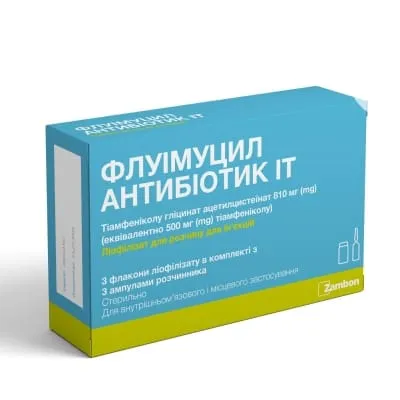
Table of Contents
INSTRUCTIONS FOR MEDICAL USE OF THE MEDICINAL PRODUCT FLUIMUCIL ANTIBIOTIC IT
Composition:
Active ingredient: 1 vial contains tiambutanol glycinate acetylcysteinate 810 mg (equivalent to 500 mg of tiambutanol);
Excipient: disodium edetate 2.5 mg;
solvent: 1 ampoule contains water for injections – 4 ml.
Pharmaceutical form. Lyophilisate for solution for injection.
Main physico-chemical properties.
Contents of the vial: white or light-yellowish flaky mass with a slight sulfurous odor;
Contents of the ampoule: clear, colorless liquid.
Pharmacotherapeutic group. Antibacterial agents for systemic use. Phenicol derivatives. ATC code J01BA02.
Pharmacological properties.
Pharmacodynamics.
The medicinal product Fluimucil antibiotico IT liquefies mucous and mucopurulent secretions and possesses a broad spectrum of antibacterial activity.
The properties of the drug allow both intramuscular and local administration with good local tolerance.
The mucolytic effect of the drug in the respiratory tract is confirmed by its pronounced liquefying action on mucus and viscous mucopurulent secretions, and is characterized by high clinical tolerability, superior to that of a simple combination of acetylcysteine and thiamphenicol.
The presence of a broad-spectrum antibiotic in the drug formulation enables its use in the treatment of bronchopulmonary infections; the medicinal product is particularly active against pathogenic microorganisms causing respiratory tract diseases: pneumococci, haemophili, Kl. pneumoniae, etc., including anaerobic microorganisms. Fluimucil antibiotico IT ensures effective treatment of respiratory infections due to its ability to liquefy viscous secretions and combat bacterial infections caused by them, as well as facilitates the removal of exudate, thereby promoting faster and more complete expression of bactericidal activity.
Acetylcysteine enhances the therapeutic effect of thiamphenicol; the free sulfhydryl group of acetylcysteine induces lysis of existing mucus, facilitating penetration, activity, and distribution of the antibiotic in tissues, providing an anti-adhesive effect, which has been demonstrated, for example, against Pseudomonas in respiratory epithelial cells.
Pharmacokinetics.
Pharmacokinetic studies of thiamphenicol glycinate acetylcysteinate in animals and humans have shown that the drug is completely absorbed and eliminated via normal pathways, both after oral and parenteral administration of thiamphenicol glycinate acetylcysteinate.
The levels of thiamphenicol in blood plasma and tissues (lungs) were evaluated in rats following oral and parenteral administration of thiamphenicol glycinate acetylcysteinate, thiamphenicol glycinate, and thiamphenicol base. No differences in absorption parameters among these three compounds were observed.
Peak plasma concentrations of thiamphenicol are observed as early as 15 minutes after intramuscular administration of Fluimucil antibiotico IT to guinea pigs.
In dogs, the plasma half-life (t½) after intravenous administration of thiamphenicol glycinate acetylcysteinate is approximately 70 minutes.
Clinical characteristics.
Indications.
Treatment of bacterial respiratory infections caused by microorganisms sensitive to the drug.
Local use:
-
Acute and chronic bronchitis, pneumonia, lung abscess, obstructive emphysema, bronchiectasis, cystic fibrosis, pertussis, bronchiolitis.
-
Management of bronchopulmonary complications after thoracic surgical interventions (bronchopneumonia, atelectasis), facilitation of bronchoaspiration during anesthesia, prevention of infectious complications.
-
Nonspecific forms of respiratory infections in mycobacterial infections to improve drainage of cavitary lesions.
-
Catarrhal and purulent otitis, infections of the auditory tube, sinusitis, laryngotracheitis, rhinopharyngitis, prevention and treatment of obstructive and infectious complications during tracheostomy, preparation for bronchoscopy, bronchoaspiration, and bronchography.
Systemic use:
In all the above-mentioned cases of bronchopulmonary diseases when combined antimicrobial and mucolytic therapy is recommended by the physician.
Contraindications.
Hypersensitivity to any component of the drug, history of bone marrow suppression, anuria, use of the medicinal product in patients with severe liver and kidney diseases, peptic ulcer of the stomach and duodenum in the stage of exacerbation, presence of hemoptysis, pulmonary hemorrhage, bronchial asthma without thickening of sputum.
Interaction with other medicinal products and other types of interactions.
Adult and pediatric patients.
Interaction studies have not been conducted.
Cases of interaction with other medicinal products, as well as specific incompatibilities with the drug, have not been described. Laboratory studies on interactions are lacking. Although thiamphenicol is not metabolized in the liver, there is evidence of inhibition of hepatic enzymes and a potential effect on the metabolism of other drugs.
Concomitant use of antitussive agents may enhance sputum retention due to suppression of the cough reflex.
Special precautions for use.
The medicinal product is an antibiotic; the duration of treatment with this drug should be limited to the shortest period necessary to treat the infection. If mucolytic therapy is required after resolution of the infection, acetylcysteine should be administered separately.
Fluimucil antibiotico IT is obtained through esterification and salt formation of thiamphenicol; therefore, the precautions established for this antibiotic also apply to the present preparation, considering that thiamphenicol injections may cause transient hematological changes (particularly erythropoiesis suppression, such as reticulocytopenia and anemia, less frequently – leukopenia and thrombocytopenia). These changes are reversible and concentration-dependent in blood. The severity of hematological changes depends on the dose and duration of treatment.
Such changes may be more pronounced and prolonged in cases of overdose associated with renal insufficiency, except in patients with a history of medullary insufficiency.
The drug should only be used to treat diseases caused by microorganisms sensitive to it; it should not be used for prophylaxis or treatment of simple infections.
In cases where prolonged treatment is necessary (more than 10 days), periodic monitoring of blood counts is recommended. If leukocyte count decreases below 4000/μL and granulocyte count decreases by more than 40%, administration of the drug should be discontinued.
In patients with moderate or severe renal impairment, it is recommended to administer the mucolytic and antibiotic separately, since the dose of thiamphenicol should be reduced.
For premature infants and newborns up to 2 weeks of age, a special dosing regimen (on average 25 mg/kg) is recommended due to functional immaturity of the kidneys.
Administration of the drug in aerosol form, especially at the beginning of treatment, primarily liquefies bronchial secretions and increases their volume. If the patient is unable to cough effectively, postural drainage and bronchoaspiration should be performed.
Administration of the drug in aerosol form to patients with asthmatic conditions should be performed under physician supervision. In the event of bronchospasm, administration of the drug should be immediately discontinued, and if possible, resumed later with prior administration of bronchodilators.
This medicinal product contains less than 1 mmol (23 mg)/dose of sodium, i.e., it is practically sodium-free.
Use during pregnancy or breastfeeding.
Fertility
Chronic toxicity and fertility studies in rats indicate dose-dependent inhibition of spermatogenesis when doses exceeding therapeutic levels are administered. Fertility is fully restored after discontinuation of treatment.
Pregnancy
There is limited data (fewer than 300 pregnancies) regarding the use of thiamphenicol during pregnancy. Animal studies do not indicate a direct or indirect harmful effect on reproductive toxicity.
The use of this medicinal product during pregnancy is possible only under medical supervision if the anticipated benefit to the mother outweighs the potential risk to the fetus.
Breastfeeding
Thiamphenicol passes into breast milk in amounts that may affect newborn infants during breastfeeding.
If administration of the drug is necessary during treatment, breastfeeding should be discontinued.
Ability to influence reaction speed when driving or operating machinery.
There are no data confirming any effect on reaction speed.
Method of Administration and Dosage
Fluimucil antibiotic IT is intended for intramuscular and local administration.
The lyophilisate should be reconstituted with the solvent provided in the package immediately before use.
Local administration
Inhalation:
Adults – 250 mg 1–2 times daily;
Children from 1 year of age – 125 mg 1–2 times daily.
The medicinal solution should be placed into the inhalation chamber.
Endotracheobronchial administration:
Adults and children from 1 year of age – 1–2 mL of the prepared solution per procedure, depending on the instrument used (bronchoscope, catheter, or other).
Washing of cavities and sinuses:
Adults and children from 1 year of age – 1–2 mL per procedure.
Instillation into nose and ears:
Adults and children from 1 year of age – 2–4 drops per administration.
Systemic administration
Intramuscular
Adults: 500 mg administered 2–3 times daily at regular intervals.
Children:
Up to 3 years of age – 25 mg/kg given twice daily;
From 3 to 7 years of age – 250 mg twice daily;
From 7 to 12 years of age – 250 mg three times daily.
If necessary, doses may be doubled (during the first 2–3 days of treatment in particularly severe cases). Dose increases are not permitted in premature infants, newborns, or patients aged 65 years and older.
The treatment course should not exceed 10 days.
Children
Use with caution in premature infants and children under 3 years of age (average dose – 25 mg/kg) due to immature renal function.
Overdose
No cases of overdose in adults or children have been reported.
Symptoms
In general, symptoms of overdose should not differ from those described as adverse effects and possible nonspecific complications associated with overdose of broad-spectrum antibiotics (dysbacteriosis, superinfections).
Treatment
Provide supportive therapy.
Adverse reactions.
The main adverse effects associated with systemic use of thiamphenicol are suppression of bone marrow function, leading to moderate anemia, thrombocytopenia, and leukopenia. These effects are dose-dependent and reversible upon discontinuation of treatment.
With systemic use of Fluimucil antibiotic IT, the following adverse reactions have been reported, the frequency of which cannot be estimated based on available data:
| System organ class |
Side effects |
| Immune system disorders |
Anaphylactic reactions |
| Blood and lymphatic system disorders |
Anemia, thrombocytopenia, leukopenia |
| Nervous system disorders |
Optic neuritis, peripheral neuropathy (as a result of prolonged use) |
| Gastrointestinal disorders |
Nausea, vomiting, diarrhea |
| Skin and subcutaneous tissue disorders |
Rash |
| General disorders and administration site conditions |
Hyperthermia |
In newborns and premature infants, a syndrome may develop, which initially presents with abdominal distension, pallor, cyanosis, and may progress to severe cardiovascular disturbances, up to and including fatal outcome.
When inhaled Fluimucil antibiotic IT was used, the following adverse reactions have been reported, the frequency of which cannot be estimated based on available data:
| System organ class |
Side effects |
| Immune system disorders |
Hypersensitivity reactions |
| Respiratory, thoracic and mediastinal disorders |
Laryngeal edema, bronchospasm (mainly in patients suffering from bronchial asthma), rhinorrhea |
| Gastrointestinal disorders |
Stomatitis, nausea |
| General disorders and administration site conditions |
Rash |
Clinical studies and post-marketing surveillance of topical administration of Fluimucil antibiotic IT in the treatment of children did not reveal clinically significant differences in the nature, frequency, severity, or reversibility of adverse reactions between the safety profile in adults and children or any other age groups.
Shelf life.
Lyophilisate for solution for injection (vials): 3 years.
Solvent: water for injections (ampoules) 5 years.
Kit: 3 years.
The shelf life of the kit is determined by the shortest shelf life of its components.
After reconstitution, the lyophilisate may be stored in the refrigerator for 24 hours; during this time the medicinal product may be used only for topical administration. Slight opalescence of the solution may occur, which does not indicate a change in its properties and does not interfere with its use.
Do not use after the expiry date stated on the packaging.
Storage conditions.
Store at a temperature not exceeding 25 °C.
Keep out of the reach and sight of children.
Incompatibilities.
When administered topically or systemically, Fluimucil antibiotic IT should not be mixed with other medicinal products.
When using the medicinal product, glassware should be used; contact of the solution with metallic surfaces (except stainless steel) and rubber surfaces should be avoided. Used containers and nebulizer components should be rinsed thoroughly with a large amount of water.
Packaging.
3 vials of lyophilisate and 3 ampoules of solvent (4 ml each) of water for injections in a cardboard box.
Prescription category. Prescription only.
Manufacturer. Zambon S.P.A. / Zambon S.P.A.
Manufacturer's address.
Via della Chimica, 9 - 36100 Vicenza (province of Vicenza), Italy / Via della Chimica, 9 - 36100 Vicenza (VI), Italy.
Marketing Authorization Holder. Zambon S.P.A. / Zambon S.P.A.
Address of Marketing Authorization Holder.
Via Lillo del Duca, 10 – 20091 Bresso, Milan, Italy / Via Lillo del Duca, 10 – 20091 Bresso, Milan, Italy.