Florised-zdorovya
Ukraine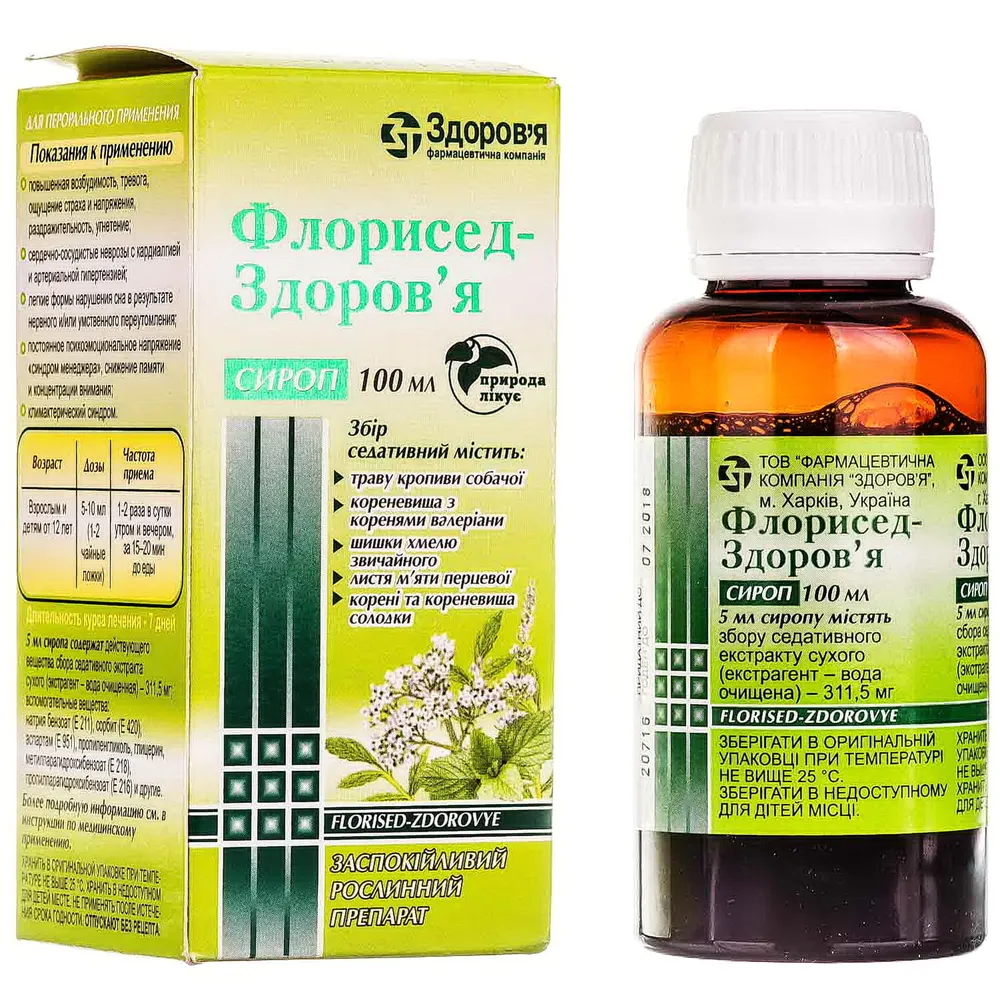
Table of Contents
INSTRUCTION for medical use|consumption| of the medicinal product FLORISED-ZDOROVYE (FLORISED-ZDOROVYE)
Composition:
Active substances:
5 ml of syrup contain 311.5 mg of dry sedative extract (extraction solvent – purified water) [sedative herbal mixture contains: herb of Urtica dioica, hops strobiles of Humulus lupulus, leaves of peppermint Mentha piperita, rhizomes with roots of valerian Valeriana officinalis, roots and rhizomes of licorice Glycyrrhiza glabra (4:2:1.5:1.5:1)];
Excipients: sodium benzoate (E 211), sorbitol (E 420), aspartame (E 951), propylene glycol, glycerin, polyethylene glycol, methylparahydroxybenzoate (E 218), propylparahydroxybenzoate (E 216), "Lemon" flavor containing maltodextrin, gum arabic, citric acid; purified water.
Excipients: sodium benzoate (E 211), sorbitol (E 420), aspartame (E 951), propylene glycol, glycerin, polyethylene glycol, methylparahydroxybenzoate (E 218), propylparahydroxybenzoate (E 216), "Lemon" flavor, purified water.|....|
Pharmaceutical form. Syrup.
Main physicochemical characteristics: liquid ranging in color from brown to dark brown with a slightly yellowish or greenish tint, with a specific odor. Opalescence and slight sedimentation are permissible.
Pharmacotherapeutic group. Psycholeptics. Hypnotics and sedatives. ATC code N05CM.
Pharmacological properties.
Pharmacodynamics. A complex herbal preparation whose action is determined by biologically active substances of black horehound, hops, mint, valerian, and licorice (hydroxycinnamic acids, flavonoids, terpene glycosides, etc.). Exerts a comprehensive sedative effect on the central nervous system: provides a mild calming effect, reduces psycho-emotional tension, hypersensitivity to external stimuli, and associated manifestations of vegetative dysfunction, and eliminates sleep disturbances. Does not cause drug dependence when used long-term.
Clinical characteristics.
Indications. Mild forms of neurasthenia and neuroses accompanied by increased excitability, anxiety, feelings of fear and tension, irritability, depression, fatigue; cardiovascular neuroses with cardialgia and arterial hypertension; mild forms of sleep disturbances due to nervous and/or mental overstrain; chronic psychoemotional stress ("manager’s syndrome"); decreased memory and attention concentration; climacteric syndrome.
Contraindications. Hypersensitivity to the components of the drug; acute inflammatory diseases of the stomach and intestines; irritable bowel syndrome; gastric ulcer; bronchial asthma; hepatic and renal function disorders; hypokalemia; severe obesity; depression and other disorders associated with central nervous system depression.
Interaction with other medicinal products and other types of interactions. When using any other medicinal products, consult a physician regarding the possibility of taking this drug.
Concomitant use with other sedatives and cardiovascular drugs is possible.
The drug may potentiate the effects of alcohol, cardiac glycosides, hypnotics, psychotropic agents, analgesics, spasmolytics, and centrally-acting antihypertensive drugs. When used concomitantly with cardiac glycosides, antiarrhythmic agents (quinidine), thiazide and loop diuretics, and laxatives, hypokalemia may be intensified.
Special precautions for use
During treatment, alcohol consumption should be avoided. The drug should be administered with caution to patients with gastroesophageal reflux (heartburn), myocarditis, pericarditis, myocardial infarction, or bradycardia.
The drug contains sorbitol; therefore, if a patient has been diagnosed with intolerance to certain sugars, medical advice should be sought before taking this medicinal product.
Aspartame contained in the drug is a derivative of phenylalanine and may pose a risk for patients with phenylketonuria.
The presence of methylparahydroxybenzoate (E 218) and propylparahydroxybenzoate (E 216) in the formulation may cause allergic reactions (possibly delayed-type).
Use during pregnancy or breastfeeding. The drug is contraindicated during pregnancy. If use of the drug is necessary, breastfeeding should be discontinued.
Ability to affect reaction rate when driving or operating machinery. Driving or operating machinery is not recommended during treatment.
Method of administration and dosage. Administer orally to adults and children aged 12 years and older at a dose of 5–10 mL (1–2 teaspoons) 1–2 times daily (in the morning and evening), 15–20 minutes before meals. Maximum daily dose – 20 mL (4 teaspoons).
For sleep disorders, administer 5–10 mL (1–2 teaspoons) once daily in the evening before bedtime.
When using syrup in doses that are multiples of 10 mL, the drug may be administered in sachet form.
Duration of treatment depends on the therapeutic response and is usually 7 days. Treatment may be repeated after 1–2 weeks.
Children. Do not use in children under 12 years of age (experience/use has not been established).
***Overdose.***Symptoms: general weakness, decreased hearing and visual acuity, palpitations, mental excitement, pronounced fatigue, disturbances in water-electrolyte balance, and intensification of adverse reactions.
Treatment: gastric lavage; if necessary, symptomatic therapy. In cases of pronounced neurological adverse effects, caffeine should be administered.
Side effects.
The drug is generally well tolerated; however, in some patients, fatigue, drowsiness, weakness, reduced work capacity, headache, dizziness, suppression of emotional responses, depression, decreased arterial pressure, nausea, spasmodic abdominal pain, and hypokalemia may occur. In individual patients, dyspeptic symptoms and hypersensitivity reactions (including hyperemia, rash, itching, skin swelling, urticaria) are possible.
The presence of methylparahydroxybenzoate and propylparahydroxybenzoate in the formulation may cause allergic reactions (possibly delayed).
If any adverse events or unusual reactions occur, consult a physician regarding further use of the drug.
Shelf life. 2 years.
Storage conditions. Store in the original packaging at a temperature not exceeding 25 °C.
Keep out of reach of children.
Packaging. 50 mL, 100 mL, or 200 mL in a bottle in a box; 10 mL in sachets, 20 pcs in a box.
Dispensing category. Over-the-counter.
Manufacturer. Limited Liability Company "Pharmaceutical Company "Zdorovya".
Manufacturer's address and place of business. 22, Shevchenka Street, Kharkiv, Kharkiv region, 61013, Ukraine.