Floxal®
Ukraine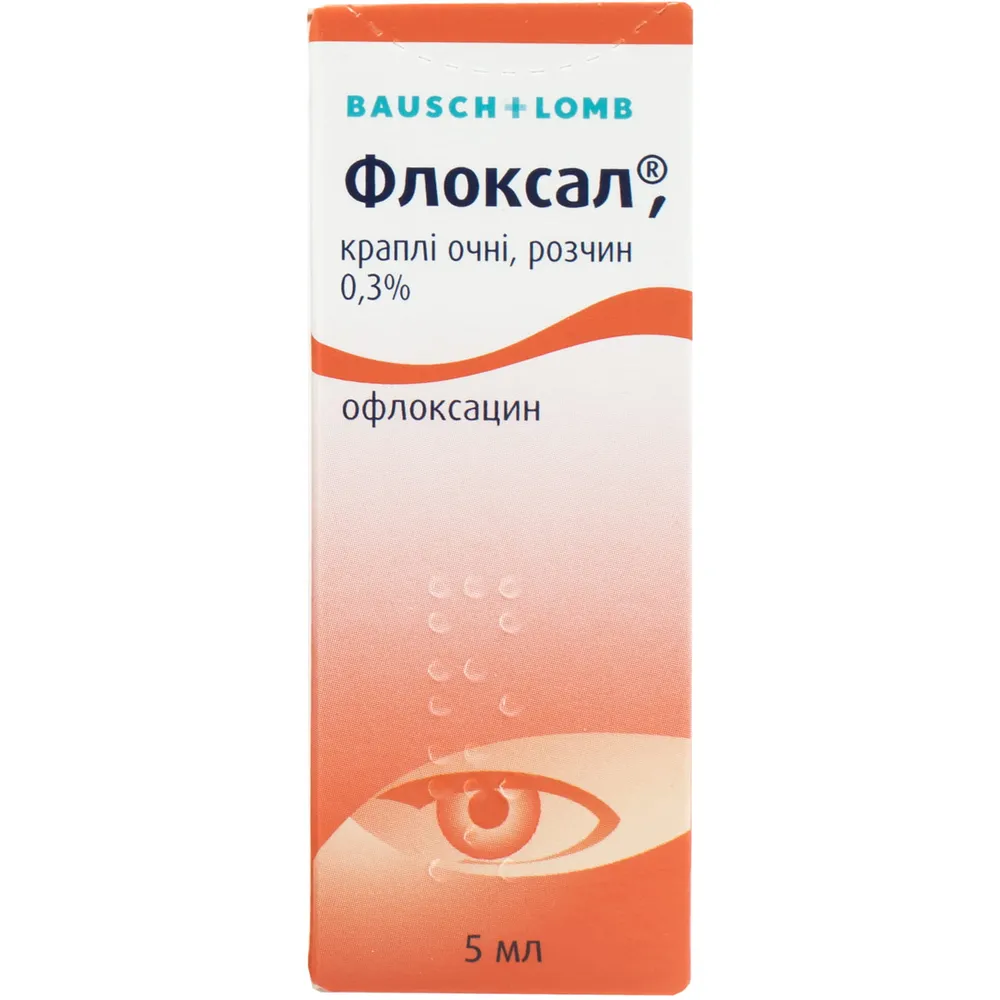
Table of Contents
INSTRUCTION FOR MEDICAL USE OF THE MEDICINAL PRODUCT FLOXAL® (FLOXAL®)
Composition:
Active substance: ofloxacin;
1 ml of solution contains ofloxacin 3 mg; 1 drop contains 0,1 mg of ofloxacin;
Excipients: benzalkonium chloride, hydrochloric acid, sodium hydroxide, sodium chloride, water for injections.
Pharmaceutical form. Eye drops, solution.
Main physicochemical characteristics: clear, yellowish aqueous solution.
Pharmacotherapeutic group.
Agents used in ophthalmology. Anti-infectives. Ofloxacin.
ATC code S01AE01.
Pharmacological properties.
Pharmacodynamics.
Ofloxacin, a derivative of quinolone acid, is a fluoroquinolone (gyrase inhibitor) antibiotic with bactericidal activity.
Breakpoints
Ofloxacin testing was performed using a dilution series. Minimum inhibitory concentrations for susceptible and resistant bacteria were determined (see table).
EUCAST (European Committee on Antimicrobial Susceptibility Testing) breakpoints
| Pathogen |
Susceptible |
Resistant |
| Enterobacteriaceae |
≤0.5 mg/l |
>1 mg/l |
| Staphylococcus spp. |
≤1 mg/l |
>1 mg/l |
| Streptococcus pneumoniae |
≤0.125 mg/l |
>4 mg/l |
| Haemophilus influenzae |
≤0.5 mg/l |
>0.5 mg/l |
| Moraxella catarrhalis |
≤0.5 mg/l |
>0.5 mg/l |
| Neisseria gonorrhoeae |
≤0.12 mg/l |
>0.25 mg/l |
| Non-species related threshold values* |
≤0.5 mg/l |
>1 mg/l |
*Primarily determined based on serum pharmacokinetics.
Antibacterial spectrum
The spectrum of activity of ofloxacin includes obligate anaerobes, facultative anaerobes, aerobes, and other microorganisms such as Chlamydia.
The prevalence of acquired resistance in individual species may vary depending on geographic location and over time. Therefore, obtaining local resistance data is essential for appropriate treatment of severe infections.
Microbiological identification of the causative pathogen and its sensitivity to ofloxacin is mandatory in cases of severe infections or lack of therapeutic response. Cross-resistance between ofloxacin and other fluoroquinolones is possible.
The information below is derived from a resistance study conducted using 1391 isolates from examined eyes (mainly external swabs) across 31 centers in Germany.
This study provides representative data on aerobes causing ocular infections in Germany. It may be assumed that the prevalence of bacteria capable of causing ophthalmological diseases in other countries will not be identical but will be similar; therefore, the bacteria listed below are the most common causative agents of bacterial infections of the external eye.
Resistance data refer to systemic administration. When applied topically to the eye, significantly higher antibiotic concentrations are achieved; thus, clinical efficacy is observed even against pathogens identified as resistant in laboratory studies. This effect, for example, is observed with Enterococcus species.
Typically sensitive species
Gram-positive aerobes: Bacillus spp., methicillin-sensitive Staphylococcus aureus,
Gram-negative aerobes: Acinetobacter baumannii, Acinetobacter lwoffi, Enterobacter cloacae, Escherichia coli, Haemophilus influenzae, Haemophilus parainfluenzae, Klebsiella oxytoca, Klebsiella pneumoniae, Moraxella catarrhalis, Proteus mirabilis, Serratia marcescens.
Species that may be insensitive due to acquired resistance when the drug is used
Gram-positive aerobes: Corynebacterium spp., Enterococcus faecalis, methicillin-resistant* Staphylococcus aureus, Staphylococcus epidermidis, Streptococcus pneumoniae*, Streptococci (except Streptococcus pneumoniae)*.
Gram-negative aerobes: Pseudomonas aeruginosa, Stenotrophomonas maltophilia.
Species with inherent resistance to the drug
Gram-positive aerobes: Enterococcus spp.
*Resistance rate exceeds 50% in at least one region.
*Inherent susceptibility of most individual species lies within intermediate ranges. However, in tear fluid, concentrations of at least 4 mg/L are achieved for 4 hours after a single instillation, which is sufficient to eliminate 100% of microorganisms.
Pharmacokinetics.
Efficacy largely depends on the ratio between maximum tissue concentration (Cmax) and the minimum inhibitory concentration (MIC) of the pathogen.
Animal experiments have shown that after topical application, ofloxacin can be detected in the cornea, conjunctiva, ocular muscle, sclera, iris, ciliary body, and anterior chamber of the eye. With repeated administration, the drug accumulates in therapeutic concentrations in the vitreous body.
After administration of Floxal® eye drops five times daily at 5-minute intervals, ofloxacin concentrations in human intraocular fluid reach 1.2–1.7 µg/mL within 60–120 minutes. After 3 hours, this level decreases to 0.8 µg/mL. Depending on the frequency of instillation, ofloxacin concentration in intraocular fluid decreases to zero within 5–6 hours.
By analogy with animal study results, it can be assumed that other ocular tissues contain higher concentrations of the drug than intraocular fluid. Since ofloxacin can bind to melanin-containing tissues, a prolonged elimination from these tissues is expected. The plasma elimination half-life of ofloxacin following systemic administration ranges from 3.5 to 6.7 hours.
Clinical characteristics.
Indications.
Anterior segment eye infections caused by pathogenic microorganisms sensitive to ofloxacin, such as bacterial conjunctivitis, keratitis, blepharitis, and dacryocystitis; also for hordeolum and corneal ulcer.
Contraindications.
Hypersensitivity to any component of the drug or to other quinolones.
Interaction with other medicinal products and other forms of interaction.
Not known to date. Studies on drug interactions conducted with systemic administration of ofloxacin have shown that the clearance of metabolites of caffeine and theophylline is slightly affected by ofloxacin.
Special precautions for use
The safety and efficacy in children under 1 year of age have not been established.
There is only limited evidence of efficacy and safety of 0.3% ophthalmic solutions containing ofloxacin in the treatment of conjunctivitis in newborns.
The use of ophthalmic solutions containing ofloxacin in newborns for the treatment of ophthalmia neonatorum caused by Neisseria gonorrhoeae or Chlamydia trachomatis is not recommended, as administration in this age group has not been studied.
If an allergic reaction to the drug occurs, its use must be discontinued.
Prior to the first administration, microbiological examination of smears taken from the conjunctival sac is advisable to determine bacterial strain sensitivity to the drug.
With prolonged use, development of bacterial resistance and emergence of microorganisms insensitive to the antibacterial agent may occur. If symptoms worsen or no clinical improvement is observed, treatment must be discontinued and alternative therapy initiated.
Cases of corneal perforation have been reported in patients with pre-existing corneal epithelial defects or corneal ulcers who were treated with topical fluoroquinolone antibiotics. However, in many cases, risk factors were present, such as advanced age, presence of large corneal ulcers, concomitant ocular diseases (e.g., severe dry eye), systemic inflammatory conditions (e.g., rheumatoid arthritis), or concomitant use of corticosteroids or nonsteroidal anti-inflammatory drugs. Despite this, due to the risk of corneal perforation, caution is required when using this medicinal product in patients with existing corneal epithelial defects or corneal ulcers.
During treatment with ofloxacin, excessive sun exposure or ultraviolet irradiation (e.g., tanning beds, sunlamps, etc.) should be avoided, as photosensitivity may occur.
During treatment, rigid contact lenses should not be used. Therefore, it is recommended to remove rigid lenses before applying the medicinal product and reinsert them no sooner than 20 minutes after instillation.
The medicinal product contains the preservative benzalkonium chloride, which may cause irritation of the conjunctiva.
When using FLOXAL® ophthalmic drops together with other ophthalmic drops/ointments, medicinal products should be administered at intervals of at least 15 minutes. In any case, ophthalmic ointment should be applied last.
With systemic use of fluoroquinolones, caution is advised in patients at risk of QT interval prolongation, namely: those with congenital long QT syndrome, those receiving concomitant medications that prolong the QT interval (e.g., class IA and III antiarrhythmics, tricyclic antidepressants, macrolides, antipsychotics), those with uncorrected electrolyte imbalances (e.g., hypokalemia, hypomagnesemia), elderly patients, and patients with cardiac conditions (e.g., heart failure, myocardial infarction, bradycardia).
Tendon inflammation and rupture may occur with systemic fluoroquinolone therapy, including ofloxacin, particularly in elderly patients and in patients receiving concomitant corticosteroids. Therefore, caution is required, and if early signs of tendon inflammation occur, treatment with FLOXAL® eye drops should be discontinued.
Benzalkonium chloride may be absorbed by soft contact lenses and may alter the color of contact lenses. Contact lenses should be removed before instillation of this medicinal product and reinserted 20 minutes later. Benzalkonium chloride may also cause eye irritation, particularly in cases of dry eye or corneal disorders. Based on limited available data, there is no difference in the adverse event profile in children compared to adults. However, children's eyes generally show a stronger reaction to benzalkonium chloride than adult eyes. Irritation may influence treatment recommendations in pediatric patients. Benzalkonium chloride has been reported to cause eye irritation, symptoms of dry eye, and may affect the tear film and corneal surface. Caution is advised in patients with dry eye or in patients with potentially compromised corneas. Patients should be monitored during prolonged use of the medicinal product.
Use during pregnancy or breastfeeding
Despite the absence of evidence for any embryotoxic effects, FLOXAL® eye drops should be avoided during pregnancy or breastfeeding if possible.
Ability to affect reaction speed when driving or operating machinery
The use of FLOXAL® eye drops does not affect the patient's reaction speed.
Following instillation into the conjunctival sac, blurred vision may occur for several minutes. Until vision clears, patients should refrain from driving or operating machinery.
Method of Administration and Dosage
The dosage and duration of treatment are always determined by a physician depending on the severity of the disease and the patient's age.
Unless otherwise prescribed, FLOXAL®, eye drops, should be administered into the conjunctival sac of the affected eye, 1 drop 4 times daily. The duration of treatment with FLOXAL® eye drops should not exceed 2 weeks.
Instructions for Use
Gently pull down the lower eyelid and, by slightly pressing the dropper bottle, instill 1 drop into the conjunctival sac of the affected eye.
Children
FLOXAL®, eye drops, may be prescribed to children from 1 year of age.
Overdose
No cases of overdose have been reported to date.
Treatment is symptomatic; immediately rinse the eye(s) with water.
Side effects.
Immediately after administration, blurred vision may occur for several minutes.
General manifestations.
Serious reactions following systemic use of ofloxacin are rare, and most symptoms are reversible. Although only a small amount of ofloxacin is absorbed into the systemic circulation following topical application, the possibility of adverse effects, as reported, cannot be excluded.
Immune system.
Occasionally – conjunctival hyperemia and/or mild burning sensation in the eye. In most cases, these symptoms are transient.
In very rare cases (<1/10,000): hypersensitivity, including angioneurotic edema, dyspnea, anaphylactic reactions/shock, swelling of the mouth and throat and tongue, itching of eyes and eyelids.
Nervous system: in isolated cases – dizziness.
Eye disorders.
Frequent: eye discomfort, eye irritation.
Occasional: keratitis, conjunctivitis, blurred vision, photophobia, eye swelling, eye redness, foreign body sensation, increased lacrimation, dry eyes, eye pain, itching, eyelid edema.
In rare cases (from 1/10,000 to 1/1,000), corneal deposits may occur, particularly in patients with a history of corneal disease.
There have been reports that, very rarely, topical application may cause reactions such as toxic epidermal necrolysis and Stevens-Johnson syndrome. A causal relationship with FLOXAL® eye drops regarding these manifestations has not been established.
Gastrointestinal disorders: in isolated cases – nausea.
Skin and subcutaneous tissue disorders: in isolated cases – facial swelling, periorbital edema.
Serious, sometimes fatal, hypersensitivity reactions, occasionally after the first dose, have been observed with systemic use of quinolones.
In patients receiving systemic fluoroquinolones, tendon rupture or tendonitis, including shoulder, hand, and Achilles or other tendons, have been reported, requiring surgical repair or resulting in prolonged disability. Clinical studies and post-marketing experience with systemic quinolones indicate that the risk of such tendon ruptures may be increased in patients receiving concomitant corticosteroids, particularly in elderly patients. This risk primarily affects tendons under high mechanical stress, including the Achilles tendon.
Shelf life.
Shelf life of the drug in the unopened vial – 3 years.
Shelf life after opening the vial – 6 weeks.
Do not use the drug after the expiry date stated on the packaging.
Storage conditions.
Store in the original packaging at a temperature not exceeding 25 °C, in a place inaccessible to children.
Packaging.
5 mL of the drug in a bottle with dropper and screw cap. One bottle per cardboard box.
Prescription status. Prescription only.
Manufacturer.
Dr. Gerhard Mann Chem.-pharm. Fabrik GmbH
Manufacturer's address.
Brunsbütteler Damm 165/173, 13581 Berlin, Germany.