Fleertis
Ukraine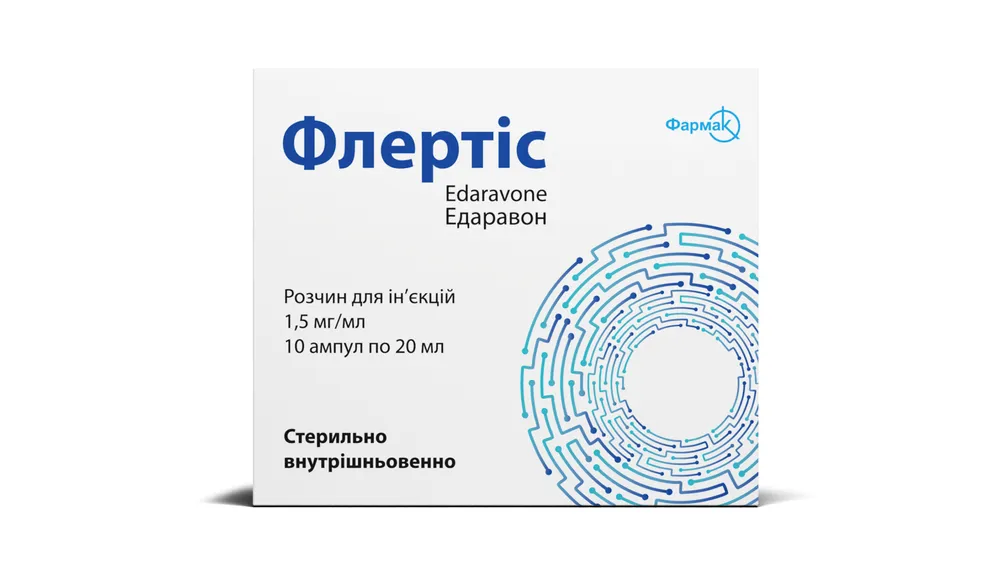
Table of Contents
INSTRUCTIONS FOR MEDICAL USE OF THE MEDICINAL PRODUCT FLERTIS (FLERTIS)
Composition:
Active substance: edaravone;
1 ml of solution contains edaravone 1.5 mg;
Excipients: sodium chloride; sodium metabisulfite (E 223); cysteine hydrochloride monohydrate; phosphoric acid concentrated; sodium hydroxide; water for injections.
Pharmaceutical form. Injection solution.
Main physicochemical properties: clear, colorless liquid.
Pharmacotherapeutic group. Other drugs for the treatment of diseases of the central nervous system. ATC N07XX14.
Pharmacological properties.
Pharmacodynamics.
Free radicals, such as hydroxyl radicals (·OH), are among the main factors contributing to cerebral vascular damage associated with ischemia. During ischemia or hemorrhage, abnormal overproduction of arachidonic acid metabolites leads to increased generation of free radicals. These free radicals induce lipid peroxidation of unsaturated fatty acids present in cellular membrane lipids, causing membrane damage, which results in impaired brain function.
The etiology of the onset and progression of amyotrophic lateral sclerosis (ALS) has not yet been fully established. However, it has been hypothesized that oxidative stress caused by free radicals may be an etiological factor in this pathology.
Edaravone scavenges free radicals and inhibits lipid peroxidation, thereby reducing oxidative damage to brain cells (vascular endothelial cells / nerve cells).
In the acute phase of ischemic cerebral infarction, this medicinal product protects the brain by suppressing the onset and progression (exacerbation) of ischemic cerebrovascular disorders such as cerebral edema, ischemic stroke, neurological symptoms, and delayed neuronal death. In the case of amyotrophic lateral sclerosis (ALS), this medicinal product demonstrates inhibition of disease progression through its suppressive effect, reducing oxidative damage to nerve cells.
Pharmacokinetics.
Plasma concentration
The pharmacokinetics of the drug were studied in five healthy male volunteers and five healthy elderly male volunteers aged 65 years, measured 30 minutes after repeated intravenous administration of the drug at a dose of 0.5 mg/kg twice daily for 2 days.
| Pharmacokinetic parameters |
Healthy male volunteers (n = 5) |
Healthy elderly male volunteers (n = 5) |
| C max (ng/mL) |
888 ± 171 |
1041 ± 106 |
| t ½ α (h) |
0.27 ± 0.11 |
0.17 ± 0.03 |
| t ½ β (h) |
2.27 ± 0.80 |
1.84 ± 0.17 |
The concentration of unchanged drug in plasma decreased similarly in both groups without signs of accumulation.
Rate of binding to serum proteins
The binding rate of edaravone (5 µM and 10 µM) to human serum protein and human serum albumin was 92% and 89–91%, respectively (in vitro).
Metabolism
In plasma, the main metabolites of edaravone in healthy adults and healthy elderly men are sulfate conjugates; glucuronide conjugates have also been detected. In urine, glucuronides were predominantly found, with smaller amounts of sulfates.
Excretion
After repeated intravenous administration of this medicinal product twice daily for 2 days to healthy adult men and healthy elderly men (0.5 mg/kg/30 min × 2 times/day), 0.7–0.9% and 71.0–79.9% of the dose were excreted in urine as unchanged drug and as metabolites, respectively, within 12 hours after administration.
Clinical Characteristics.
Indications.
Alleviation of neurological symptoms, manifestations of impaired activities in daily life, and functional disorders associated with acute ischemic stroke.
Slowing the progression of functional disorders in patients with amyotrophic lateral sclerosis (ALS).
Contraindications.
Severe renal impairment.
Hypersensitivity to any component of the medicinal product in medical history.
Interaction with other medicinal products and other forms of interaction.
When used concomitantly with antibiotics excreted via the kidneys (e.g., sodium cefazolin, cefotiam hydrochloride, piperacillin sodium, etc.), there is a potential risk of exacerbated renal dysfunction; careful monitoring with regular assessment of renal function is required when used in combination. The mechanism of this phenomenon is unknown. Since this medicinal product is primarily eliminated via the kidneys, concomitant use of antibiotics that are also renally excreted may increase the renal burden.
Furtes should be dissolved in sodium chloride physiological solution prior to administration. Mixing the medicinal product with other intravenous solutions containing various sugars may lead to a reduction in edaravone concentration.
The medicinal product must not be mixed with parenteral nutrition solutions and/or solutions containing amino acids, nor administered through the same infusion system, as this may result in decreased edaravone concentration.
Do not mix with anticonvulsant agents, including diazepam, sodium phenytoin, etc., as precipitation may occur. Also, do not mix with potassium canrenoate, as the solution may become cloudy.
Special precautions for use.
Fertis should be administered under the careful supervision of physicians who have sufficient knowledge of this medicinal product and experience in its use for this disease.
Prior to administration of the medicinal product, the patient or their authorized representative should be adequately informed about possible adverse reactions, etc.
During therapy, worsening of acute renal failure or renal dysfunction, severe hepatic dysfunction and/or disseminated intravascular coagulation (DIC) may occur, which could be fatal. Serious cases of concomitant development of renal failure, hepatic failure and/or hematological disorders have been reported.
There have been few instances of administration of this medicinal product to patients with severe forms of ALS (above stage 4) or to patients whose forced vital capacity is less than 70% of the theoretical normal value; therefore, its efficacy and safety have not been established. The decision to administer the medicinal product to such patients should be made cautiously, taking into account the risks and benefits.
At the beginning of treatment with the medicinal product or immediately after administration, blood urea nitrogen (BUN), creatinine, aspartate aminotransferase (AST), alanine aminotransferase (ALT), lactate dehydrogenase (LDH), creatine kinase, erythrocytes, and platelet analysis should be performed to detect early changes in these parameters, as laboratory test results may deteriorate in most cases during the early stages of treatment. Laboratory tests should be performed regularly during edaravone administration. If abnormal changes in test parameters and/or symptoms such as oliguria are observed, administration of the medicinal product should be discontinued immediately and appropriate measures taken. In addition, careful monitoring of the patient should continue after completion of the injections.
Patients with dehydration and high blood urea nitrogen/creatinine ratio or other signs should be closely monitored during treatment, as fatal outcomes have been reported in such patients.
In patients with amyotrophic lateral sclerosis (ALS), as the disease progresses, serum creatinine levels may decrease due to muscle atrophy. Therefore, instead of comparing a single serum creatinine value with a reference value, changes in serum creatinine levels should be monitored to confirm the presence or absence of a deteriorating trend. In addition, since BUN levels vary depending on the body's hydration status, changes in BUN levels should be monitored rather than comparing a single BUN value with a reference value, to confirm the presence or absence of a deteriorating trend.
In patients with muscle atrophy, in addition to measuring serum creatinine and BUN before and during injections, renal function should be assessed using tests independent of changes in muscle mass, such as estimated glomerular filtration rate based on serum cystatin C or urinary creatinine clearance.
If complications such as infection occur during injection and additional antibiotic therapy is required, the necessity of continuing the injection should be carefully evaluated. If the injection is continued, laboratory parameters must be monitored particularly closely. Furthermore, even after completion of the administration, careful monitoring should continue with regular checks of laboratory test results (see section "Interaction with other medicinal products and other forms of interaction").
If renal dysfunction occurs during injection, administration of the medicinal product should be discontinued immediately and appropriate measures taken in collaboration with physicians experienced in the management of renal dysfunction.
A high number of fatal cases have been observed in patients with infections or severe impairment of consciousness (i.e., ≥100 points on the Japanese Coma Scale). Therefore, a careful risk/benefit assessment should be conducted for these patients.
Elderly patients require particularly careful monitoring, as a high number of fatal cases have been reported in this patient group.
Fertis should be used with caution in the following patient categories:
- with renal dysfunction and/or dehydration — due to high risk of developing acute renal failure (acute renal failure or renal dysfunction may worsen. Fatal outcomes have been reported in patients with high blood urea nitrogen/creatinine ratio prior to administration);
- with infection (renal failure may be exacerbated due to worsening of the patient's general condition);
- with hepatic dysfunction (possible worsening of hepatic failure);
- with heart disease (possible worsening of the disease and development of renal failure);
- with severe impairment of consciousness (fatal cases have been reported in this patient group);
- elderly patients (fatal cases have been reported in this patient group).
Hematological tests should be performed frequently and patients should be closely monitored, as thrombocytopenia or granulocytopenia may occur. If pathological findings are detected, administration of the medicinal product should be discontinued immediately and appropriate measures taken.
This medicinal product contains potassium metabisulfite (E 223), which may rarely cause hypersensitivity reactions and bronchospasm.
Use during pregnancy or breastfeeding.
Pregnancy. The safety of using this medicinal product during pregnancy has not been established. It is not recommended for use in pregnant women or women who may become pregnant.
Breastfeeding period. Women should avoid breastfeeding during treatment with this medicinal product. Animal studies in rats have demonstrated that edaravone passes into milk.
Ability to affect reaction rate when driving or operating machinery.
The medicinal product is intended for use in a hospital setting; therefore, such data are not available.
Method of Administration and Dosage
Relief of neurological symptoms, manifestations of impaired daily functioning, and functional disorders associated with acute ischemic stroke.
The usual dose for adults is 1 ampoule (30 mg edaravone), diluted in 100 mL of physiological saline, administered intravenously over 30 minutes twice daily, in the morning and evening.
Treatment with this drug should be initiated within 24 hours after symptom onset. The treatment duration is 14 days.
Slowing progression of functional disorders in patients with amyotrophic lateral sclerosis (ALS).
The usual dose for adults is 2 ampoules (60 mg edaravone), diluted in 100 mL of physiological saline, administered intravenously over 60 minutes once daily.
Typically, a treatment cycle consists of a 28-day period comprising both administration and rest phases. The first cycle includes 14 days of drug administration followed by a 14-day rest period. The second and subsequent cycles consist of 10 days of drug administration within a 14-day period, followed by a 14-day rest period.
Use in patients with acute ischemic stroke.
The treatment duration should be adjusted according to the patient's clinical condition.
Geriatric patients.
Since physiological functions are generally reduced in elderly patients, if adverse effects occur, the drug should be discontinued and appropriate measures taken. It is known that fatal outcomes occur more frequently in elderly patients; therefore, monitoring should be especially careful.
Children.
The safety of use of this medicinal product in children has not been established.
There is insufficient experience of use in children with acute ischemic stroke; clinical experience in children with ALS is lacking.
Overdose.
Cases of overdose have not been reported.
Side effects
Renal system:
Uncommon: acute renal failure;
Rare: nephrotic syndrome.
Renal function tests should be performed regularly and patients should be closely monitored, as acute renal failure or nephrotic syndrome may occur. If reduced renal function or symptoms such as oliguria, etc., are detected, the drug should be discontinued immediately and appropriate measures taken.
Skin:
Common: rash;
Uncommon: erythema, swelling, itching sensation;
Frequency not known: erythema.
Hepatobiliary system:
Uncommon: liver function disorders, hepatic failure;
Frequency not known: fulminant hepatitis, jaundice.
Liver function tests should be performed frequently and patients should be closely monitored, as severe hepatitis, including fulminant hepatitis, liver dysfunction, or jaundice, may occur, accompanied by significant increases in blood levels of AST, ALT, alkaline phosphatase, gamma-glutamyltransferase, LDH, bilirubin, etc. If pathological findings are detected, the drug should be discontinued immediately and appropriate measures taken.
Nervous system:
Uncommon: insomnia, headache.
Cardiovascular system:
Uncommon: increased blood pressure.
Blood:
Common: decreased erythrocyte count, leukocytosis, leukopenia, reduced hematocrit, decreased hemoglobin levels, thrombocytosis;
Rare: DIC syndrome, thrombocytopenia;
Frequency not known: agranulocytosis.
Hematological tests should be performed periodically, as DIC syndrome may occur. If any abnormalities in hematological tests or suspicion of DIC syndrome are detected, the use of this medicinal product should be discontinued and appropriate therapeutic measures taken.
Respiratory system:
Frequency not known: acute lung injury syndrome, accompanied by pyrexia, cough, dyspnea, and abnormalities on chest X-ray.
Patients should be closely monitored, as acute lung injury with fever, cough, dyspnea, and abnormalities on chest X-ray may occur. If any signs of acute lung injury are detected, the drug should be discontinued immediately and appropriate measures taken.
Gastrointestinal system:
Uncommon: nausea, vomiting.
Musculoskeletal system:
Frequency not known: rhabdomyolysis.
Patients should be closely monitored, as rhabdomyolysis may occur. If myalgia, weakness, increased creatine phosphokinase (CPK) levels, and/or increased myoglobin levels in blood and/or urine occur, administration of this drug should be discontinued and appropriate therapeutic measures taken.
Immune system:
Frequency not known: shock, anaphylaxis (urticaria, decreased blood pressure, breathing difficulties, etc.).
Patients should be closely monitored, as shock and anaphylactoid reactions (urticaria, decreased blood pressure, dyspnea, etc.) may occur. If pathological findings are detected, the drug should be discontinued and appropriate measures taken.
Laboratory parameter changes:
Common: increased levels of ALT, AST, LDH, gamma-glutamyltransferase, alkaline phosphatase, bilirubin, creatinine, uric acid in blood serum, glucosuria, hematuria, proteinuria, increased serum cholesterol levels, increased triglyceride levels, decreased total serum protein, increased CPK (CK), decreased CPK (CK), decreased serum potassium levels, increased serum potassium levels;
Uncommon: decreased serum cholesterol levels, decreased serum calcium levels.
Injection site reactions:
Uncommon: rash, erythema, and swelling at the injection site.
General disorders:
Common: fever;
Uncommon: hyperthermia, feeling of warmth, increased blood pressure, headache.
Reporting of suspected adverse reactions
Reporting suspected adverse reactions after drug registration is important. It allows continuous monitoring of the benefit-risk balance of the medicinal product. Medical and pharmaceutical professionals, as well as patients or their legal representatives, should report all suspected adverse reactions and lack of drug efficacy through the automated pharmacovigilance information system at the following link: https://aisf.dec.gov.ua/.
Shelf life. 2 years.
Do not use the medicinal product after the expiry date stated on the packaging.
Incompatibilities
Do not mix with other medicinal products except those specified in the section "Administration and dosage."
Storage conditions.
No special storage conditions required.
Keep out of reach of children.
Packaging.
20 ml in glass vials. 5 vials in a blister. 2 blisters in a carton.
Prescription status. Prescription only.
Manufacturer.
JSC "Farmak".
Manufacturer's address and location of its business activities.
74, Kyrylivska Street, Kyiv, 04080, Ukraine.