Flamidez gel
Ukraine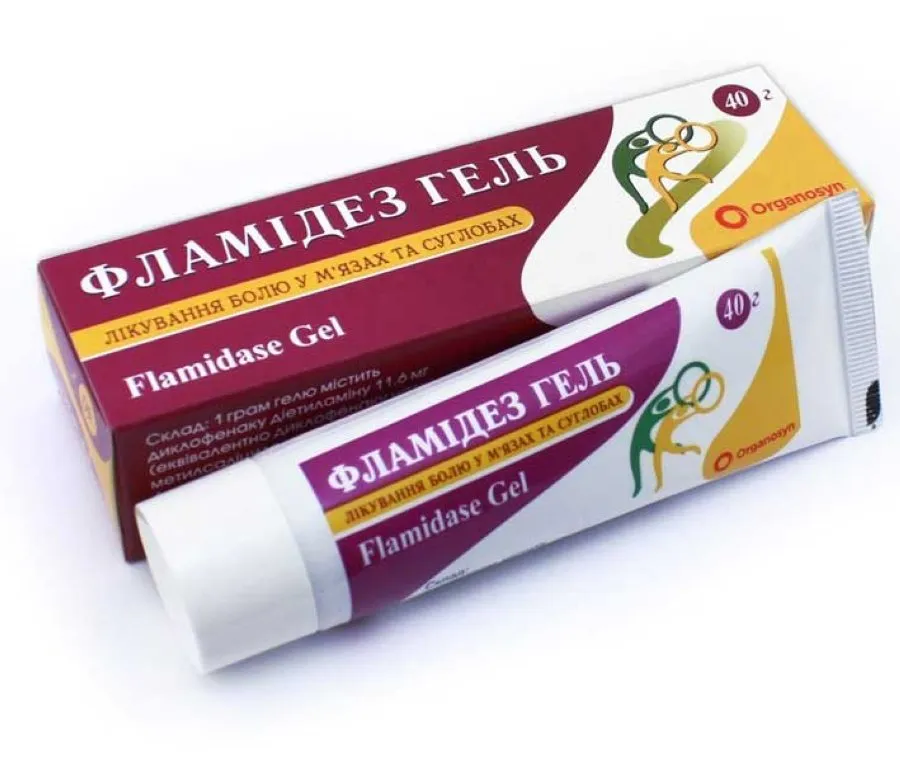
Table of Contents
INSTRUCTIONS FOR MEDICAL USE OF THE MEDICINAL PRODUCT FLAMIDASE GEL
Composition:
Active substances: diclofenac diethylamine (diclofenaci diethylaminum), methyl salicylate (methylii salicylas), levomenthol (levomentholum);
1 g of gel contains 11.6 mg of diclofenac diethylamine (equivalent to 10 mg of sodium diclofenac), 100 mg of methyl salicylate, and 50 mg of levomenthol;
Excipients: benzyl alcohol; carbopol 934; propylene glycol; citric acid monohydrate; isopropyl alcohol; edetate disodium; polyoxyl hydrogenated castor oil; diethylamine; purified water.
Pharmaceutical form. Gel.
Main physicochemical characteristics: white soft mass.
Pharmacotherapeutic group.
Topically applied agents for joint and muscular pain. ATC code M02A A65.
Pharmacological Properties
Pharmacodynamics
Flamidex gel exerts local analgesic, anti-inflammatory, and anti-edematous effects. The pharmacological action of the drug is determined by the components included in its formulation.
Diclofenac. Diclofenac is a nonsteroidal anti-inflammatory drug (NSAID) with pronounced analgesic, anti-inflammatory, antirheumatic, and antipyretic properties. The main mechanism of action is inhibition of cyclooxygenase enzymes and disruption of prostaglandin biosynthesis.
In inflammation caused by injuries or rheumatic diseases, the use of diclofenac reduces pain, tissue swelling, and shortens the recovery period of functions in injured joints, ligaments, tendons, and muscles.
Methyl salicylate. Methyl salicylate is a derivative of salicylic acid and exerts a local irritant effect. By stimulating skin receptors, methyl salicylate induces the production and release into the bloodstream of large amounts of biologically active substances that regulate pain sensitivity. This leads to the release of substance P from neurons. Reduced accumulation of substance P in nerve endings results in diminished pain perception. In addition, methyl salicylate, which belongs to the NSAID class, inhibits prostaglandin synthesis by suppressing cyclooxygenase, thereby reducing edema and infiltration of inflamed tissues.
Levomenthol. Levomenthol stimulates cold receptors, exerts vasodilatory and mild analgesic effects, and produces a cooling sensation. It enhances the penetration of active substances through the skin.
Pharmacokinetics
Diclofenac has been detected in blood plasma following topical application of 2 g of the drug to the calf three times daily for 6 days. Mean pharmacokinetic parameters were: AUC0-t – 9 ng·h/mL, Cmax – 4 ng/mL, and Tmax – 4.5 hours. In comparison, oral administration of 75 mg diclofenac results in an AUC of 1600 ng·h/mL. Thus, systemic bioavailability of diclofenac following topical application is significantly lower than after oral administration, reducing the risk of adverse effects.
Approximately 99% of diclofenac is bound to plasma proteins.
Methyl salicylate is rapidly absorbed through the skin and is primarily excreted in urine.
Levomenthol is excreted in urine and bile as glucuronide conjugate.
Clinical characteristics.
Indications.
Local treatment of myositis, fibrositis, sciatica, muscle and tendon strains, traumatic injuries of the musculoskeletal system, muscle and joint pain due to heavy physical exertion, inflammatory and degenerative joint diseases, rheumatic disorders of the musculoskeletal system: bursitis, arthritis, tenosynovitis, tendinitis.
Contraindications.
- Individual hypersensitivity to diclofenac, acetylsalicylic acid, or other nonsteroidal anti-inflammatory drugs (NSAIDs), or to any other component of the drug.
- History of bronchial asthma attacks, urticaria, or acute rhinitis induced by acetylsalicylic acid or other NSAIDs.
- Skin epidermis damage, open wounds at the site of application.
- Third trimester of pregnancy.
- Children under 14 years of age.
Interaction with other medicinal products and other forms of interaction.
Due to minimal systemic absorption of the drug when applied topically, interaction with other medicinal products is unlikely. However, possible interactions known for oral formulations of diclofenac should be taken into account.
Although adequate controlled interaction studies have not been conducted, excessive use of topical salicylates may potentially enhance the effect of coumarin anticoagulants and antiplatelet agents. Therefore, caution is advised in patients receiving coumarin anticoagulants or antiplatelet agents, including aspirin.
Special precautions for use
Flamidex gel is intended for topical use only. The product must not be taken orally.
Prior to application, consult a physician if there is a history of the following conditions: peptic ulcer disease of the stomach and duodenum, hepatic or renal impairment, significant disorders of the blood system, bronchial asthma, nasal mucosal polyps, or allergic reactions.
After applying the gel, hands should be washed thoroughly to avoid contact of the product with the eyes and mucous membranes.
The product should be used with caution in combination with oral NSAIDs.
The likelihood of systemic adverse effects with topical application of diclofenac is low compared to oral administration; however, this risk increases when the product is applied over relatively large skin areas for prolonged periods.
If any skin rash develops, discontinue use of the product immediately.
The product should be applied only to intact skin areas, avoiding contact with inflamed, damaged, or infected skin, eyes, and other mucous membranes.
The product must not be used under airtight occlusive dressings. However, use under non-occlusive dressings is acceptable. In cases of ligament sprains, the affected area may be bandaged with a wrap.
Flamidex gel contains propylene glycol, which may cause mild local skin irritation in some patients.
If symptoms do not improve, medical advice should be sought.
Use during pregnancy or breastfeeding
There are no clinical data on the use of Flamidex gel during pregnancy. Although systemic effects of diclofenac following topical application are lower than with oral administration, it is unknown whether the systemic exposure achieved after topical use of Flamidex gel could be harmful to the embryo/fetus. Since the impact of prostaglandin synthesis inhibition on pregnancy outcomes following topical diclofenac application has not been studied, the product should be used during the first 6 months of pregnancy only if, in the physician’s opinion, the expected benefit to the mother outweighs the potential risk to the fetus. During the first and second trimesters of pregnancy, Flamidex gel should not be used unless clearly necessary. If used, the dose should be as low as possible and the duration of treatment as short as possible.
During the third trimester of pregnancy, systemic use of prostaglandin synthesis inhibitors, including Flamidex gel, may cause cardiovascular and renal toxicity in the fetus. Use of diclofenac in late pregnancy may result in prolonged bleeding time in both mother and child and may delay the onset of labor. Use of the product is contraindicated during the third trimester of pregnancy.
Effects on the mother and newborn, as well as late in pregnancy:
-
Possible prolonged bleeding time, anti-aggregatory effect, which may occur even at very low doses;
-
Inhibition of uterine contractions, leading to delayed or prolonged labor.
Use of NSAIDs during pregnancy, starting from week 20, may cause rare but serious renal complications in the unborn child. As a consequence, oligohydramnios and other complications may occur.
NSAIDs should not be used from week 20 to week 28 of pregnancy unless prescribed by a physician. Flamidex gel is contraindicated during the third trimester of pregnancy (from week 28 until delivery).
Breastfeeding
During breastfeeding, use of the product is possible only if, in the physician’s opinion, the expected benefit to the mother outweighs the potential risk to the infant. Under such circumstances, the product must not be applied to the breasts or over large skin areas, nor should it be used for prolonged periods (more than 1 week).
If treatment is necessary, breastfeeding should be discontinued.
Female fertility
Like other NSAIDs, Flamidex gel may adversely affect female fertility. Therefore, it is not recommended for use in women attempting to conceive. If a woman experiences difficulties with conception or is undergoing infertility evaluation, discontinuation of Flamidex gel should be considered.
Ability to affect reaction speed when driving or operating machinery
Flamidex gel, when used topically, does not affect the ability to drive or operate complex machinery.
Method of Administration and Dosage
For external use only.
For adults and children aged 14 years and older, a small amount of gel (2–4 g), corresponding in size to a cherry or a walnut, should be applied to the affected area 3–4 times daily and gently rubbed in until completely absorbed. Prolonged use of the gel on large areas of skin and in high doses should be avoided. The gel may be used concomitantly with oral administration of diclofenac sodium tablets, provided a physician has been consulted beforehand.
After application, hands should be washed unless the treated area involves the hands.
The duration of treatment depends on the indication and therapeutic response, and should be determined by a physician. The gel should not be used for longer than 14 days in cases of soft tissue injury and rheumatism, or for longer than 21 days in cases of arthritic pain, unless otherwise directed by a physician.
Elderly patients may use the standard dosage.
Children. The product is contraindicated in children under 14 years of age. If the medicinal product is used in children aged 14 years and older for longer than 7 days, or if symptoms worsen, medical advice should be sought.
Overdose.
Overdose is unlikely due to the minimal systemic absorption of diclofenac following topical application. However, accidental ingestion may lead to the development of systemic adverse reactions.
In case of accidental ingestion, gastric lavage, administration of adsorbents, and symptomatic treatment using therapeutic measures applicable for NSAID poisoning are indicated. The patient should seek immediate medical attention. Symptomatic treatment should be initiated upon the appearance of complications such as elevated blood pressure, renal failure, seizures, respiratory depression, or gastrointestinal complications.
Adverse Reactions.
Flamidex gel is generally well tolerated by patients.
Immune system disorders: isolated cases – at the site of gel application, skin redness, itching, burning sensation, or skin eruptions (including pustular eruptions), eczema.
Skin and subcutaneous tissue disorders: very rare – allergic skin reactions; rare – dermatitis, including contact dermatitis (e.g., localized skin eruptions, itching, redness, swelling, or papules), bullous dermatitis; isolated cases – generalized skin reactions, urticaria, angioneurotic edema, photosensitization, bronchospasm, bronchial asthma. Skin burns at the application site are possible.
Systemic reactions. If the gel is applied to large areas of skin over a prolonged period, systemic adverse reactions cannot be completely ruled out. However, the likelihood of such reactions following topical diclofenac application is low compared to the frequency of adverse reactions observed with oral diclofenac therapy. In the event of systemic reactions, reference should be made to the information provided in the instructions for medical use of other diclofenac formulations.
If any skin eruptions occur, the use of the medicinal product should be discontinued.
In case of any other adverse events or unusual reactions, consult a physician.
Reporting of adverse reactions after drug registration is of great importance. It enables ongoing monitoring of the benefit-risk balance of the medicinal product. Healthcare and pharmacy professionals, as well as patients or their legal representatives, are encouraged to report all suspected adverse reactions and lack of efficacy via the automated pharmacovigilance information system at the following link: https://aisf.dec.gov.ua.
Shelf life. 2 years.
Storage conditions.
Store in the original packaging, protected from light, in a place inaccessible to children, at a temperature not exceeding 30 °C. Do not freeze.
Packaging.
Tubes of 20 g, 30 g, 40 g, or 100 g; 1 tube per cardboard box.
Supply category. Over-the-counter.
Manufacturer.
Encube Ethicals Private Limited.
Manufacturer's address and location of business activity.
Plot No. C-1, Madkaim Industrial Estate, Madkaim, Post Mardol, Ponda, Goa – 403 404, India.