Phytolysin
Ukraine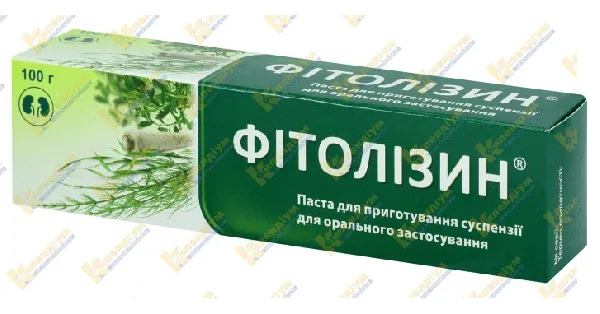
Table of Contents
INSTRUCTIONS FOR MEDICAL USE OF THE MEDICINAL PRODUCT PHYTOLYSIN® (PHYTOLYSIN)
Composition:
Active ingredient: 100 g of paste contains 67.2 g of concentrated extract from a mixture of medicinal plant raw materials [couch grass rhizomes (Agropyron repens (L.) Beauv., rhizoma) – 12.5 g, onion husks (Allium cepa L., squama) – 5 g, birch leaves (Betula pendula Roth; Betula pubescens Ehrh., folium) – 10 g, fenugreek seeds (Trigonella foenum – graecum L., semen) – 15 g, parsley root (Petroselinum sativum Hoffm., radix) – 17.5 g, goldenrod herb (Solidago virgaurea L., herba) – 5 g, field horsetail herb (Equisetum arvense L., herba) – 10 g, lovage root (Levisticum officinale Koch, radix) – 10 g, bird's-foot grass herb (Polygonum aviculare L., herba) – 15 g] (1:1.3–1.6) (extraction solvent – ethanol 45%);
Excipients: sage oil, pine oil, orange oil, peppermint oil, agar, ethylparahydroxybenzoate (E 214), wheat starch, vanillin, glycerin, purified water.
Pharmaceutical form. Paste for the preparation of an oral suspension.
Main physicochemical properties: soft consistency paste, greenish-brown in color, with a characteristic aromatic odor.
Pharmacotherapeutic group.
Agents affecting the genitourinary system and sex hormones. Agents promoting dissolution of urinary concretions.
ATC code G04BC.
Pharmacological properties.
The medicinal product exerts diuretic, anti-inflammatory, antimicrobial, and analgesic effects. These properties are due to biologically active substances present in the medicinal herbs. The biologically active substances enhance the excretion of sodium and chloride ions, increase glomerular filtration, and reduce tubular reabsorption in the kidneys. They increase diuresis without disturbing the electrolyte balance.
Flavonoids inhibit the growth of gram-positive microflora in the urinary tract, enhance urea excretion, block oxidation of ascorbic acid, and prevent its conversion into oxalic acid. Saponins exhibit pronounced antibacterial activity against staphylococci. Aglycones exert a spasmolytic effect.
Silicates (Equisetum arvense, Polygonum aviculare) help maintain the balance between colloids and crystalloids in urine, thus preventing the formation of urinary concretions; they also improve excretion of uric acid.
Phytolysin® promotes flushing out of sand and small urinary concretions; it prevents the growth of existing concretions and postoperative recurrence of stone formation.
Clinical characteristics.
Indications.
Infectious and inflammatory diseases of the urinary tract associated with urolithiasis; prevention of urolithiasis relapses, including after surgical removal of stones.
Contraindications.
Hypersensitivity to any component of the medicinal product or to plants of the Asteraceae (Compositae) family (e.g. common goldenrod), Apiaceae (Umbelliferae), anethole (lovage root), or birch pollen (birch leaves). Conditions requiring reduced fluid intake (e.g. renal insufficiency, cardiac insufficiency).
Conditions associated with increased blood coagulation.
Obstruction of the urinary tract.
Acute nephritis, nephroses, phosphate lithiasis.
Interaction with other medicinal products and other forms of interaction.
Due to the diuretic effect of the product, accelerated elimination of other concurrently administered medicinal products should be considered.
The product may enhance the effects of hypoglycemic agents, nonsteroidal anti-inflammatory drugs, lithium salts, monoamine oxidase inhibitors, and anticoagulants; it may also prolong the action of pentobarbital, paracetamol, and aminopyrine.
The product may reduce the absorption of medicinal substances in the small intestine, including beta-carotene and alpha-tocopherol, as well as cholesterol.
Special precautions for use
There have been no reports of interactions.
Glycemic monitoring is necessary in patients with diabetes mellitus when using this product due to the potential hypoglycemic effect of fenugreek.
If pain, complications during urination, presence of blood in urine, worsening of symptoms, or fever occur, immediate medical advice must be sought.
The medicinal product should not be used in patients with edema due to renal or cardiac insufficiency.
During treatment, it is recommended to consume a large amount of fluids.
The product contains ethanol in an amount of approximately 200 mg per single dose, equivalent to 5 ml of beer or 2 ml of wine. Residual amounts of alcohol do not cause clinically significant reactions.
The product contains ethyl parahydroxybenzoate, which may cause allergic reactions (possibly of delayed type).
The medicinal product contains a negligible amount of gluten (contained in wheat starch) and is considered "gluten-free." The likelihood that taking Phytolysin® will lead to exacerbation of symptoms in celiac disease is extremely low.
5 g of paste contains no more than 15 μg of gluten.
Patients with wheat allergy (other than celiac disease) must not use this medicinal product.
Use during pregnancy or breastfeeding
There are no safety and efficacy data regarding the use of the product during pregnancy; therefore, the product should not be used during this period.
The medicinal product may be used only if, in the physician’s opinion, the benefit of treatment outweighs the potential risk to the fetus.
As it is unknown whether use of the product during breastfeeding is safe, breastfeeding should be discontinued during treatment.
There are no data available on fertility.
Effects on ability to drive and use machines
There are no data on the effect of the medicinal product on the ability to drive vehicles or operate machinery. If dizziness occurs during treatment, patients should refrain from driving or operating machinery.
Method of Administration and Dosage
Adults
One teaspoon (approximately 5 g) of paste, dissolved in ½ cup of warm boiled water, is administered per dose. Administer 3–4 times daily after meals.
The usual duration of treatment is 2 to 4 weeks. If necessary, the treatment course may be repeated.
If there is no improvement, symptoms persist or the condition worsens, medical advice should be sought.
Since urine output increases during treatment, an adequate fluid intake should be maintained throughout therapy.
Children
There is no experience with the use of the medicinal product in children and adolescents under 18 years of age; therefore, it should not be administered to patients in this age group.
Overdose
Cases of overdose have not been reported.
In the event of overdose, manifestations of adverse reactions may be intensified.
Treatment is symptomatic.
Side effects.
Immune system:
allergic reactions, including rashes, urticaria, itching, allergic rhinitis, facial swelling.
Nervous system:
dizziness.
Gastrointestinal tract:
nausea, vomiting, diarrhea, bloating.
Skin and subcutaneous tissue:
increased sensitivity to ultraviolet radiation (photosensitization).
Urinary system:
renal colic.
Shelf life. 3 years.
Do not use the drug after the expiry date!
Storage conditions.
Store in the original packaging at a temperature not exceeding 25°C.
Keep out of reach of children.
Packaging.
100 g of paste in an aluminum tube, in a cardboard box.
Availability. Over-the-counter (without prescription).
Manufacturer.
Herbapol Warsaw Ltd.
Manufacturer's address.
Olowkowa 54, 05-800 Pruszkow, Poland /
05-800 Pruszkow Olowkowa 54, Poland.