Ferrophol
Ukraine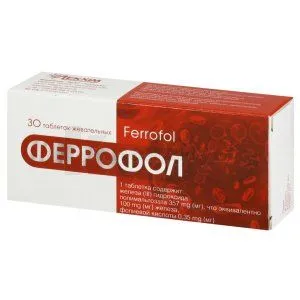
Table of Contents
INSTRUCTIONS for medical use of the medicinal product FERROFOL (FERROFOL)
Composition:
Active substances: iron (III) hydroxide polymaltose complex, folic acid;
One tablet contains 357 mg of iron (III) hydroxide polymaltose complex, equivalent to 100 mg of iron, and 0.35 mg of folic acid;
Excipients: microcrystalline cellulose, cocoa powder, sodium cyclamate, polyethylene glycol 6000, talc, vanillin, dextrates, chocolate flavoring.
Pharmaceutical form. Chewable tablets.
Main physico-chemical properties: single-layer, round-shaped tablets, light brown to brown in color, with white specks, marked with a line; upper and lower surfaces are flat, edges are beveled. Under magnification, the fracture surface shows a relatively homogeneous structure.
Pharmacotherapeutic group. Antianaemic agent. Combination products containing iron and folic acid.
ATC code B03AD04.
Pharmacological properties.
Pharmacodynamics.
Ferrofol contains maltodextrin (partially hydrolyzed starch) and an inorganic iron (III) compound. In Ferrofol, trivalent iron is a component of a complex organic compound.
Iron participates in the formation of hemoglobin. Like other iron preparations, Ferrofol does not affect erythropoiesis and is ineffective in anemias not caused by iron deficiency.
The structure of the preparation is similar to the natural iron compound—ferritin. Absorbed iron binds to ferritin and is stored in the liver. Subsequently, it is incorporated into hemoglobin in the bone marrow.
Folic acid, contained in the medicinal product, belongs to the group of B vitamins. It is a precursor of tetrahydrofolate, which acts as a coenzyme in various metabolic processes, including the biosynthesis of purines and thymidylate of nucleic acids. It is necessary for the synthesis of nucleoproteins and for maintaining normal erythropoiesis.
Pharmacokinetics.
Absorption and distribution.
Studies with radiolabeled drug have shown that absorption, specifically the amount of iron incorporated into hemoglobin, is inversely proportional to the dose of the drug. There is a correlation between the degree of iron deficiency and the amount of iron absorbed (the greater the iron deficiency, the better the absorption). With therapeutic use, absorption is approximately 10%. The absorption process occurs primarily in the duodenum and small intestine. At the beginning of treatment, the bioavailability of iron from the iron (III) hydroxide polymaltose complex is lower than that from bivalent iron (II) preparations.
Folic acid is absorbed primarily in the duodenum and small intestine. The highest blood concentrations are achieved within 30–60 minutes. At a dose of 350 mcg, absorption may reach approximately 80%.
Metabolism and elimination.
Unabsorbed iron is excreted in feces. Folic acid is metabolized, in particular, in enterocytes and hepatocytes. Folates bind to transport proteins and distribute to all organs. Elimination occurs primarily via the kidneys and gastrointestinal tract.
Clinical characteristics.
Indications.
Treatment and prevention of iron deficiency without anemia (latent iron deficiency) and iron deficiency anemia (clinically evident iron deficiency) in conditions associated with increased demand for folic acid during pregnancy or breastfeeding. Iron deficiency and its severity must be confirmed by appropriate laboratory tests.
Contraindications.
- Hypersensitivity or intolerance to the active substance or any excipient of the medicinal product;
- Excess iron in the body (e.g., hemochromatosis, hemosiderosis);
- Disorders of iron excretion mechanisms (lead poisoning anemia, sideroblastic anemia, thalassemia);
- Anemias not caused by iron deficiency (e.g., hemolytic anemia, vitamin B12 deficiency-induced megaloblastic anemia);
- Esophageal stricture and/or other obstructive gastrointestinal disorders; intestinal diverticulum, intestinal obstruction, regular blood transfusions; malignant neoplasms, untreated cobalamin deficiency;
- Concomitant use of parenteral iron preparations.
Interaction with other medicinal products and other forms of interaction.
Preclinical studies in rats using tetracycline, aluminum hydroxide, acetylsalicylic acid, sulfasalazine, calcium carbonate, calcium acetate, calcium phosphate combined with vitamin D3, bromazepam, magnesium aspartate, D-penicillamine, methyldopa, paracetamol, and auranofin did not reveal any interaction with iron(III) hydroxide polymaltose complex.
In vitro studies showed no interaction between iron(III) hydroxide polymaltose complex and food components such as phytic acid, oxalic acid, tannins, sodium alginate, choline and choline salts, vitamin A, vitamin D3, and vitamin E, soybean oil, and soy flour. The study results indicate that iron(III) hydroxide polymaltose complex can be taken during or immediately after meals.
Interaction between iron(III) hydroxide polymaltose complex and tetracycline or aluminum hydroxide was investigated in three clinical studies (crossover studies involving 22 patients each). No significant reduction in tetracycline absorption was observed. Tetracycline plasma concentrations did not fall below the level required for bacteriostatic action. Administration of aluminum hydroxide and tetracycline did not reduce iron absorption from iron(III) hydroxide polymaltose complex. Therefore, iron(III) hydroxide polymaltose complex can be used concomitantly with tetracyclines, other phenolic compounds, and aluminum hydroxide.
Administration of the medicinal product does not affect the results of tests for occult blood (hemoglobin-sensitive tests); therefore, there is no need to discontinue treatment.
Concomitant use of parenteral iron preparations and the medicinal product Ferrofol is not recommended, as such use may inhibit absorption of orally administered iron preparations. Parenteral iron preparations may be used only when oral iron therapy is inappropriate.
Folic acid may enhance phenytoin metabolism, leading to reduced serum phenytoin concentrations, particularly in patients with folic acid deficiency. In some patients, an increased frequency of epileptic seizures may occur. Folic acid enhances the efficacy of lithium salt therapy.
Patients taking phenytoin or other anticonvulsant drugs should consult their physician before using products containing folic acid.
It has been reported that concomitant use of chloramphenicol and folic acid in patients with folic acid deficiency may result in antagonism of the hematopoietic response to folic acid. Although the significance and mechanism of this interaction are unknown, hematopoietic response to folic acid should be closely monitored in patients receiving both medicinal products simultaneously.
Special precautions for use
Treatment of anaemia should always be carried out under medical supervision. If there is no improvement in haematological parameters (an increase in haemoglobin levels by approximately 20–30 g/L within 3 weeks after initiation of treatment), the treatment regimen should be re-evaluated.
The medicinal product contains folic acid, which may mask vitamin B12 deficiency. Potential vitamin B12 deficiency should be ruled out in patients with anaemia prior to initiating treatment due to the risk of developing irreversible neurological disorders (see section "Contraindications").
Administration of iron polymaltose complex may result in darkening of stool colour; however, this is of no clinical significance.
Caution is advised in patients receiving repeated blood transfusions, as red blood cells already contain iron stores, and administration of the product may lead to iron overload.
Infections and tumours may cause the development of anaemia. Oral iron preparations may be administered after treatment of the underlying disease, taking into account the benefit-risk ratio.
When prescribing the product to patients with diabetes mellitus, it should be noted that
1 tablet contains 0.03 bread units.
Iron preparations should be used with caution in patients with the following conditions: leukaemia, chronic liver or kidney diseases, inflammatory gastrointestinal disorders, peptic ulcer disease of the stomach and duodenum, intestinal disorders (enteritis, ulcerative colitis, Crohn's disease).
The medicinal product Ferrofol contains 9 mg of sodium per tablet. This amount corresponds to 0.5% of the WHO recommended maximum daily intake of sodium for adults, which is 2 g.
Use during pregnancy or breastfeeding
Data on use during the first trimester of pregnancy do not indicate adverse effects on pregnancy or on the health of the foetus or newborn. Animal studies have not revealed any direct or indirect harmful effects on pregnancy, embryonic or foetal development. However, the medicinal product should be used with caution during pregnancy.
Human breast milk contains iron and folic acid bound to lactoferrin. It is unknown how much iron from the iron (III) hydroxide polymaltose complex passes into breast milk. It is unlikely that administration of the medicinal product Ferrofol will have an adverse effect on the breastfed infant.
Use of the medicinal product Ferrofol during pregnancy or breastfeeding is recommended only after consultation with a physician.
Ability to influence reaction rate while driving or operating machinery
Appropriate studies have not been conducted. It is unlikely that the medicinal product Ferrofol affects reaction speed while driving or operating complex machinery.
Dosage and Administration
The medicinal product Ferrofol, chewable tablets, should be taken during or immediately after meals. The tablets may be swallowed whole.
Treatment of iron-deficiency anemia with increased demand for folic acid:
1 chewable tablet 2–3 times daily.
After normalization of blood hemoglobin levels: 1 chewable tablet daily until at least delivery, to restore iron stores.
Treatment and prevention of latent iron deficiency with increased demand for folic acid: 1 chewable tablet daily.
Children. Currently, there are no data available on the use of the medicinal product in children.
Overdose.
During administration of Ferrofol, no cases of intoxication or excessive iron accumulation in the body have been reported due to the specific characteristics of controlled release and the low toxicity of the polymaltose complex of iron (III) hydroxide (LD50 in animals > 2000 mg iron/kg body weight). No cases of accidental overdose with fatal outcomes have been reported.
There have been reports that excessive doses of folic acid may cause changes in the central nervous system (altered mental status, sleep disturbances, irritability, and hyperactivity), nausea, abdominal distension, and flatulence.
Adverse Reactions
The frequency of occurrence of adverse effects is classified into the following categories: very common (> 1/10), common (≥ 1/100 to < 1/10), uncommon (≥ 1/1000 to < 1/100), rare (< 1/1000).
Change in stool color is a well-known adverse reaction associated with oral iron-containing preparations; however, this phenomenon is not clinically significant and is often not reported. Other common adverse events include gastrointestinal disturbances (nausea, constipation, diarrhea, and abdominal pain).
Immune system disorders.
Very rare: allergic reactions.
Gastrointestinal disorders.
Very common: change in stool color*.
Common: diarrhea, nausea, abdominal pain (including abdominal pain, dyspepsia, epigastric discomfort, abdominal distension), constipation.
Uncommon: vomiting (including vomiting, belching), change in tooth enamel color, gastritis.
Skin and subcutaneous tissue disorders.
Uncommon: pruritus, rash (including rash, macular rash, bullous rash**, urticaria**, erythema**).
Nervous system disorders.
Uncommon: headache.
Musculoskeletal and connective tissue disorders.
Rare: muscle spasms (including involuntary muscle contractions, tremor), myalgia.
*Although the frequency of stool color change based on meta-analysis results is lower, this is a well-known adverse event associated with oral iron preparations. Therefore, stool color change has been classified as a very common adverse reaction.
**Information on these events was obtained from spontaneous post-marketing reports; according to estimates, the frequency is < 1/491 (upper limit of the 95% confidence interval).
Reporting of adverse reactions after drug registration is highly important. It enables ongoing monitoring of the benefit-risk balance of the medicinal product. Healthcare and pharmaceutical professionals, as well as patients or their legal representatives, are encouraged to report all suspected adverse reactions and lack of efficacy via the Automated Pharmacovigilance Information System at the following link: https://aisf.dec.gov.ua.
Shelf life. 3 years.
Storage conditions.
Store in the original packaging at a temperature not exceeding 25 °C. Keep out of reach of children.
Packaging.
10 tablets in a blister; 3 blisters per cardboard box.
Prescription status.
Prescription only.
Manufacturer.
JSC "Tekhnolohiya".
Manufacturer's address and place of business.
8 Stara Prorizna Street, Uman, Cherkasy Oblast, 20300, Ukraine.