Fentanyl
Ukraine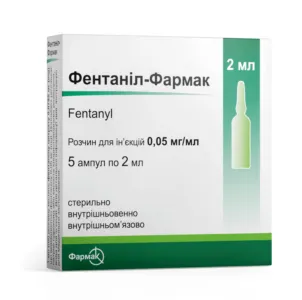
Table of Contents
INSTRUCTIONS FOR MEDICAL USE OF THE MEDICINAL PRODUCT FENTANYL (FENTANYL)
Composition:
Active substance: fentanyl;
1 ml of solution contains fentanyl 0.05 mg;
Excipients: citric acid monohydrate; water for injections.
Pharmaceutical form. Injection solution.
Main physicochemical properties: clear, colorless liquid.
Pharmacotherapeutic group. Agents acting on the nervous system. Anesthetics. General anesthetics. Agents for opioid anesthesia. ATC code N01AH01.
Pharmacological properties.
Pharmacodynamics.
Opioid analgesic. Exerts pronounced analgesic effect. Significantly exceeds morphine in analgesic activity.
Opioid receptor agonist, interacts predominantly with mu-receptors of the central nervous system (CNS), spinal cord, and peripheral tissues. Enhances the activity of the antinociceptive system and increases the pain sensitivity threshold. Disrupts the transmission of excitation via specific and non-specific pain pathways to the nuclei of the thalamus, hypothalamus, and amygdaloid complex. Reduces the emotional perception of pain, causes euphoria, which promotes the development of dependence (both physical and psychological). By reducing excitability of pain centers, produces a sedative effect.
With repeated administration, tolerance and drug dependence may develop.
Depresses the respiratory center, stimulates the vomiting center and vagal centers, leading to bradycardia. Increases smooth muscle tone of internal organs, as well as sphincters of the urethra, urinary bladder, sphincter of Oddi, biliary tract, and gastrointestinal tract, with simultaneous inhibition of peristalsis, thereby enhancing water absorption from the gastrointestinal tract. Reduces renal blood flow intensity. Leads to increased levels of amylase and lipase in blood.
Analgesic effect after intravenous administration develops within 1–3 minutes, reaches maximum within 5–7 minutes; after intramuscular administration, the effect begins within 10–15 minutes; duration of effect after single administration is approximately 30 minutes.
Pharmacokinetics.
Rapidly redistributes from blood and brain into muscle and adipose tissues. Elimination half-life is 10–30 minutes. Plasma protein binding is 79%. Metabolized in the liver via N-dealkylation and hydroxylation, as well as in the kidneys, intestine, and adrenal glands. Clearance is 0.4–0.5 L/min, elimination half-life is 10–30 minutes, volume of distribution is 60–80 mL. Excreted by the kidneys (approximately 75% as metabolites and 10% unchanged) and via the intestine (9% as metabolites). Excreted into breast milk.
Clinical characteristics.
Indications.
As an analgesic and an adjunct in neuroleptanalgesia, general anesthesia, and as an anesthetic for induction during anesthesia. As a respiratory depressant in intensive care therapy.
Contraindications.
Respiratory depression due to suppression of the respiratory center, bronchial asthma, drug addiction, intracranial hypertension, severe hepatic insufficiency, increased individual sensitivity to any component of the drug.
Fentanyl is contraindicated in cesarean section surgery prior to fetal extraction and other obstetric procedures (possible depression of the fetal respiratory center).
Interaction with other medicinal products and other types of interactions.
Buprenorphine reduces the effect of the drug.
When used concomitantly with other agents that exhibit CNS depressant effects [opioids, sedatives, hypnotics (including barbiturates), neuroleptics (including phenothiazines), tranquilizers (including benzodiazepines or related agents), muscle relaxants, general anesthetics, antihistamines causing sedation, gabapentinoids (gabapentin and pregabalin), and other non-selective CNS depressants (e.g., alcohol)], there may be a mutual enhancement of adverse effects (CNS depression, respiratory depression, arterial hypotension).
With chronic use of barbiturates (especially phenobarbital), a reduction in the analgesic effect of narcotic analgesics may occur. Prolonged use of barbiturates or narcotic analgesics leads to development of cross-tolerance.
Benzodiazepines prolong the recovery time from neuroleptanalgesia.
Nitrous oxide intensifies muscle rigidity; antihypertensive agents enhance arterial hypotension; monoamine oxidase inhibitors increase the risk of severe complications.
Naloxone reverses respiratory depression and analgesia caused by narcotic analgesics. Nalorphine reverses respiratory depression caused by narcotic analgesics while preserving their analgesic effect.
Special precautions.
Fentanyl administration is recommended only under conditions of readiness for resuscitation and solely in the presence of an anesthesiologist.
Euphoria is possible.
Discontinuation of the drug should be performed gradually.
Use with caution in patients with impaired liver or kidney function, hypothyroidism, adrenal insufficiency, prostate hypertrophy, shock, myasthenia, inflammatory gastrointestinal disorders, as well as in patients aged 60 years and older. When high doses are used in emaciated or asthenic patients, secondary respiratory depression may develop due to fentanyl excretion into the gastric lumen 1–2 hours after administration and subsequent resorption.
Alcohol consumption must be avoided during treatment.
In case of adverse reactions, activated charcoal may be administered to conscious patients.
Extreme caution is required when using fentanyl, particularly in patients with myasthenia gravis, in whom rigidity of respiratory muscles may occur. There is evidence of the danger of using fentanyl in opioid-dependent patients, as it may lead to fatal respiratory depression. Due to postoperative respiratory depression following fentanyl administration, patients require postoperative monitoring. In the presence of respiratory depression, an opioid antagonist—naloxone—should be administered. All patients require monitoring for 6 hours after the last dose of naloxone is administered. Respiratory stimulation may be achieved by administering doxapram, which does not affect analgesia. Elderly patients exhibit increased cerebral sensitivity to fentanyl; therefore, they require lower doses.
Tolerance and opioid use disorder (abuse and dependence).
Repeated use of opioids may lead to tolerance and physical and psychological dependence. Repeated opioid use may result in opioid use disorder (OUD). Abuse or intentional misuse of opioids may lead to overdose and/or death. The risk of developing OUD is increased in patients with a personal or family history (parents or siblings) of substance use disorders (including alcohol use disorder), tobacco users, or patients with a personal history of other mental health disorders (e.g., major depression, anxiety, and personality disorders).
Withdrawal syndrome.
Repeated administration of the drug at short intervals over a prolonged period may lead to withdrawal syndrome after discontinuation of therapy, which may manifest as adverse reactions such as nausea, vomiting, diarrhea, restlessness, chills, tremor, and excessive sweating.
Use during pregnancy or breastfeeding.
The medicinal product is contraindicated during pregnancy and breastfeeding.
Ability to affect reaction speed when driving or operating machinery.
During treatment, patients should avoid potentially hazardous activities requiring rapid psychomotor reactions.
Dosage and Administration
Fentanyl is administered intravenously or intramuscularly.
Adults:
- For premedication and in the postoperative period – 1–2 mL (0.05–0.1 mg fentanyl) intramuscularly;
- For induction of anesthesia – 2–4 mL (0.1–0.2 mg fentanyl) intravenously;
- For neuroleptanalgesia – 4–12 mL (0.2–0.6 mg fentanyl) intravenously, repeated every 20 minutes;
- For surgical procedures under local anesthesia – 0.5–1 mL (0.025–0.05 mg fentanyl) intramuscularly or intravenously; repeated administration may be performed every 20–30 minutes;
- For relief of severe pain – 0.5–1–2 mL (0.025–0.05–0.1 mg fentanyl) intramuscularly or intravenously.
Children aged 2 to 12 years: 0.04 mL/kg (0.002 mg/kg) body weight administered intramuscularly.
Children. The drug is not recommended for use in children under 2 years of age.
Overdose.
Early and dangerous manifestation is respiratory center depression. Toxic leukoencephalopathy has been observed in cases of fentanyl overdose.
Treatment: general resuscitation measures, oxygen inhalation, administration of opioid receptor antagonists and agonist-antagonists (naloxone, nalorphine), and respiratory analeptics.
Adverse Reactions.
Cardiovascular system: bradycardia, tachycardia, orthostatic hypotension.
Respiratory system: respiratory depression, bronchospasm, apnea. Development of pulmonary edema indicates overdose as a possible cause of fatal outcome.
Central and peripheral nervous system: headache, vertigo, hallucinations, increased intracranial pressure, muscle rigidity; after administration of high doses – euphoric activity. Frequency unknown – withdrawal syndrome (see section "Special precautions"), delirium (symptoms may include a combination of reactions such as agitation, anxiety, disorientation, confusion, fear, visual and auditory hallucinations, sleep disturbances, nightmares). High doses may provoke opioid-induced respiratory depression and arterial hypotension with circulatory insufficiency and development of a comatose state, requiring administration of naloxone and infusion therapy. Seizures occur more frequently in young children; therefore, such patients require monitoring after fentanyl administration.
Eye disorders: miosis.
Gastrointestinal system: dry mouth, constipation, nausea, vomiting; uncommon – dysphagia.
Hepatobiliary and biliary tract: biliary spasm, fluctuations in liver enzyme levels.
Urinary system: renal colic, antidiuretic effect. In overdose, there is a risk of developing renal failure.
Skin, subcutaneous tissue, and immune system: allergic reactions, including rash and pruritus.
General disorders: disturbances of libido and potency.
Other: possible toxic reactions: pruritus, erythema at the site of subcutaneous injection, bleeding into submucosal tissue; acute toxic delirium may develop after subcutaneous administration. Respiratory depression may occur postoperatively due to fentanyl use. Toxicity depends on individual patient sensitivity to the drug. Signs of opioid overdose include the triad of symptoms: coma, pinpoint pupils, and respiratory depression.
Shelf life.
5 years.
Storage conditions.
Store in the original packaging at a temperature not exceeding 25 °C.
Keep out of reach of children.
Incompatibility. The product should not be mixed in the same container with other medicinal products.
Packaging.
2 ml or 10 ml in an ampoule; 5 ampoules in a blister; 1, 2, or 20 blisters in a cardboard box.
2 ml in an ampoule; 10 ampoules in a blister; 1 or 10 blisters in a cardboard box.
Prescription status.
Prescription only.
Manufacturer.
Limited liability company "Kharkiv Pharmaceutical Enterprise "Zdorovya Narodu".
Manufacturer's address and location of business activity.
41 Kulikovska Street, Kharkiv, Kharkiv Oblast, 61002, Ukraine.