Fenilin-zdorovya
Ukraine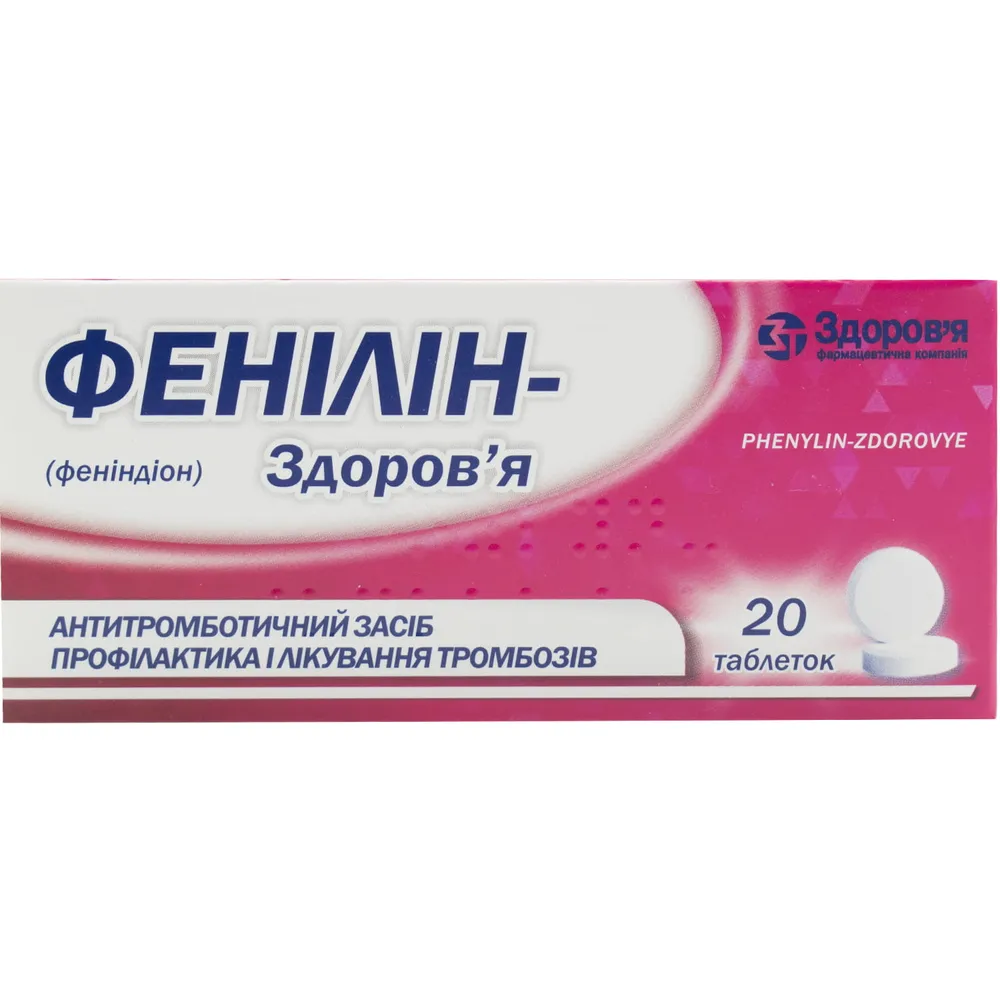
Table of Contents
INSTRUCTIONS for medical use | consumption | of the medicinal product PHENYLIN-ZDOROVYE (PHENYLIN-ZDOROVYE)
Composition:
Active substance: phenindione;
1 tablet | tablet | contains phenylin (|contains|phenindione) | 30 mg;
Excipients: lactose monohydrate; potato starch; talc; citric acid, monohydrate.
Pharmaceutical form. Tablets | tablets |.
Main physicochemical properties: tablets | tablets | white or white with | with | a creamy | shade of color, flat cylindrical in shape with beveled edges. Speckles are permissible.
Pharmacotherapeutic group. Antithrombotic agents. Vitamin K antagonists. ATC code B01A A02.
Pharmacological properties.
Pharmacodynamics. An agent affecting blood coagulation and platelet function. Indirect-acting anticoagulant.
The mechanism of action is due to competitive antagonism with vitamin K. Phenindione blocks vitamin K reductase, disrupts the formation in the liver of the active form of vitamin K, which is essential for the synthesis of prothrombin and other clotting factors (VII, IX, and X). Causes hypoprothrombinemia.
Reduces plasma tolerance to heparin, decreases blood lipid content, and improves vascular permeability.
The anticoagulant effect (reduction in the concentration of blood clotting factors) develops gradually (due to the action of previously synthesized clotting factors), becomes apparent within 8–10 hours, and reaches its maximum within 24–36 hours after administration. Duration of action persists for 1–4 days after discontinuation of the drug.
Pharmacokinetics. After oral administration, it is rapidly and almost completely absorbed. Protein binding is not strong. Crosses histohematologic barriers (including the placental barrier) and accumulates in tissues. Metabolized in the liver with the involvement of cytochrome P450. Excreted by the kidneys in unchanged form and as metabolites. May accumulate.
Clinical characteristics.
Indications. Prevention and treatment of thrombosis (especially deep vein thrombosis of the lower limbs|extremities|), thromboembolic complications (pulmonary artery embolism, embolic| strokes, myocardial infarction), and thrombus formation in the postoperative period, including in patients with mechanical heart valve prostheses.
Contraindications. Hypersensitivity to the components of the drug; hemophilia; threat of pregnancy termination; large postoperative wounds; bleeding from the gastrointestinal, respiratory, or genitourinary systems; recent surgical procedures or trauma to the brain/spinal cord or eyes; recent lumbar anesthesia, liver or kidney biopsy; severe|severe| hepatic and/or renal failure; hemorrhagic diatheses; hypocoagulation (initial|baseline| prothrombin| level less than 70%); erosive-ulcerative lesions|lesions| of the gastrointestinal tract; severe arterial hypertension; conditions where therapy cannot be conducted safely (e.g., psychoses, dementia, alcoholism).
Interaction with other medicinal products and other types of interactions. The effect of the drug is enhanced|enhanced| by thrombolytic|, antiplatelet| agents, anticoagulants, adrenocorticotropic hormone, anabolic| steroids, azathioprine|, allopurinol|, amiodarone|, anesthetics, narcotic analgesics, androgens, antibiotics, tricyclic| antidepressants, agents that acidify|acidify| urine, glucocorticosteroids|, diazoxide|, disopyramide|, nalidixic| acid, isoniazid|, clofibrate|, metronidazole|, paracetamol|, reserpine|, vitamin E, phenylbutazone, |sulfonamides|, disulfiram|, quinidine, cyclophosphamide|, thyroid hormones, iodine preparations, liquid paraffin, cimetidine, and other microsomal| oxidation inhibitors. The drug's effect is reduced|reduced| by vitamin K, propranolol|, agents that alkalinize urine, antacids|, cholestyramine|, phenazone|, haloperidol, diuretics, carbamazepine|, barbiturates, oral contraceptives, rifampicin|.
Special precautions for use|use|. Use with caution in elderly patients (increased risk of bleeding, especially intracranial|intracranial|), in moderate hepatic and/or renal insufficiency, increased vascular|vessel| permeability, pericarditis, during the postpartum period, and in gynecological disorders.
Particular attention is required when administering oral anticoagulants to patients prior to surgical procedures, including tooth extraction. Intramuscular and subcutaneous injections during treatment with this drug should be performed cautiously to avoid hematoma formation; the risk of bleeding is increased in patients with congestive heart failure, predisposition to thrombosis, and in women aged over 60 years.
In acute thrombosis, administer concurrently with|with| heparin.
Calciphylaxis is a rare syndrome of vascular calcification with skin necrosis, associated with high mortality. This condition is primarily observed in patients with end-stage renal disease undergoing hemodialysis, or in patients with risk factors such as protein C or S deficiency, hyperphosphatemia, hypercalcemia, or hypoalbuminemia. Rare cases of calcification have been reported in patients receiving vitamin K antagonists, including phenindione, even in the absence of kidney disease. If calciphylaxis is diagnosed, appropriate treatment should be initiated and discontinuation of the drug should be considered.
During treatment with the drug, regular monitoring of the prothrombin| ratio (normal range — 2.0–4.0) is required, along with regular extended coagulation| blood tests (coagulogram, thromboelastogram|, platelet count), and urine analysis for early detection of hematuria.
To monitor anticoagulant activity, use the prothrombin| time: reliable prevention of venous thrombosis is achieved when prothrombin| time is doubled, and arterial thrombosis prevention when it is increased 3–4 times (normal range — 11–14 seconds).
The drug should not be administered during menstruation (treatment should be discontinued 2 days before onset) and in the first days after|after| childbirth.
Pink|rose-colored| discoloration of urine and orange discoloration of palms are due to phenindione| metabolism (conversion to the enol| form) and are not dangerous. Urine color|color| changes with acidification of urine, which can be used to differentiate urine discoloration from hematuria. In cases of palm discoloration and urine color| changes, the drug should be replaced with another anticoagulant, except for omefin|.
The drug contains lactose; therefore, if a patient has known intolerance to certain sugars, medical advice should be sought before taking this medicinal product.
Use during pregnancy or breastfeeding. The drug is contraindicated during pregnancy (especially in the first trimester and in the second half of the third trimester). The drug should not be used in the first days after|after| childbirth. If use|use| of the drug is necessary, breastfeeding should be discontinued.
Ability to affect reaction speed when driving or operating machinery. During treatment, patients should refrain from driving and from potentially hazardous activities requiring increased attention and speed|quickness| of psychomotor reactions.
Dosage and Administration.
Administer orally after meals to adults and children aged 14 years and older (with body weight of at least 45 kg).
The dose is determined individually by a physician, taking into account sensitivity to the drug, the nature of the disease, dietary habits, and concomitant therapy.
For adults: on the first day of treatment, administer a daily dose of 120–180 mg (4–6 tablets) in 3–4 divided doses; on the second day, 90–150 mg (3–5 tablets) daily; thereafter, 30–60 mg (1–2 tablets) in 1–2 divided doses, depending on the blood prothrombin level.
For children aged 14 years and older (with body weight of at least 45 kg): on the first and second days of treatment, administer a daily dose of 90–150 mg (3–5 tablets) in 3–4 divided doses; thereafter, 30–60 mg (1–2 tablets) in 1–2 divided doses, depending on the blood prothrombin level.
The single dose, frequency, and duration of administration are determined individually by the physician based on the prothrombin index value, which should be maintained within 40–60%. If the prothrombin level falls below 40–50%, the drug should be discontinued immediately.
For prophylaxis of thromboembolic complications: administer 30 mg (1 tablet) 1–2 times daily.
Maximum doses for adults: single dose — 50 mg; daily dose — 200 mg.
The drug should be discontinued gradually.
Children. The drug is indicated for children aged 14 years and older with body weight of at least 45 kg.
Overdose.
Symptoms: hemorrhagic syndrome (gastrointestinal, uterine, or nasal bleeding, hematuria, hemorrhages into the skin, muscles, or parenchymatous organs).
Treatment: discontinue the drug; administer vitamin K orally (5–10 mg). In cases of severe bleeding, administer vitamin K intravenously slowly (1 mg/min) at a total dose of 10–50 mg (normalizes prolonged prothrombin time within 6 hours). In cases of massive bleeding or in patients with hepatic insufficiency, simultaneously administer fresh frozen plasma. Use of aminocaproic acid, vitamin C, and vitamin P may also be considered.
Adverse reactions.
Hematologic system: with prolonged use — micro- and macrohematuria, bleeding from the oral cavity and nasopharynx, gastrointestinal hemorrhage, hemorrhage into muscles.
Blood system: suppression of bone marrow hematopoiesis (agranulocytosis, leukopenia, leukemoid reactions).
Gastrointestinal system: nausea, vomiting, diarrhea, sore throat, taste disturbances, stomatitis, toxic hepatitis, jaundice, ulcerative colitis, paralytic ileus with abdominal distension.
Cardiovascular system: myocarditis.
Allergic reactions: skin rash (erythematous, macular, papular), exfoliative dermatitis, eosinophilia, hyperthermia, massive edema, skin necrosis.
Urinary system: impaired kidney function, pink or rose-colored urine, albuminuria.
Other: headache, orange discoloration of palms.
Shelf life. 3 years.
Storage conditions. Store in the original packaging at a temperature not exceeding 25 °C. Keep out of reach of children.
Packaging. Tablets, 20 in a blister pack in a box.
Prescription status. Prescription only.
Manufacturer. Limited Liability Company "Pharmaceutical Company "Zdorov'ya".
Manufacturer's address and location of business activity. Ukraine, 61013, Kharkiv region, city of Kharkiv, Shevchenko Street, building 22.