Femoston conti mini
Ukraine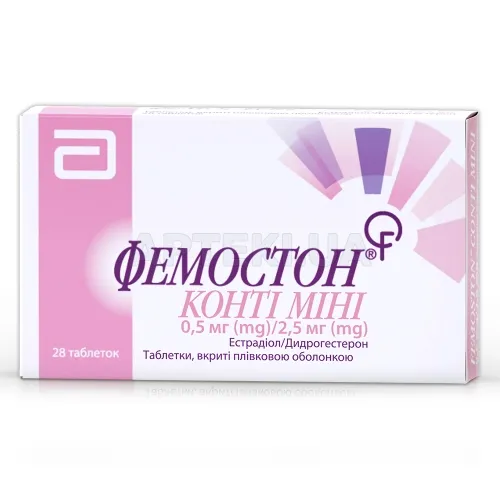
Table of Contents
INSTRUCTIONS FOR MEDICAL USE OF THE MEDICINAL PRODUCT FEMOSTON® CONTI MINI (FEMOSTON® CONTI MINI)
Composition:
Active substances: dydrogesterone; estradiol;
One tablet contains micronized dydrogesterone 2.5 mg and micronized hemihydrate estradiol equivalent to estradiol 0.5 mg;
Excipients: lactose monohydrate; hypromellose (HPMC 2910); maize starch; colloidal anhydrous silicon dioxide; magnesium stearate; film coating Yellow 1 (macrogol 3350, polyvinyl alcohol, talc, titanium dioxide (E 171), iron oxide yellow (E 172)).
Pharmaceutical form. Film-coated tablets.
Main physicochemical properties: round, biconvex, yellow film-coated tablets with the inscription "379" on one side.
Pharmacotherapeutic group. Drugs for the treatment of diseases of the genitourinary system and sex hormones. Progestogens in combination with estrogens. Dydrogesterone and estrogen. ATC code G03F A14.
Pharmacological properties.
Pharmacodynamics.
Estradiol
The active component, 17ß-estradiol, is chemically and biologically similar to endogenous human estradiol. Estradiol replaces the declining estrogen production in women during menopause and alleviates menopausal symptoms.
Dydrogesterone
Dydrogesterone is an orally active progestogen whose activity is comparable to that of parenterally administered progesterone.
Since estrogens stimulate endometrial growth, estrogen monotherapy increases the risk of endometrial hyperplasia and endometrial cancer. Adding a progestogen to estrogen therapy significantly reduces the estrogen-induced risk of endometrial hyperplasia in women with an intact uterus.
Clinical trial data
Reduction of estrogen deficiency symptoms and improvement of bleeding profile.
Reduction of menopausal symptoms was observed within the first few weeks of treatment.
With FEMOSTON® CONTI MINI, a statistically significant reduction in moderate and severe hot flushes compared to placebo was observed starting from week 4 of treatment. The frequency of moderate and severe hot flushes continued to decrease throughout the treatment period up to week 13. In two studies, amenorrhea (absence of bleeding or spotting) was observed in approximately 91% and 88% of women, respectively, during months 10–12 of treatment. Irregular bleeding and/or spotting occurred in approximately 10% and 21% of women during the first 3 months of treatment, and in approximately 9% and 12% during months 10–12 of treatment.
Pharmacokinetics.
Estradiol
Absorption
Estradiol absorption depends on particle size. Micronized estradiol is rapidly absorbed from the gastrointestinal tract.
The following Table 1 presents mean steady-state pharmacokinetic parameters of estradiol (E2), estrone (E1), and estrone sulfate (E1S) for each dose of micronized estradiol. Data are presented as mean (SD).
Table 1
| Estradiol 0.5 mg |
||||
| Parameters |
E2 |
E1 |
Parameters |
E1S |
| Cmax (pg/mL) |
34.8 (30.4) |
182 (110) |
Cmax (ng/mL) |
6.98 (3.32) |
| Cmin (pg/mL) |
- |
- |
- |
- |
| Cav (pg/mL) |
21.5 (16.0) |
- |
- |
- |
| AUC0-t (pg·h/mL) |
516 (383) |
2959 (2135) |
AUC0-t (ng·h/mL) |
82.0 (42.6) |
Distribution
Estrogens are present in either free or protein-bound form. Approximately 98–99% of the estradiol dose is bound to plasma proteins, of which 30–52% is bound to albumin and about 46–69% to sex hormone-binding globulin (SHBG).
Metabolism
After oral administration, estradiol is subject to extensive metabolism. The main unconjugated and conjugated metabolites are estrone and estrone sulfate. These metabolites may contribute to estrogenic activity directly or after conversion to estradiol. Estrone sulfate may participate in enterohepatic recirculation.
Excretion
In urine, the main compounds are glucuronides of estrone and estradiol. The elimination half-life ranges from 10 to 16 hours. Estrogens are excreted into breast milk.
Dose- and time-dependency
With daily administration of FEMOSTON® CONTI MINI, estradiol concentrations reach steady state by approximately day 5. In most cases, steady-state concentrations are achieved between days 8 and 11 of treatment.
Dydrogesterone
Absorption
After oral administration, dydrogesterone is rapidly absorbed, with a Tmax of 0.5–1.5 hours.
Table 2 below presents mean steady-state pharmacokinetic parameters of dydrogesterone (D) and dihydrodydrogesterone (DHD). Data are presented as mean (SD).
Table 2
| Dydrogesterone 2.5 mg |
||
| Parameters |
D |
DHD |
| Cmax (ng/mL) |
0.759 (0.313) |
18.9 (7.22) |
| Cmin (ng/mL) |
0.0309 (0.0209) |
- |
| Cav (ng/mL) |
0.117 (0.0455) |
- |
| AUC0-τ (ng*hour/mL) |
2.81 (1.09) |
90.4 (44.1) |
|milligram-equivalents|
After administration of a single dose, food delays the time to reach peak plasma concentration of dydrogesterone by approximately 1 hour, resulting in a reduction of peak plasma concentrations of dydrogesterone by about 20%, without affecting the extent of exposure to dydrogesterone and DHD.
Distribution.
After oral administration, the apparent volume of distribution of dydrogesterone is large, amounting to approximately 22,000 liters. Dydrogesterone and DHD are more than 90% bound to plasma proteins.
Metabolism.
After oral administration, dydrogesterone is rapidly metabolized to form DHD. Plasma levels of the main active metabolite, 20α-dihydrodydrogesterone (DHD), reach peak concentrations at the same time as dydrogesterone. Plasma levels of DHD are significantly higher compared to the parent compound. The AUC and Cmax ratios of DHD to dydrogesterone are approximately 25 and 20, respectively. The mean terminal elimination half-life of dydrogesterone and DHD is about 15 hours. A common characteristic of all metabolites is the preservation of the 4,6-diene-3-one configuration of the parent compound and the absence of 17α-hydroxylation. This explains the lack of estrogenic and androgenic effects of dydrogesterone.
Excretion.
After oral administration of radiolabeled dydrogesterone, on average 63% of the dose is excreted in urine. The apparent total plasma clearance of dydrogesterone is high, amounting to approximately 20 L/min. Complete elimination is achieved within 72 hours. DHD is present in urine predominantly as a conjugate with glucuronic acid.
Dose and time dependence.
Pharmacokinetics after single and multiple doses are linear in the range of oral doses from 2.5 to 20 mg (milligram-equivalents). Comparison of single and multiple dose kinetics shows that the pharmacokinetics of dydrogesterone and DHD are not altered by repeated administration. Steady-state conditions are usually achieved after 3 days of treatment.
Clinical characteristics.
Indications.
Hormone replacement therapy (HRT) for relief of symptoms due to estrogen deficiency in postmenopausal women, not earlier than 12 months after the last menstruation.
Contraindications.
- Known hypersensitivity to the active substances or to any of the excipients.
- Diagnosed or suspected breast cancer.
- Established or suspected estrogen-dependent malignant neoplasms (e.g., endometrial cancer).
- Established or suspected progestagen-dependent neoplasms.
- Meningioma or history of meningioma.
- Genital bleeding of unknown etiology.
- Untreated endometrial hyperplasia.
- History of or current venous thromboembolism (deep vein thrombosis, pulmonary embolism).
- Presence of thrombophilic disorders (e.g., protein C, protein S or antithrombin deficiency; see section "Special precautions").
- Acute or recent arterial thromboembolic disease (e.g., angina pectoris, myocardial infarction).
- Acute liver disease or history of liver disease if liver function tests have not normalized.
- Porphyria.
Interaction with other medicinal products and other forms of interaction.
Drug interaction studies have not been conducted.
Efficacy of estrogens and progestagens may be impaired
- Metabolism of estrogens and progestagens may be enhanced when co-administered with substances known to induce enzymes involved in drug metabolism, particularly CYP450 2B6, 3A4, 3A5, 3A7. Such substances include anticonvulsants (e.g., phenobarbital, carbamazepine, phenytoin) and anti-infective agents (e.g., rifampicin, rifabutin, nevirapine, efavirenz).
- Although ritonavir and nelfinavir are known as potent inhibitors of CYP450 3A4, 3A5, 3A7, when co-administered with steroid hormones they paradoxically induce these enzymes.
- Herbal preparations containing St. John’s wort (Hypericum perforatum) may enhance metabolism of estrogens and progestagens via effects on CYP450 3A4.
- Clinically, increased metabolism of estrogens and progestagens may lead to reduced efficacy and changes in uterine bleeding patterns.
Effect of HRT with estrogens on other medicinal products
Hormonal contraceptives containing estrogens have been shown to substantially reduce lamotrigine plasma concentrations due to induction of lamotrigine glucuronidation. This may reduce seizure control. Although the potential interaction between hormone replacement therapy and lamotrigine has not been studied, a similar interaction is expected, which may lead to reduced seizure control in women taking both medications.
Pharmacodynamic interactions
During clinical trials of hepatitis C virus (HCV) treatment with the combination of ombitasvir/paritaprevir/ritonavir and dasabuvir with or without ribavirin, ALT levels exceeding the upper limit of normal by more than 5 times were observed significantly more frequently in women taking ethinylestradiol-containing medicinal products, such as combined hormonal contraceptives (CHCs). Additionally, ALT elevation was also observed in women receiving glecaprevir/pibrentasvir or sofosbuvir/velpatasvir/voxilaprevir who were taking ethinylestradiol-containing medicinal products such as CHCs. In women taking medicinal products containing estrogens other than ethinylestradiol, such as estradiol, in combination with ombitasvir/paritaprevir/ritonavir and dasabuvir with or without ribavirin, the degree of ALT elevation was similar to that in women not receiving any estrogens; however, due to the limited number of women taking other estrogens, caution is advised when co-administering this medicinal product with the following combination therapies: ombitasvir/paritaprevir/ritonavir and dasabuvir with or without ribavirin, glecaprevir/pibrentasvir, or sofosbuvir/velpatasvir/voxilaprevir (see section "Special precautions").
Estrogens may interfere with metabolism of other medicinal products
Estrogens may inhibit CYP450 enzymes involved in drug metabolism through competitive inhibition. This should be particularly considered for medicinal products with a narrow therapeutic index, such as:
- Tacrolimus and cyclosporine A (CYP450 3A4, 3A3);
- Fentanyl (CYP450 3A4);
- Theophylline (CYP450 1A2).
Clinically, this may lead to increased plasma levels of these substances to toxic concentrations. Therefore, careful monitoring of drug levels over a prolonged period may be required, as well as dose reduction of tacrolimus, fentanyl, cyclosporine A, and theophylline.
Special precautions for use.
For treatment of symptoms related to postmenopause in women, hormone replacement therapy (HRT) should be initiated only when such symptoms adversely affect quality of life. In all cases, a careful benefit-risk assessment should be performed at least annually, and HRT should be continued only if benefits outweigh risks.
Evidence regarding risks associated with HRT in the treatment of premature menopause is limited. However, due to the low absolute risk in younger women, the benefit-risk ratio in these women may be more favorable than in older women.
Medical examination/follow-up
Prior to initiating or resuming hormone replacement therapy, a complete personal and family history should be obtained. Physical examination (including gynecological and breast examination) should be performed, taking into account the patient’s history, contraindications, and warnings for use of this medicinal product. Periodic examinations are recommended during treatment, with frequency and extent determined individually. Women should be informed about changes in the breasts that should be reported to a physician or nurse (see "Breast cancer" below). Examinations, including appropriate imaging methods such as mammography, should be performed according to established screening practices, modified according to individual clinical needs.
Conditions requiring monitoring of patients
Patients with any of the following conditions currently present, in history, or with worsening during pregnancy or previous hormonal therapy should be closely monitored. It should be noted that these conditions may recur or worsen during treatment with FEMOSTON® CONTI MINI. These include:
- Leiomyoma (uterine fibroids) or endometriosis;
- Risk factors for thromboembolic disorders (see below);
- Risk factors for estrogen-dependent tumors, e.g., first-degree hereditary predisposition to breast cancer;
- Arterial hypertension;
- Liver disease (e.g., liver adenoma);
- Diabetes mellitus with or without vascular complications;
- Cholelithiasis;
- Migraine or (severe) headache;
- Systemic lupus erythematosus;
- History of endometrial hyperplasia (see below);
- Epilepsy;
- Bronchial asthma;
- Otosclerosis.
Meningioma
Cases of meningioma (single and multiple) have been reported during treatment with FEMOSTON® CONTI MINI. Patients should be monitored for signs and symptoms of meningioma according to clinical practice. If meningioma is diagnosed, any treatment with FEMOSTON® CONTI MINI should be discontinued (see section "Contraindications"). Tumor regression has been observed after discontinuation of treatment.
Reasons for immediate discontinuation of therapy
Therapy should be discontinued if a contraindication is identified, as well as in the following situations:
- Development of jaundice or worsening of liver function;
- Significant increase in blood pressure;
- First occurrence of migraine-like headache;
- Pregnancy.
Endometrial hyperplasia and carcinoma
In women with an intact uterus, the risk of endometrial hyperplasia and carcinoma increases with prolonged use of estrogens alone. An increase in endometrial cancer risk by 2–12 times has been observed in women taking estrogen-only therapy compared to non-users, depending on duration of treatment and estrogen dose (see section "Adverse reactions"). The risk may remain elevated for at least 10 years after discontinuation of treatment.
Adding progestagen cyclically for at least 12 days per 28-day cycle or continuous combined estrogen-progestagen therapy in women with an intact uterus can prevent the excess risk associated with estrogen-only HRT.
Breakthrough uterine bleeding or spotting may occur during the first months of treatment. If they occur after some time from the start of treatment or persist after discontinuation, their cause should be investigated, which may include endometrial biopsy to exclude malignant neoplasms.
Breast cancer
Overall data indicate an increased risk of breast cancer in women taking combined estrogen-progestagen or estrogen-only HRT, depending on the duration of HRT.
Combined estrogen-progestagen therapy
Both the randomized placebo-controlled Women’s Health Initiative Study (WHI) and meta-analysis of prospective epidemiological studies consistently show an increased risk of breast cancer in women using combined estrogen-progestagen therapy as HRT, becoming evident after approximately 3 (1–4) years (see section "Adverse reactions").
Estrogen-only therapy
The Women’s Health Initiative Study (WHI) did not show an increased risk of breast cancer in women after hysterectomy taking estrogen-only HRT. Observational studies have mainly reported a slight increase in risk of breast cancer diagnosis, which is significantly lower than in patients taking combinations of estrogen and progestagen (see section "Adverse reactions").
Results of a large-scale meta-analysis showed that after discontinuation of treatment, the increased risk decreases over time, and the time required to return to baseline levels depends on the duration of prior HRT use. If HRT was used for more than 5 years, the risk may persist for 10 years or longer. HRT, particularly combined estrogen-progestagen therapy, increases mammographic density, which may negatively affect radiological detection of breast cancer.
Ovarian cancer
Ovarian cancer occurs significantly less frequently than breast cancer. Epidemiological data from a large meta-analysis showed a slightly increased risk in women using estrogen-only or estrogen-progestagen combination therapy as hormone replacement therapy; this risk emerges within 5 years of use and decreases over time after discontinuation of therapy. Some other studies, including the WHI study, suggest that use of combined HRT may be associated with the same or slightly lower risk (see section "Adverse reactions").
Venous thromboembolism
HRT is associated with a 1.3–3-fold increased risk of venous thromboembolism (VTE), i.e., deep vein thrombosis or pulmonary embolism. The occurrence of this event is more likely during the first year of HRT than later (see section "Adverse reactions").
Patients with known thrombophilic disorders have an increased risk of VTE, and HRT may further increase this risk. Therefore, hormone replacement therapy is contraindicated in this group of patients (see section "Contraindications").
Well-established risk factors for VTE include estrogen use, advanced age, major surgery, prolonged immobilization, obesity (BMI > 30 kg/m²), pregnancy/postpartum period, systemic lupus erythematosus (SLE), and cancer. There is no consensus on the role of varicose veins in VTE development.
As for all postoperative patients, preventive measures should be taken to prevent VTE after surgery. If prolonged immobilization is required after elective surgery, temporary discontinuation of HRT is recommended 4–6 weeks before the procedure. Treatment should not be resumed until the woman has fully regained mobility.
Women without personal history of VTE but with a first-degree relative with thrombosis at a young age may be offered screening after careful discussion of its limitations (screening detects only a portion of thrombophilic disorders).
HRT is contraindicated if a thrombophilic disorder is detected that differs from the type of thrombosis in family members or if the disorder is severe (e.g., antithrombin, protein S or protein C deficiency, or a combination of disorders).
For women already on long-term anticoagulant therapy, the benefits and risks of HRT use should be carefully weighed.
If venous thromboembolism develops after starting therapy, the medicinal product should be discontinued. Patients should be warned to seek immediate medical attention if symptoms suggestive of thromboembolism occur (e.g., painful leg swelling, sudden chest pain, dyspnea).
Ischemic heart disease (IHD)
Randomized controlled trials have not provided evidence of protection against myocardial infarction in women with or without IHD who were taking combined estrogen-progestagen HRT or estrogen-only HRT.
Combined estrogen-progestagen therapy
The relative risk of IHD with combined estrogen-progestagen HRT is slightly increased. Since the baseline absolute risk of IHD largely depends on age, the number of additional IHD cases due to estrogen and progestagen use is very small in healthy women close to menopause but will increase with age.
Estrogen-only therapy
Data from randomized controlled trials did not show an increased risk of IHD in women after hysterectomy receiving estrogen-only therapy.
Ischemic stroke
Combined estrogen-progestagen and estrogen-only therapies are associated with up to a 1.5-fold increased risk of ischemic stroke. The relative risk does not change with age or time since menopause. However, since the baseline risk of stroke largely depends on age, the overall risk of stroke in women taking HRT increases with age (see section "Adverse reactions").
Other conditions
Estrogens may cause fluid retention; therefore, careful monitoring is required in patients with cardiac or renal impairment.
Women with pre-existing hypertriglyceridemia should be closely monitored during estrogen replacement or hormone replacement therapy, as rare cases of significant increases in plasma triglyceride levels leading to pancreatitis have been observed in such women during estrogen treatment.
Exogenous estrogens may induce or exacerbate symptoms of hereditary or acquired angioedema.
Estrogens increase thyroxine-binding globulin (TBG) levels, resulting in increased concentrations of circulating total thyroid hormones, measured as protein-bound iodine, thyroxine (by column or radioimmunoassay), or triiodothyronine (by radioimmunoassay). Triiodothyronine uptake is reduced, indicating elevated TBG. Concentrations of free thyroxine and triiodothyronine remain unchanged. Levels of other serum binding proteins—corticosteroid-binding globulin and sex hormone-binding globulin—may also increase, leading to increased circulating levels of corticosteroids and sex hormones, respectively. Concentrations of free or biologically active hormones remain unchanged. Concentrations of other plasma proteins (angiotensinogen/renin substrate, alpha-1-antitrypsin, ceruloplasmin) may also increase.
HRT does not improve cognitive function. Some data suggest an increased risk of possible dementia in women who initiate long-term combined or estrogen-only HRT after age 65.
Patients with rare hereditary conditions such as galactose intolerance, total lactase deficiency, or glucose-galactose malabsorption should not take this medicinal product.
Combined estrogen/progestagen therapy is not a method of contraception.
Experience with treatment in women over 65 years of age is limited.
Elevation of ALT levels
During clinical trials involving patients treated for hepatitis C virus (HCV) infection with the combination of ombitasvir/paritaprevir/ritonavir and dasabuvir with or without ribavirin, ALT levels exceeding the upper limit of normal by more than 5 times were observed significantly more frequently in women taking ethinylestradiol-containing medicinal products, such as combined hormonal contraceptives (CHCs). Additionally, ALT elevation was also observed in patients receiving glecaprevir/pibrentasvir or sofosbuvir/velpatasvir/voxilaprevir who were taking ethinylestradiol-containing medicinal products such as CHCs. In women taking medicinal products containing estrogens other than ethinylestradiol, such as estradiol, in combination with ombitasvir/paritaprevir/ritonavir and dasabuvir with or without ribavirin, the degree of ALT elevation was similar to that in women not receiving any estrogens; however, due to the limited number of women taking other estrogens, caution is advised when co-administering this medicinal product with the following combination therapies: ombitasvir/paritaprevir/ritonavir and dasabuvir with or without ribavirin, glecaprevir/pibrentasvir, or sofosbuvir/velpatasvir/voxilaprevir (see section "Interaction with other medicinal products and other forms of interaction").
Use during pregnancy or breastfeeding.
FEMOSTON® CONTI MINI is not indicated for use during pregnancy. If pregnancy occurs during treatment with FEMOSTON® CONTI MINI, the medicinal product should be discontinued immediately.
Current results of most epidemiological studies on accidental fetal exposure to combinations of estrogens and progestagens indicate absence of teratogenic or fetotoxic effects.
There are insufficient data on the use of estradiol/dydrogesterone in pregnant women.
Breastfeeding
FEMOSTON® CONTI MINI is not indicated for use during breastfeeding.
Ability to affect reaction speed when driving or operating machinery.
FEMOSTON® CONTI MINI has no effect or negligible effect on the ability to drive or operate machinery.
Method of administration and dosage.
For oral use.
Continuous combined regimen: estrogen and progestagen are taken daily without interruption. One tablet should be taken daily throughout a 28-day cycle.
FEMOSTON® CONTI MINI should be taken continuously, without interruption between packs.
For initiation and continuation of treatment of postmenopausal symptoms, the lowest effective dose should be used for the shortest duration (see section "Special precautions").
Continuous combined therapy can be initiated with FEMOSTON® CONTI MINI or FEMOSTON® CONTI depending on the time elapsed since the onset of menopause and severity of symptoms.
Depending on clinical response, dosage may later be adjusted according to individual needs.
Patients switching from continuous sequential or cyclic regimens of other medicinal products should complete their current 28-day treatment cycle, after which they may switch to FEMOSTON® CONTI MINI. Patients switching from continuous combined regimens may start treatment with FEMOSTON® CONTI MINI at any time.
If a tablet is missed, it should be taken as soon as possible. If more than 12 hours have passed, treatment should continue with the next tablet, without taking the missed dose. In such cases, the likelihood of breakthrough bleeding or spotting may be increased.
FEMOSTON® CONTI MINI may be taken independently of food intake.
Children.
The medicinal product is not intended for use in children.
Overdose.
Both estradiol and dydrogesterone are substances with low toxicity. Symptoms of overdose may include nausea, vomiting, breast tenderness, dizziness, abdominal pain, drowsiness/fatigue, and withdrawal bleeding. It is unlikely that specific symptomatic treatment will be required in cases of overdose. This also applies to cases of overdose in children.
Adverse reactions
The most common adverse reactions observed in patients receiving estradiol/dydrogesterone therapy during clinical trials were headache, abdominal pain, breast pain/tenderness, and back pain.
Adverse reactions observed during clinical trials (n=5108) are grouped in Table 3 according to their frequency.
Table 3
| MedDRA System Organ Classes |
Very common ≥1/10 |
Common from ≥1/100 to <1/10 |
Uncommon from ≥1/1000 to <1/100 |
Rare from ≥1/10000 to <1/1000 |
| Infections and infestations |
Vaginal candidiasis |
|||
| Benign, malignant and unspecified neoplasms |
Increased size of leiomyoma |
|||
| Immune system disorders |
Hypersensitivity |
|||
| Psychiatric disorders |
Depression, nervousness |
Decreased libido |
||
| Nervous system disorders |
Headache |
Migraine, dizziness |
||
| Cardiac disorders |
Myocardial infarction |
|||
| Vascular disorders |
Venous thromboembolism* |
|||
| Gastrointestinal disorders |
Abdominal pain |
Nausea, vomiting, flatulence |
||
| Hepatobiliary disorders |
Liver function abnormalities, in some cases with jaundice, asthenia or malaise and abdominal pain, gallbladder function disorders |
|||
| Skin and subcutaneous tissue disorders |
Allergic skin reactions (e.g. rash, urticaria, pruritus) |
Angioneurotic edema, vasculitis |
||
| Musculoskeletal and connective tissue disorders |
Back pain |
|||
| Reproductive system and breast disorders |
Breast pain/tenderness |
Menstrual disorders (including postmenopausal bleeding, metrorrhagia, menorrhagia, oligo-/amenorrhea, irregular menstruation, dysmenorrhea), pelvic pain, cervical discharge |
Breast enlargement, premenstrual syndrome |
|
| General disorders and administration site conditions |
Asthenic conditions (asthenia, fatigue, malaise), peripheral edema |
|||
| Investigations |
Increased body weight |
Decreased body weight |
* See additional information below.
Breast cancer risk
- Up to a 2-fold increased risk of diagnosed breast cancer has been reported in women receiving combined estrogen-progestagen therapy for a period of more than 5 years.
- The increased risk in patients receiving estrogen-only|monotherapy is lower than in|around|those who|WHO| receive combined estrogen-progestagen therapy.|
- The level of risk depends on the duration of use|use| (see section «Special precautions»).
- Below is an assessment of the absolute risk based on results from the largest randomized placebo-controlled Women’s Health Initiative (WHI) study and the largest meta-analysis of prospective epidemiological studies.
The largest meta-analysis of prospective epidemiological studies
Table 4
Estimated additional risk of breast cancer after 5 years of use in women with a body mass index of 27 kg/m²
| Age at initiation of HRT (years) |
Number of cases per 1000 women who have never used HRT, over a 5-year period (50–54 years)1 |
Relative risk |
Number of additional cases per 1000 women taking HRT, over 5 years |
| HRT with estrogen-only therapy |
|||
| 50 |
13.3 |
1.2 |
2.7 |
| HRT with combined estrogen-progestogen therapy |
|||
| 50 |
13.3 |
1.6 |
8.0 |
| Note: Since breast cancer incidence varies across each EU country, the number of additional breast cancer cases will also change proportionally. 1Based on baseline incidence rates in England in 2015 for women with a body mass index of 27 kg/m². |
|||
Table 5
Estimated additional risk of breast cancer after 10 years of use in women with a body mass index of 27 kg/m2
| Age at start of HRT (years) |
Number of cases per 1000 women who have never used HRT over a 10-year period (50–59 years)1 |
Relative risk |
Number of additional cases per 1000 women using HRT over 10 years |
| HRT with estrogen-only therapy |
|||
| 50 |
26.6 |
1.3 |
7.1 |
| HRT with combined estrogen and progestogen therapy |
|||
| 50 |
26.6 |
1.8 |
20.8 |
| 1Taken from baseline incidence rates in England in 2015 for women with a body mass index of 27 kg/m2. Note: since breast cancer incidence varies in each EU country, the number of additional breast cancer cases will also change proportionally. |
|||
Table 6
WHI study in the USA: additional risk of breast cancer after 5 years of use
| Age range (years) |
Number of cases per 1000 women in the placebo group over 5 years |
Relative risk and 95% confidence interval (CI) |
Number of additional cases per 1000 women receiving HRT over 5 years (95% CI) |
| CEE alone as estrogen-only hormone therapy |
|||
| 50–79 |
21 |
0.8 (0.7–1.0) |
-4 (-6–0)² |
| CEE+MPA combined estrogen-progestogen HRT ‡ |
|||
| 50–79 |
17 |
1.2 (1.0–1.5) |
+4 (0–9) |
| ‡ Among women not using HRT prior to the study, no significant risk was observed during the first 5 years of treatment; after 5 years of HRT, the risk was higher than in non-users. |
|||
Endometrial cancer risk
Postmenopausal women with intact uterus
The risk of endometrial cancer is approximately 5 cases per 1000 women with intact uterus who do not use HRT.
The use of estrogen-only HRT in women with intact uterus is not recommended due to an increased risk of endometrial cancer (see section "Special precautions"). Depending on the duration of estrogen-only therapy and estrogen dose, the increase in endometrial cancer risk observed in epidemiological studies ranged from 5 to 55 additional cases diagnosed per 1000 women aged 50 to 65 years.
Adding a progestagen to estrogen-only therapy for at least 12 days per cycle can prevent this increased risk. In the Million Women Study (MWS), the use of combined (sequential or continuous) HRT for five years did not increase the risk of endometrial cancer (risk ratio 1.0 (0.8–1.2)).
Ovarian cancer
The use of estrogen-only or combined estrogen-progestagen HRT has been associated with a slightly increased risk of ovarian cancer diagnosis (see section "Special precautions").
In data from a meta-analysis of 52 epidemiological studies, an increased risk of ovarian cancer was reported in women using HRT compared to women who had never used HRT (risk ratio 1.43, 95% CI 1.31–1.56). In women aged 50 to 54 years who used HRT for 5 years, this resulted in 1 additional case per 2000 women. In women aged 50 to 54 years who did not use HRT, ovarian cancer is diagnosed in approximately 2 out of 2000 women over 5 years.
Venous thromboembolism risk
HRT is associated with a 1.3- to 3-fold increase in the relative risk of venous thromboembolism (VTE), i.e., deep vein thrombosis or pulmonary embolism. The occurrence of such events is more likely during the first year of HRT use (see section "Special precautions").
Among 4 to 7 out of 1000 women aged 50 years who do not use HRT, a venous thrombosis may occur on average over five years.
Among 9 to 12 out of 1000 women aged 50 years who use estrogen-progestagen HRT for five years, a venous thrombosis may occur (i.e., 5 additional cases).
Ischemic heart disease risk
The risk of ischemic heart disease is slightly increased in women aged 60 years and older who use combined estrogen-progestagen HRT (see section "Special precautions").
Ischemic stroke risk
The use of estrogen-only therapy and estrogen-progestagen therapy is associated with up to a 1.5-fold increase in the relative risk of ischemic stroke. The risk of hemorrhagic stroke is not increased during HRT use.
The relative risk does not depend on age or duration of use, but since the baseline risk increases significantly with age, the overall risk of stroke in women using HRT rises with increasing age (see section "Special precautions").
Among 8 out of 1000 women aged 50 years who do not use HRT, an ischemic stroke may occur on average over five years. Among 11 out of 1000 women aged 50 years who use HRT, an ischemic stroke may occur (i.e., 3 additional cases).
Other adverse reactions reported in association with estrogen/progestagen therapy (including estradiol/dydrogesterone):
- Benign, malignant and unspecified neoplasms: estrogen-dependent neoplasms, both benign and malignant, e.g., endometrial cancer, ovarian cancer. Increase in size of progestagen-dependent neoplasms (e.g., meningiomas);
- Blood and lymphatic system disorders: hemolytic anemia;
- Immune system disorders: systemic lupus erythematosus;
- Metabolism and nutrition disorders: hypertriglyceridemia;
- Nervous system disorders: possible dementia, chorea, exacerbation of epilepsy;
- Eye disorders: increased corneal curvature, intolerance to contact lenses;
- Reproductive system and breast disorders: fibrocystic changes in the breasts, cervical erosion;
- Vascular disorders: arterial thromboembolism;
- Gastrointestinal disorders: pancreatitis (in women with pre-existing hypertriglyceridemia);
- Skin and subcutaneous tissue disorders: erythema multiforme, nodular erythema, chloasma or melasma, which may persist after discontinuation of the drug;
- Musculoskeletal and connective tissue disorders: leg cramps;
- Investigation findings: increased total thyroid hormone levels;
- Congenital, familial and genetic disorders: worsening of porphyria;
- Renal and urinary disorders: urinary incontinence.
Reporting suspected adverse reactions after medicine authorization is important. It allows continuous monitoring of the benefit-risk balance of the medicinal product. Healthcare professionals and patients, as well as their legal representatives, are encouraged to report all suspected adverse reactions and lack of efficacy through the Automated Pharmacovigilance Information System at: https://aisf.dec.gov.ua.
Shelf life. 4 years.
Storage conditions. Store in a place inaccessible to children. No special storage conditions required.
Packaging. 28 tablets per blister. 1 or 3 blisters per cardboard box.
Prescription status. Prescription only.
Manufacturer. Abbott Biologicals B.V., The Netherlands.
Manufacturer's address and location of operations. Veerweg 12, 8121 AA Olst, The Netherlands.