Fastum® gel
Ukraine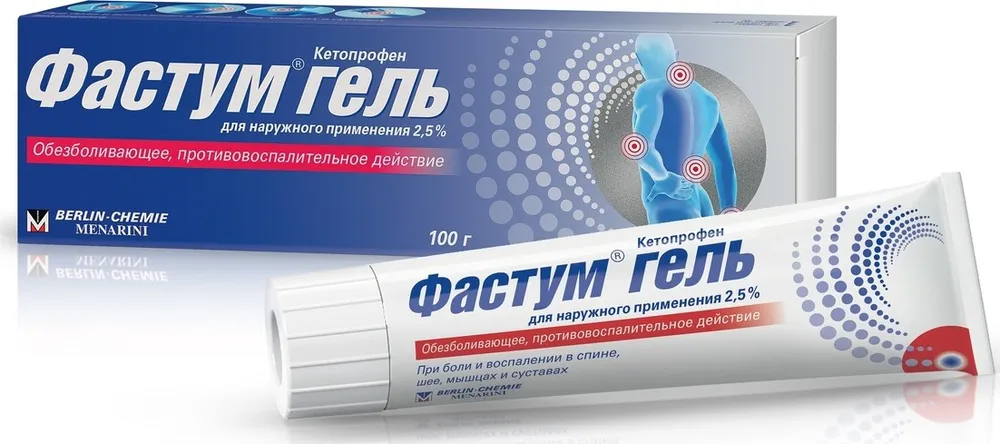
Table of Contents
INSTRUCTIONS FOR MEDICAL USE OF THE MEDICINAL PRODUCT FASTUM® GEL (FASTUM® GEL)
Composition:
Active substance: ketoprofen;
1 g of gel contains ketoprofen 0.025 g;
Excipients: carbomer, ethanol 96%, neroli fragrance (containing citral, citronellols, farnesol, geraniol, D-limonene and linalool), lavender fragrance (containing citral, citronellols, coumarin, eugenol, geraniol, D-limonene and linalool), triethanolamine, purified water.
Pharmaceutical form. Gel.
Main physicochemical properties: viscous gel, colorless or slightly yellowish, almost transparent, with a fragrant odor.
Pharmacotherapeutic group.
Non-steroidal anti-inflammatory drugs for topical use. ATC code M02A A10.
Pharmacological properties.
Pharmacodynamics.
Ketoprofen exerts anti-inflammatory and analgesic effects.
Ketoprofen contained in a suitable vehicle penetrates through the skin to the site of inflammation, thereby enabling local treatment of joint, tendon, ligament, and muscle injuries associated with pain syndrome.
Pharmacokinetics.
Absorption of the medicinal product applied to the skin into the systemic circulation occurs very slowly. When 50 to 150 mg of ketoprofen is applied, the concentration of the active substance in plasma 5–8 hours later amounts to only 0.08–0.15 μg/mL.
Clinical characteristics.
Indications.
Local treatment of rheumatic or traumatic pain in the musculoskeletal system and joints, particularly in contusions, sprains, muscle strains, neck stiffness, and lumbago.
Contraindications.
FASTUM® GEL is contraindicated in the following cases:
- Hypersensitivity to the active substance or to any of the excipients.
- History of hypersensitivity.
- History of photosensitivity reactions.
- Known hypersensitivity reactions, such as asthma symptoms, allergic rhinitis, or urticaria, occurring after administration of ketoprofen, fenofibrate, tiaprofenic acid, acetylsalicylic acid, or other nonsteroidal anti-inflammatory drugs (NSAIDs).
- History of skin allergy reactions following the use of ketoprofen, tiaprofenic acid, fenofibrate, UV blockers, or other perfumery products.
- Exposure to sunlight, even in the form of diffused light or UV irradiation in a solarium, during treatment and for two weeks after its discontinuation (see section "Special precautions").
- Application to skin with pathological changes such as dermatosis, eczema, or acne, to infected skin, or to open wounds.
- Application to the skin around the eyes.
- Third trimester of pregnancy (see section "Use during pregnancy or lactation").
Interaction with other medicinal products and other forms of interaction.
No interactions between FASTUM® GEL and other medicinal products have been observed. Interaction is unlikely due to low serum concentrations following topical application. Nevertheless, monitoring is recommended in patients receiving treatment with coumarin derivatives.
Special precautions for use.
FASTUM® GEL should be used with caution in patients with cardiac, hepatic, or renal insufficiency. There have been reports of isolated cases of systemic adverse reactions associated with renal impairment.
Application of the gel should not be combined with the use of occlusive dressings.
The gel must not come into contact with mucous membranes or eyes.
Topical application of large amounts of the product may lead to systemic effects such as hypersensitivity and bronchial asthma.
Prolonged use, especially over extended periods, of topical medicinal products may lead to sensitization or local irritation.
If redness occurs, treatment should be discontinued.
If any skin reactions develop, including those related to concomitant use of products containing octocrylene, treatment with the gel should be stopped immediately (octocrylene is an excipient used to prevent photodegradation of cosmetic and personal hygiene products such as shampoos, after-shave lotions, shower and bath gels, skin creams, lipsticks, anti-aging creams, makeup removers, and hair lacquers).
During treatment and for 2 weeks after its completion, it is recommended to wear clothing covering the treated area to avoid photosensitivity.
Hands should be thoroughly washed after each application of the medicinal product. The recommended duration of treatment should not be exceeded, as the risk of developing contact dermatitis and photosensitivity reactions increases over time.
Patients suffering from asthma in combination with chronic rhinitis, chronic sinusitis, and/or nasal polyps have a higher risk of developing allergy to aspirin and/or non-steroidal anti-inflammatory drugs (NSAIDs) than the general population.
Physical dependence on the medicinal product FASTUM® GEL does not develop.
Pediatric population: The safety and efficacy of topical ketoprofen in the form of a gel in children have not been established.
FASTUM® GEL contains a non-fragrance oil, which includes allergens such as citral, citronellols, farnesol, geraniol, D-limonene, and linalool, as well as lavender fragrance, which in turn contains allergens such as citral, citronellols, coumarin, eugenol, geraniol, D-limonene, and linalool. These allergens may cause allergic reactions.
FASTUM® GEL contains ethanol, which may cause a burning sensation on damaged skin.
Use during pregnancy or breastfeeding.
Clinical data on the topical dosage form are lacking. The recommendations below are based on data concerning systemic dosage forms.
Pregnancy.
Clinical data on the use of topical ketoprofen formulations during pregnancy are lacking. Even though systemic exposure is lower compared to oral administration, it is unknown whether the systemic exposure to ketoprofen achieved after topical application could be harmful to the embryo/fetus. During the first and second trimesters of pregnancy, FASTUM® GEL should not be used unless absolutely necessary. If used, the dose should be as low as possible and the duration of treatment as short as possible.
During the third trimester of pregnancy, systemic use of prostaglandin synthesis inhibitors, including ketoprofen, may cause toxic effects on the fetal heart, lungs, and kidneys. Towards the end of pregnancy, prolonged bleeding time may occur in both mother and child, and labor may be delayed. Therefore, FASTUM® GEL is contraindicated during the last trimester of pregnancy (see section "Contraindications").
Use of NSAIDs may also delay the onset of labor.
Breastfeeding.
There are no data on the penetration of ketoprofen into breast milk following topical application. After systemic administration, traces of ketoprofen have been detected in breast milk. The use of ketoprofen in breastfeeding mothers is not recommended.
During the first and second trimesters of pregnancy and during breastfeeding, FASTUM® GEL should be used only after consultation with a physician and after individual assessment of the benefit-risk ratio in each case. In case of suspected or planned pregnancy, consult a physician before using this product.
Ability to influence the speed of reactions when driving vehicles or operating machinery.
Unknown.
Method of Administration and Dosage
The gel should be applied in a thin layer to affected areas 1 or 2 times daily, with gentle massage to enhance absorption.
Special precautions for disposal and other handling.
Opening the soft aluminum tube: unscrew the cap and pierce the aluminum membrane with the tip located on the outer part of the cap.
Children
The safety and efficacy of ketoprofen gel in children have not been established.
Overdose
Overdose is unlikely with topical application. Given the low plasma levels of ketoprofen following skin application, symptoms of overdose are improbable. However, if the gel is accidentally ingested, systemic adverse effects may occur, the severity of which depends on the amount ingested. In such cases, symptomatic and supportive treatment should be administered, as for overdose with orally administered anti-inflammatory agents.
Side effects
Like all medicinal products, FASTUM® GEL may cause adverse reactions, although not everyone experiences them.
As with other topically applied medicinal products, undesirable effects may occur on the skin. Local skin reactions (e.g., erythema, pruritus, and burning sensation) have been reported, which may subsequently spread beyond the site of application and, in some cases, may be severe and become generalized (e.g., bullous or vesicular eczema), in addition to hypersensitivity reactions and skin reactions (photosensitivity).
The frequency and severity of these effects are significantly reduced if exposure to sunlight—including visits to solariums—is avoided during treatment and for two weeks after treatment.
Other systemic effects of NSAIDs: their occurrence depends on the transdermal diffusion of the active substance and thus on the amount of gel applied, the area of application, the integrity of the skin, the duration of treatment, and the use of occlusive dressings (reactions involving the gastrointestinal tract and kidneys).
When analyzing adverse effects, the frequency of adverse reactions was categorized as follows: very common (≥10%), common (≥1/100 to <1/10), uncommon (≥1/1,000 to <1/100), rare (≥1/10,000 to <1/1,000), very rare (<1/10,000), and not known (frequency cannot be estimated based on available data).
Immune system disorders
Not known: anaphylactic reactions, including anaphylactic shock, angioedema, hypersensitivity reactions.
Gastrointestinal disorders
Very rare: peptic ulcer, gastrointestinal bleeding, diarrhea.
Skin and subcutaneous tissue disorders
Uncommon: local skin reactions such as erythema, eczema, pruritus, and burning sensation.
Rare: dermatological reactions (photosensitization, bullous rashes, urticaria). More severe adverse reactions, such as bullous or vesicular eczema, which may spread or become generalized, occur very rarely.
Very rare: contact dermatitis.
Not known: bullous dermatitis.
Renal and urinary disorders
Very rare: renal failure or worsening of pre-existing renal impairment. Isolated cases of systemic adverse reactions, including renal disorders, have been reported.
Elderly patients are particularly susceptible to adverse reactions associated with NSAIDs.
Reporting of suspected adverse reactions
Reporting suspected adverse reactions after a medicinal product is authorized is important. It allows continued monitoring of the benefit-risk balance of the medicinal product. Healthcare professionals are encouraged to report any suspected adverse reactions.
Shelf life. 5 years.
Do not use the medicinal product after the expiry date stated on the packaging.
Storage conditions.
No special storage conditions required. Keep out of the reach of children.
Packaging.
Tube containing 20 g, 30 g, 50 g, or 100 g of gel; 1 tube in a cardboard box.
Prescription category. Prescription only.
Manufacturer.
A. Menarini Manufacturing Logistics and Services S.r.l.
Manufacturer's address.
Via Sette Santi 3, 50131 Florence (FI), Italy.
Marketing Authorization Holder.
A. MENARINI INDUSTRIE FARMACEUTICHE RIUNITE S.r.l.
Address of the Marketing Authorization Holder.
Via Sette Santi 3, 50131 Florence, Italy.