Famotidine-farmex
Ukraine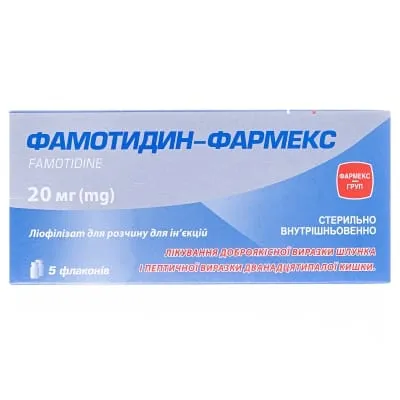
Table of Contents
INSTRUCTIONS FOR MEDICAL USE OF THE MEDICINAL PRODUCT FAMOTIDINE-PHARMEX (FAMOTIDINE-PHARMEX)
Composition:
Active substance: famotidine;
1 vial contains famotidine 20 mg;
Excipients: aspartic acid, mannitol (E 421).
Pharmaceutical form. Lyophilisate for solution for injection.
Main physicochemical properties: white or almost white porous lyophilized mass.
Pharmacotherapeutic group. Drugs for treatment of peptic ulcer and gastroesophageal reflux disease. H2-receptor antagonists. Famotidine.
ATC code A02B A03.
Pharmacological Properties.
Pharmacodynamics.
Famotidine is a potent competitive inhibitor of H2-histamine receptors. The main clinically significant pharmacological effect of famotidine is inhibition of gastric secretion. Famotidine reduces both the concentration of acid and the volume of gastric secretion, while pepsin production remains proportional to the volume of gastric juice secreted.
In healthy volunteers and patients with hypersecretion, famotidine inhibits basal and nocturnal gastric secretion, as well as secretion stimulated by pentagastrin, betazole, caffeine, insulin, and the physiological vagal reflex.
The duration of inhibition of secretion after administration of 20 mg and 40 mg doses lasts from 10 to 12 hours.
Single oral administration of 20 mg and 40 mg doses in the evening provides inhibition of basal and nocturnal acid secretion.
Famotidine has practically no effect on fasting or postprandial serum gastrin levels.
Famotidine does not affect gastric emptying, exocrine pancreatic function, hepatic blood flow, or portal circulation.
Famotidine does not influence the hepatic cytochrome P450 enzyme system.
No antiandrogenic effects of the drug have been observed. Serum hormone levels remain unchanged after treatment with famotidine.
Pharmacokinetics.
The kinetics of famotidine are linear.
Distribution. Plasma protein binding is relatively weak – 15–20%.
Elimination half-life – 2.3–3.5 hours. In patients with severe renal impairment, the elimination half-life of famotidine may exceed 20 hours.
Metabolism. The drug is metabolized in the liver. The only metabolite detected in humans is the sulfoxide.
Excretion. Famotidine is excreted by the kidneys (65–70%); 30–35% of the administered dose undergoes metabolism. Renal clearance ranges from 250 to 450 mL/min, indicating some degree of tubular secretion. 25–30% of an orally administered dose and 65–70% of an intravenously administered dose are excreted unchanged in urine. A small amount of the administered dose may be excreted as the sulfoxide metabolite.
Clinical characteristics.
Indications.
Benign gastric ulcer.
Peptic ulcer of the duodenum.
Conditions of hypersecretion, such as Zollinger-Ellison syndrome.
Gastroesophageal reflux disease.
Prevention of aspiration of acidic gastric contents (Mendelson's syndrome) during general anesthesia.
Contraindications.
Hypersensitivity to any component of the drug or to other H2-histamine receptor antagonists.
Childhood age; pregnancy or breastfeeding period (due to lack of sufficient clinical experience).
Interaction with other medicinal products and other types of interactions.
Absorption of certain medicinal products (e.g., ketoconazole, amoxicillin, iron preparations) depends on gastric acidity. Therefore, famotidine should be administered at least 2 hours after such medicinal products.
Concomitant use with other H2-receptor antagonists may significantly reduce the effectiveness of tolazoline. Although there are no confirmed interactions between famotidine and tolazoline, the likelihood of their occurrence is sufficiently high; therefore, the effect of tolazoline should be monitored at the beginning and after completion of concomitant therapy. If a reduction in tolazoline effect occurs, its dose should be gradually increased or famotidine treatment discontinued.
Food and antacids do not have a significant impact on famotidine therapy.
Famotidine does not affect the cytochrome P450 hepatic oxidase system; therefore, the metabolism of oral anticoagulants, antipyrine, aminopyrine, theophylline, phenytoin, diazepam, ethanol, and propranolol remains unchanged.
Probenecid may slow the elimination of famotidine.
There is a risk of reduced efficacy of calcium carbonate as a phosphate-binding agent when used concomitantly with famotidine in patients undergoing hemodialysis.
Concomitant use of posaconazole oral suspension and famotidine should be avoided if possible, since famotidine may reduce the absorption of posaconazole oral suspension when used concomitantly.
Concomitant use of famotidine with tyrosine kinase inhibitors (TKIs), such as dasatinib, erlotinib, gefitinib, and pazopanib, may lead to decreased plasma concentrations of TKIs and, consequently, reduced efficacy; therefore, concomitant use of famotidine with these TKIs is not recommended. For further additional recommendations, please refer to the instructions for medical use of individual medicinal products containing TKIs.
Special precautions for use.
Before initiating treatment with Famotidine-Pharmex, the presence of malignant tumors in the stomach and duodenum must be excluded. Treatment with this drug may mask symptoms of gastric carcinoma.
Famotidine-Pharmex should be used with caution and at lower doses in patients with hepatic insufficiency. Since cross-sensitivity between H2-receptor antagonists has been reported, the use of Famotidine-Pharmex is contraindicated in patients with hypersensitivity to other H2-receptor antagonists.
Treatment with Famotidine-Pharmex must not be initiated without a physician's prescription or proper medical evaluation if:
- the patient has kidney or liver disease. Mental disorders (confusion) may occur in elderly patients or in patients with impaired liver or kidney function, requiring dose reduction;
- the patient has concomitant diseases or is taking other medications simultaneously;
- a middle-aged or elderly patient experiences new-onset digestive complaints or changes in previous symptoms;
- the patient has stomach complaints accompanied by weight loss;
- black-colored stools appear;
- the patient has swallowing difficulties or chronic abdominal pain.
The drug should be used with caution in patients with acute porphyria (including history of porphyria) or immunodeficiency.
Symptoms of duodenal ulcer may resolve within 1–2 weeks; however, treatment should be continued until healing is confirmed by endoscopic or radiographic examination.
Regular monitoring is required for patients (especially elderly patients and those with a history of gastric and/or duodenal ulcer) who are taking the drug in combination with nonsteroidal anti-inflammatory drugs (NSAIDs).
When used concomitantly with antacids, the interval between administration of the drug and antacids should be at least 1–2 hours.
If a dose is missed, it should be taken as soon as possible; however, the dose should not be doubled if it is time for the next scheduled dose.
Treatment with the drug should not be initiated without prior proper medical evaluation in cases of heartburn, symptoms of hyperacidic state, stomach pain, or postprandial hyperacidity in elderly patients.
Use during pregnancy or breastfeeding.
Fertility
In studies in rats and rabbits, oral administration of famotidine at doses up to 2000 and 500 mg/kg body weight per day, respectively, did not reveal any adverse effects on reproductive function. However, adequate and well-controlled studies in pregnant women have not been conducted.
Pregnancy.
Famotidine belongs to pregnancy safety category B regarding fetal risk during pregnancy.
Famotidine crosses the placenta. Controlled studies in pregnant women have not been conducted.
The use of Famotidine-Pharmex is contraindicated during pregnancy.
Breastfeeding. Famotidine is excreted in breast milk; therefore, breastfeeding should be discontinued during treatment with Famotidine-Pharmex.
The use of Famotidine-Pharmex during breastfeeding is contraindicated (see section "Contraindications").
Ability to affect reaction rate when driving or operating machinery.
Patients should exercise caution when performing potentially hazardous activities requiring increased attention and psychomotor speed, as this drug may cause dizziness.
Dosage and Administration
Dosage
The prepared injection solution may be administered only intravenously.
The medicinal product may be used only in a hospital setting and only for patients who cannot take oral dosage forms. As soon as possible, patients should be switched to tablets containing famotidine as the active ingredient.
The usual dose of Famotidine-Farmeks for adults is 20 mg twice daily (every 12 hours) administered intravenously.
Zollinger-Ellison Syndrome.
The initial dose for adults is 20 mg intravenously every 6 hours. Subsequently, the dose may be increased depending on gastric acid secretion and the patient's clinical condition.
Prevention of gastric juice aspiration under general anesthesia.
20 mg of the drug administered intravenously on the morning of surgery or no later than 2 hours before the start of surgery.
The single intravenous dose must not exceed 20 mg.
Renal impairment.
Since famotidine is primarily excreted by the kidneys, the drug should be used with caution in patients with severe renal impairment.
If creatinine clearance is < 30 mL/min or serum creatinine exceeds 3 mg/100 mL, the daily dose of the drug (both for intravenous and oral administration) should be reduced to 20 mg or the dosing interval should be extended to 36–48 hours.
Cardiovascular disorders.
Prolonged intravenous infusion is recommended.
Use in pediatric practice.
The safety and efficacy of the drug in children have not been established; therefore, the use of Famotidine-Farmeks in children and adolescents is contraindicated (see section "Contraindications").
Elderly patients.
There is no need to adjust the dose based on the patient's age.
Administration
Famotidine-Farmeks is intended for intravenous administration only.
For intravenous administration, the lyophilisate for injection solution should be dissolved in 5–10 mL of 0.9% sodium chloride solution. After reconstitution, the chemical and physical stability of the solution is maintained for 24 hours at a temperature of 2°C to 8°C.
The diluted solution should be administered slowly (over 2 minutes).
When administered as an intravenous infusion, the solution should be infused over 15–30 minutes.
Infusion solutions.
According to compatibility studies, the following infusion solutions may be used: glucose with potassium solution, sodium lactate solution, 5% glucose solution, Ringer's solution, Ringer's solution with lactic acid, and Salsole A (0.9% sodium chloride solution).
| Infusion solution |
Stability period of diluted solution (hours) |
| Glucose solution with potassium |
4 |
| Glucose 5% solution |
5 |
| Ringer's solution |
|
| Ringer's solution with lactic acid |
8 |
| Salsol A (sodium chloride 0.9% solution) |
The solution of the drug must be prepared immediately before use. From a microbiological point of view, the diluted preparation should be used immediately. Only clear, colorless solution should be used.
Children.
The safety and efficacy of the drug in children have not been established.
Overdose.
When famotidine was administered at a dose of 800 mg daily over a period of 1 year in patients with pathological hypersecretion syndrome, no severe adverse reactions were observed.
Symptoms: vomiting, motor agitation, tremor, decreased arterial pressure, tachycardia, ventricular arrhythmia, and collapse may develop.
Treatment: symptomatic and supportive therapy, monitoring of the patient's condition.
Adverse reactions.
The undesirable effects listed below have been described as isolated or rare. However, in many cases, a causal relationship with famotidine therapy has not been established.
| Body systems |
Adverse reactions |
| Hematologic disorders |
agranulocytosis; leukopenia; pancytopenia; thrombocytopenia; neutropenia |
| Immune system disorders |
anaphylaxis |
| Metabolism and nutrition disorders |
anorexia |
| Psychiatric disorders |
depression; hallucinations; agitation; anxiety; confusion; anorexia; insomnia; decreased libido |
| Neurological disorders |
headache; dizziness; drowsiness; dysgeusia; seizures; paraesthesia; loss of balance |
| Ear and labyrinth disorders |
tinnitus |
| Eye disorders |
conjunctival irritation; eye swelling |
| Cardiac disorders |
arrhythmia; bradycardia; tachycardia; palpitations; atrioventricular block |
| Vascular disorders |
decreased blood pressure |
| Respiratory, thoracic and mediastinal disorders |
bronchospasm |
| Gastrointestinal disorders |
diarrhea; constipation; abdominal discomfort; flatulence; abdominal pain; nausea; vomiting; dry mouth; acute pancreatitis |
| Hepatobiliary disorders |
cholestatic jaundice; hepatitis |
| Skin and subcutaneous tissue disorders |
acne; alopecia; angioneurotic edema; dry skin; toxic epidermal necrolysis; xeroderma; urticaria; pruritus; severe skin reactions (Stevens-Johnson syndrome, exfoliative dermatitis, erythema) |
| Musculoskeletal and connective tissue disorders |
arthralgia; muscle cramps; myalgia |
| Reproductive system and breast disorders |
gynecomastia*; impotence |
| General disorders and administration site conditions |
increased fatigue; low-grade fever |
| Abnormal laboratory findings |
liver enzyme level abnormalities |
* Gynaecomastia occurs very rarely and is reversible after discontinuation of treatment.
Reporting of suspected adverse reactions
Reporting of suspected adverse drug reactions, observed after marketing authorization of the medicinal product, is very important. It allows continuous monitoring of the benefit-risk balance of the medicinal product. Healthcare professionals are requested to report any suspected adverse reactions through the national reporting systems.
Shelf life. 3 years.
Storage conditions.
Store in the original packaging at a temperature of +2 °C to +8 °C. Keep out of reach of children.
Packaging.
20 mg in a vial, 5 vials in a blister pack, 1 blister pack in a cardboard box.
Prescription status. Prescription only.
Manufacturer.
LLC "FARMEKS GROUP".
Manufacturer's address and location of its business activity.
100 Shevchenka Street, Boryspil, Kyiv region, 08301, Ukraine