F-gel®
Ukraine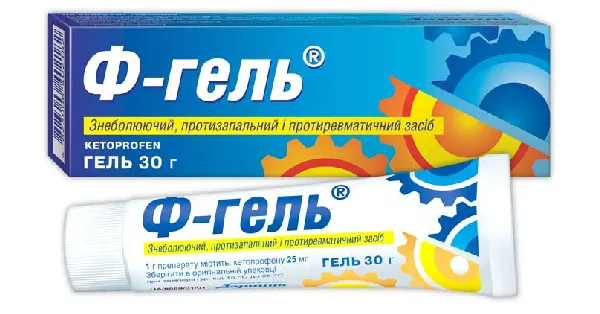
Table of Contents
INSTRUCTIONS FOR MEDICAL USE OF THE MEDICINAL PRODUCT F-gel® (F-gel)
Composition:
Active substance: ketoprofen;
1 g of gel contains ketoprofen 25 mg;
Excipients: ethanol (96 %), methylparaben (E 218), carbomer 980, tromethamine, lavender oil, neroli oil, purified water.
Pharmaceutical form. Gel.
Main physicochemical properties: homogeneous, colorless, almost transparent gel with a specific odor.
Pharmacotherapeutic group. Non-steroidal anti-inflammatory drugs for topical use. Ketoprofen. ATC code M02A A10.
Pharmacological Properties.
Pharmacodynamics.
The active ingredient of the medicinal product – ketoprofen – belongs to the group of non-steroidal anti-inflammatory agents, derivatives of arylpropionic acid. Ketoprofen exerts analgesic and anti-inflammatory effects due to inhibition of cyclooxygenase-1 (COX-1), cyclooxygenase-2 (COX-2), and bradykinin, stabilization of lysosomal membranes, and inhibition of macrophage migration. It possesses analgesic and anti-inflammatory activity both at the early stage (vascular phase) and late stage (cellular phase) of the inflammatory response. F-gel® also inhibits platelet aggregation.
Pharmacokinetics.
When applied topically, ketoprofen is absorbed through the skin, penetrates locally into inflamed tissues, and maintains a therapeutic concentration there for a prolonged period. Systemic absorption is very low (only 5% of the applied dose) and occurs slowly. After application of gel containing 50 to 150 mg of ketoprofen to the skin, the concentration of the active substance in blood plasma after 5–8 hours is no more than 0.08–0.15 μg/mL, which practically does not produce clinically significant effects on the body.
Clinical characteristics.
Indications.
- Muscle and joint pain caused by injuries or trauma.
- Tendovaginitis.
Contraindications.
- Known hypersensitivity reactions, such as symptoms of bronchial asthma, allergic rhinitis, or urticaria, occurring during the use of ketoprofen, fenofibrate, tiaprofenic acid, acetylsalicylic acid, or other nonsteroidal anti-inflammatory drugs.
- Hypersensitivity to any component of the medicinal product.
- History of skin allergic reactions during the use of ketoprofen, fenofibrate, tiaprofenic acid, ultraviolet (UV) light blockers, or perfumed products.
- History of photosensitization reactions.
- Exposure to sunlight, including indirect sunlight and ultraviolet radiation in solariums, throughout the entire treatment period and for 2 weeks after discontinuation of the medicinal product.
- Skin integrity impairment (wounds, rashes, eczema, injuries, skin infections).
- Third trimester of pregnancy.
Interaction with other medicinal products and other types of interactions.
Since the plasma concentration of the medicinal product is extremely low, symptoms of interaction with other medicinal products (similar to those observed with systemic use) are possible only with frequent and prolonged application:
with methotrexate, cardiac glycosides, lithium salts, cyclosporine – increased toxicity due to reduced excretion;
with anticoagulants, antiplatelet agents, acetylsalicylic acid or other nonsteroidal anti-inflammatory drugs, glucocorticoids, oral hypoglycemic agents, phenytoin – enhanced effect of the aforementioned medicinal products; concomitant use of the medicinal product with other topical formulations (creams, gels) containing ketoprofen or other nonsteroidal anti-inflammatory drugs is not recommended;
with antihypertensive agents, diuretics, mifepristone – reduced effect of the aforementioned medicinal products. At least 8 days must elapse between the end of mifepristone treatment and the start of ketoprofen therapy.
Special precautions for use.
F-gel® should be used only externally.
If a dose of the gel is missed, do not double the dose at the next application.
Hands should be washed immediately after each application of the medicinal product.
The use of the medicinal product should be discontinued immediately in case of skin reactions, including skin reactions during concomitant use with products containing octocrylene (octocrylene is contained in some cosmetic and hygiene products such as shampoos, after-shave gels, shower gels, creams, lipsticks, anti-aging creams, makeup removers, hair sprays, to prevent their photodegradation). Treatment should be stopped immediately after the development of any skin reaction following application of the medicinal product.
F-gel® should not be applied to areas with acne, open wounds and areas adjacent to them, mucous membranes, areas around the eyes, or into the eyes.
The gel should not be used under occlusive dressings.
Exposure to sunlight (even on a cloudy day) or ultraviolet (UV) radiation in a solarium during topical application of ketoprofen may cause potentially serious skin reactions (photosensitization). To avoid the risk of photosensitization, the following precautions should be taken: protect treated skin areas by wearing clothing during treatment and for 2 weeks after discontinuation of the medicinal product, wash hands thoroughly after each application of the gel, use surgical gloves during prolonged treatment to avoid local irritation, avoid visiting solariums during treatment and for 2 weeks after discontinuation of the medicinal product.
Topical application of large amounts of the gel may result in systemic effects, including hypersensitivity reactions and asthma. The recommended dose and duration of treatment should not be exceeded, as the risk of contact dermatitis and photosensitization reactions increases over time.
There have been reports of isolated cases of systemic adverse reactions associated with kidney impairment.
F-gel® should be used with caution in patients with impaired renal or hepatic function, or with concomitant heart failure.
F-gel® should be used with caution and under medical supervision in patients taking anticoagulants, diuretics, or lithium salts.
The gel should not be used near open flames, as it contains ethanol.
Use during pregnancy or breastfeeding.
First and second trimesters of pregnancy.
In studies conducted on mice and rats, no teratogenic or embryotoxic effects were observed. In rabbit studies, a slight embryotoxic effect was observed, likely related to maternal toxicity. There are no clinical data on the use of topical forms of ketoprofen during pregnancy. Even though systemic exposure is lower compared to oral administration, it is unknown whether the systemic exposure to the medicinal product F-gel® achieved after topical application could be harmful to the embryo/fetus. During the first and second trimesters of pregnancy, the medicinal product F-gel® should be used only if clearly needed, after consultation with a physician and careful assessment of the benefit-risk ratio in each individual case. When used, the dose should be as low as possible and the duration of treatment as short as possible.
Third trimester of pregnancy. Systemic use of prostaglandin synthetase inhibitors, to which the medicinal product F-gel® belongs, during the third trimester of pregnancy may cause cardiopulmonary and renal toxicity in the fetus. Prolonged bleeding may occur in both mother and child towards the end of pregnancy, and labor may be prolonged. Therefore, F-gel® is contraindicated during the last trimester of pregnancy (see section "Contraindications").
Breastfeeding period.
Following systemic administration (oral, rectal, parenteral), traces of ketoprofen are excreted in breast milk. F-gel® should not be used during breastfeeding.
If pregnancy is suspected or planned, consult a physician before using this medicinal product.
Ability to influence reaction rate when driving or operating machinery.
There are no data indicating a negative effect of the medicinal product on reaction speed when driving or operating machinery.
Method of Administration and Dosage
Apply Ph-gel® to the skin of the affected area as a thin layer – 3-5 cm or more of gel 1-2 times daily, gently rubbing in until completely absorbed. The amount of gel depends on the size of the affected area: 5 cm of gel corresponds to 100 mg of ketoprofen, 10 cm corresponds to 200 mg of ketoprofen. After each application, hands should be washed immediately.
Ph-gel® may be used in combination with other medicinal forms of ketoprofen (capsules, tablets, rectal suppositories). The total maximum daily dose of ketoprofen should not exceed 200 mg, regardless of the medicinal form used.
The duration of treatment is determined individually but should not exceed 10 days.
Children
The safety and efficacy of the medicinal product in this age group have not been established.
Overdose
Since the level of ketoprofen penetrating through the skin into blood plasma is low, overdose is unlikely.
Main symptoms: irritation, erythema, itching.
Treatment: thoroughly wash the skin with running water, discontinue use of the gel, and consult a physician.
Systemic adverse reactions may develop with prolonged use of the medicinal product, high doses, or application over large skin areas.
Accidental oral ingestion of the gel may cause drowsiness, dizziness, nausea, vomiting, epigastric pain, and, with high doses of ketoprofen, bradypnea, coma, convulsions, gastrointestinal bleeding, acute renal failure, or increased or decreased arterial pressure.
Treatment: symptomatic therapy with supportive measures to maintain vital functions. Gastric lavage and administration of activated charcoal (the first dose combined with sorbitol) may be beneficial, especially within the first 4 hours after overdose or after ingestion of a dose 5–10 times higher than recommended.
Side effects.
Gastrointestinal tract: heartburn, nausea, vomiting, diarrhea, constipation, peptic ulcer, gastrointestinal bleeding.
Renal and urinary system: worsening of renal dysfunction or renal failure, especially in patients with chronic kidney disease; rarely – interstitial nephritis.
Immune system: hypersensitivity reactions, including angioedema, bronchospasm, asthma attacks, anaphylactic reactions.
Skin and subcutaneous tissue: hyperemia, pruritus, burning sensation, edema, urticaria, photosensitivity reactions, dermatitis (contact, bullous), eczema, including bullous and vesicular forms, which may spread and become generalized, Stevens-Johnson syndrome.
Depending on the penetration capacity of the active substance, the amount of gel applied, the size of the treated area, integrity of the skin, and duration of drug use, other adverse reactions involving the gastrointestinal and urinary systems are possible.
Elderly patients are more susceptible to the occurrence of adverse reactions when using nonsteroidal anti-inflammatory drugs.
Shelf life.
2 years.
Storage conditions.
Store in the original packaging, out of reach of children, at a temperature between 15 °C and 25 °C.
Packaging.
30 g in a tube; 1 tube per carton.
Prescription status.
Prescription only.
Manufacturer.
JSC "Pharmaceutical Company "Darnitsya".
Manufacturer's address and place of business.
13, Boryspilska St., Kyiv, 02093, Ukraine.