Eukabal® 600 sachet
Ukraine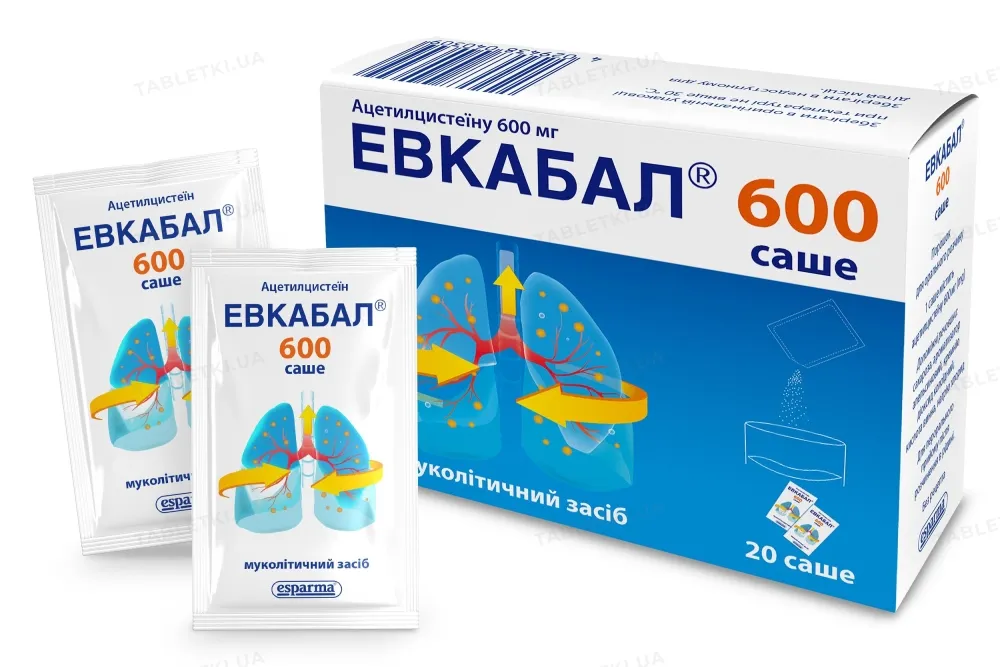
Table of Contents
INSTRUCTIONS FOR MEDICAL USE OF THE MEDICINAL PRODUCT EUCABAL®600 sachet EUCABAL®600 sachet
Composition:
Active substance: acetylcysteine;
1 sachet contains 600 mg of acetylcysteine;
Excipients: sucrose, orange flavor, colloidal anhydrous silicon dioxide, tartaric acid, sodium chloride.
Pharmaceutical form. Oral powder for solution.
Main physicochemical characteristics: white or almost white, homogeneous powder without agglomerates and foreign inclusions; over time – partially agglomerated.
Pharmacotherapeutic group. Mucolytic agents.
ATC code R05C B01.
Pharmacological properties.
Pharmacodynamics.
Acetylcysteine is a derivative of the amino acid cysteine. Acetylcysteine exerts a secretolytic and secretomotor effect in the bronchial area. It is believed to break disulfide bonds of mucopolysaccharides and exert a depolymerizing effect on DNA (in purulent mucus). This mechanism contributes to a reduction in mucus viscosity. An alternative mechanism of acetylcysteine is probably based on the ability of its chemically active sulfhydryl group to bind and thus neutralize chemical radicals.
Acetylcysteine promotes increased synthesis of glutathione, which is important for detoxification of harmful agents. This explains the action of acetylcysteine as an antidote in paracetamol poisoning.
Prophylactic use of acetylcysteine has reduced the frequency and severity of bacterial exacerbations in patients with chronic bronchitis/mucoviscidosis.
Pharmacokinetics.
After oral administration, acetylcysteine is rapidly and completely absorbed. It undergoes metabolism in the liver to form the pharmacologically active metabolite cysteine, as well as diacetylcysteine, cystine, and subsequently mixed disulfides. Due to significant first-pass effect, the bioavailability of acetylcysteine after oral administration is very low (approximately 10%). Maximum plasma concentration is reached within 1–3 hours after administration, with a peak plasma concentration of the cysteine metabolite of approximately 2 μmol/L. Plasma protein binding is approximately 50%.
Acetylcysteine and its metabolites are present in the body in three different forms: partially in the free form, partially bound to proteins via labile disulfide bridges, and partially as incorporated amino acids. Acetylcysteine is excreted by the kidneys as inactive metabolites (inorganic sulfates, diacetylcysteine). The elimination half-life is determined mainly by rapid biotransformation in the liver and is approximately 1 hour. In case of impaired liver function, the elimination half-life is prolonged to 8 hours.
Distribution
Acetylcysteine is distributed in the body both in unchanged form (20%) and as active metabolites (80%). It is predominantly found in the lungs, bronchial secretions, liver, and kidneys. The volume of distribution of acetylcysteine ranges from 0.33 to 0.47 L/kg. Plasma protein binding is about 50% at 4 hours after administration and decreases to 20% at 12 hours.
Metabolism and elimination
After oral administration, acetylcysteine is rapidly and extensively metabolized in the intestinal wall and liver. Approximately 30% of the dose is excreted by the kidneys. The T1/2 of acetylcysteine is 6.25 hours.
N-acetylcysteine crosses the placental barrier and is detected in umbilical cord blood. Information regarding penetration into breast milk is lacking. There is no information on the penetration of acetylcysteine across the blood-brain barrier.
Clinical characteristics.
Indications. Used to reduce sputum viscosity and improve sputum expectoration and cough clearance in bronchitis caused by common colds.
Contraindications. Known hypersensitivity to acetylcysteine or any of the excipients. Active gastric or duodenal ulcer, hemoptysis, pulmonary hemorrhage.
Children under 14 years of age.
Interaction with other medicinal products and other forms of interaction.
Interaction studies have been conducted only in adults.
Concomitant use of acetylcysteine with antitussive agents may increase sputum retention due to suppression of the cough reflex. Therefore, such combination therapy should be prescribed with particular caution.
Reports on inactivation of antibiotics (tetracyclines, aminoglycosides, penicillins) by acetylcysteine are based exclusively on in vitro studies in which the substances were mixed directly. However, for safety reasons, an interval of at least 2 hours should be maintained between administration of these drugs. This does not apply to cefixime and loracarbef.
Concomitant administration of acetylcysteine and glyceryl trinitrate (nitroglycerin) may potentiate the vasodilatory and antiplatelet effects of nitroglycerin. When simultaneous use of nitroglycerin and acetylcysteine is necessary, patients should be monitored for hypotension, which may be severe. Patients should be warned about the possibility of headache.
Activated charcoal reduces the effectiveness of acetylcysteine.
It is not recommended to dissolve acetylcysteine with other drugs in the same glass.
When in contact with metals or rubber, sulfides with a characteristic odor are formed; therefore, glassware should be used for dissolving the drug.
Effect on laboratory tests. Acetylcysteine may interfere with colorimetric assays for salicylates and with the determination of ketone bodies in urine.
Special precautions for use
The drug should be administered with caution to patients with a history of gastric or duodenal ulcer, especially when other medicinal products that irritate the gastric mucosa are used concomitantly.
Severe skin reactions (Stevens−Johnson syndrome and Lyell's syndrome) have been reported during acetylcysteine treatment. Therefore, if skin or mucous membrane changes occur, the drug should be discontinued immediately and a physician should be consulted regarding further management.
Acetylcysteine should be prescribed with caution in patients with bronchial asthma due to the potential risk of bronchospasm. When pouring the sachet contents into a container during solution preparation, the powder may become airborne and irritate the nasal mucosa, potentially causing reflex bronchospasm. If bronchospasm occurs, treatment with the drug should be discontinued immediately and medical advice should be sought.
Acetylcysteine should be used with caution in patients with liver or kidney disease to prevent accumulation of nitrogen-containing substances in the body.
The use of acetylcysteine, particularly at the beginning of treatment, causes liquefaction of bronchial secretions and thus increases their volume. If the patient is unable to effectively expectorate mucus, postural drainage and bronchoaspiration may be required.
Acetylcysteine affects histamine metabolism; therefore, long-term therapy should not be prescribed to patients with histamine intolerance, as it may lead to symptoms of intolerance (headache, vasomotor rhinitis, itching).
Mucolytic agents may cause bronchial obstruction in children under 2 years of age. Due to physiological characteristics of the respiratory system in this age group, the ability to clear respiratory secretions is limited. Therefore, mucolytics should not be used in children under 2 years of age.
A mild sulfurous odor is not indicative of drug deterioration; it is characteristic of the active substance.
One sachet of "EUCABAL®600sachet" contains less than 1 mmol (23 mg) of sodium, i.e., it is practically sodium-free.
The drug contains sucrose; therefore, it should not be administered to patients with rare hereditary forms of fructose intolerance, sucrase-isomaltase deficiency, or glucose-galactose malabsorption syndrome.
One sachet of "EUCABAL®600sachet" contains 2.3 g of sucrose (approximately 0.2 bread units). This should be taken into account when administering the drug to patients with diabetes mellitus.
The formulation contains orange flavoring, which includes lactose. Patients with rare hereditary intolerance to galactose, lactase deficiency, or glucose-galactose malabsorption should not take "EUCABAL®600sachet".
Use during pregnancy or breastfeeding
Pregnancy
There are insufficient clinical data on the effects of acetylcysteine in pregnant women. Animal studies have not revealed direct or indirect adverse effects on pregnancy, embryofetal development, parturition, or postnatal development. Before using the drug during pregnancy, potential risks should be weighed against the expected benefits.
Breastfeeding
There is no information available on the passage of acetylcysteine into breast milk. The drug should be used during pregnancy or breastfeeding only after careful assessment of the benefit-risk ratio.
Fertility
Animal studies have not shown any harmful effects on human fertility at the recommended doses.
Ability to affect reaction speed when driving or operating machinery.
There is no evidence that acetylcysteine affects the ability to drive or operate machinery.
Dosage and Administration.
The medicine should be taken after meals, dissolved in a glass of water.
Unless otherwise prescribed, the recommended dose for adults and adolescents aged 14 years and older is 1 sachet of powder per day (corresponding to 600 mg of acetylcysteine per day).
The medicine should not be used for more than 4–5 days without consulting a physician.
Children. The use of the medicine in children under 14 years of age is contraindicated.
Overdose.
There are no reported cases of overdose with oral formulations of acetylcysteine. Volunteers have taken 11.2 g of acetylcysteine per day for three months without experiencing any serious adverse effects. Acetylcysteine administered orally at doses of 500 mg/kg/day was tolerated without signs of intoxication.
Symptoms.
Overdose may cause gastrointestinal symptoms such as nausea, vomiting, and diarrhea. In children, there is a risk of hypersecretion.
Treatment.
Treatment is symptomatic.
Adverse reactions.
Adverse reactions are categorized by frequency as follows: very common (≥ 1/10), common (≥ 1/100 to < 1/10), uncommon (≥ 1/1000 to < 1/100), rare (≥ 1/10000 to < 1/1000), very rare (< 1/10000), and not known (frequency cannot be estimated from available data).
| Body system |
Adverse reactions |
|||
| Uncommon |
Rare |
Very rare |
Unknown |
|
| Immune system disorders |
Hypersensitivity |
Anaphylactic shock, anaphylactic/anaphylactoid reactions |
||
| Blood and lymphatic system disorders |
Anemia |
|||
| Nervous system disorders |
Headache |
|||
| Ear and labyrinth disorders |
Tinnitus |
|||
| Respiratory system disorders |
Rhinorrhea |
|||
| Cardiovascular system disorders |
Tachycardia |
Hemorrhages |
||
| Chest and mediastinum disorders |
Bronchospasm – mainly in patients with bronchial hyperreactivity in bronchial asthma, dyspnea |
|||
| Gastrointestinal disorders |
Vomiting, diarrhea, stomatitis, abdominal pain, nausea |
Dyspepsia |
Unpleasant breath odor |
|
| Skin and subcutaneous tissue disorders |
Urticaria, rash, exanthema, Quincke's edema, pruritus |
Eczema |
||
| General disorders and administration site conditions |
Hyperthermia |
Facial swelling |
||
| Investigations |
Decreased blood pressure |
|||
In addition, there have been very rare reports of bleeding during the use of acetylcysteine, sometimes due to hypersensitivity reactions.
In very rare cases, severe skin reactions such as Stevens-Johnson syndrome and Lyell's syndrome have been reported in connection with the use of acetylcysteine. In most of these cases, at least one other medicinal product could have contributed to the development of the skin-mucosal syndrome.
If any new changes appear on the skin or mucous membranes, a physician should be consulted immediately and administration of acetylcysteine should be discontinued promptly.
Cases of reduced platelet aggregation have been observed; however, the clinical significance of this effect has not been established.
Reporting suspected adverse reactions.
Reporting suspected adverse reactions after marketing authorization is of great importance. It allows continuous monitoring of the benefit-risk balance of the medicinal product. Healthcare professionals should report any suspected adverse reactions in accordance with national regulatory requirements.
Shelf life. 3 years.
Storage conditions.
Store in the original packaging at a temperature not exceeding 30 °C.
Keep out of the reach of children.
Packaging.
Each sachet contains 3 g of powder (600 mg active ingredient). Packaged in cardboard boxes containing 10, 20, or 50 sachets.
Availability. Over-the-counter (without prescription).
Manufacturer.
Lindopharm GmbH.
Manufacturer's address and location of operations.
Neue Strasse 82, 40721 Hilden, Germany.
Marketing Authorization Holder.
Esparma GmbH.
Address of Marketing Authorization Holder.
Bielefelder Strasse 1, 39171 Sülzetal, Germany.