Etacizin
Ukraine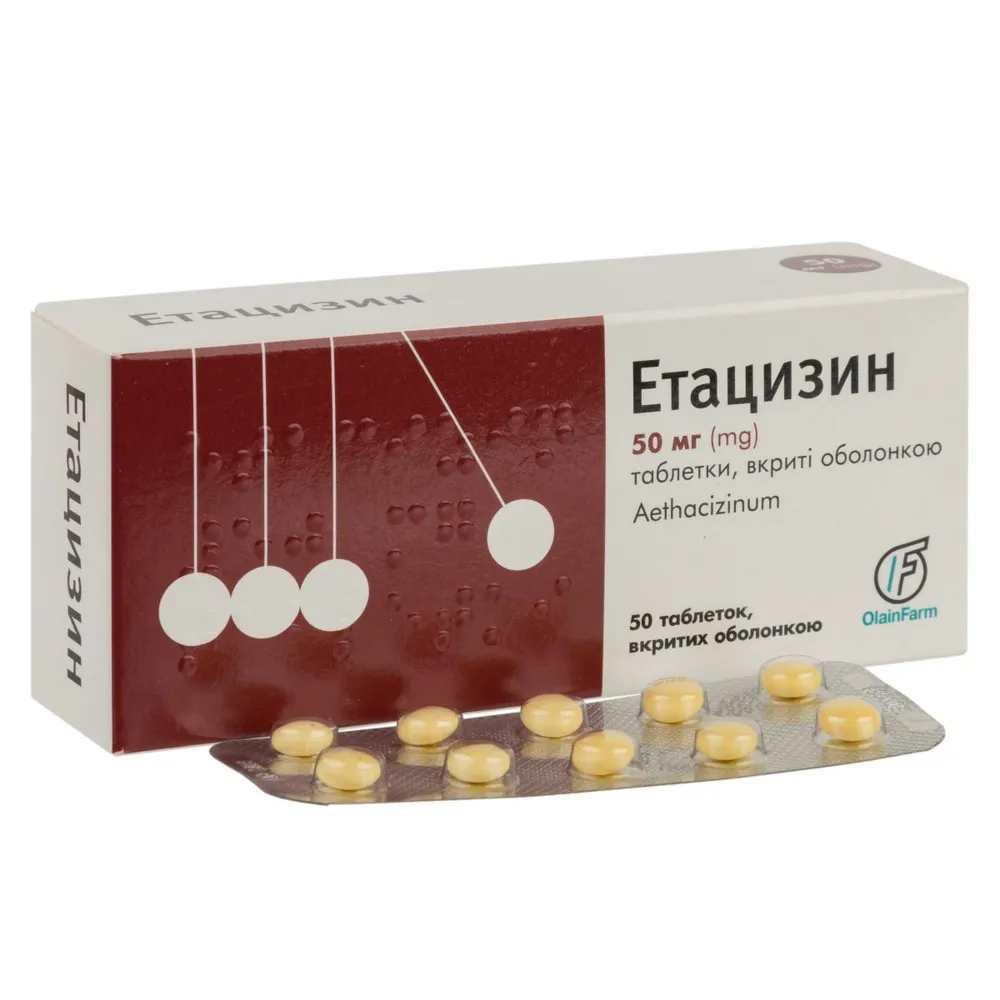
Table of Contents
INSTRUCTION FOR MEDICAL USE OF THE MEDICINAL PRODUCT ETHACIZINE
Composition:
Active substance: ethacizine;
One coated tablet contains ethacizine 50 mg;
Excipients: potato starch, methylcellulose, sucrose, calcium stearate; coating: sucrose, povidone, calcium carbonate, light magnesium carbonate, colloidal anhydrous silicon dioxide, carnauba wax, colorants: quinoline yellow (E 104), sunset yellow FCF (E 110), titanium dioxide (E 171).
Pharmaceutical form. Coated tablets.
Main physicochemical properties: round, biconvex, yellow-coated tablets. In cross-section, the coating and the core of almost white color are visible.
Pharmacotherapeutic group. Antiarrhythmic agents, class IC. ATC code C01BC09.
Pharmacological properties.
Pharmacodynamics.
Etacizin is a class IC antiarrhythmic agent. It has pronounced and prolonged antiarrhythmic effect. It suppresses the rate of rise of the action potential without altering the resting potential. It primarily affects sodium channels (both on the outer and inner surface of the cell membrane), reducing the amplitude and slowing down the inactivation and reactivation processes of the fast sodium current. It blocks calcium ion influx through slow membrane channels. It prolongs the refractory periods of the atria and atrioventricular node. It slows down the rate of rise of the action potential in atrial and ventricular Purkinje fibers and in accessory pathways of excitation conduction through the atrioventricular (AV) node and Kent bundle. It suppresses sinoatrial conduction, especially in the sick sinus syndrome, widens the QRS complex on the electrocardiogram (by approximately 25%) due to slowing of ventricular conduction (in the His-Purkinje system). It has negative inotropic effects and exhibits local anesthetic and spasmolytic activity.
Etacizin does not change heart rate with short-term use but reduces it with long-term use.
Pharmacokinetics.
After oral administration, Etacizin is rapidly absorbed from the gastrointestinal tract and can be detected in the blood within 30–60 minutes. Maximum plasma concentration of Etacizin is reached within 2.5–3 hours. Bioavailability is 40%. Approximately 90% is bound to plasma proteins. The average half-life is about 2.5 hours. All the aforementioned pharmacokinetic parameters are subject to significant individual variability. Etacizin undergoes extensive metabolism during its first pass through the liver. Some of the resulting metabolites possess antiarrhythmic activity.
Etacizin is excreted from the body in the form of metabolites via urine.
Clinical characteristics.
Indications.
Ventricular and supraventricular extrasystoles; episodes of atrial fibrillation and flutter; ventricular and supraventricular tachycardia, including in the syndrome of premature ventricular excitation.
Contraindications.
- Hypersensitivity to etacizine or to excipients of the medicinal product;
- pronounced conduction disturbances (including sinoatrial block, atrioventricular block of II–III degree in the absence of a pacemaker), disturbances of intraventricular conduction;
- pronounced left ventricular myocardial hypertrophy;
- presence of postinfarction cardiosclerosis;
- cardiogenic shock;
- acute coronary syndrome;
- acute myocardial infarction and the three-month period following acute myocardial infarction;
- pronounced dilation of cardiac chambers;
- reduced left ventricular ejection fraction (echocardiographic data), sinus node arrest;
- pronounced arterial hypotension;
- chronic heart failure class III and IV;
- severe impairment of liver and/or kidney function;
- electrolyte imbalance (hypokalemia, hyperkalemia, hypomagnesemia);
- concomitant use of monoamine oxidase inhibitors (MAO inhibitors);
- concomitant use of class IC (moricizine [etmozine], propafenone, alapinin) and class IA (quinidine, procainamide, disopyramide, ajmaline) antiarrhythmic agents;
- cardiac arrhythmias in combination with conduction blocks within the His-Purkinje system;
- pregnancy and breastfeeding;
- patient age under 18 years.
Interaction with medicinal products and other types of interactions.
Concomitant use of class IC antiarrhythmic agents—moricizine, encainide, flecainide, propafenone—is contraindicated. The combination of β-adrenoreceptor blockers with class IC antiarrhythmic agents (Etacizine) enhances the antiarrhythmic effect, particularly regarding arrhythmias provoked by physical exertion or stress. This combination allows the use of antiarrhythmic agents in lower doses, thereby reducing the frequency of their adverse effects. This combination is indicated for the treatment and prevention of paroxysmal tachycardias, including ventricular tachycardias.
Etacizine may be taken together with amiodarone (class III). In such cases, doses of both drugs should be reduced. For prevention of ventricular fibrillation or paroxysmal ventricular tachycardia, a combination of mexiletine + etacizine + anaprilin may be used.
When etacizine is used concomitantly with digoxin, the antiarrhythmic effects of both drugs are enhanced and myocardial contractility improves. However, nausea and anorexia may occur due to increased serum digoxin concentration. In such cases, the digoxin dose should be reduced.
Administration of glutamic acid together with etacizine counteracts the cardiodepressive effect of the latter in patients with initial signs of circulatory impairment.
Etacizine should not be prescribed together with MAO inhibitors.
When treating with etacizine, its interaction with ethanol-containing medicinal products should be taken into account.
Alcohol consumption is prohibited during etacizine treatment.
Special precautions for use.
Treatment of arrhythmias caused by myocardial infarction should see section "Contraindications" be initiated no earlier than 3 months after the onset of myocardial infarction.
Etacizin should be prescribed with particular caution in the following conditions:
sick sinus syndrome, bradycardia, first-degree AV block, incomplete bundle branch block of the His bundle, severe circulatory disorders (ischemic heart disease, chronic heart failure), cardiomegaly (increased risk of arrhythmogenic effects), presence of a cardiac pacemaker (increased risk of arrhythmia), closed-angle glaucoma, benign prostatic hyperplasia, hepatic or renal insufficiency.
Like other antiarrhythmic agents, Etacizin may exert arrhythmogenic effects; therefore, the following rules should be observed when prescribing the drug:
- Carefully review contraindications to the use of the drug.
- Correct hypokalemia, if detected, prior to initiating treatment.
- Do not use concomitantly with antiarrhythmic drugs of class IA and IC.
- It is advisable to initiate course treatment in a hospital setting (especially during the first 3–5 days of treatment, monitoring ECG changes after test and repeated doses of Etacizin or based on continuous ECG monitoring).
- Immediately discontinue course treatment if there is an increase in the number of ectopic ventricular complexes, signs of conduction block or bradycardia, widening of ventricular complexes by more than 25%, reduction in their amplitude, prolongation of the P wave on ECG exceeding 0.12 seconds, or QT interval exceeding 500 ms. The drug should be used cautiously if the QT interval exceeds 400 ms.
Risk factors for arrhythmogenic effects of Etacizin include: organic heart disease (especially previous myocardial infarction), reduced left ventricular ejection fraction.
Arrhythmogenic effects are not directly dose-dependent. To reduce the likelihood of arrhythmogenic effects, it is recommended to use Etacizin concomitantly with low doses of β-adrenoblockers.
During treatment, regular monitoring of the patient's condition and cardiovascular function (ECG, blood pressure, echocardiography) is required.
Etacizin contains sucrose; therefore, the drug should not be administered to patients with rare hereditary fructose intolerance, glucose-galactose malabsorption, or sucrase-isomaltase deficiency.
The tablet coating contains the colorant "Tartrazine" (E 110), which may cause allergic reactions.
Patients with sick sinus syndrome require ECG monitoring 2–3 days after initiation of treatment, especially upon first use of the drug.
Patients with impaired liver function should be treated with caution during prolonged therapy due to possible hepatotoxic effects (use is contraindicated in severe liver dysfunction).
Use during pregnancy or breastfeeding
Pregnancy
There are no clinical data on the use of etacizin during pregnancy. Animal studies do not indicate a direct or indirect harmful effect on pregnancy or embryonic/fetal development. However, use during pregnancy is contraindicated.
Breastfeeding
Etacizin is excreted in breast milk; therefore, use of the drug during breastfeeding is contraindicated.
Ability to affect reaction speed when driving or operating machinery.
Etacizin may cause dizziness and visual disturbances; therefore, patients should refrain from driving vehicles or operating potentially hazardous machinery in such cases.
Dosage and Administration
Etacizin should be taken orally, independent of food intake, starting at 50 mg 2–3 times daily. If the clinical response is inadequate, the dose may be increased (with mandatory ECG monitoring) to 50 mg 4 times daily (200 mg total).
Once a stable antiarrhythmic effect is achieved, maintenance therapy should be continued using individually adjusted minimal effective doses.
Some patients may require combination therapy with Etacizin and β-adrenoblockers to achieve stable antiarrhythmic action.
Elderly Patients
Caution is advised when administering Etacizin to elderly patients. The initial dose should be reduced and dose escalation should be performed carefully.
Hepatic Impairment
Caution is recommended in patients with impaired liver function during long-term treatment, due to the potential for hepatotoxic effects. Etacizin is contraindicated in patients with severe hepatic dysfunction.
Children
The use of this medicinal product in children is contraindicated.
Overdose
Etacizin has a narrow therapeutic index, and severe intoxication may easily occur (especially when used concomitantly with other antiarrhythmic agents).
Symptoms: prolongation of PR interval and widening of QRS complex, increased amplitude of T waves, bradycardia, sinoatrial and AV block, asystole, episodes of polymorphic and monomorphic ventricular tachycardia, decreased myocardial contractility, persistent arterial hypotension, dizziness, blurred or worsened vision, headache, and gastrointestinal disturbances.
Treatment: gastric lavage. Symptomatic therapy: sodium bicarbonate, which may help resolve QRS widening, bradycardia, and arterial hypotension. Antiarrhythmic agents of Class IA and IC should not be used to treat ventricular tachycardia.
Close patient monitoring with control of arterial pressure and ECG (monitoring for at least 6 hours until adverse ECG changes resolve) is required.
Adverse Reactions
Classification of adverse reactions by frequency of occurrence: very common (≥ 1/10); common (≥ 1/100 to < 1/10); uncommon (≥ 1/1,000 to < 1/100); rare (≥ 1/10,000 to < 1/1,000); very rare (< 1/10,000); unknown (cannot be estimated from available data).
Adverse reactions do not occur in all patients and often depend on the dose administered. To avoid them, maximum doses of the drug should not be prescribed immediately.
Allergic reactions may occur in individuals with hypersensitivity.
Cardiovascular system: rare – sinus node arrest, AV block, intraventricular conduction disturbances, decreased myocardial contractility, reduced coronary blood flow; very rare – arrhythmogenic effects, especially after myocardial infarction and in other cardiac pathologies leading to decreased myocardial contractility and development of heart failure; very rare – proarrhythmic effect with risk of sudden fatal outcome.
ECG changes: very rare – prolonged PQ interval, widened P wave and QRS complex.
Central nervous system: common – dizziness, accommodation disorders (at the beginning of treatment); rare – headache, mild drowsiness; very rare – balance disturbances during walking or sudden head turns; very rare – diplopia.
Gastrointestinal tract: rare – nausea, epigastric pain.
Shelf life.
3 years.
Storage conditions.
Store in the original packaging at a temperature not exceeding 25°C.
Keep out of reach of children.
Packaging.
10 tablets in a blister pack. 5 blisters in a cardboard box.
Prescription status.
Prescription only.
Manufacturer.
JSC "Olfa"/Olpha AS.
Manufacturer's address and place of business.
5 Rupnicu Street, Olaine, Olaine District, LV-2114, Latvia.