Espa-lipon® inj. 600
Ukraine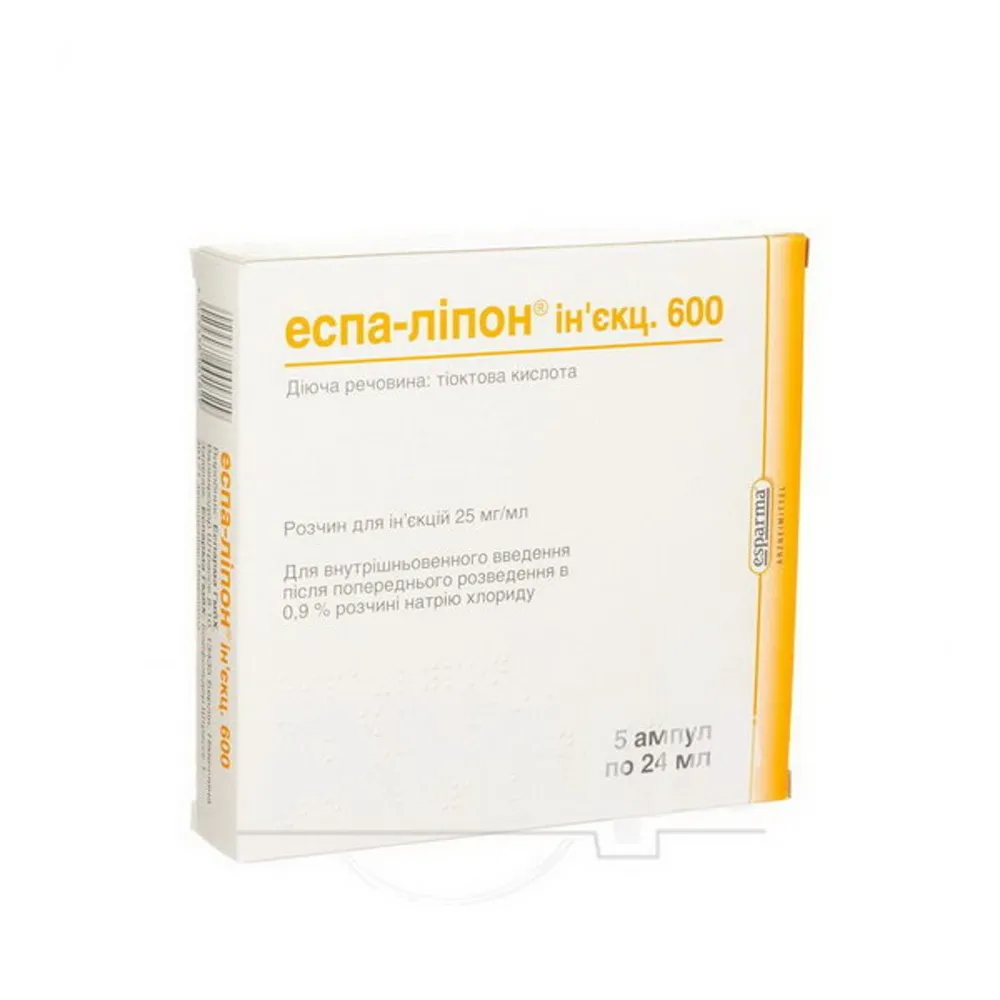
Table of Contents
INSTRUCTION FOR MEDICAL USE OF THE MEDICINAL PRODUCT ESPA-LIPON® inj. 600 (ESPA-LIPON® inj. 600)
Composition:
Active substance: thioctic acid (thioctic acid);
1 ampoule contains 755 mg of ethylenediamine salt of thioctic acid (equivalent to 600 mg of thioctic acid);
Excipient: water for injections.
Pharmaceutical form. Solution for injection.
Main physico-chemical properties: clear solution of greenish-yellow color.
Pharmacotherapeutic group.
Agents affecting the digestive system and metabolic processes. Thioctic acid.
ATC code A16AX01.
Pharmacological properties.
Pharmacodynamics.
Thioctic acid is a substance produced in the body that functions as a coenzyme in the oxidative decarboxylation of α-keto acids. Hyperglycemia caused by diabetes mellitus leads to glucose deposition on vascular matrix proteins and the formation of advanced glycation end-products. This process results in reduced endoneurial blood flow and endoneurial hypoxia/ischemia, associated with increased generation of free oxygen radicals that damage nerves, as well as depletion of the antioxidant glutathione in peripheral nerves. In 1995, a multicenter placebo-controlled study was conducted to evaluate the efficacy of thioctic acid in the symptomatic treatment of diabetic polyneuropathy, which demonstrated favorable effects of thioctic acid on studied symptoms such as paresthesia, burning sensations, numbness, and pain.
Pharmacokinetics.
Thioctic acid exhibits a high first-pass effect in the liver. There are significant inter-individual differences in systemic availability of thioctic acid. Biotransformation of thioctic acid occurs via oxidation of side chains and conjugation. Elimination is primarily renal.
In humans, the plasma half-life is approximately 25 minutes, and total plasma clearance ranges from 10 to 15 ml/min/kg. At the end of a 30-minute infusion of 600 mg, the measured plasma concentration is about 20 µg/ml. Radiolabeled studies in animals (rats, dogs) have shown that 80–90% of the drug is predominantly excreted as metabolites. Similarly, in humans, only a small amount of unchanged substance is excreted in urine. Biotransformation occurs mainly through oxidative shortening of side chains (beta-oxidation) and/or S-methylation of thiol groups.
Clinical characteristics.
Indications.
Symptomatic treatment of diabetic polyneuropathy.
Contraindications.
Hypersensitivity to thioctic acid or to any of the excipients of the medicinal product.
Interaction with other medicinal products and other forms of interactions.
Thioctic acid reacts with ionic metal complexes (e.g., with cisplatin); therefore, the drug may reduce the efficacy of cisplatin.
Thioctic acid forms poorly soluble complex compounds with sugar molecules (e.g., with levulose solution).
Thioctic acid is a metal chelator; therefore, it should not be administered concomitantly with metals (e.g., iron or magnesium-containing preparations).
Thioctic acid may enhance the hypoglycemic effect of insulin and oral antidiabetic agents by increasing peripheral tissue sensitivity to these agents, thus necessitating possible dose adjustments of insulin or oral antidiabetic drugs. For this reason, careful monitoring of blood glucose levels is required, particularly at the beginning of therapy.
Note.
Regular alcohol consumption is a significant risk factor for the development and progression of neuropathic syndromes and may therefore influence the success of treatment with the medicinal product «ESPALIPON® inj. 600». Thus, patients with diabetic polyneuropathy are generally advised to avoid alcohol consumption. This also applies to intervals when therapy is not being administered.
Special precautions for use
When thioctic acid is administered parenterally, hypersensitivity reactions have been observed, up to and including the development of anaphylactic shock. Therefore, patients must be under appropriate medical supervision. If early symptoms occur (e.g. itching, nausea, weakness, etc.), treatment should be discontinued immediately; under certain circumstances, further therapeutic measures may be required.
Cases of autoimmune insulin syndrome (AIS) have been reported during treatment with thioctic acid. Patients with the human leukocyte antigen genotype (alleles HLA-DRB1*04:06 and HLA-DRB1*04:03) are more susceptible to developing AIS during treatment with thioctic acid. The HLA-DRB1*04:03 allele (susceptibility coefficient for AIS development – 1.6) is particularly prevalent among Caucasian populations (more common in Southern Europe than in Northern Europe), while the HLA-DRB1*04:06 allele (susceptibility coefficient for AIS development – 56.6) is especially common in Japanese and Korean patients.
AIS should be considered in the differential diagnosis of spontaneous hypoglycemia in patients receiving thioctic acid.
The main principle in the treatment of diabetic polyneuropathy is optimal control of diabetes. Frequent monitoring of glycemia is necessary when treating patients with diabetes mellitus. In some cases, doses of hypoglycemic agents may need to be adjusted to prevent hypoglycemia.
During treatment of polyneuropathy, due to regenerative processes, transient increased sensitivity may occur, accompanied by paresthesia with sensations of "pins and needles."
Alcohol consumption is a risk factor for polyneuropathy and may reduce the effectiveness of the drug. Therefore, it is recommended to abstain from alcohol consumption during treatment with this medicinal product. The drug should not be administered simultaneously with preparations containing metals (iron, magnesium, calcium preparations) or with dairy products containing calcium.
The drug is light-sensitive; therefore, vials should only be removed from the packaging immediately before use.
The prepared infusion solution must be protected from sunlight by covering it with light-protective bags. Under these conditions, the solution remains suitable for use for up to 6 hours.
A certain limitation for intravenous administration of thioctic acid preparations is advanced age (over 75 years).
Use during pregnancy or breastfeeding
The use of thioctic acid during pregnancy is not recommended due to the lack of adequate clinical data.
There are no data on the passage of thioctic acid into breast milk; therefore, its use during breastfeeding is not recommended.
Ability to affect reaction speed when driving or operating machinery
During treatment, caution is required when driving or engaging in other potentially hazardous activities that require increased attention and rapid psychomotor reactions.
Dosage and Administration.
For adults, administer once daily 12–24 mL of the solution diluted in 250 mL of 0.9% sodium chloride solution (equivalent to 300 mg or 600 mg of thioctic acid per day).
The solution should be given as an intravenous infusion, administered over a period of 2–4 weeks during the initial treatment phase.
Infusion Instructions.
For preparation of the infusion solution, only 0.9% sodium chloride solution should be used. The drug must be administered intravenously by slow drip infusion over at least 30 minutes. Prior to administration, the contents of one ampoule of "ESPA-LIPON® inj. 600" should be diluted in 250 mL of 0.9% sodium chloride solution. The drug is sensitive to sunlight; therefore, the solution should be prepared immediately before use and the prepared infusion flask should be protected from light using a light-protective cover. The light-protected infusion solution may be stored for approximately 6 hours.
Children.
As there are no data on the safety and efficacy of thioctic acid use in children, the drug is not recommended for use in this age group.
Overdose.
In case of overdose, symptoms such as nausea, vomiting, and headache may occur. In the event of overdose or suspected adverse effects, the infusion must be stopped immediately. Without removing the infusion needle, slowly infuse 0.9% sodium chloride solution through the same needle.
There have been reports of accidental or intentional administration of thioctic acid in doses of 10–40 g during alcohol intoxication, resulting in isolated cases with severe signs of intoxication, including fatal outcomes. Clinical manifestations of intoxication included psychomotor disturbances or dizziness, followed by generalized seizures and development of lactic acidosis. Consequences of thioctic acid intoxication may include hypoglycemia, shock, rhabdomyolysis, hemolysis, disseminated intravascular coagulation (DIC), bone marrow suppression, and multiorgan failure.
Treatment. In cases of suspected significant thioctic acid intoxication (e.g., > 80 mg/kg body weight in adults and > 50 mg/kg body weight in children), immediate hospitalization is indicated, and management should follow general principles of poisoning treatment (e.g., induction of emesis, gastric lavage, activated charcoal, etc.). Treatment of life-threatening complications such as generalized seizures and lactic acidosis, as well as other severe consequences of intoxication, should follow modern intensive care principles and be conducted symptomatically. To date, there are no data on the usefulness of hemodialysis, hemoperfusion, or hemofiltration for enhanced elimination of thioctic acid.
Side effects
Classification of frequency of adverse reactions:
very common: ≥ 1/10;
common: ≥ 1/100 – < 1/10;
uncommon: ≥ 1/1000 – < 1/100;
rare: ≥ 1/10000 – < 1/1000;
very rare: < 1/10000;
unknown: frequency cannot be determined from available data.
Blood and lymphatic system disorders.
In isolated cases, petechial hemorrhages in mucous membranes/skin, hypocoagulation, thrombophlebitis have been observed.
Very rare: after intravenous administration of thioctic acid, hemorrhagic rash (purpura), thrombocytopenia, platelet dysfunction, hypocoagulation, hemorrhagic rashes (purpura), platelet function disorders have been observed.
Immune system disorders.
Unknown: autoimmune insulin syndrome (see section "Special precautions"). Skin allergic reactions such as rash, urticaria, pruritus, eczema, as well as systemic reactions up to shock, may occur.
Nervous system disorders.
Very rare: altered or impaired taste sensations, headache, hot flashes, increased sweating, dizziness, visual disturbances. After intravenous administration of thioctic acid, seizures and diplopia have been observed. In most cases, all these manifestations resolve spontaneously.
Unknown: loss of consciousness, seizures.
Gastrointestinal disorders.
In individual cases, during rapid intravenous injection, nausea, vomiting, diarrhea, abdominal pain may occur, which resolve spontaneously.
Hepatobiliary disorders.
Unknown: cholestatic hepatitis.
Metabolic and nutritional disorders.
Very rare: due to improved glucose utilization, blood glucose levels may decrease, possibly leading to symptoms resembling hypoglycemia, such as dizziness, increased sweating, headache, visual disturbances.
Cardiac and vascular disorders.
During rapid intravenous administration, chest pain and tachycardia may occur, which resolve spontaneously.
General disorders and administration site conditions.
Common: after rapid intravenous administration, increased intracranial pressure and dyspnea may occur, which resolve spontaneously.
Very rare: in isolated cases, reactions at the injection site and weakness have been reported.
Shelf life. 3 years.
Shelf life after reconstitution in physiological saline solution, protected from light, is 6 hours.
Storage conditions.
Store at temperatures not exceeding 25 °C in the original packaging to protect from light.
Keep out of reach of children.
Incompatibilities.
Thioctic acid reacts in vitro with metal ion complexes (e.g., cisplatin).
Thioctic acid forms complex compounds with sugar molecules (e.g., levulose solution), which are poorly soluble.
Injectable solution of thioctic acid is incompatible with glucose solution, Ringer's solution, and other solutions known to react with SH groups or disulfide bridges.
For infusion of the medicinal product "ESPA-LIPON® inj. 600", only 0.9% sodium chloride solution should be used as a solvent.
Packaging.
24 ml in an ampoule; 5 ampoules in a cardboard box with labeling in Ukrainian.
Prescription status. Prescription only.
Manufacturer.
Esparma GmbH, Germany.
Manufacturer's address.
Valenroder Strasse 8-10, 13435 Berlin, Germany.
Marketing authorization holder.
Esparma GmbH, Germany.
Address of the marketing authorization holder.
Bielefelder Strasse 1, 39171 Schöningen, Germany.