Escuzan long
Ukraine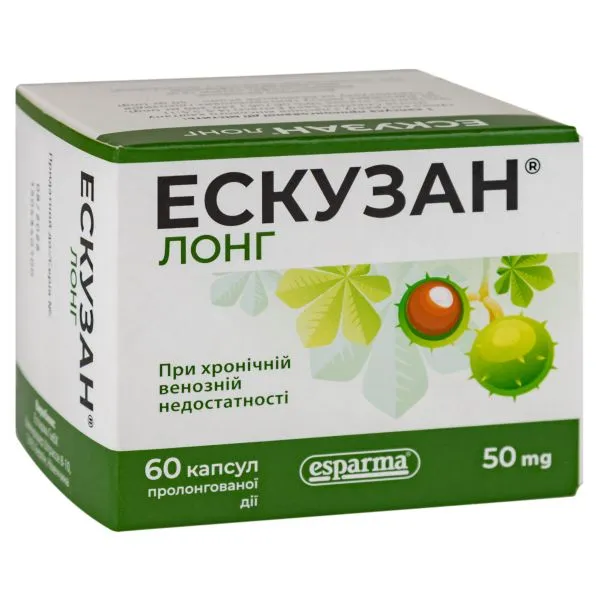
Table of Contents
INSTRUCTIONS FOR MEDICAL USE OF THE MEDICINAL PRODUCT ESCUSAN® LONG (AESCUSAN® LONG)
Composition:
Active substance: 1 prolonged-release capsule contains dry extract of Horse Chestnut Seeds (Horse Chestnut Seeds Extract) (4.5–5.5:1) (extractant ethanol 50% vol./vol.) 240–290 mg, corresponding to the content of triterpene glycosides calculated as anhydrous escin – 50 mg;
Excipients: dextrin, copovidone, talc, ammonium methacrylate copolymer (type A), ammonium methacrylate copolymer (type B), triethyl citrate;
Capsule shell: iron oxide black (E 172), iron oxide red (E 172), iron oxide yellow (E 172), titanium dioxide (E 171), indigo carmine (E 132), quinoline yellow (E 104), gelatin, purified water, sodium dodecyl sulfate.
Pharmaceutical form. Prolonged-release capsules.
Main physico-chemical properties: hard gelatin capsules with a transparent green body and an opaque brown cap, filled with spherical granules ranging from light brown to brown.
Pharmacotherapeutic group. Angioprotectors. Capillary stabilizing agents.
ATC code C05CX.
Pharmacological Properties
Aescin, the main active component of horse chestnut seed extract, exerts anti-exudative and vessel-strengthening effects.
Pharmacodynamics.
The glycocalyx (mucopolysaccharides) acts as a molecular sieve in capillary walls: large particles such as proteins cannot penetrate beyond the vessels. In patients with varicose veins, blood contains an increased amount of lysosomal enzymes, which enzymatically degrade mucopolysaccharides, thereby damaging the "molecular sieve" of vessel walls and making them permeable to large particles (proteins). As a result, under the influence of osmotic pressure, water exits the vessels into the extravascular space, leading to edema formation. Horse chestnut seed extract reduces the activity of lysosomal enzymes in blood. Thus, the balance between synthesis and degradation of mucopolysaccharides, which had been pathologically shifted due to lysosomal enzymes, is restored. Pathologically increased vascular permeability caused by chronic venous insufficiency is normalized due to reduced capillary wall permeability. This establishes a physiological equilibrium between water filtration and absorption. When filtration is elevated due to increased vascular wall permeability for macromolecules, edema develops. Horse chestnut seed extract reduces filtration, thereby preventing edema development; with prolonged use, due to improved fluid balance, regression of existing edema is achieved.
Pharmacokinetics.
According to previous studies, up to 0.11% of the drug "Escusan® long", 50 mg prolonged-release capsules, is excreted unchanged in urine after oral administration. Low renal clearance levels (4.8 ml/min) indicate that elimination of aescin after oral administration occurs primarily via biotransformation through extrarenal pathways, possibly in blood and liver. Aescin can be completely removed from the body by hemodialysis.
Clinical characteristics.
Indications.
Chronic venous insufficiency:
- leg edema;
- leg heaviness and pain, itching;
- calf muscle cramps.
Contraindications.
Hypersensitivity to dry extract of horse chestnut seeds and/or to any component of the drug. Renal insufficiency.
Special precautions.
If unusual symptoms occur in the legs (edema, skin color changes, sensation of tension or warmth), as well as pain, immediate medical advice should be sought, as these symptoms may indicate serious medical complications (venous thrombosis in the legs, i.e. blockage of leg veins by a blood clot).
If skin inflammation, thrombophlebitis, or subcutaneous induration, severe pain, ulcers, sudden swelling of one or both legs, or cardiac or renal insufficiency occur, immediate medical advice must be sought, as these may be manifestations of a serious disorder.
When used concomitantly with anticoagulant drugs, monitoring of blood coagulation parameters is required.
Renal function should be monitored during treatment with this drug.
All recommended non-invasive measures should be followed, such as leg bandaging, wearing supportive stockings, or cold water dousing.
Interaction with other medicinal products and other forms of interaction.
The drug enhances the effect of antithrombotic agents. Cephalosporin antibiotics increase the concentration of free escin in blood and the risk of adverse effects.
Concomitant use of the drug with aminoglycoside antibiotics should be avoided due to increased nephrotoxic potential of aminoglycosides.
Use during pregnancy or breastfeeding.
Due to insufficient data, the use of the drug during pregnancy and breastfeeding is not recommended.
Ability to affect reaction speed when driving or operating machinery.
The use of the drug does not affect the ability to drive a vehicle or operate machinery.
Dosage and Administration.
The drug is taken orally, 1 capsule twice daily (in the morning and evening), before meals. Capsules should be swallowed whole with a sufficient amount of water. If mild gastrointestinal disturbances occur, it is recommended to take the capsules during meals.
The duration of treatment is determined individually by a physician, depending on the severity of the disease and the clinical efficacy of the drug.
Children.
The medicinal product is not recommended for children (under 18 years of age) due to lack of safety data.
Overdose.
In case of overdose, saponins contained in horse chestnut seeds may cause nausea; vomiting and diarrhea may also occur, along with drowsiness, delirium, mydriasis, and potentially fatal respiratory paralysis within 24–48 hours.
Treatment: if vomiting does not occur and a large amount of the drug has been ingested, gastric lavage (e.g. with 0.02% potassium permanganate solution) and administration of activated charcoal are recommended; symptomatic treatment.
Side effects.
The frequency of adverse reactions is classified as follows: very common (≥1/10); common (≥1/100 to <1/10); uncommon (≥1/1000 to <1/100); rare (≥1/10,000 to <1/1000); very rare (<1/10,000); not known (cannot be estimated from available data).
The following undesirable effects may occur:
Gastrointestinal system: uncommon — diarrhea, nausea and vomiting, gastrointestinal discomfort.
Nervous system: uncommon — headache, dizziness.
Cardiovascular system: very rare — tachycardia, arterial hypertension.
Reproductive system: very rare — metrorrhagia.
Skin (hypersensitivity reactions): rare — allergic dermatitis (itching, rash, erythema, eczema); very rare — severe allergic reactions (in some cases with bleeding).
When high doses of the drug are used, nephrotoxic reactions and thrombosis are possible.
Shelf life. 3 years.
Storage conditions.
Store in the original packaging at a temperature not exceeding 25 °C, in a place inaccessible to children.
Packaging.
10 capsules in a blister, 3, 6, or 9 blisters per cardboard box.
30 capsules in a blister, 1, 2, or 3 blisters per cardboard box.
Supply category.
Over-the-counter (without prescription).
Manufacturer.
Esparma GmbH.
Manufacturer's address and place of business.
Walendorfer Strasse 8-10, 13435 Berlin, Germany.
Marketing authorization holder.
Esparma GmbH.
Address of the marketing authorization holder.
Bielefelder Strasse 1, 39171 Schielkendorf, Germany.