Erbisol
Ukraine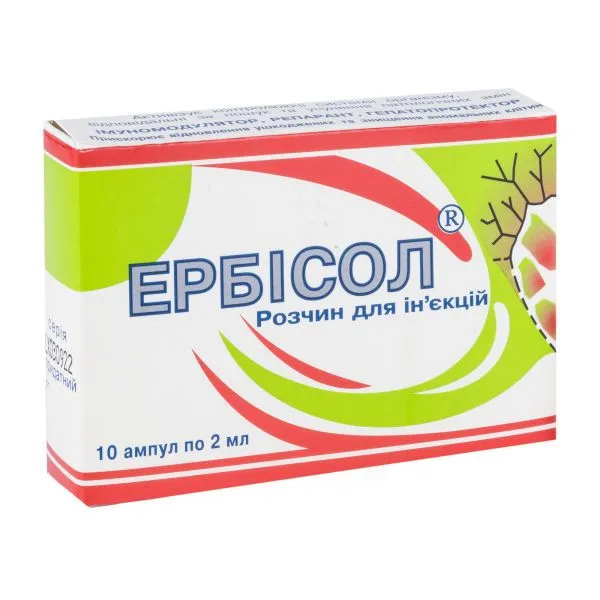
Table of Contents
INSTRUCTION FOR MEDICAL USE OF THE MEDICINAL PRODUCT ERBISOL® (ERBISOL®)
Composition:
Active substances:
1 ml of the preparation contains: a complex of natural non-protein low-molecular organic compounds of non-hormonal origin obtained from animal embryonic tissue, containing oligopeptides and glycopeptides (total 0.07–1.0 mg), nucleotides, amino acids;
Excipients: 0.9% sodium chloride isotonic solution.
Pharmaceutical form. Injection solution.
Main physicochemical properties: transparent or slightly opalescent colorless or light yellow liquid with a specific odor.
Pharmacotherapeutic group.
Immunostimulants. ATC code: L03A X.
Hepatotropic agents. ATC code: A05BA.
Pharmacological Properties
Pharmacodynamics. The pharmacological activity of the medicinal product is determined by the content of low-molecular-weight biologically active peptides, which activate the body's natural, evolutionarily developed control systems responsible for detecting and eliminating pathological changes. ERBISOL® activates the immune system to accelerate recovery of damaged cells and destruction of abnormal cells and tissues. The primary immunomodulating effect of the drug is manifested mainly through its action on the macrophage link, which is responsible for repair of damaged cells and restoration of functional activity of organs and tissues, as well as through NK cells (CD3-16+56+) and T-killers (CD3+16+56+), which are responsible for destruction of damaged cells incapable of regeneration, or abnormal cells (mutant, malignant, virus-infected cells, etc.) and tissues. Simultaneously, ERBISOL® exerts an immunocorrective effect in immune status disorders, promoting its normalization through activation of T-lymphocytes, Th1-helpers and T-killers, and inhibition of Th2-helper and B-lymphocyte activity. This is important for restoring the balance between cellular and humoral immunity in oncological diseases and for cessation of allergic reactions. Depending on the body's immune status, the drug also modulates the activity of certain other factors of humoral and cellular immunity: it induces synthesis of α-, β-, and γ-interferon, tumor necrosis factor, interleukin-2 (IL-2) and IL-12, while suppressing synthesis of IL-4 and IL-10. ERBISOL® potentiates the effects of antibiotics and exogenous interferons, while simultaneously reducing their toxic side effects.
ERBISOL® accelerates regeneration and repair processes in erosive-ulcerative lesions of the gastrointestinal tract and promotes healing of mucosal injuries in the stomach and duodenum. The drug enhances the regenerative-reparative potential of tissues, leading to rapid healing of traumatic, purulent, and postoperative wounds, trophic ulcers of various etiologies, accelerated consolidation of bone fragments in fractures, and supports effective treatment of periodontitis.
ERBISOL® demonstrates efficacy in the treatment of acute and chronic hepatitis of various etiologies, including toxic, drug-induced, and viral hepatitis, in which the drug activates liver regeneration processes. In viral hepatitis, ERBISOL®, in addition, activates cytotoxic T-lymphocytes (CD8+) and T-killers (CD3+16+56+), which are responsible for destruction of virus-infected cells, and induces synthesis of α-, β-, and γ-interferon, increasing their blood levels by 4–6 times, thereby promoting accelerated viral elimination. At the same time, by activating liver regeneration processes, the drug facilitates replacement of dead hepatocytes with healthy cells, allowing ERBISOL® to be classified among agents that alleviate the severity of infectious disease. The drug exhibits anti-inflammatory properties, although treatment of chronic inflammatory processes may involve a transient exacerbation phase lasting 2–5 days. ERBISOL® promotes normalization of hepatocyte functions, demonstrates pronounced antioxidant and membrane-stabilizing effects at the level of plasma membranes, prevents development of dystrophy, cytolysis, and cholestasis, as well as atherosclerosis in liver diseases, and supports normalization of bilirubin and transaminase levels. This leads to rapid resolution of asthenovegetative, dyspeptic, and pain syndromes. By enhancing liver functions, the drug facilitates accelerated elimination of exogenous toxic agents and harmful metabolic byproducts from the body.
In chronic obstructive pulmonary diseases and bronchial asthma, as well as in respiratory insufficiency, administration of ERBISOL® reduces manifestations of neutrophilic inflammation, whose excessive activation contributes to irreversible bronchial obstruction due to destruction of elastic and collagenous lung matrix. Reduction of cellular inflammation improves external respiration function, thereby reducing tissue hypoxia, enhancing cellular energy supply, decreasing membrane burden with toxins and immune complexes, strengthening erythrocyte membrane function (which binds catecholamines), reducing relative viscosity of erythrocyte suspension and their aggregation tendency, and increasing erythrocyte deformability. These effects promote improved blood fluidity and microcirculation. The clinical effect of ERBISOL® is manifested in significant reduction of disease symptom severity, positive improvement in dynamic parameters of external respiration function, and decreased frequency of inhaled bronchodilator use.
In insulin-dependent diabetes mellitus, ERBISOL®, by inhibiting Th2-helper and B-lymphocyte activity, reduces intensity of the autoimmune process, and by activating macrophages, promotes repair of damaged beta-cells, resulting in reduced daily insulin requirement, as well as stable compensation of carbohydrate and lipid metabolism and decreased lipid peroxidation. This contributes to reduction or elimination of clinical manifestations and improvement of liver, myocardial, and cardiovascular system function. In combined therapy, ERBISOL® positively affects treatment of neuropathies and diabetic macro- and microangiopathies, improves microcirculation in blood vessels, and prevents gangrene development. In newly diagnosed diabetes, the drug promotes significant reduction in daily insulin dose and sustained long-term remission. In patients with non-insulin-dependent diabetes mellitus, ERBISOL® improves metabolic syndrome parameters and enhances myocardial contractile function. ERBISOL® contributes to improved quality of life in diabetic patients.
In oncological diseases, ERBISOL® does not stimulate the imbalanced immune system of patients but promotes its correction, normalizing immune status by activating T-lymphocytes, Th1-helpers and T-killers, while inhibiting Th2-helper and B-lymphocyte activity, thereby supporting restoration of specific cellular immunity, particularly activation of T-killers. The drug also activates macrophages and natural killers (NK cells) of nonspecific immunity, induces synthesis of α- and γ-interferon and tumor necrosis factor. This leads to inhibition of both growth and metastasis of malignant tumors, and in combination with surgical intervention or chemotherapy and radiation therapy, promotes their effective destruction. As a supportive agent during chemotherapy and radiation therapy, ERBISOL® significantly enhances treatment efficacy in two ways. First, as a reparant, hepatoprotector, and immunoprotector, it protects healthy cells and tissues from chemical and radiation damage and promotes repair of injured areas. This allows use of more intensive regimens involving potent chemotherapeutic agents and higher radiation doses without risk of particularly adverse consequences for patients, preventing hair loss and eliminating or substantially reducing manifestations of asthenovegetative, dyspeptic, and pain syndromes. Second, as an immunomodulator, the drug restores antitumor immune functions and, despite the damaging effects of chemotherapy and radiation therapy, promotes normalization of patients' immune status after treatment to levels comparable to those in healthy individuals. This enables, unlike standard chemotherapy and radiation therapy, mobilization of the body's natural antitumor defense mechanisms both during treatment and in inter-course periods, thereby enhancing treatment efficacy and improving quality of life, and potentially allowing replacement of some chemotherapy and radiation therapy courses with immunotherapy and immunocorrection using ERBISOL®.
In clinical studies involving patients receiving ERBISOL®, a reduction was observed in the number of recurrent intensive courses of chemotherapy and radiation therapy required in the near term, as well as decreased frequency of new metastatic nodules developing between scheduled treatment courses.
ERBISOL® is an adaptogen that enhances the body's protective and adaptive-resilience functions. ERBISOL® is recommended for use in complex therapy of consequences of radiation exposure and environmental pollution. The drug exhibits radioprotective effects, associated with its membrane-stabilizing and antioxidant properties, activation of repair processes at both cellular and genetic levels (it activates DNA polymerase B – a genetic code repair enzyme), and normalization of liver function for effective elimination of exogenous toxic agents.
ERBISOL® activates the immune system to perform body surveillance and restoration, which is of great importance in gerontology, as during life a large number of abnormal cells accumulate, many of which remain in a "hidden" state and become activated when the immune system weakens. ERBISOL® promotes restoration of immune system function, enabling activated NK and T-killers to perform surveillance — detecting and destroying abnormal cells — while macrophages partially restore, i.e., regenerate, functions of organs and tissues impaired in elderly individuals.
The immunomodulating effect begins to develop on days 5–7 and reaches maximum levels by days 20–21, remaining at this level for an additional 8–10 days after completion of the treatment course. The reparative effect begins to develop on days 2–3 of treatment, while the hepatoprotective effect becomes apparent after 2–3 injections of the drug.
The drug is non-toxic, does not exhibit cumulative toxicity, allergenic, teratogenic, mutagenic, or carcinogenic properties.
Pharmacokinetics. Not studied.
Clinical characteristics.
Indications.
ErbiSol is used in complex therapy for:
- Gastroenterology: hepatitis of various etiologies (including viral, toxic, and drug-induced hepatitis caused by the use of antibiotics, interferons, chemotherapeutic agents, and other potent drugs causing adverse effects), reactive hepatitis, steatohepatosis, liver cirrhosis, peptic ulcer of the stomach and duodenum, erosive gastroduodenitis, nonspecific ulcerative colitis;
- Toxicology: ERBI SOL® enhances hepatic detoxification functions;
- Endocrinology: diabetes mellitus, autoimmune thyroiditis;
- General therapy: nonspecific lung diseases (pneumonia, chronic bronchitis), pulmonary tuberculosis, angiopathies, for improvement of microcirculation, normalization of vascular tone and blood filling, metabolic dystrophies. ERBI SOL® is used in comprehensive treatment of individuals affected by consequences of radiation exposure and environmental pollution; the drug has pronounced adaptive-corrective properties in combination of the above-mentioned pathologies and enhances compensatory and protective functions of the body;
- Allergology: allergic and autoimmune diseases, including bronchial asthma;
- Gerontology: functional insufficiency associated with age-related disorders in liver, immune, nervous, and cardiovascular systems. For increasing physical activity and alleviating asthenic syndrome, as well as for enhancing potency;
- Dentistry: periodontitis;
- Surgery and traumatology: traumatic, postoperative and purulent-septic wounds, fractures (to accelerate consolidation of bone fragments), trophic ulcers of various etiologies, diabetic angiopathies, for activation of reparative processes in complex treatment of pressure ulcers;
- Oncology: during surgical treatment for prevention of metastasis and rapid wound healing. During chemotherapy and radiation therapy, ERBI SOL® is used in combination as a supportive agent acting as a hepatoprotector, immunoprotector, and reparant; during rehabilitation and inter-course periods, it is used as an immunocorrector and reparant to enhance the body's anti-tumor defense.
Contraindications.
Individual intolerance, hypersensitivity to any component of the drug.
Interaction with other medicinal products and other types of interactions.
ERBI SOL® enhances the effect of antibacterial agents and exogenous interferons, while reducing their toxic effects. To ensure effective targeted immunomodulating action, ERBI SOL® should not be prescribed concomitantly with immunomodulators that stimulate humoral immunity. ERBI SOL® increases receptor sensitivity; therefore, when used in combination with hormonal drugs, biostimulants, and bioinhibitors (tranquilizers, hypnotics, sedatives, psychotropic agents, depressants, etc.), their dosage should be monitored and reduced if necessary.
Special precautions for use
In case of cholecystitis, combine with therapy aimed at normalizing the function of the biliary system.
Can be combined with anti-Helicobacter eradication therapy. In patients with increased gastric acidity, antisecretory and antacid agents should be used.
In diabetes mellitus, starting from the 3rd day of treatment, blood glucose levels should be monitored. If a decrease in glucose levels is observed, from the 10th day the dose of hypoglycemic agents may be slightly reduced. If a tendency toward reduced glucose levels persists, the treatment course may be extended to 23–30 days. In cases of autoimmune aggression, to suppress it, additional administration of ERBI SOL® 2 ml once daily at 21–24 hours for 5–7 days is recommended.
In patients with high arterial pressure, as well as during the exacerbation phase of a pathological process, ERBI SOL® should be used with caution, reducing the dose to 2 ml once every 24 hours in the evening or to 2 ml once every 48 hours.
This medicinal product contains less than 1 mmol (23 mg)/dose of sodium, i.e. it is practically sodium-free.
Use during pregnancy or breastfeeding
Studies on the efficacy of the medicinal product ERBI SOL® during pregnancy or breastfeeding have not been conducted. ERBI SOL® should not be administered during pregnancy or breastfeeding.
Ability to affect reaction rate when driving or operating machinery
The effect of the drug on reaction speed while driving or operating machinery has not been studied. It is unlikely that the medicinal product ERBI SOL® affects the ability to drive or operate machinery.
Administration and Dosage.
The dosage and treatment course are determined individually by a physician depending on the nature and course of the disease (as monotherapy or as part of combination therapy).
ERBISOL® is administered intramuscularly, intravenously, intraarterially, intraperitoneally, or intratumorally once daily to adults at 2–4 mL. The treatment course lasts 20 days. Considering the body's chronorhythms, single daily administration should preferably be scheduled in the evening before bedtime at 21:00–24:00, 2–3 hours after a meal. In case of twice-daily administration, an additional dose is given in the morning at 6:00–9:00, 1–2 hours before a meal. The average total course dose ranges from 40 to 80 mL.
For reactive hepatitis, autoimmune and allergic diseases, adults are prescribed 2 mL daily intramuscularly for 20 days.
For wounds and periodontitis, adults are prescribed 4 mL intramuscularly daily for the first 10 days, followed by 2 mL daily for the next 10 days, if needed. In generalized periodontitis, additional infiltration injections into the gums or applications/electrophoresis of ERBISOL® from the anode (+) to the gums are recommended.
For patients with chronic obstructive pulmonary diseases and bronchial asthma with respiratory insufficiency of Grade I, ERBISOL® is administered intramuscularly at 2 mL once daily at 21:00–24:00 for the first 3 days, then at 2 mL twice daily at 16:00–18:00 and 21:00–24:00 for the next 5 days, followed by 2 mL once daily at 21:00–24:00 for 7 days. The total course dose is 40 mL.
For patients with chronic obstructive pulmonary diseases and bronchial asthma with respiratory insufficiency of Grade II, ERBISOL® is administered intramuscularly at 2 mL once daily at 21:00–24:00 for the first 3 days, then at 2 mL twice daily at 16:00–18:00 and 21:00–24:00 for the next 10 days, followed by 2 mL once daily at 21:00–24:00 for 7 days. The total course dose is 60 mL.
For chronic obstructive pulmonary diseases and bronchial asthma associated with severe and irreversible changes in external respiration function and respiratory insufficiency of Grade III, and for pulmonary tuberculosis, the treatment course requires no less than 80 mL of ERBISOL®. Patients in this group are prescribed the drug intramuscularly at 2 mL twice daily—at 16:00–18:00 and 21:00–24:00. The treatment course lasts 20 days. This proposed treatment approach complements the stepwise scheme of basic therapy.
For hepatitis, steatohepatosis, liver cirrhosis, ulcerative lesions of the stomach and duodenum, erosive gastroduodenitis, nonspecific ulcerative colitis, metabolic dystrophies, tissue injuries, fractures (to accelerate consolidation of bone fragments), trophic ulcers of various etiologies, pressure sores, as well as in rehabilitation and restorative therapy, to enhance physical performance, adaptive and protective functions of the body, and to eliminate asthenic syndrome, the drug is administered intramuscularly to adults at 2 mL twice daily—at 6:00–9:00 and 21:00–24:00—for 20 days. Alternatively, for the first 3 days, 2 mL is administered once daily at 21:00–24:00; for the next 10 days, 2 mL twice daily at 6:00–9:00 and 21:00–24:00; followed by 2 mL once daily at 21:00–24:00 for 7 days.
For diabetes mellitus and autoimmune thyroiditis, ERBISOL® is prescribed twice daily at 2 mL—morning at 6:00–9:00 and evening at 21:00–24:00—administered intravenously or intramuscularly for 20 days.
In oncological diseases as a supportive and rehabilitation agent during radiotherapy, ERBISOL® is administered intramuscularly to adults at 2 mL twice daily—morning at 6:00–9:00 and evening at 21:00–24:00—for 20 days, starting 1–2 days prior to the radiotherapy course.
During chemotherapy, ERBISOL® is administered daily to adults, starting 2–3 days before the chemotherapy course, at 2 mL once daily in the evening at 21:00–24:00 intramuscularly, continuing throughout chemotherapy and ending 7–12 days after chemotherapy (total duration 15–25 days). Additionally, 2 mL is administered intramuscularly in the morning at 6:00–9:00, starting 1–2 days before chemotherapy, continuing during chemotherapy, and ending 3–7 days after chemotherapy. Thus, on the first day and the last 4–7 days of the course, ERBISOL® may be administered once daily at 2 mL in the evening at 21:00–24:00. On days of chemotherapy administration, instead of the morning intramuscular injection of 2 mL ERBISOL®, it is advisable to administer 4–16 mL of ERBISOL® (depending on the chemotherapy regimen and dosage) fractionally, immediately before each cytostatic agent, via the same route—i.e., intravenously, intraarterially, intratumorally, or intraperitoneally—and additionally administer 2 mL intramuscularly at 17:00. For example, during intravenous drip infusion of a chemotherapeutic agent, 2 mL of ERBISOL® is administered intravenously before each 200 mL of chemotherapeutic solution. During intraarterial infusion of a chemotherapeutic agent, ERBISOL® is administered intraarterially in the same manner. During regional chemotherapy, 4 mL of ERBISOL® is administered intraarterially or intratumorally before the chemotherapeutic solution. Additional intramuscular administration of 2 mL ERBISOL® at 17:00 should continue for another 2–3 days after administration of high-dose chemotherapeutic agents. When chemotherapy includes agents affecting the patient's hormonal status, ERBISOL® should be administered no earlier than 3 hours after administration of such agents.
The calculation of the required amount of ERBISOL® to be administered together with chemotherapeutic agents to prevent their adverse effects on healthy tissues is based on the administered dose of chemotherapeutic agents: 2 mL of ERBISOL® should preferably be administered before each 25–30 mg of doxorubicin or 25–30 mg of platinum-based agents, or 0.5–0.75 g of cyclophosphamide, or 1.0 g of 5-fluorouracil, or other chemotherapeutic agents with equivalent toxic effects.
If a patient underwent surgery prior to chemoradiotherapy, ERBISOL® should be administered intramuscularly to adults at 2 mL in the evening starting from day 1–3 after surgery and continuing for 7–10 days until the start of the chemoradiotherapy course. This approach is also advisable for patients with concomitant liver diseases and/or a history of hepatitis.
To improve the patient's physical condition, 3–5 weeks after completing a chemotherapy course, a course of immunotherapy with ERBISOL® may be administered.
For the first 3 days, adults are prescribed 2 mL intramuscularly once daily in the evening at 21:00–24:00; for the next 10 days, 2 mL twice daily—morning at 6:00–9:00 and evening at 21:00–24:00—followed by 2 mL once daily in the evening at 21:00–24:00 for 7 days. Alternatively, 2 mL twice daily—at 6:00–9:00 and 21:00–24:00—may be administered daily for 20 days.
Children.
The safety and efficacy of the drug have not been studied in children. The drug should not be prescribed to children.
Overdose.
Transient increased excitability or fatigue may occur, which does not require specific treatment.
Side effects.
Sometimes within the first 2–5 days of treatment, the drug may cause an exacerbation of chronic inflammation, which in most cases is a stage of the healing process. Hypersensitivity reactions are possible, including rashes, itching sensations, increased blood pressure and body temperature.
Shelf life. 5 years.
Do not use after the expiry date stated on the packaging.
Storage conditions.
Store at temperature 4–12°C in a place inaccessible to children. Opalescence may appear during storage.
Incompatibility.
To ensure effective targeted immunomodulating action of ERBISOL®, it should not be used concomitantly with:
alcohol (neutralizes the reparative action of macrophages);
immunomodulators that may stimulate humoral immunity, thus interfering with the action of T-killers.
Packaging. 10 ampoules of 1 ml or 2 ml.
Prescription status. Prescription only.
Manufacturer.
PP "Laboratoriya Erbis"
LLC "ERBIS"
E-mail: [email protected]
Web page:www.erbisol.com.ua
Manufacturer's address and location of business activity.
10-B, Raisy Okipnoi St., office 92, Kyiv, 02002, Ukraine
tel: +38 (044) 592-37-77, 592-17-30.