Erbisol® extra
Ukraine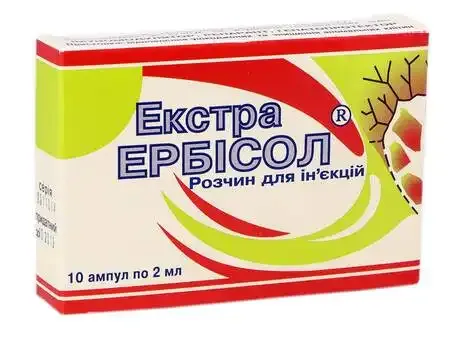
Table of Contents
INSTRUCTION for medical use of the medicinal product ERBISOL® Extra (ERBISOL® Extra)
Composition:
Active substances: 1 ml of the preparation contains: a complex of natural non-protein low-molecular organic compounds of non-hormonal origin obtained from animal embryonic tissue, oligopeptides and glycopeptides (total 0.07–0.4 mg), nucleotides, amino acids.
Excipients: 0.9% isotonic sodium chloride solution.
Pharmaceutical form. Injection solution.
Main physico-chemical properties: transparent or slightly opalescent colorless or light-yellow liquid with a specific odor.
Pharmacotherapeutic group.
Immunostimulants. ATC code L03A X.
Agents affecting the digestive system and metabolism. ATC code A16A X.
Pharmacological Properties
Pharmacodynamics
The pharmacological activity of the drug is determined by the presence of low-molecular-weight biologically active peptides, which possess immunomodulatory, reparative, antioxidant, and antihypoxic effects.
The main immunomodulatory effect of the drug is primarily manifested through its action on the macrophage link, responsible for the repair of damaged cells and restoration of functional activity of organs and tissues, as well as through NK cells (CD3-16+56+) and T-killers (CD3+16+56+), which are responsible for the destruction of damaged cells incapable of regeneration, or abnormal cells. Simultaneously, the drug exerts an immunocorrective effect and, in cases of immune status disorders, promotes its normalization through activation of T-lymphocytes, Th1-helpers, and T-killers, which is essential for restoring the balance between cellular and humoral immunity.
The reparative properties of the drug are due to its immunomodulatory action, manifested by increased activity of macrophages (which mediate the processes of repair of damaged cells and restoration of functional activity of organs and tissues), as well as N- and T-killers responsible for the destruction of damaged cells incapable of regeneration.
The antioxidant effect of the drug is achieved by inhibition of lipid peroxidation processes, increased activity of the glutathione-dependent antioxidant blood system, without altering the activity of microsomal oxidation enzymes or cytochrome P450 content, as well as through a membrane-stabilizing effect at the level of plasma membranes.
The antihypoxic properties of the drug are realized through increased tissue oxygen consumption and improved tissue respiration resulting from enhanced electron transport in mitochondria, restoration of the proton gradient across their membranes, and a rightward shift of the oxyhemoglobin dissociation curve, thus enhancing oxygen delivery to tissues.
The drug is non-toxic, lacks cumulative toxicity, and has no allergenic, teratogenic, mutagenic, or carcinogenic properties.
Pharmacokinetics
Not studied.
Clinical characteristics.
Indications.
In complex therapy:
- Cardiovascular diseases: arterial hypertension, cardiomyopathy, myocarditis, ischemic heart disease, myocardial infarction, post-infarction cardiosclerosis, diffuse cardiosclerosis;
- Neurological diseases: cerebral atherosclerosis, stroke, neurological disorders associated with impaired cerebral circulation (after stroke), polyneuritis of various etiologies, demyelinating polyneuropathies, Parkinson's disease;
- Gastrointestinal tract diseases: acute and chronic hepatitis of different etiologies, hepatopathies, hepatoses, liver cirrhosis, pancreatitis, erosive gastroduodenitis, peptic ulcer of the stomach and duodenum, nonspecific ulcerative colitis;
- Nonspecific diseases: nonspecific lung diseases (pneumonia, chronic bronchitis), metabolic dystrophies, angiopathy, for improvement of microcirculation, normalization of vascular tone and blood filling, chronic renal failure, rheumatism, diffuse connective tissue diseases, systemic vasculitis, arthritis of various etiologies, osteoarthritis, gout. ERBISOL® Extra is used in complex treatment of individuals affected by radiation exposure and environmental pollution; the drug has pronounced adaptive-corrective properties and enhances compensatory and protective functions of the body.
- Diabetes mellitus, thyroiditis, autoimmune insulin syndrome;
- Periodontitis and periodontosis;
- In surgery and traumatology: occlusive diseases of the aorta and its branches of atherosclerotic origin, obliterative endarteritis, diabetic macro- and microangiopathies, traumatic, postoperative and purulent wounds, trophic ulcers of various etiologies, pressure sores, fractures (to accelerate consolidation of bone fragments);
- In allergology: allergic diseases, including bronchial asthma, atopic dermatitis and atopic rhinoconjunctivitis;
- Skin diseases: purulent skin diseases, dermatitis and toxicoderma, neurodermatoses, eczema, psoriasis;
- In gerontology: functional insufficiency associated with age-related disorders of liver, immune, nervous and cardiovascular systems. For increasing physical activity, general vitality, and potency.
Contraindications.
Individual intolerance, hypersensitivity to any component of the drug.
Interaction with other medicinal products and other types of interactions.
ERBISOL® Extra enhances the effect of antibacterial agents and exogenous interferons, while reducing their toxic effects. For effective realization of targeted immunomodulatory action, ERBISOL® Extra should not be prescribed concomitantly with immunomodulators that stimulate humoral immunity. ERBISOL® Extra increases receptor sensitivity; therefore, when used in combination with hormonal drugs and biostimulants, their dosage should be monitored and reduced if necessary.
Special precautions for use.
In cases of increased gastric juice acidity, antisecretory and antacid agents should be used.
The drug should be administered with caution in patients with high arterial pressure, as well as during the exacerbation phase of the pathological process, with reduced dosage. For the first 5 days, take once daily 2 ml in the morning, then 2 ml twice daily, and subsequently according to the instructions.
In some cases, during the first 2–5 days of treatment, the drug may cause an exacerbation of chronic inflammatory processes; however, in most cases this represents a stage of the therapeutic process.
Use during pregnancy or breastfeeding.
Studies on the efficacy of the medicinal product ERBISOL® Extra during pregnancy or breastfeeding have not been conducted; therefore, ERBISOL® Extra should not be administered during pregnancy or breastfeeding.
Ability to influence reaction rate while driving or operating machinery.
The effect on reaction rate while driving or operating machinery has not been studied. It is unlikely that the medicinal product ERBISOL® Extra affects the ability to drive or operate machinery.
Administration and Dosage
ERBISOL® Extra is used exclusively as part of combination therapy and is administered intramuscularly every day at a dose of 2–4 mL for 20–30 days, twice daily—preferably in the morning at 6–8 a.m., 1–2 hours before a meal (for treatment of pancreatic disorders, at 9–11 a.m., 2–3 hours after eating), and in the evening before bedtime, at 8–10 p.m., 2–3 hours after eating.
In combination therapy of neurological disorders (demyelinating polyneuropathies, Parkinson’s disease), ERBISOL® Extra is administered intramuscularly daily twice a day: at 6–8 a.m. and 8–10 p.m., 2 mL each time, for the first 3 days. For the following 10–20 days, the dose is administered twice daily: 4 mL at 6–8 a.m. and 2 mL at 8–10 p.m. Subsequently, for 7–17 days, the dose is 2 mL twice daily.
In combination treatment of neurological disorders associated with impaired cerebral circulation (after stroke) and in the post-infarction period, ERBISOL® Extra is recommended to be prescribed 7–10 days after the acute phase, administered intramuscularly once daily in the morning at a dose of 2 mL for 20–30 days.
As part of combination therapy for ischemic heart disease and peripheral circulation disorders, the drug is administered intramuscularly twice daily at a dose of 2 mL each time for 20 days.
In combination treatment of obliterative vascular diseases, the drug is administered intravenously by drip infusion at a dose of 4 mL diluted in 250 mL of physiological saline solution over 1–2 hours. Maintenance therapy consists of intramuscular administration of the drug twice daily (morning and evening) at a dose of 2 mL each time. The treatment course lasts 10–15 days.
In combination therapy for non-specific ulcerative colitis, ERBISOL® Extra is administered intramuscularly twice daily (morning and evening) at a dose of 2 mL each time for 20–30 days, followed by 20–30 days of daily administration—4 mL in the morning and 2 mL in the evening—and then 10–20 days of 2 mL twice daily (morning and evening).
In combination therapy for wounds, paradontitis, and periodontosis, the drug is administered intramuscularly twice daily (morning and evening) at 2 mL each time for the first 10 days; if necessary, continued for the next 10 days at 2 mL in the morning. In generalized paradontitis, additional applications and electrophoresis of ERBISOL® Extra from the anode (+) onto the gums are recommended.
For combination treatment of hepatic dystrophies, hepatitis, erosive-ulcerative gastrointestinal tract lesions, diffuse connective tissue diseases, traumatic tissue and organ injuries, trophic ulcers of various etiologies, pressure sores, to accelerate bone fragment consolidation, and to enhance the body's compensatory and protective functions, physical performance, and general vitality, ERBISOL® Extra is administered intramuscularly twice daily (morning and evening) at 2 mL each time for 20 days; alternatively, 2 mL in the morning for the first 3 days, followed by 10 days of twice-daily administration (morning and evening) at 2 mL each time, and then 7 days of 2 mL in the morning.
In combination therapy for pancreatitis, during the first 10–20 days, ERBISOL® Extra is administered intramuscularly twice daily—at 9–11 a.m. and 8–10 p.m.—at 2 mL each time, followed by the next 10–20 days of once-daily morning administration at 2 mL.
In combination therapy for diabetes mellitus, during the first 20 days, ERBISOL® Extra is administered intramuscularly twice daily—at 9–11 a.m. and 8–10 p.m.—at 2 mL each time, followed by the next 10 days of once-daily morning administration at 2 mL. The treatment course may be repeated 2–3 times per year.
Children
The safety and efficacy of the drug have not been studied in children; therefore, it should not be administered to children.
Overdose
Transient increased excitability may occur, which does not require specific treatment.
Side effects.
Possible increase in blood pressure and body temperature. Hypersensitivity reactions are possible.
Shelf life. 5 years.
Do not use after the expiry date stated on the packaging.
Storage conditions. Store at 4–12°C in a place inaccessible to children.
Opalescence may appear during storage.
Incompatibility.
To ensure effective targeted immunomodulatory action, ERBISOL® Extra should not be used together with:
a) alcohol (neutralizes the reparative action of macrophages);
b) immunomodulators that may stimulate humoral immunity, thus interfering with the action of T-killers.
Packaging. 10 ampoules of 1 ml or 2 ml.
Prescription category. By prescription only.
Manufacturers:
- PP "Laboratoriya ERBIS"
- LLC "ERBIS"
E-mail: [email protected]
Website: www.erbisol.com.ua
Manufacturer's address and place of business. Ukraine, 02002, Kyiv, st. R. Okipnoi, 10-B, office 92.
Date of last review.