Emla
Ukraine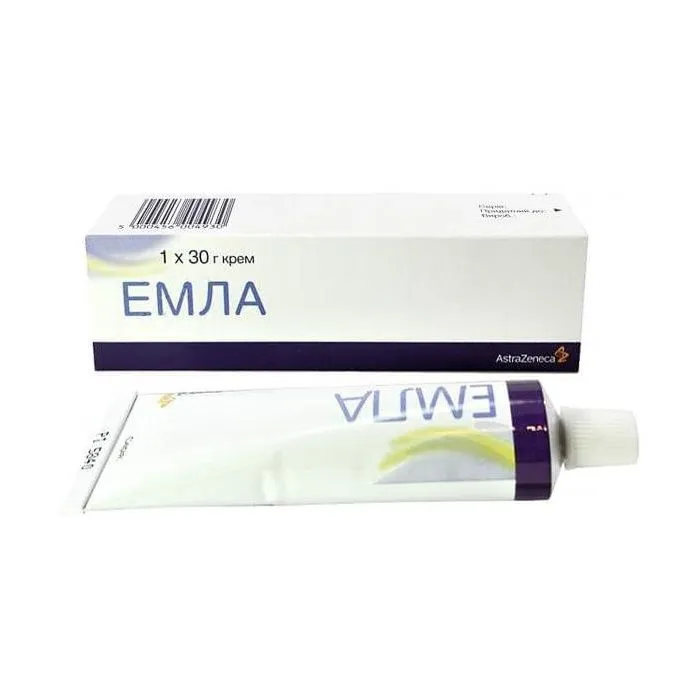
Table of Contents
INSTRUCTIONS FOR MEDICAL USE OF THE MEDICINAL PRODUCT EMLA (EMLA®)
Composition:
Active substances: lidocaine, prilocaine;
1 g of cream contains: lidocaine 25 mg, prilocaine 25 mg;
Excipients: polyoxyl 40 hydrogenated ricinoleate, carbomer 974 P, sodium hydroxide, purified water.
Pharmaceutical form. Cream.
Main physicochemical properties: white, soft, homogeneous cream.
Pharmacotherapeutic group. Local anesthetics.
ATC code N01B B20.
Pharmacological Properties
Pharmacodynamics
Emla cream contains lidocaine and prilocaine, which are local anesthetics of the substituted amide group. When penetrating into the epidermis and dermis, these substances provide anesthesia of the skin. The degree of anesthesia depends on the duration of application and dosage.
Intact Skin
With an application time of 1–2 hours, the effect lasts approximately two hours after removal of the occlusive dressing.
In clinical studies, no differences in safety and efficacy (including duration of anesthesia) were observed between elderly patients (65–96 years of age) and younger individuals when Emla was applied to intact skin.
EmLa affects the superficial vascular network, which may manifest as temporary pallor or redness. This reaction develops more rapidly, within only 30–60 minutes, in patients with atopic dermatitis, indicating faster absorption through the skin.
Studies involving healthy volunteers with intact skin showed that in 90% of individuals, anesthesia was sufficient for inserting a dermatome (4 mm in diameter) to a depth of 2 mm after 60 minutes of application, and to a depth of 3 mm after 120 minutes of application.
Reproductive Toxicity
Lidocaine
In studies assessing effects on embryonal/fetal development, where the drug was administered to rats and rabbits during organogenesis, no teratogenic effects were observed. Embryotoxic effects were noted in rabbits when the drug was administered at doses toxic to the maternal organism. Offspring of rats exposed to maternally toxic doses during late pregnancy and lactation showed reduced postnatal survival rates.
Prilocaine
Reproductive toxicity studies with prilocaine have not been completed.
In a combination study where prilocaine and lidocaine were administered to pregnant rats during organogenesis, no effects on embryonal/fetal development were observed. However, data regarding systemic effects and their clinical significance are insufficient.
Genotoxicity and Carcinogenicity
Lidocaine
Genotoxicity studies of lidocaine yielded negative results. The carcinogenicity of lidocaine has not been studied. The metabolite of lidocaine, 2,6-xylidine, has genotoxic potential in vitro. In a carcinogenicity study of 2,6-xylidine in rats in utero, postnatally, and throughout life, tumor formation was observed in the nasal cavity, subdermis, and liver. The clinical significance of tumor development following short-term/intermittent use of lidocaine is unknown.
Prilocaine
Genotoxicity studies of prilocaine yielded negative results. The carcinogenicity of prilocaine has not been studied. The metabolite of prilocaine, ortho-toluidine, has genotoxic potential in vitro. In carcinogenicity studies of ortho-toluidine in rats, mice, and hamsters, tumor formation was observed in various organs. The clinical significance of tumor development following short-term/intermittent use of prilocaine is unknown.
The Emla medicinal product is equally effective regardless of skin color/pigmentation (skin types I–VI).
EmLa can be used prior to subcutaneous or intramuscular vaccination. For intradermal vaccination with live vaccines, such as BCG, see section "Special Warnings and Precautions for Use."
Mucous Membranes of Genital Organs
The onset time for required anesthesia is shorter because absorption occurs more rapidly than when applied to intact skin.
Five to ten minutes after applying Emla cream to the mucous membranes of female genital organs, local anesthesia against pain induced by argon laser lasted 15–20 minutes (individual variations from 5 to 45 minutes).
Leg Ulcers
No negative impact on ulcer healing or bacterial flora was observed.
Treatment of leg ulcers with Emla cream provides pain relief lasting up to 4 hours after application.
Pharmacokinetics
Systemic absorption of Emla depends on the amount of cream applied, exposure time, skin thickness (which varies in different body areas), and skin condition, particularly the presence of skin diseases (e.g., absorption increases in atopic dermatitis) and shaving. When applied to ulcers, characteristics of leg ulcers may influence absorption; for example, absorption increases with increasing ulcer size.
Intact Skin
Over 3 hours after applying 60 g of Emla cream to 400 cm² (1.5 g per 10 cm²) of intact skin (thighs) in adults, systemic absorption was 3% for lidocaine and 5% for prilocaine. Absorption occurs slowly. With this dose, maximum plasma concentrations of lidocaine (mean 0.12 µg/mL) and prilocaine (mean 0.07 µg/mL) were reached approximately 4 hours after application. The risk of developing toxic symptoms exists only at concentrations of 5–10 µg/mL.
In this case, skin was shaved 8–12 hours prior to cream application.
Leg Ulcers
After applying 5–10 g of Emla cream to leg ulcers for 30 minutes, maximum plasma levels of lidocaine (0.05–0.84 µg/mL) and prilocaine (0.02–0.08 µg/mL) were reached approximately 1–2.5 hours later.
With repeated applications of Emla to ulcers, no significant accumulation of lidocaine, prilocaine, or their metabolites in plasma was observed. 2–10 g of Emla cream was applied for 30–60 minutes to a maximum area of 62 cm², a total of 15 times over 1 month, with 3–7 treatment sessions per week.
Genital Mucous Membranes
After applying 10 g of Emla cream to the vaginal mucosa for 10 minutes, maximum plasma concentrations (mean lidocaine concentration — 0.18 µg/mL, mean prilocaine concentration — 0.15 µg/mL) were observed approximately 35 minutes later.
Clinical characteristics.
Indications.
Adults
EMLA cream is used for topical anaesthesia of:
- skin at the site of injection:
- for example, for blood sampling or insertion of a peripheral venous catheter;
- for superficial surgical procedures;
- genital mucous membranes, for example, for superficial surgical procedures or prior to administration of a local anaesthetic;
- leg ulcers prior to debridement and superficial surgical procedures, for example, prior to removal of fibrin, pus, and necrotic tissue.
Children
EMLA cream may be used in children from birth onwards, depending on the indication, in the following age groups: newborns aged 0–2 months, children aged 3–11 months, and children aged 1–11 years, for topical anaesthesia of the skin at the site of injection, for example, for blood sampling or insertion of a peripheral venous catheter, and for superficial surgical procedures. EMLA cream may be prescribed for children undergoing removal of molluscum contagiosum.
Contraindications.
Known hypersensitivity to local anaesthetics of the substituted amide type, such as bupivacaine, etidocaine, mepivacaine, or to any of the excipients. Skin integrity impairment at the site of cream application (e.g., active herpes zoster, atopic dermatitis, or wounds).
EMLA should not be used:
- in children aged 0–12 months when used concomitantly with medicinal products that induce methemoglobin formation;
- in premature infants (born before 37 weeks of gestation).
Interaction with other medicinal products and other forms of interaction.
Prilocaine in high doses may lead to increased methemoglobin levels, particularly when used in combination with medicinal products that induce methemoglobin formation (such as sulfonamides, nitrofurantoin, phenytoin, phenobarbital). This list is not exhaustive.
When large doses of EMLA are used, the risk of additive effects should be considered in patients receiving local anaesthetics or medicinal products structurally related to them, as toxic effects are additive.
Specific interaction studies between lidocaine/prilocaine and Class III antiarrhythmic agents (e.g., amiodarone) have not been conducted, but caution is recommended (see also section "Special precautions for use").
Medicinal products that reduce lidocaine clearance (e.g., cimetidine or beta-blockers) may potentially contribute to the gradual attainment of toxic plasma concentrations with repeated administration of high-dose lidocaine over prolonged periods.
Children
Specific interaction studies in children have not been conducted. Interactions are likely to be similar to those in adults.
Special precautions for use.
Patients with hereditary glucose-6-phosphate dehydrogenase deficiency or idiopathic methemoglobinemia are more susceptible to developing signs of methemoglobinemia induced by the active substance of the medicinal product EMLA. In patients with glucose-6-phosphate dehydrogenase deficiency, the antidote methylene blue is ineffective in reducing methemoglobin levels and may itself oxidize hemoglobin; therefore, treatment with methylene blue is not recommended for such patients.
Particular caution is required when applying the cream around the eyes, as it may cause eye irritation. Additionally, loss of protective reflexes may lead to irritation and corneal damage. If the product gets into the eyes, they should be immediately rinsed with water or sodium chloride solution, and protection should be provided until sensitivity returns.
EMLA cream should not be applied to areas of damaged tympanic membrane. Animal studies have demonstrated toxic effects of EMLA cream when administered into the middle ear. However, in animals with intact tympanic membranes, no pathological changes were observed following administration into the external auditory canal.
Due to insufficient data on absorption of the active substances, the medicinal product should not be applied to open wounds (except trophic ulcers). Since enhanced absorption through recently shaved skin is possible, it is important to adhere to the recommended dose, taking into account the application site and duration of use (see section "Dosage and administration").
Caution should be exercised when using EMLA cream in patients with atopic dermatitis. A shorter application time of 15–30 minutes may be sufficient. Application durations exceeding 30 minutes in patients with atopic dermatitis may increase the frequency of local vascular reactions, including redness at the application site, and in some cases petechiae and purpura (see section "Adverse reactions"). For removal of molluscum contagiosum in children with atopic dermatitis, the recommended application time is 30 minutes.
Lidocaine and prilocaine exhibit bactericidal and antiviral properties at concentrations above 0.5–2%. Therefore, the outcomes of intradermal administration of live vaccines should be carefully monitored, despite one clinical study showing no effect of EMLA cream on immune response when used prior to BCG vaccination, as assessed by local blister formation.
Patients receiving Class III antiarrhythmic medicinal products (e.g., amiodarone) should be closely monitored. ECG monitoring should be considered in such individuals due to possible additive cardiac effects.
EMLA cream contains hydrogenated polyoxyl 40 stearate, which may cause skin reactions.
Children
Studies have not demonstrated whether EMLA exerts an analgesic effect during heel prick blood sampling in newborns.
In newborns/infants up to 3 months of age, transient, clinically insignificant increases in methemoglobin levels have frequently been observed within 12 hours after application of the recommended dose of EMLA cream.
If the recommended dose is exceeded, patients should be monitored for systemic adverse reactions associated with methemoglobinemia (see sections "Dosage and administration", "Adverse reactions", and "Overdose").
Until sufficient clinical data are available, EMLA should not be used:
- in children aged 0–12 months when used concomitantly with medicinal products that induce methemoglobin formation;
- in premature infants (born before 37 weeks of gestation) — due to the risk of increased methemoglobin levels.
The safety and efficacy of EMLA application to the skin and mucous membranes of the genital organs in children under 12 years of age have not been established.
Available data in children do not demonstrate adequate efficacy for circumcision.
Use during pregnancy or breastfeeding.
Pregnancy
Although systemic absorption is low with topical application, EMLA cream should be used with caution during pregnancy due to limited data on its use in pregnant women. However, animal studies do not indicate a direct or indirect adverse effect on pregnancy, embryofetal development, labor, or postnatal development. Reproductive toxicity has been demonstrated following subcutaneous/intramuscular administration of high doses of lidocaine or prilocaine, where exposure significantly exceeded that seen with topical use.
Lidocaine and prilocaine cross the placental barrier and may be absorbed by fetal tissues. Lidocaine and prilocaine have been used in a large number of pregnant women and women of reproductive age. There is no evidence of impaired reproductive performance, such as increased frequency of developmental abnormalities or direct or indirect effects on the fetus. However, the human risk has not been fully evaluated.
Data on the effects of lidocaine and prilocaine on pregnancy, embryonal/fetal development, labor, and postnatal development obtained from animal studies are incomplete.
It is considered that during short-term use in pregnancy, the benefit outweighs the possible risks.
Breastfeeding
Lidocaine and prilocaine are excreted into breast milk, but in such small amounts that the risk to the infant is generally negligible at therapeutic doses. EMLA may be used during breastfeeding if clinically indicated.
Fertility
Animal studies have shown no effect on fertility in male and female rats.
Ability to affect reaction speed when driving or operating machinery.
Treatment with EMLA cream has no effect or negligible effect on reaction speed when used at recommended doses.
Dosage and Administration
Adults and adolescents 12 years of age and older
Intact skin
Table 1
| Indications/procedure |
Dose and method of administration |
Duration of application |
| For needle insertion, e.g. insertion of venous catheter, blood sampling |
½ tube (approximately 2 g) per 10 cm2. The cream is applied in a thick layer to the skin and an occlusive dressing is applied. |
1 hour; maximum 5 hours* |
| For minor superficial surgical procedures, e.g. removal of molluscum contagiosum |
1.5–2 g per 10 cm2. The cream is applied in a thick layer to the skin and an occlusive dressing is applied. |
1 hour; maximum 5 hours* |
| For more extensive superficial surgical procedures, e.g. split-thickness skin grafting |
1.5–2 g per 10 cm2. The cream is applied in a thick layer to the skin and an occlusive dressing is applied. |
2 hours; maximum 5 hours* |
| For treatment of large areas of recently shaved skin (in outpatient treatment) |
Maximum recommended dose: 60 g. Maximum recommended treatment area: 600 cm2. |
1 hour; maximum 5 hours* |
- After prolonged application, the anesthetic effect decreases.
Trophic ulcers of the lower limbs (adults only)
For debridement of leg ulcers — approximately 1–2 g per 10 cm². Apply the cream in a thick layer onto the ulcer surface, but not more than 10 g per single treatment procedure. Cover the ulcer surface with an occlusive dressing. The tube is intended for single use only; therefore, any remaining cream after the treatment procedure should be discarded.
Duration of application — at least 30 minutes.
For debridement of trophic ulcers in areas with particularly difficult-to-penetrate tissue, the application duration may be extended up to 60 minutes. Debridement of ulcers should be performed within 10 minutes after removal of the cream.
EMLA cream has been used in up to 15 treatment procedures over a 1–2 month period without reduction in efficacy or increase in frequency or severity of local reactions.
Topical anesthesia of genital organs
Genital skin
Apply prior to administration of local anesthetics:
men — 1 g per 10 cm²; apply cream in a thick layer to the skin; application duration — 15 minutes;
women — 1–2 g per 10 cm²; apply cream in a thick layer to the skin; application duration — 60 minutes.
Application of EMLA cream alone for 60–90 minutes on genital skin in women does not provide sufficient anesthesia for thermocoagulation or diathermy of genital warts.
Mucous membranes of genital organs
Prior to removal of genital warts or administration of local anesthetics — approximately 5–10 g depending on the treatment area. The entire surface, including mucosal folds, should be covered with cream. Application under occlusive dressing is not required.
Duration of application — 5–10 minutes.
The procedure should be initiated immediately after removal of the cream.
In adolescents with body weight less than 20 kg, the maximum dose of EMLA should be proportionally reduced when applied to mucous membranes of genital organs.
Plasma concentrations have not been determined in patients receiving doses > 10 g (see also section "Pharmacokinetics").
Children (0–11 years)
For needle insertion, removal of molluscum contagiosum, and other minor superficial surgical procedures
1 g per 10 cm². Apply the cream in a thick layer to the skin and cover with an occlusive dressing.
The dose should not exceed 1 g per 10 cm² and should be adjusted according to the application area.
Table 2
| Age |
Application area |
Duration of application |
| 0–2 months1,2,3 |
Maximum 10 cm2 (total 1 g) (maximum daily dose) |
1 hour (no longer) 4 |
| 3–11 months1,2 |
Maximum 20 cm2 (total 2 g) (maximum daily dose) |
1 hour (no longer)5 |
| 1–5 years |
Maximum 100 cm2 (total 10 g) (maximum daily dose) |
1 hour; maximum 5 hours6 |
| 6–11 years |
Maximum 200 cm2 (total 20 g) (maximum daily dose) |
1 hour; maximum 5 hours6 |
1 Newborns and infants under 3 months of age should receive only 1 application within any 24-hour period. Children aged 3 months and older should receive no more than 2 applications within any 24-hour period, with an interval of at least 12 hours between applications (see sections "Special precautions" and "Side effects").
2 For safety reasons, EMLA medicinal product should not be used in infants under 12 months of age who are receiving treatment with drugs that stimulate methemoglobin formation (see sections "Special precautions" and "Side effects").
3 For safety reasons, EMLA medicinal product should not be used before 37 weeks of gestational age (see section "Special precautions").
4 Application for longer than 1 hour has not been documented.
5 No clinically significant increase in methemoglobin levels has been observed after application for up to 4 hours on an area of 16 cm².
6 After longer application, the anesthetic efficacy decreases.
In children with atopic dermatitis, the cream is applied for 30 minutes prior to removal of molluscum contagiosum.
The safety and efficacy of EMLA medicinal product applied to the skin and mucous membranes of the genital organs in children under 12 years of age have not been established.
Available data in children do not demonstrate adequate efficacy for circumcision.
Geriatric patients
Dosage reduction is not required in elderly patients.
Hepatic impairment
A single dose does not need to be reduced in patients with hepatic impairment.
Renal impairment
Dosage reduction is not required in patients with renal impairment.
Individuals who frequently apply or remove the cream should avoid direct contact to reduce the risk of developing hypersensitivity.
Children.
The cream may be used in children from birth (see section "Indications").
Overdose.
The development of systemic toxic effects of EMLA medicinal product when following recommended doses and routes of administration is highly unlikely. Symptoms of toxic effects are expected to be similar to those observed with other local anesthetics, i.e., central nervous system (CNS) excitation, and in severe cases, CNS depression and myocardial depression.
Possible symptoms include increased sweating, pallor, dizziness, headache, blurred vision, tinnitus, diplopia, decreased blood pressure, bradycardia, arrhythmia, drowsiness, chills, numbness of extremities, restlessness, seizures, shock, and cardiac arrest.
Rare cases of clinically significant methemoglobinemia have been reported. The use of prilocaine in high doses may increase methemoglobin levels, particularly in susceptible individuals (see section "Special precautions"), with too frequent use in newborns and infants under 12 months of age (see section "Dosage and administration"), and with concomitant use of medicinal products that stimulate methemoglobin formation (such as sulfonamides, nitrofurantoin, phenytoin, and phenobarbital). It should be noted that pulse oximeter readings may overestimate actual oxygen saturation when methemoglobin fraction is elevated; therefore, in suspected methemoglobinemia, monitoring oxygen saturation using CO-oximetry is more appropriate.
Local application of 125 mg prilocaine for 5 hours caused moderate methemoglobinemia in a 3-month-old infant. Local application of lidocaine at doses of 8.6–17.2 mg/kg caused severe intoxication in children.
For the treatment of clinically significant methemoglobinemia, slow intravenous injection of methylene blue should be administered (also see section "Special precautions").
Severe neurological symptoms (seizures, CNS depression) require symptomatic treatment, including artificial ventilation and administration of anticonvulsant drugs. Circulatory disturbances should be managed according to resuscitation guidelines. The antidote for methemoglobinemia is methylene blue (methylthioninium). Due to the slow systemic absorption, patients with signs of intoxication should be monitored for several hours after immediate treatment of symptoms.
At the first signs of intoxication (dizziness, nausea, vomiting, euphoria), the patient should be placed in a horizontal position; oxygen inhalation should be administered; for bradycardia, M-cholinolytics (atropine) and vasoconstrictors (norepinephrine, phenylephrine) should be given.
Other symptoms of systemic toxicity may resemble those observed with local anesthetics administered by other routes. Toxicity following local anesthetics typically manifests as CNS excitation, and in severe cases, depression of the central nervous system and cardiovascular system.
Adverse reactions.
Summary of safety profile
The most frequently observed adverse reactions were related to reactions at the application site (transient reactions at the site of application), which were reported as common.
List of adverse reactions
The frequency of adverse reactions associated with the use of the medicinal product EMLA is presented in the table below and is based on data on adverse events reported in clinical trials and/or during post-marketing use. Adverse reactions are listed by system organ classes according to MedDRA (Medical Dictionary for Regulatory Activities) and level of preferred term usage.
Frequency is defined as follows: very common (≥ 1/10), common (≥ 1/100, < 1/10), uncommon (≥ 1/1,000, < 1/100), rare (≥ 1/10,000, < 1/1,000), very rare (< 1/10,000). Within each frequency group, adverse reactions are listed in order of decreasing severity.
Table 3
| Blood and lymphatic system disorders |
Rare |
Methaemoglobinaemia1 |
| Immune system disorders |
Rare |
Hypersensitivity1,2,3 |
| Eye disorders |
Rare |
Corneal irritation1 |
| Skin and subcutaneous tissue disorders |
Rare |
Purpura1, petechiae1 (especially with prolonged application in children with atopic dermatitis or molluscum contagiosum) |
| General disorders and administration site conditions |
Frequent |
Burning sensation2,3, itching at application site2,3, erythema at application site1,2,3, swelling at application site1,2,3, sensation of warmth at application site2,3, pallor at application site1,2,3 |
| Uncommon |
Burning sensation1, irritation at application site3, itching at application site1, paraesthesia at application site2 such as pricking, sensation of warmth at application site1 |
1 intact skin
2 mucous membranes of the genital organs
3 trophic ulcers of the lower limbs
In case of an overdose, rapid absorption, or development of hypersensitivity, adverse reactions are expected to be similar in nature to those observed after administration of amide-type local anesthetics by other routes.
Children
The frequency, type, and severity of adverse reactions were similar in pediatric and adult age groups, except for methemoglobinemia, which was more frequently observed in newborns and infants aged 0–12 months, often associated with overdose (see section "Overdose").
Reporting of suspected adverse reactions
Reporting of suspected adverse reactions after medicinal product authorization is important. It allows continuous monitoring of the benefit-risk balance of the medicinal product. Healthcare professionals should report any suspected adverse reactions via the national pharmacovigilance system.
Shelf life.
3 years.
Storage conditions.
Store at a temperature not exceeding 30 °C. Do not freeze.
Keep out of reach and sight of children.
Packaging.
5 g in a tube; 5 tubes together with 12 occlusive patches in a cardboard box;
30 g in a tube; 1 tube in a cardboard box.
Prescription status.
Over-the-counter.
Manufacturer.
Recipharm Karlskoga AB.
Aspen Bad Oldesloe GmbH.
Manufacturer's address and location of operations.
Björkbornsvägen 5, Karlskoga, 69133, Sweden.
Industriestrasse 32 - 36, 23843 Bad Oldesloe, Germany.