Emaplag®
Ukraine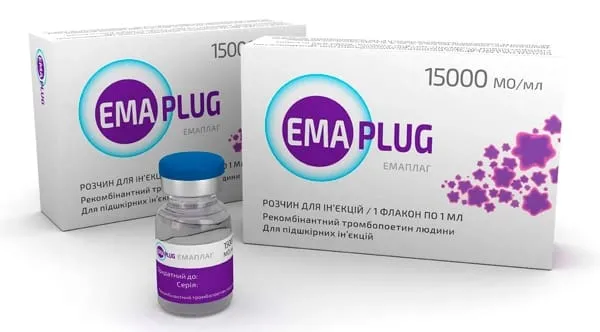
Table of Contents
INSTRUCTIONS FOR MEDICAL USE OF THE MEDICINAL PRODUCT EMAPLAG® (EMAPLUG®)
Composition:
Active substance: 1 ml of solution contains 15,000 IU of recombinant human thrombopoietin;
Excipients: human serum albumin, sodium chloride, water for injections.
Pharmaceutical form. Solution for injection.
Main physicochemical properties: clear, colorless solution.
Pharmacotherapeutic group. Antihemorrhagic agents. Other systemic hemostatics.
ATC code B02B X.
Pharmacological Properties
Pharmacodynamics
Thrombopoietin is a glycoprotein that specifically stimulates the proliferation and differentiation of megakaryocytes, promotes the formation and release of platelets, and facilitates the restoration of platelet counts in peripheral blood as well as the overall recovery of leukocyte levels.
Pharmacokinetics
Pharmacokinetic study of single subcutaneous administration of Emplag® to healthy volunteers
Healthy volunteers were randomized into three groups (150 IU/kg, 300 IU/kg, and 600 IU/kg). Each group consisted of 8 subjects; the total number of subjects was 24. The results showed that in most cases, absorption and elimination exhibited characteristics of linear pharmacokinetics. T1/2ka values for the three groups were 2.5 ± 1.1 hours, 3.2 ± 2.6 hours, and 4.2 ± 2.4 hours, respectively; Tmax values were 9.0 ± 1.9 hours, 10.8 ± 2.4 hours, and 11.8 ± 5.4 hours, respectively. Elimination of Emplag® was slow, with a prolonged in vivo half-life. The elimination half-life was similar across the three groups: 46.3 ± 6.9 hours, 40.2 ± 9.4 hours, and 38.7 ± 11.9 hours.
Pharmacokinetic study of multiple-dose administration of Emplag®
Eight patients were divided into two groups. In Group 1, the drug was administered every other day (subcutaneously, 300 IU/kg, a total of 7 doses). In Group 2, the drug was administered daily (subcutaneously, 300 IU/kg, a total of 14 doses). Each group consisted of 4 subjects.
The concentration of Emplag® in the blood of each patient increased progressively with the number of injections. Cmin values in patients of Group 1 and Group 2 reached steady-state concentrations of 1637 ± 969 pg/mL after 5 doses and 2906 ± 1736 pg/mL after 7 doses, respectively. The trend of Cmax change corresponded to that of Cmin in both groups. Steady-state Cmax values were 2135 ± 1095 pg/mL and 4193 ± 3436 pg/mL, respectively. No significant differences in kinetic parameters such as AUC, Tpeak, and T1/2 were observed between the first and the last administration. The pharmacokinetics of the drug were found to be time-independent. With repeated subcutaneous administration of Emplag®, a positive correlation was observed between plasma concentration and cumulative drug dose. With daily administration over 14 days, no tendency toward accumulation was observed.
Clinical characteristics.
Indications.
Treatment of chemotherapy-induced thrombocytopenia in patients with solid tumors. Therapy with the medicinal product Emaplag® is recommended for patients with platelet counts below 50×109/l or when the physician considers it necessary to increase the platelet count.
Treatment of immune thrombocytopenia (ITP) when platelet count is below 20×109/l and corticosteroid therapy is ineffective (including in patients who either did not respond to initial therapy or had a therapeutic effect but for whom repeated corticosteroid treatment is not permissible), without splenectomy. The medicinal product Emaplag® is indicated only for treatment of patients with thrombocytopenia who are at risk of bleeding and is not used for normalization of platelet counts.
Contraindications.
Hypersensitivity to the components of the drug.
Severe form of cardiac or cerebral angiopathy.
Blood agglutination or recent history of thrombosis.
Use in patients with severe forms of infectious diseases is permitted only after control of the infection has been established.
Interaction with other medicinal products and other types of interactions.
Available clinical data are insufficient to characterize the interaction of the medicinal product Emaplag® with other drugs.
Special precautions for use.
In rare cases, administration of Emplag® to patients with idiosyncrasy may lead to thrombocytosis; therefore, the drug should be used under direct medical supervision.
For patients with solid tumors and chemotherapy-induced thrombocytopenia, the medicinal product Emplag® should be administered 6–24 hours after chemotherapy.
Even when using Emplag®, patients should avoid situations and medications that increase the risk of bleeding.
Complications of thrombopoiesis
An excessive number of platelets may lead to complications in thrombopoiesis—thromboembolism. Overdosing or failure to follow the instructions for use of Emplag® may result in increased platelet count and, consequently, increase the risk of thromboembolism. To minimize the risk of thromboembolism during therapy with Emplag®, it is recommended to set a target platelet level below the normal range.
Poor response to Emplag® therapy
In patients with a poor response to treatment with Emplag® and in patients in whom a platelet response cannot be maintained, the presence of neutralizing antibodies and myelofibrosis should be evaluated. If platelet counts do not reach a level sufficient to prevent severe bleeding, treatment with Emplag® should be discontinued. According to results from a clinical study of Emplag® involving 74 patients, non-neutralizing antibodies to Emplag® at a titer of 1:5 were detected in 3 patients (4%).
Malignant tumors and exacerbation of malignant diseases
The medicinal product Emplag® may stimulate thrombopoietin receptors on the surface of hematopoietic cells, potentially increasing the risk of developing hemoblastoses. Emplag® is not recommended for use in myelodysplastic syndrome or in thrombocytopenias caused by factors other than steroid-refractory ITP.
During therapy with Emplag®, blood tests should be performed regularly, typically every two days, to monitor platelet counts in peripheral blood. If platelet counts reach the target level, administration of Emplag® should be discontinued. Complete blood count results should be monitored before, during, and after treatment with Emplag®. Prior to initiating therapy with Emplag®, a peripheral blood smear should be performed to establish baseline morphological abnormalities in erythrocytes and leukocytes. Complete blood count should be performed before starting treatment with Emplag® and at least 2 weeks after discontinuation of the drug.
Use during pregnancy or breastfeeding.
There are insufficient clinical data to confirm the safety of Emplag® in pregnant women or women who are breastfeeding.
Ability to affect reaction speed when driving or operating machinery.
Emplag® may cause somnolence and hyperactivity. Patients taking Emplag® are advised to exercise caution when driving or operating machinery.
Dosage and Administration
For the treatment of thrombocytopenia occurring during chemotherapy in patients with solid tumors, the drug is administered subcutaneously 6–24 hours after the administration of the antineoplastic agent.
The dose is 300 IU/kg body weight once daily. The treatment duration is 14 days.
Administration of the drug should be discontinued if platelet count reaches ≥ 100×109/L or if the absolute increase in platelet count is ≥ 50×109/L.
In cases of chemotherapy-induced anemia or leukopenia, Emaplague® should be used in combination with recombinant erythropoietin or recombinant human granulocyte colony-stimulating factor, respectively.
For treatment of patients with immune thrombocytopenia unresponsive to corticosteroid therapy, the medicinal product Emaplague® may be administered subcutaneously at the recommended dose of 300 IU/kg body weight once daily for 14 days. Administration of the drug should be discontinued if platelet count reaches 100×109/L within 14 days.
Specific emergency treatments, including platelet transfusion and antifibrinolytic hemostatic therapy, should be administered in case of epistaxis, oral cavity bleeding, or internal organ hemorrhage.
Children
Not recommended for use.
Overdose
According to published data, thrombopoietin overdose may lead to increased platelet count and consequently cause thromboembolism. In such cases, treatment with Emaplague® should be discontinued and platelet levels should be closely monitored.
Adverse reactions
The adverse reactions listed below are classified by organs and systems and by frequency of occurrence. Frequency categories: very common (≥ 1/10), common (≥ 1/100 to < 1/10), uncommon (≥ 1/1000 to < 1/100), rare (≥ 1/10,000 to < 1/1000), very rare (< 1/10,000).
Adverse reactions associated with the use of the medicinal product Emaplag® occurred rarely. Occasionally, fever, myalgia, and dizziness were observed, which resolved spontaneously. Symptomatic treatment was indicated for individual patients experiencing pronounced adverse reactions. Laboratory test results showed that the medicinal product Emaplag® does not affect hemoglobin and leukocyte recovery after chemotherapy and has no significant effect on platelet morphology and aggregation, coagulation function, liver, or kidneys.
Table 1
Adverse events associated with the use of the medicinal product Emaplag® in patients with solid tumors and chemotherapy-induced thrombocytopenia (311 patients)
| Classes and organ systems |
Adverse reaction |
Number of cases |
| General disorders and administration site reactions |
Fever |
4 (1.3%) |
| Chills |
2 (0.6%) |
|
| Malaise |
1 (0.3%) |
|
| Fatigue |
2 (0.6%) |
|
| Musculoskeletal and connective tissue disorders |
Knee pain |
2 (0.6%) |
| Nervous system disorders |
Headache |
2 (0.6%) |
| Dizziness |
3 (1.0%) |
|
| Hypertension |
2 (0.6%) |
Table 2
Adverse reactions associated with the use of the medicinal product Emplag® in patients with corticosteroid-unresponsive ITP (73 patients)
| Organ classes and systems |
Adverse reaction |
Number of cases |
| Skin and subcutaneous tissue disorders |
Eczema |
1 (1.37%) |
| Nervous system disorders |
Somnolence |
2 (2.74%) |
| Dizziness |
2 (2.74%) |
|
| Eye disorders |
Visual field defect |
1 (1.37%) |
| Gastrointestinal disorders |
Diarrhea |
1 (1.37%) |
| Vascular disorders |
Hypertension |
2 (2.74%) |
| Immune system disorders |
Anaphylactoid reaction |
1 (1.37%) |
| General disorders and administration site reactions |
Fatigue |
2 (2.74%) |
| Pain at injection site |
2 (2.74%) |
Shelf life. 3 years.
Storage conditions.
Store at 2 to 8 °C in the original packaging. The temperature must be maintained within the specified range until the time of administration to the patient. Do not freeze, do not shake.
Packaging.
1 ml in a vial; 1 vial in a carton.
Prescription status. Prescription only.
Manufacturer.
Shenyang Sunshine Pharmaceutical Co., Ltd.
Manufacturer's address and location of business activity.
No.3 A 1, Road 10, Economy and Technology Development Zone, Shenyang, People’s Republic of China.
Marketing Authorization Holder.
Yuria-Pharm LLC.
Address of the Marketing Authorization Holder.
10 M. Amosova Street, Kyiv, Ukraine, 03680.