Elipa
Ukraine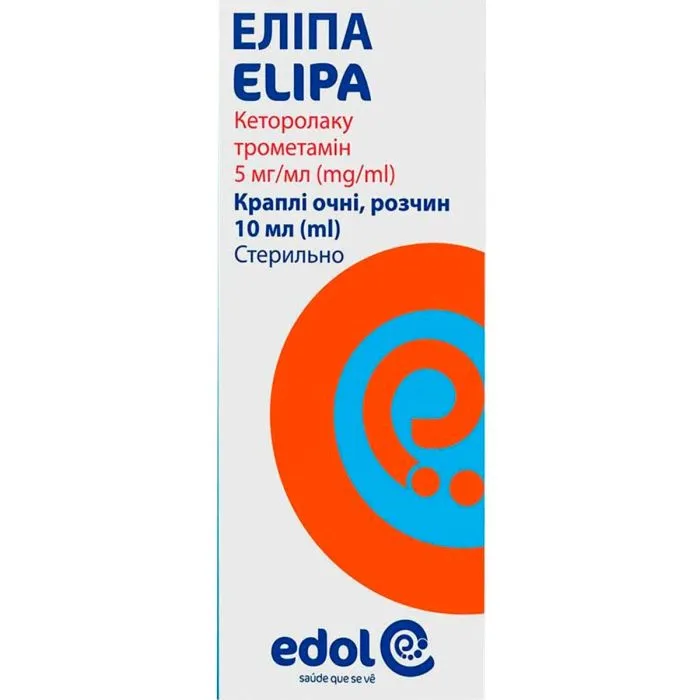
Table of Contents
INSTRUCTION FOR MEDICAL USE OF THE MEDICINAL PRODUCT ELIPA (ELIPA)
Composition:
Active substance: ketorolac tromethamine;
1 ml of solution contains ketorolac tromethamine 5 mg;
Excipients: sodium chloride, disodium edetate, benzalkonium chloride 50% solution, hydrochloric acid 10% or sodium hydroxide 40%, water for injections.
Medicinal form. Eye drops, solution.
Main physicochemical properties: clear, colorless, odorless solution.
Pharmacotherapeutic group. Agents used in ophthalmology. Non-steroidal anti-inflammatory agents. Ketorolac. ATC code S01BC05.
Pharmacological properties.
Pharmacodynamics.
Ketorolac tromethamine is a non-steroidal anti-inflammatory drug (NSAID) that exerts analgesic and anti-inflammatory effects. Ketorolac tromethamine inhibits the enzyme cyclooxygenase, which is required for the biosynthesis of prostaglandins. It has been demonstrated that topical ocular administration of the medicinal product Elipa reduces the level of prostaglandins in aqueous humor.
When administered systemically, ketorolac tromethamine does not cause pupillary constriction. Clinical study results indicate that Elipa has no significant effect on intraocular pressure.
Pharmacokinetics.
As demonstrated in clinical studies, higher levels of ketorolac in aqueous humor and very low or undetectable levels in blood plasma following ocular administration indicate that topical use of ketorolac tromethamine for the treatment of ocular diseases results in extremely low systemic absorption in patients.
Clinical characteristics.
Indications.
The medicinal product Elipa is indicated for the prevention and reduction of inflammation and associated symptoms following ophthalmic surgery.
The medicinal product Elipa is indicated for use in adults.
Contraindications.
Hypersensitivity to the active substance or to any of the excipients of the product.
There is a risk of cross-sensitization to acetylsalicylic acid and other nonsteroidal anti-inflammatory drugs. The product Elipa is contraindicated in patients with a history of hypersensitivity to these drugs.
Interaction with other medicinal products and other forms of interaction.
Interaction studies have not been conducted.
The medicinal product Elipa has been safely used with ophthalmic and systemic medicinal products such as antibiotics, sedatives, beta-blockers, carbonic anhydrase inhibitors, miotics, mydriatics, and cycloplegic agents.
Elipa may delay or slow healing. It is known that topical corticosteroids also delay or impair healing. Concomitant use of topical NSAIDs and topical corticosteroids may increase the risk of healing complications (see section "Special precautions for use").
Special precautions for use.
The medicinal product Elipa should be used with caution in patients with known bleeding tendencies or those receiving other medicinal products that may prolong bleeding time.
Like other anti-inflammatory agents, Elipa may mask the usual signs of infection.
All NSAIDs may delay or slow wound healing. Concomitant use of NSAIDs and topical corticosteroids may increase the risk of healing complications.
Caution should be exercised when using the medicinal product Elipa together with topical corticosteroids in patients susceptible to corneal epithelial damage.
Topical NSAIDs may cause keratitis. In some patients, prolonged use of topical NSAIDs may lead to corneal epithelial damage, thinning of the cornea, erosion, corneal ulceration, or perforation. These events may threaten vision. Patients showing signs of corneal epithelial damage should immediately discontinue use of topical NSAIDs and be closely monitored for corneal status.
Topical NSAIDs should be used with caution in patients with complications following ophthalmic surgery, corneal denervation, corneal epithelial defects, diabetes mellitus, ocular surface diseases (e.g., dry eye syndrome), rheumatoid arthritis, or in cases of repeated ophthalmic surgeries within a short period, as these conditions may increase the risk of corneal adverse events, which may threaten vision.
Post-marketing experience with topical NSAIDs also indicates that use for more than 24 hours before surgery or longer than 14 days after surgery may increase the risk and severity of corneal adverse events in patients.
This medicinal product contains benzalkonium chloride. Each 1 ml of solution contains 0.05 mg of benzalkonium chloride. It may cause irritation. Contact with soft contact lenses should be avoided (remove contact lenses before administering the medication and reinsert them 15 minutes after administration). Benzalkonium chloride may discolor soft contact lenses.
Post-marketing reports have included cases of bronchospasm or exacerbation of bronchial asthma in patients with known hypersensitivity to acetylsalicylic acid/NSAIDs or with a history of bronchial asthma, associated with the use of Elipa, which may be a contributing factor. Elipa should be used with caution in such patients (see section "Adverse reactions").
Patients should be advised to avoid contact between the dropper tip and the eye or surrounding tissues to prevent injury or contamination of the eye drops.
Adverse effects can be minimized by using the lowest effective dose for the shortest duration necessary to control symptoms.
Use during pregnancy or breastfeeding.
Pregnancy
There are no adequate data on the use of eye drops containing ketorolac tromethamine in pregnant women. Reproductive toxicity has been observed in animal studies. Inhibition of prostaglandin synthesis may adversely affect pregnancy and/or embryonic/fetal development and/or postnatal development. Although systemic exposure following ocular administration of ketorolac is expected to be very low, Elipa is not recommended during pregnancy.
Breastfeeding
Elipa is not recommended for women who are breastfeeding. Ketorolac tromethamine is excreted in breast milk following systemic administration.
Fertility
There are no adequate data on the effect of ketorolac tromethamine on human fertility.
Ability to affect reaction speed when driving or operating machinery.
Blurred vision may occur temporarily after instillation of eye drops. Patients should not drive or operate machinery until vision is clear.
Dosage and Administration
Dosage
Instill 1 drop into the eye 3 times daily, starting 24 hours before surgery and continuing for 3 weeks after surgery.
Administration
For ophthalmic use.
Instill 1 drop of the solution into the lower conjunctival sac of the affected eye by gently pulling down the lower eyelid and looking upward.
If Elipa is used concurrently with other ophthalmic medicinal products for local administration, an interval of at least 5 minutes should be maintained between the applications of the two medicinal products.
Children
Elipa is not recommended for use in children.
Overdose
No cases of overdose have been reported with the use of Elipa. Overdose is unlikely when the product is used as recommended.
In case of accidental ingestion, drink fluids to dilute the product.
Adverse reactions
The most commonly reported adverse reactions associated with the use of Elipa were transient stinging and burning upon instillation.
Adverse reactions are listed by system organ class and frequency. Frequency is defined as follows: very common (≥1/10); common (≥1/100, <1/10); uncommon (≥1/1000, <1/100); rare (≥1/10 000, <1/1000); very rare (<1/10 000); frequency not known (cannot be estimated from available data).
Immune system disorders
Common: hypersensitivity, including localized allergic reactions.
Nervous system disorders
Common: headache.
Eye disorders
Very common: eye irritation (including burning sensation); eye pain (including stinging).
Common: superficial keratitis, eye and/or eyelid edema, eye pruritus, conjunctival hyperemia, eye infection, eye inflammation, iritis, keratic precipitates, retinal hemorrhage, cystoid macular edema, eye injury, increased intraocular pressure, blurred and/or worsened vision.
Uncommon: corneal ulcer, corneal infiltrates, dry eye, lacrimation (epiphora).
Frequency not known: corneal damage (decreased corneal thickness, corneal erosion, epithelial disruption, corneal perforation)*, ulcerative keratitis, eye swelling, eye hyperemia.
Respiratory, thoracic and mediastinal disorders
Frequency not known: bronchospasm or exacerbation of bronchial asthma**.
* Isolated post-marketing reports of corneal damage, including corneal thinning, corneal erosion, epithelial damage, and corneal perforation, have been received. These events occurred primarily in patients who were concurrently using topical corticosteroids and/or in patients with concomitant diseases (see section "Special precautions for use").
** In the post-marketing period, cases of bronchospasm or exacerbation of bronchial asthma have been reported in patients with known hypersensitivity to acetylsalicylic acid/NSAIDs or with a history of bronchial asthma, associated with the use of Elipa, which may be a contributing factor.
When used at doses recommended for ophthalmological topical treatment, no typical adverse reactions associated with systemic use of NSAIDs (including ketorolac tromethamine) have been observed.
Reporting of suspected adverse reactions
Reporting suspected adverse reactions after medicine authorization is important. It allows continued monitoring of the benefit-risk balance of the medicine. Healthcare professionals are encouraged to report any suspected adverse reactions through the national pharmacovigilance system.
Shelf life. 36 months.
The shelf life after first opening of the dropper bottle is 28 days.
Storage conditions.
Store below 30 °C. Keep in the original package to protect from light and moisture. Keep out of reach of children.
Packaging.
10 ml in a dropper bottle; 1 dropper bottle per cardboard box.
Prescription category.
Prescription only.
Manufacturer.
Laboratorio Edol - Produtos Farmacêuticos, S.A.
Manufacturer's address and place of business.
Av. 25 de Abril, No 6 - 6A, Linda-a-Velha, 2795-225, Portugal.