Exoterin
Ukraine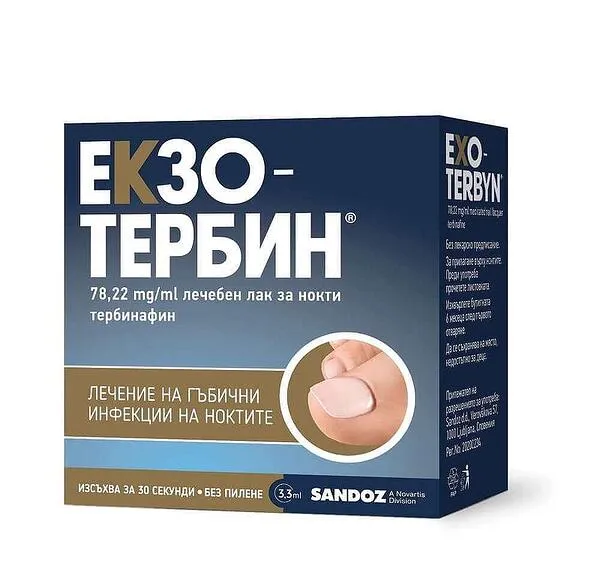
Table of Contents
INSTRUCTIONS FOR MEDICAL USE OF THE MEDICINAL PRODUCT EXOTERIN (EXOTERIN)
Composition:
Active substance: terbinafine hydrochloride;
1 ml of solution contains terbinafine hydrochloride equivalent to 78.22 mg of terbinafine;
Excipients: ethanol 96%, hydroxypropyl chitosan, purified water.
Pharmaceutical form. Therapeutic nail lacquer.
Main physicochemical characteristics: clear solution.
Pharmacotherapeutic group. Antifungal agents for dermatological use. Topically applied antifungal agents. Other topically applied antifungal agents.
ATC code D01AE15.
Pharmacological properties.
Pharmacodynamics.
Mechanism of action
Terbinafine is an allylamine with a broad spectrum of antifungal activity against fungal infections of the skin caused by dermatophytes such as Trichophyton (e.g. T. rubrum, T. mentagrophytes, T. verrucosum, T. violaceum), Microsporum canis, and Epidermophyton floccosum. At low concentrations, terbinafine exerts a fungicidal effect against dermatophytes and mould fungi. Activity against yeast fungi may be either fungicidal (e.g. Pityrosporum orbiculare or Malassezia furfur) or fungistatic, depending on the species. In vitro, terbinafine has been shown to possess sporicidal activity.
Terbinafine specifically inhibits an early stage of sterol biosynthesis in the fungal cell. This leads to ergosterol deficiency and intracellular accumulation of squalene, resulting in fungal cell death. The action of terbinafine is mediated through inhibition of the enzyme squalene epoxidase in the fungal cell membrane. This enzyme does not belong to the cytochrome P450 system. Terbinafine does not affect hormone metabolism or that of other substances.
Clinical trial data
Clinical efficacy
Adults
Study PM1331
Mild to moderate onychomycosis. Study PM1331 was a randomized, double-blind, placebo-controlled, active-comparator Phase III trial designed to compare treatment with Exoderil versus placebo solution for topical use and 5% amorolfine as active control. Exoderil or placebo solution was applied once daily for the first 4 weeks and once weekly for the following 44 weeks throughout the 48-week study period. Amorolfine was applied once weekly for 48 weeks in an open-label manner due to other characteristics of the medicinal product and nail removal procedures.
Overall, 953 patients were randomized in the study: 406 in the Exoderil treatment group, 410 in the placebo group, and 137 in the active control group (5% amorolfine).
Efficacy endpoints were assessed at the end of the observation period (week 60). All assessments were performed on the target toenail of the great toe. Efficacy endpoints:
- Complete cure rate: includes combined negative potassium hydroxide microscopy and fungal culture for dermatophytes, as well as absence of residual clinical signs (completely clear nail).
- Treatment response rate: includes combined negative potassium hydroxide microscopy, negative fungal culture for dermatophytes, and residual nail involvement of < 10%.
- Mycological cure rate: includes combined negative potassium hydroxide microscopy and negative fungal culture for dermatophytes.
Table 1 summarizes the results of the primary and key secondary efficacy endpoints.
Table 1: PM1331: Results of primary and key secondary efficacy endpoints at week 60 (ITT population)
| Endpoint |
Exoderil (N = 406) |
Placebo vehicle (N = 410) |
Amorolfine (N = 137) |
Odds ratio (95% CI) |
|
| Exoderil vs placebo vehicle |
Exoderil vs amorolfine |
||||
| Rate of complete cure |
5.67% |
2.20% |
2.92% |
2.68 (1.22; 5.86)* |
2.00 (0.68; 5.88) |
| Rate of positive treatment response |
6.65% |
3.41% |
3.65% |
2.02 (1.04; 3.90)* |
1.88 (0.71; 4.98) |
| Rate of cure based on mycological examination |
20.44% |
12.20% |
18.98% |
1.85 (1.26; 2.71)** |
1.10 (0.67; 1.79) |
CI – confidence interval; ITT – intent-to-treat population.
Logistic regression model including treatment factor (last observation carried forward method).
* p < 0.05, ** p < 0.025.
Children
The safety and efficacy of Exoderil in children under 2 years of age have not been established.
For the age group from 2 to 17 years, the tolerability and efficacy of Exoderil were evaluated in a multicenter open-label study involving 20 children (16 children aged 2 to 11 years and 4 children aged 12 to 17 years) with mild to moderate toenail onychomycosis (study PM Ped-004).
The primary endpoint included local tolerability at the application site throughout the entire study period. During the entire treatment period, mild skin irritation was recorded in 3 children (6 events). Skin irritation resolved and did not lead to discontinuation of treatment. Regarding efficacy, 2/12 (16.7%) children aged 2 to 11 years and 2/4 (50%) children aged 12 to 17 years achieved complete cure during the follow-up period (ITT population).
Pharmacokinetics
Terbinafine, nail lacquer, demonstrated good penetration properties through the keratin of the nail plate. Achieving fungicidal concentrations at the site of infection, the active substance inhibits squalene epoxidase and thereby exerts fungistatic and fungicidal effects (see section "Pharmacodynamics").
Due to the limited area to which the topical agent is applied, the amount of terbinafine entering the systemic circulation after treatment with Exoderil is negligible. Mean steady-state plasma concentrations (± standard deviation [SD]) of terbinafine after weekly application of Exoderil (197 ± 134 ng/mL) are more than 3 orders of magnitude lower than those after oral administration of terbinafine (1.70 ± 0.77 µg/mL). After prolonged use of Exoderil (up to 52 weeks), there is no evidence of drug accumulation in the body.
The mean steady-state concentration (± SD) of terbinafine in the nail after weekly application of Exoderil (9245 ± 6325 µg/g) is more than 3 orders of magnitude higher (11,000-fold) than after oral administration of terbinafine (1.01 µg/g). The steady-state concentration of terbinafine in the nail with topical application of Exoderil is also many orders of magnitude higher than the minimum inhibitory concentration (MIC) of terbinafine against dermatophytes (> 500,000 MIC). Terbinafine remains present in nails for up to 24 weeks after completion of treatment.
Clinical characteristics.
Indications.
Mild to moderate fungal infections of the nails caused by dermatophytes and/or other fungi sensitive to terbinafine.
For use in adults.
Note official recommendations regarding appropriate use of antifungal agents.
Contraindications.
Hypersensitivity to the active substance or to any of the excipients of the medicinal product.
Interaction with other medicinal products and other forms of interaction.
Interaction studies have not been performed. However, following application according to recommendations, systemic bioavailability of terbinafine is considered negligible (see section "Pharmacokinetics"), therefore systemic interactions are not expected.
Other medicinal products must not be applied to the affected areas.
Special precautions for use.
With regard to topical agents for the treatment of onychomycosis, systemic therapy should be considered if more than 3 nails are affected or if more than half of the nail plate is involved or the nail matrix is affected, as well as in the presence of predisposing factors such as diabetes mellitus and immune disorders.
The duration of the disease, the extent of nail plate involvement, and nail thickness may influence treatment outcomes.
Exoderil is intended for external use only.
Patients with a history of diabetes mellitus, immune disorders, peripheral vascular diseases, damaged, painful or severely injured nails, skin disorders such as psoriasis, any other chronic skin conditions, or yellow nail syndrome (lower limb edema, respiratory disorders, and yellow discoloration of nails) should consult a physician before initiating treatment.
Contact with any part of the body other than the affected area should be avoided until the lacquer has completely dried. Accidental contact with eyes or mucous membranes may cause irritation. In case of accidental exposure to these areas, thoroughly rinse with running water.
The effect of nail polish or other nail cosmetics on the efficacy of the medicinal product Exoderil has not been evaluated.
Exoderil contains ethanol. This medicinal product contains 616 mg of alcohol (ethanol) per 1 ml of solution. This may cause a burning sensation on damaged skin.
Use during pregnancy or breastfeeding.
Pregnancy
There are no data available on the use of terbinafine in pregnant women. Animal studies do not indicate harmful effects on pregnancy or fetal health.
Exoderil should not be used during pregnancy unless clearly necessary.
Breastfeeding
Terbinafine passes into breast milk. After topical application, only low systemic exposure is expected.
Terbinafine should be used during breastfeeding only if the expected benefit to the mother outweighs the potential risk to the infant. Contact between infants and any skin area to which the product has been applied should be avoided.
Fertility
Animal studies have not shown any effect of terbinafine on fertility.
Ability to affect reaction speed while driving or operating machinery
Exoderil does not affect the ability to drive or operate machinery.
Method of Administration and Dosage
The medicinal nail lacquer is indicated for use on fingernails and toenails.
Method of Administration
For external use only (for application to nails)
Before applying Exoderil, remove any nail polish or other cosmetic products from the nails and surrounding skin. Thoroughly clean and dry the affected areas.
Apply Exoderil as a thin layer using the applicator to the entire surface of the affected nail, 5 mm of the adjacent skin, and, if possible, under the free edge of the nail, as well as to the skin beneath the nail. Wait approximately 30 seconds until the lacquer is completely dry. The nails to which the product has been applied should not be washed or exposed to water for at least 6 hours. Therefore, it is recommended to apply the medicinal lacquer in the evening before going to bed, as well as after bathing or showering. After this time interval has passed, normal hygiene procedures may be resumed.
Exoderil does not need to be removed with any solvent or abrasive (i.e., by filing the nails). It is sufficient to thoroughly rinse the nails with water.
After the initial 4-week period of daily treatment, Exoderil should be applied to the affected nails once weekly.
Overall, the treatment duration for fingernails is approximately 6 months, and for toenails from 9 to 12 months.
Additional systemic therapy with oral antifungal agents should be considered if there is inadequate response to topical treatment at the end of the treatment period, or in cases of severe nail infection, including involvement of one or more nails of the hands and/or feet and/or matrix involvement. In such cases, medical advice should be sought.
Children
The safety and efficacy of Exoderil in children aged 2 to 17 years have not yet been established. Available information regarding use in children is provided in the sections "Adverse Reactions" and "Pharmacological Properties." Exoderil should not be used in children (under 18 years of age) due to the lack of clinical experience with the medicinal product in this patient population.
Overdose
Given the method of administration, overdose is unlikely. Following topical application of Exoderil, no systemic signs of overdose are expected. In case of accidental ingestion, appropriate symptomatic measures should be taken.
Adverse reactions
Summary of safety profile
Adults
The safety profile of Exoderil in adults is based on pooled data from two randomized, double-blind, placebo-controlled studies (RM1331 and RM0731) conducted in patients with mild to moderate onychomycosis. Overall, 556 patients received Exoderil at the recommended dosage regimen and 454 patients received placebo solution. The most frequently reported adverse reaction was erythema (0.9% in the Exoderil group; no cases of application site erythema were reported in the placebo group). All cases of erythema were mild and transient.
List of adverse reactions in tabular form
Table 2 summarizes the adverse reactions reported in patients with onychomycosis who received Exoderil. The frequency of adverse reactions is defined according to the following classification: very common (≥ 1/10); common (≥ 1/100 to < 1/10); uncommon (≥ 1/1,000 to < 1/100); rare (≥ 1/10,000 to < 1/1,000); very rare (< 1/10,000); frequency not known (cannot be estimated from available data).
Table 2: Adverse reactions in patients with onychomycosis treated with Exoderil
| System organ class |
Frequency |
Preferred term |
| Skin and subcutaneous tissue disorders |
Uncommon |
Erythema Skin irritation |
Children
The safety of Exoderil was evaluated in 20 children aged 2 to 17 years with mild to moderate onychomycosis who participated in an open-label Phase III study (PM Ped-004). The most common adverse reaction in children was skin irritation at the application site, reported in 3 out of 16 children (18.8%) aged 2 to 11 years. No adverse events were observed in 4 adolescents aged 12 to 17 years. Skin irritations in children were mild and transient.
Reporting of suspected adverse reactions
Reporting of adverse reactions following marketing authorization of the medicinal product is important. It allows continuous monitoring of the benefit-risk balance of the medicinal product. Healthcare professionals, pharmacists, patients, and their legal representatives are encouraged to report all suspected adverse reactions and lack of efficacy through the Automated Pharmacovigilance Information System at the following link: https://aisf.dec.gov.ua.
Shelf life: 3 years.
After first opening of the bottle: 6 months.
Storage conditions.
No special storage temperature requirements. Keep the bottle tightly closed to prevent drying of the contents. Store in the original packaging to protect from light. Keep away from heat sources and open flames. Keep out of reach of children.
Packaging.
3.3 ml or 6.6 ml of solution in a bottle with an applicator. 1 bottle per cardboard box.
Availability category. Over-the-counter (without prescription).
Manufacturer.
Alfasigma S.p.A.
or
Salutas Pharma GmbH
Manufacturer's address and location of operations.
Via Enrico Fermi, 1, Alanno (PE), 65020, Italy
Otto-von-Guericke-Allee 1, 39179 Barleben, Saxony-Anhalt, Germany