Exemestane - vista
Ukraine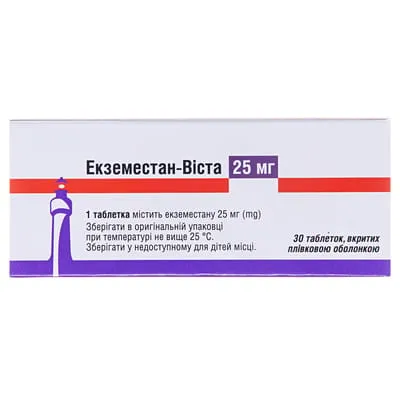
Table of Contents
INSTRUCTIONS FOR MEDICAL USE OF THE MEDICINAL PRODUCT Exemestane-Vista (Exemestane-Vista)
Composition:
Active substance: exemestane;
1 tablet contains 25 mg of exemestane;
Excipients: povidone K30, sodium starch glycolate (type A), microcrystalline cellulose, talc, colloidal anhydrous silicon dioxide, magnesium stearate, polysorbate 80, corn starch, pregelatinized starch, Opadry II 85F18422 white (polyvinyl alcohol, titanium dioxide (E 171), macrogol 3350, talc).
Pharmaceutical form. Film-coated tablets.
Main physico-chemical properties: white, round, film-coated tablets with a smooth surface and intact edges.
Pharmacotherapeutic group. Hormone antagonists and related agents. Enzyme inhibitors. ATC code L02BG06.
Pharmacological Properties
Pharmacodynamics
Mechanism of Action
Exemestane is an irreversible steroidal aromatase inhibitor, structurally similar to the natural substance androstenedione. In postmenopausal women, estrogens are primarily produced through the conversion of androgens to estrogens by the enzyme aromatase in peripheral tissues. Inhibition of estrogen synthesis via aromatase inhibition is an effective and selective treatment approach for hormone-dependent breast cancer in postmenopausal women. In postmenopausal women, exemestane significantly reduces serum estrogen concentrations starting at a dose of 5 mg; maximal reduction (> 90%) is achieved with doses of 10–25 mg. In postmenopausal patients with breast cancer diagnosis receiving 25 mg of exemestane daily, total aromatase activity was reduced by 98%.
Exemestane has no progestogenic or estrogenic activity. A minor androgenic activity, likely related to the 17-hydro derivative, was observed mainly when exemestane was administered at high doses. During studies of long-term daily administration, exemestane did not affect the biosynthesis of cortisol or aldosterone in the adrenal glands, as assessed by measurements of their levels before and after ACTH (adrenocorticotropic hormone) stimulation testing; this demonstrated selectivity with respect to other enzymes involved in steroid metabolism.
Therefore, there is no need for glucocorticoid or mineralocorticoid replacement therapy.
A slight, dose-independent increase in serum levels of luteinizing hormone (LH) and follicle-stimulating hormone (FSH) is observed even at low doses; however, this effect is expected for drugs in this pharmacological class and is likely due to a feedback mechanism at the pituitary level resulting from reduced estrogen concentrations, which stimulates pituitary gonadotropin secretion (also in postmenopausal women).
Clinical Efficacy and Safety
Adjuvant Therapy of Early-Stage Breast Cancer
In a multicenter, randomized, double-blind study (IES – Intergroup Exemestane Study), involving 4724 postmenopausal women with primary breast cancer with estrogen receptor-positive or estrogen receptor status unknown, patients who remained recurrence-free after 2–3 years of adjuvant tamoxifen therapy were randomized to receive either exemestane (25 mg/day) or tamoxifen (20 or 30 mg/day) for an additional 3–2 years to complete a total of 5 years of hormonal therapy.
Follow-up with median 52 months in the Intergroup Exemestane Study
Results with a median treatment duration of approximately 30 months and a median follow-up of approximately 52 months demonstrated that continuing treatment with exemestane after 2–3 years of adjuvant tamoxifen was associated with a clinically and statistically significant improvement in disease-free survival (DFS) compared to continuing tamoxifen. The results showed that during the observation period, exemestane reduced the risk of breast cancer recurrence by 24% compared to tamoxifen (hazard ratio – 0.76; p = 0.00015). The more favorable effect of exemestane over tamoxifen on disease-free survival was evident regardless of lymph node status or prior chemotherapy.
The use of exemestane also significantly reduced the risk of contralateral breast cancer development (hazard ratio – 0.57; p = 0.04158).
In the overall study population, a trend toward improved overall survival was observed with exemestane (222 deaths) compared to tamoxifen (262 deaths), with a hazard ratio of 0.85 (log-rank test: p = 0.07362), representing a 15% reduction in risk of death in favor of exemestane. A statistically significant 23% reduction in risk of death (hazard ratio for overall survival – 0.77; Wald chi-square test: p = 0.0069) was observed with exemestane compared to tamoxifen when adjusting for predefined prognostic factors (i.e., estrogen receptor status, lymph node status, prior chemotherapy, use of hormone replacement therapy, and bisphosphonates).
Key Efficacy Outcomes in All Patients (Intention-to-treat Population) and in Patients with Estrogen Receptor-Positive Breast Cancer at 52 Months
| Endpoint Population |
Exemestane Events/N (%) |
Tamoxifen Events/N (%) |
Hazard Ratio |
p-value* |
| Disease-free survival a |
||||
| All patients |
354/2352 (15.1%) |
453/2372 (19.1%) |
0.76 (0.67–0.88) |
0.00015 |
| ER+ patients |
289/2023 (14.3%) |
370/2021 (18.3%) |
0.75 (0.65–0.88) |
0.00030 |
| Contralateral breast cancer |
||||
| All patients |
20/2352 (0.9%) |
35/2372 (1.5%) |
0.57 (0.33–0.99) |
0.04158 |
| ER+ patients |
18/2023 (0.9%) |
33/2021 (1.6%) |
0.54 (0.30–0.95) |
0.03048 |
| Breast cancer-free survival b |
||||
| All patients |
289/2352 (12.3%) |
373/2372 (15.7%) |
0.76 (0.65–0.89) |
0.00041 |
| ER+ patients |
232/2023 (11.5%) |
305/2021 (15.1%) |
0.73 (0.62–0.87) |
0.00038 |
| Freedom from distant recurrence c |
||||
| All patients |
248/2352 (10.5%) |
297/2372 (12.5%) |
0.83 (0.70–0.98) |
0.02621 |
| ER+ patients |
194/2023 (9.6%) |
242/2021 (12.0%) |
0.78 (0.65–0.95) |
0.01123 |
| Overall survival d |
||||
| All patients |
222/2352 (9.4%) |
262/2372 (11.0%) |
0.85 (0.71–1.02) |
0.07362 |
| ER+ patients |
178/2023 (8.8%) |
211/2021 (10.4%) |
0.84 (0.68–1.02) |
0.07569 |
* Log-rank test; ER+ patients = patients with estrogen receptor-positive status.
a Disease-free survival is defined as the first occurrence of local or systemic recurrence, contralateral breast cancer, or death from any cause.
b Breast cancer-free survival is defined as the first occurrence of local or systemic recurrence, contralateral breast cancer, or death due to breast cancer.
c Distant recurrence-free survival is defined as the first occurrence of distant recurrence or death due to breast cancer.
d Overall survival is defined as death from any cause.
In a supplementary analysis of the subgroup of patients with positive or unknown estrogen receptor status, the unadjusted hazard ratio for overall survival was 0.83 (log-rank test: p = 0.04250), representing a clinically and statistically significant 17% reduction in the risk of death.
Results from an additional bone health study conducted within the Intergroup Exemestane Study showed that women who received exemestane after 2–3 years of tamoxifen treatment experienced moderate bone mineral density loss. In the overall study, the incidence of fractures occurring after treatment initiation, assessed over a 30-month treatment period, was higher in patients receiving exemestane compared to tamoxifen (4.5% vs. 3.3%, respectively; p = 0.038).
Findings from an additional endometrial assessment study within the Intergroup Exemestane Study indicate that after 2 years of treatment, endometrial thickness decreased with a median reduction of 33% in patients receiving exemestane, compared to no significant change in those receiving tamoxifen. Endometrial thickening observed at the start of exemestane treatment returned to normal (< 5 mm) in 54% of patients receiving exemestane.
Extended follow-up with a median of 87 months in the Intergroup Exemestane Study.
Results with a median treatment duration of approximately 30 months and a median follow-up duration of approximately 87 months demonstrated that continuing treatment with exemestane after 2–3 years of adjuvant tamoxifen therapy was associated with a clinically and statistically significant improvement in disease-free survival compared to continuing tamoxifen. The results showed that during the study observation period, exemestane significantly reduced the risk of breast cancer recurrence by 16% compared to tamoxifen (hazard ratio 0.84; p = 0.002).
Overall, the greater benefit of exemestane compared to tamoxifen in terms of disease-free survival was evident regardless of lymph node status or prior chemotherapy or hormonal therapy. Statistical significance was not achieved in several small-sample subgroups. These subgroups showed a trend favoring exemestane in patients with more than 9 positive nodes or prior CMF chemotherapy (cyclophosphamide + methotrexate + 5-fluorouracil). In patients with unknown nodal status, other prior chemotherapy regimens, or unknown/absent prior hormonal therapy, a statistically non-significant trend favoring tamoxifen was observed.
Furthermore, exemestane also significantly prolonged breast cancer-free survival (hazard ratio – 0.82; p = 0.00263) and distant recurrence-free survival (hazard ratio – 0.85; p = 0.02425).
Exemestane also reduced the risk of contralateral breast cancer, although the effect was no longer statistically significant during this observation period in the study (hazard ratio – 0.74; p = 0.12983). In the overall study population, a trend toward improved overall survival was observed with exemestane (373 deaths) compared to tamoxifen (420 deaths), with a hazard ratio of 0.89 (log-rank test: p = 0.08972), representing an 11% reduction in the risk of death in favor of exemestane. After adjusting for predefined prognostic factors (i.e., estrogen receptor status, lymph node status, prior chemotherapy, use of hormone replacement therapy, and bisphosphonates), a statistically significant 18% reduction in the risk of death (hazard ratio for overall survival – 0.82; chi-square test (Wald test): p = 0.0082) was observed with exemestane compared to tamoxifen in the overall study population.
In a supplementary analysis of the subgroup of patients with positive or unknown estrogen receptor status, the unadjusted hazard ratio for overall survival was 0.86 (log-rank test: p = 0.04262), representing a clinically and statistically significant 14% reduction in the risk of death.
Results from the additional bone health study indicate that treatment with exemestane for 2–3 years following 3–2 years of tamoxifen led to increased bone loss during this treatment period (mean % change in bone mineral density (BMD) from baseline at 36 months: -3.37 (spine), -2.96 (total hip) with exemestane vs. -1.29 (spine), -2.02 (total hip) with tamoxifen). However, by the end of the 24-month post-treatment period, the change in BMD from baseline was minimal in both treatment groups, with slightly greater final BMD reduction in the tamoxifen group across all sites (mean % change in BMD at 24 months from baseline: -2.17 (spine), -3.06 (total hip) with exemestane vs. -3.44 (spine), -4.15 (total hip) with tamoxifen).
The total number of all fractures recorded during both treatment and follow-up periods was significantly higher in the exemestane group compared to the tamoxifen group (169 (7.3%) vs. 122 (5.2%); p = 0.004), but no difference was observed in the number of fractures recorded as osteoporosis-related.
Treatment of advanced breast cancer.
In a randomized, comparative, controlled clinical trial, daily 25 mg exemestane demonstrated a statistically significant increase in overall survival, time to disease progression, and time to treatment failure compared to standard hormonal therapy with megestrol acetate in postmenopausal women with advanced breast cancer that had progressed during or after tamoxifen treatment as adjuvant therapy or as first-line therapy for advanced disease.
Pharmacokinetics.
Absorption
After oral administration, exemestane is rapidly absorbed. The fraction absorbed from the gastrointestinal tract is high. Absolute bioavailability has not been established, although absorption may be limited by the first-pass effect. Following a single 25 mg dose after food, the mean plasma concentration reaches a maximum at 2 hours and equals 17 ng/mL. Exemestane pharmacokinetics are linear and time-independent, with no accumulation observed during long-term administration. The terminal elimination half-life is approximately 24 hours. Food has been shown to enhance absorption: plasma levels are 40% higher compared to patients who took the drug on an empty stomach.
Distribution.
The volume of distribution of exemestane, uncorrected for oral bioavailability, is approximately 20,000 L. Exemestane pharmacokinetics are linear, and the terminal elimination half-life of exemestane is 24 hours. Plasma protein binding is 90% and independent of concentration. Exemestane and its metabolites do not bind to erythrocytes. Exemestane does not accumulate unpredictably after repeated dosing.
Metabolism and excretion
Exemestane is metabolized via oxidation of the methylene group (6) involving the CYP3A4 isoenzyme and/or via reduction of the 17-keto group involving aldoketoreductase, followed by conjugation. The clearance of exemestane is 500 L/h. Regarding aromatase inhibition, these metabolites are either inactive or less active than the parent compound. After oral administration of a single radiolabeled (14C) dose of exemestane, elimination of the drug and its metabolites was mostly complete within one week, with equal portions of the dose excreted in urine and feces (40% each). 0.1–1% of the radioactive dose was excreted in urine as unchanged radiolabeled exemestane.
Special populations
Age. No significant correlation between systemic exposure to exemestane and age was observed.
Renal impairment. In patients with impaired renal function (CLcr < 30 mL/min), systemic exposure to exemestane was twice as high compared to healthy volunteers.
Considering the safety data of exemestane, dose adjustment is not necessary.
Hepatic impairment.
In patients with moderate or severe hepatic impairment, systemic exposure to exemestane was 2–3 times higher compared to healthy volunteers. Considering the safety data of exemestane, dose adjustment is not necessary.
Clinical characteristics.
Indications.
Adjuvant therapy in postmenopausal women with early-stage invasive breast cancer and estrogen receptor-positive tumors, after 2–3 years of initial adjuvant tamoxifen therapy.
Treatment of advanced breast cancer in women with naturally or therapeutically induced postmenopausal status in whom disease progression has occurred following antiestrogen therapy. Efficacy has not been demonstrated in patients with estrogen receptor-negative tumors.
Contraindications.
Hypersensitivity to the active substance or to any of the excipients of the medicinal product.
The medicinal product is also contraindicated in premenopausal women, as well as in women during pregnancy or breastfeeding.
Interaction with other medicinal products and other forms of interaction.
In vitro studies have shown that exemestane is metabolized by cytochrome P450 (CYP3A4) and aldo-keto reductases (see section "Pharmacokinetics"), and does not inhibit any of the major CYP isoenzymes. A clinical pharmacokinetic study demonstrated that specific inhibition of CYP3A4 by ketoconazole does not significantly affect the pharmacokinetics of exemestane.
In an interaction study with rifampicin, a potent inducer of CYP450 enzymes, administered at a daily dose of 600 mg together with a single 25 mg dose of exemestane, the AUC of exemestane decreased by 54% and Cmax by 41%. Since the clinical significance of this interaction has not been studied, concomitant use of drugs such as rifampicin, anticonvulsants (e.g., phenytoin and carbamazepine), and herbal preparations containing St. John's wort (Hypericum perforatum), which are known to induce CYP3A4, may reduce the efficacy of Exemestane-Vista.
Exemestane-Vista should be used with caution in combination with medicinal products that are metabolized by CYP3A4 and have a narrow therapeutic index. There is no experience with the concomitant clinical use of exemestane and other anticancer medicinal products.
Exemestane-Vista must not be used with medicinal products containing estrogens, as their pharmacological effect may be counteracted when used concomitantly.
Special precautions for use.
Exemestane-Vista should not be prescribed to women with a premenopausal endocrine status. Therefore, in appropriate clinical cases, postmenopausal status should be confirmed by assessing levels of LH, FSH, and estradiol.
Exemestane-Vista should be administered with caution to patients with impaired liver or kidney function.
Exemestane-Vista is a drug that strongly reduces estrogen levels; decreased bone mineral density and increased fracture rates have been observed following exemestane treatment (see section "Pharmacodynamics"). At the beginning of adjuvant therapy with Exemestane-Vista in women suffering from osteoporosis or at risk of developing it, baseline bone mineral density should be assessed according to current clinical guidelines and practices. Bone mineral density in patients with advanced disease should be evaluated on an individual basis.
Although sufficient data on the impact of therapy on the loss of bone mineral density caused by exemestane are lacking, monitoring of patients receiving Exemestane-Vista is necessary, and treatment or prevention of osteoporosis should be initiated in patients at risk.
Prior to initiating aromatase inhibitor therapy, routine assessment of 25-hydroxy metabolites of vitamin D levels should be performed, as severe vitamin D deficiency is common in women with early-stage breast cancer. Women with vitamin D deficiency should receive vitamin D supplementation.
Use during pregnancy or breastfeeding.
Pregnancy. Clinical data on the use of exemestane in pregnant women are unavailable. Animal studies have shown reproductive toxicity; therefore, Exemestane-Vista is contraindicated in pregnant women.
Based on animal studies and its mechanism of action, exemestane may cause embryotoxic effects when administered during pregnancy. In animal studies, administration of exemestane to pregnant rats and rabbits resulted in increased rates of abortion and embryofetal toxicity. Pregnant women who have been prescribed exemestane should be informed about the potential risk to the fetus. Women of reproductive potential should be advised to use effective contraception during treatment with Exemestane-Vista and for 1 month after discontinuation of the drug.
Breastfeeding. It is unknown whether exemestane is excreted in human milk. Exemestane-Vista should not be used in women who are breastfeeding.
Women in perimenopausal period or of reproductive age.
Physicians should discuss the need for appropriate contraception with women who may become pregnant, including those in the perimenopausal period or who have recently transitioned into postmenopause, until their postmenopausal status is fully confirmed (see sections "Contraindications" and "Special precautions for use").
Ability to affect reaction speed when driving or operating machinery.
During treatment with exemestane, somnolence, drowsiness, asthenia, and dizziness have been reported. Patients should be informed that if these symptoms occur, their physical and/or mental reactions required for driving or operating machinery may be impaired.
Method of Administration and Dosage
Adult and Elderly Patients
The recommended dose of Exemestane-Vista is 1 tablet of 25 mg daily after a meal.
In patients with early-stage breast cancer, treatment with Exemestane-Vista should continue until completion of a five-year combined sequential adjuvant hormonal therapy (tamoxifen followed by Exemestane-Vista) or until tumor recurrence occurs.
In patients with advanced breast cancer, treatment with Exemestane-Vista should continue until tumor progression becomes evident.
Dose adjustment is not required in patients with hepatic or renal impairment.
Children. Exemestane-Vista is not recommended for use in children.
Overdose
Clinical study data on exemestane administration at single doses up to 800 mg in healthy female volunteers and up to 600 mg in postmenopausal women with malignant breast cancer indicate good tolerance of these doses. A single dose of exemestane that may cause life-threatening symptoms has not been established. In animal studies, mortality was observed after administration of single doses equivalent to 2000 and 4000 times the recommended human dose (on a mg/m² basis). There are no specific antidotes for overdose. Symptomatic treatment should be administered. General supportive measures are indicated, including continuous monitoring of vital functions and careful observation of the patient's health status.
Adverse Reactions
Exemestane was generally well tolerated in all clinical studies when administered at the standard dose of 25 mg/day; adverse events were usually of mild to moderate severity.
The discontinuation rate due to adverse events was 7.4% in patients with early-stage breast cancer receiving adjuvant exemestane after initial adjuvant tamoxifen therapy. The most commonly reported adverse events were hot flushes (22%), arthralgia (18%), and increased fatigue (16%).
The discontinuation rate due to adverse events was 2.8% in the overall population of patients with advanced breast cancer. The most commonly reported adverse events were hot flushes (14%) and nausea (12%).
Most adverse events can be explained by the expected pharmacological consequences of estrogen blockade (e.g., hot flushes).
Adverse reactions reported during clinical studies and post-marketing experience with exemestane are listed below by system organ class and frequency.
Frequency categories are defined as follows: very common (≥ 1/10), common (≥ 1/100 to < 1/10), uncommon (≥ 1/1000 to < 1/100), rare (≥ 1/10,000 to < 1/1000), very rare (< 1/10,000), frequency not known (cannot be estimated based on available data).
Blood and lymphatic system disorders:
very common – leukopenia**;
common – thrombocytopenia**;
frequency not known – decreased lymphocyte count**.
Immune system disorders:
uncommon – hypersensitivity.
Metabolism and nutrition disorders:
common – anorexia.
Psychiatric disorders:
very common – depression, insomnia.
Nervous system disorders:
very common – headache, dizziness;
common – carpal tunnel syndrome, paraesthesia;
rare – somnolence.
Vascular disorders:
very common – hot flushes.
Gastrointestinal disorders:
very common – abdominal pain, nausea;
common – vomiting, diarrhea, constipation, dyspepsia.
Hepatobiliary disorders:
very common – increased liver enzymes, increased blood bilirubin levels, increased blood alkaline phosphatase levels;
rare – hepatitis†, cholestatic hepatitis†.
Skin and subcutaneous tissue disorders:
very common – increased sweating;
common – alopecia, rash, urticaria, pruritus;
rare – acute generalized exanthematous pustulosis†.
Musculoskeletal and connective tissue disorders:
very common – joint pain and musculoskeletal pain*;
common – fracture, osteoporosis.
General disorders and administration site conditions:
very common – pain, increased fatigue;
common – peripheral edema, asthenia.
* Includes arthralgia and less frequently limb pain, osteoarthritis, back pain, arthritis, myalgia, and joint stiffness.
** In patients with advanced breast cancer, cases of thrombocytopenia and leukopenia were reported as rare. Transient decreases in lymphocyte count were observed in approximately 20% of patients receiving exemestane, particularly in those with pre-existing lymphopenia. However, mean lymphocyte counts over time did not significantly change in these patients, and no increase in the frequency of viral infections was observed. These effects were not seen in patients treated in early-stage breast cancer studies.
† Frequency calculated according to the rule of 3/X.
The table below lists the frequency of pre-specified adverse reactions and disorders in the Intergroup Exemestane Study in patients with early-stage breast cancer, regardless of causal relationship, reported in patients receiving exemestane therapy and during the period up to 30 days after its completion.
| Adverse reactions and disorders |
Exemestane (N = 2249) |
Tamoxifen (N = 2279) |
| Hot flushes |
491 (21.8%) |
457 (20.1%) |
| Increased fatigue |
367 (16.3%) |
344 (15.1%) |
| Headache |
305 (13.6%) |
255 (11.2%) |
| Insomnia |
290 (12.9%) |
204 (9.0%) |
| Increased sweating |
270 (12.0%) |
242 (10.6%) |
| Gynecological disorders |
235 (10.5%) |
340 (14.9%) |
| Dizziness |
224 (10.0%) |
200 (8.8%) |
| Nausea |
200 (8.9%) |
208 (9.1%) |
| Osteoporosis |
116 (5.2%) |
66 (2.9%) |
| Vaginal bleeding |
90 (4.0%) |
121 (5.3%) |
| Other primary cancer |
84 (3.6%) |
125 (5.3%) |
| Vomiting |
50 (2.2%) |
54 (2.4%) |
| Visual disturbances |
45 (2.0%) |
53 (2.3%) |
| Thromboembolism |
16 (0.7%) |
42 (1.8%) |
| Osteoporotic fracture |
14 (0.6%) |
12 (0.5%) |
| Myocardial infarction |
13 (0.6%) |
4 (0.2%) |
In the Intergroup Exemestane Study, the incidence of myocardial ischemia in the exemestane and tamoxifen treatment groups was 4.5% and 4.2%, respectively. No significant differences were observed for any individual cardiovascular events, including arterial hypertension (9.9% vs. 8.4%), myocardial infarction (0.6% vs. 0.2%), and heart failure (1.1% vs. 0.7%).
In the Intergroup Exemestane Study, treatment with exemestane was associated with a higher incidence of hypercholesterolemia compared to tamoxifen (3.7% vs. 2.1%).
In a separate double-blind, randomized study in postmenopausal women with early-stage, low-risk breast cancer who received either exemestane (N = 73) or placebo (N = 73) for 24 months, treatment with exemestane was associated with a mean reduction in plasma LDL-cholesterol levels of 7–9% compared to a 1% increase in the placebo group. A reduction in apolipoprotein A1 levels of 5–6% was also observed in the exemestane treatment group compared to a reduction of 0–2% in the placebo group. The effect on all other analyzed lipid parameters (total cholesterol, HDL-cholesterol, triglycerides, apolipoprotein-B, and lipoprotein-a) was similar between the two treatment groups. The clinical significance of these findings is unknown.
In the Intergroup Exemestane Study, gastric ulcer was observed more frequently in the exemestane treatment group compared to the tamoxifen treatment group (0.7% vs. < 0.1%). Most patients who developed gastric ulcer while receiving exemestane were also concomitantly or previously treated with nonsteroidal anti-inflammatory drugs (NSAIDs) and/or had a history of their use.
Reporting of suspected adverse reactions. Reporting suspected adverse reactions after marketing authorization is important. It allows continued monitoring of the benefit-risk balance of the medicinal product. Healthcare professionals should report any suspected adverse reactions in accordance with applicable regulatory requirements.
Shelf life. 2 years.
Storage conditions.
Store in the original packaging at a temperature not exceeding 25°C.
Keep out of the reach and sight of children.
Packaging.
10 tablets per blister, 3 or 10 blisters per cardboard box.
Prescription status. Prescription only.
Manufacturer.
Sindan Pharma S.R.L.
Manufacturer's address and location of operations.
Bd. Ion Mihalache, 11, Sector 1, 011171, Bucharest, Romania.