Echinacea farcos
Ukraine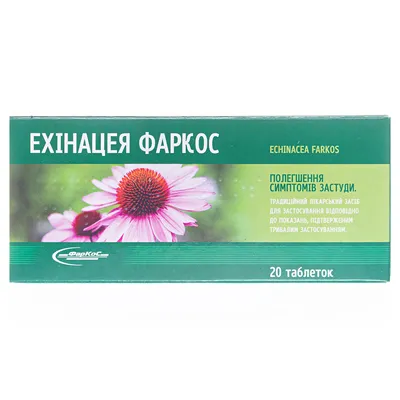
Table of Contents
INSTRUCTIONS FOR MEDICAL USE OF THE MEDICINAL PRODUCT ECHINACEA Pharcos
Composition:
Active substance: juice of freshly harvested aerial parts of flowering purple coneflower (Echinacea purpurea L.);
One tablet contains 100 mg of juice from freshly harvested aerial parts of flowering purple coneflower (Echinacea purpurea L.) (calculated as 100% dry substance);
Excipients: maize starch, colloidal silicon dioxide, microcrystalline cellulose, sorbitol, calcium stearate.
Pharmaceutical form. Tablets.
Main physicochemical properties: round, biconvex tablets with a score line on one side, ranging in color from light brown with a grayish tint to light brown, grayish-brown, and dark brown; light and dark inclusions may be present.
Pharmacotherapeutic group.
Immunostimulants. ATC code L03AX.
Pharmacological properties.
Pharmacodynamics.
A plant-derived biogenic stimulant that exerts immunomodulatory and anti-inflammatory effects, stimulates bone marrow hematopoiesis, thereby increasing the number of leukocytes and reticuloendothelial cells of the spleen. It primarily activates cellular immunity, enhances macrophage phagocytic activity and granulocyte chemotaxis, promotes cytokine release, increases macrophage production of interleukin-1, accelerates transformation of B-lymphocytes into plasma cells, enhances antibody production and T-helper activity. Increases non-specific resistance of the body (including against influenza and herpes viruses).
Due to the immune-stimulating activity of Echinacea purpurea in humans, resistance to respiratory tract infections is enhanced.
Pharmacokinetics.
Well absorbed in the gastrointestinal tract. Excreted in urine and feces.
Clinical characteristics.
Indications.
The traditional herbal medicinal product Echinacea Pharcos is used for the relief of cold symptoms.
Contraindications.
Hypersensitivity to echinacea, other plants of the Asteraceae family (chamomile, arnica, calendula, yarrow) or to any other component of the medicinal product.
Progressive systemic diseases (e.g., tuberculosis, sarcoidosis, rheumatism, systemic lupus erythematosus); autoimmune diseases (e.g., collagenoses, multiple sclerosis); immunodeficiency states (e.g., HIV infection, AIDS); immunosuppression (e.g., cytostatic therapy for oncological diseases, history of organ or bone marrow transplantation); blood disorders (e.g., agranulocytosis, leukemia). Hereditary predisposition to allergic reactions (e.g., urticaria, atopic dermatitis, bronchial asthma, chronic viral diseases). Neoplasms, diabetes mellitus.
Pregnancy or breastfeeding. Children under 12 years of age.
Interaction with other medicinal products and other forms of interaction.
Due to the immunostimulatory effect, echinacea may reduce the efficacy of medicinal products with immunosuppressive action (e.g., cyclosporine, methotrexate).
The medicinal product is not recommended to be used concomitantly with drugs having hepatotoxic effects, such as amiodarone, ketoconazole, and steroid preparations.
Enhancement or reduction of effect cannot be excluded when used concomitantly with drugs whose elimination depends on the activity of cytochrome P450 isoenzymes CYP3A or CYP1A2.
Special precautions for use
Experience with the use of Echinacea preparations in children under 12 years of age is limited; therefore, the medicinal product should not be used in this age group of patients.
If symptoms do not disappear within 10 days of treatment, or, on the contrary, worsen, or body temperature rises, medical advice should be sought immediately. In case of respiratory diseases with frequent relapses and prolonged symptoms such as difficulty in breathing, fever, purulent or bloody sputum, it is necessary to consult a physician without delay.
Patients with atopic diseases and those with hereditary predisposition to allergies are at risk of developing anaphylactic reactions. Such patients should consult a physician before starting treatment with this product.
Echinacea Pharcos contains sorbitol; therefore, if a patient has been diagnosed with intolerance to certain sugars, medical advice should be sought before taking this medicinal product.
Concomitant intake of vitamins A, E, and C is recommended during treatment.
Echinacea Pharcos is a traditional herbal medicinal product for use according to indications supported by long-standing use.
Use during pregnancy or breastfeeding.
Limited data (several hundred pregnant women) indicate no adverse effects of Echinacea on pregnancy or on the health of the fetus/newborn. Data regarding the newborn's immune system are lacking. To date, no other relevant epidemiological studies have been conducted.
Experience with the use of this medicinal product during pregnancy or breastfeeding is limited; therefore, it should not be used during these periods except under the specific instruction of a physician.
Data on the effect of the medicinal product on fertility are lacking.
Ability to influence reaction rate when driving or operating machinery.
Given the possible effect of Echinacea on the nervous system, the medicinal product should be used with caution when driving or operating machinery.
Method of administration and dosage.
Tablets can be sucked, chewed, or swallowed with liquid. The time of administration does not depend on food intake.
For adults and children aged 12 years and older, the recommended dose is 1 tablet (100 mg) twice daily. Maximum daily dose — 4 tablets (400 mg).
Duration of treatment — 10 days with daily use, or 20 days when taking the drug every other day. Treatment should be initiated at the first signs of illness. The patient should consult a physician if symptoms do not resolve within 10 days of using the drug or if adverse reactions not listed in this instruction occur.
Children.
The drug is not recommended for children under 12 years of age due to lack of experience with its use.
Overdose.
Symptoms: nausea, vomiting, diarrhea, constipation, increased excitability, sleep disturbances (insomnia).
Treatment: symptomatic therapy, gastric lavage, enteral sorbents.
Adverse reactions.
The frequency of adverse reactions cannot be determined based on available data. The adverse reactions listed below may occur in individual cases.
Immune system disorders: hypersensitivity reactions (e.g., pruritus, skin rashes, skin hyperemia, facial swelling); Stevens-Johnson syndrome; angioneurotic edema of the skin; Quincke's edema; anaphylactic shock. Allergic reactions in patients with hereditary predisposition to allergy. Impact on the course of autoimmune diseases (disseminated encephalomyelitis, nodular erythema, immune thrombocytopenia, Evans syndrome, and Sjögren's syndrome with impaired renal tubular function).
Respiratory, thoracic and mediastinal disorders: bronchospasm with obstruction and bronchial asthma on the background of hypersensitivity reactions.
Blood and lymphatic system disorders: leukopenia during prolonged use (over 8 weeks).
Gastrointestinal disorders: gastrointestinal disturbances, including nausea, vomiting, diarrhea, abdominal pain.
Nervous system disorders: excitation, dizziness, sleep disturbances.
Cardiovascular disorders: arterial hypotension.
Shelf life.
2 years.
Storage conditions.
Store in the original packaging at a temperature not exceeding +25°C. Keep out of reach of children.
Packaging.
10 tablets in a blister; 2 blisters per carton.
Prescription status.
Over-the-counter.
Manufacturer.
LLC "Pharmaceutical Company "FarkoS".
Manufacturer's address and location of its business activities.
360, Svjato-Pokrovska St., Gostomel, Irpin, Kyiv region, 08290, Ukraine.
Marketing authorization holder.
LLC "Pharmaceutical Company "FarkoS".
Address of the marketing authorization holder.
50-A, Zodchykh St., Kyiv, 03162, Ukraine.