Ebrantil
Ukraine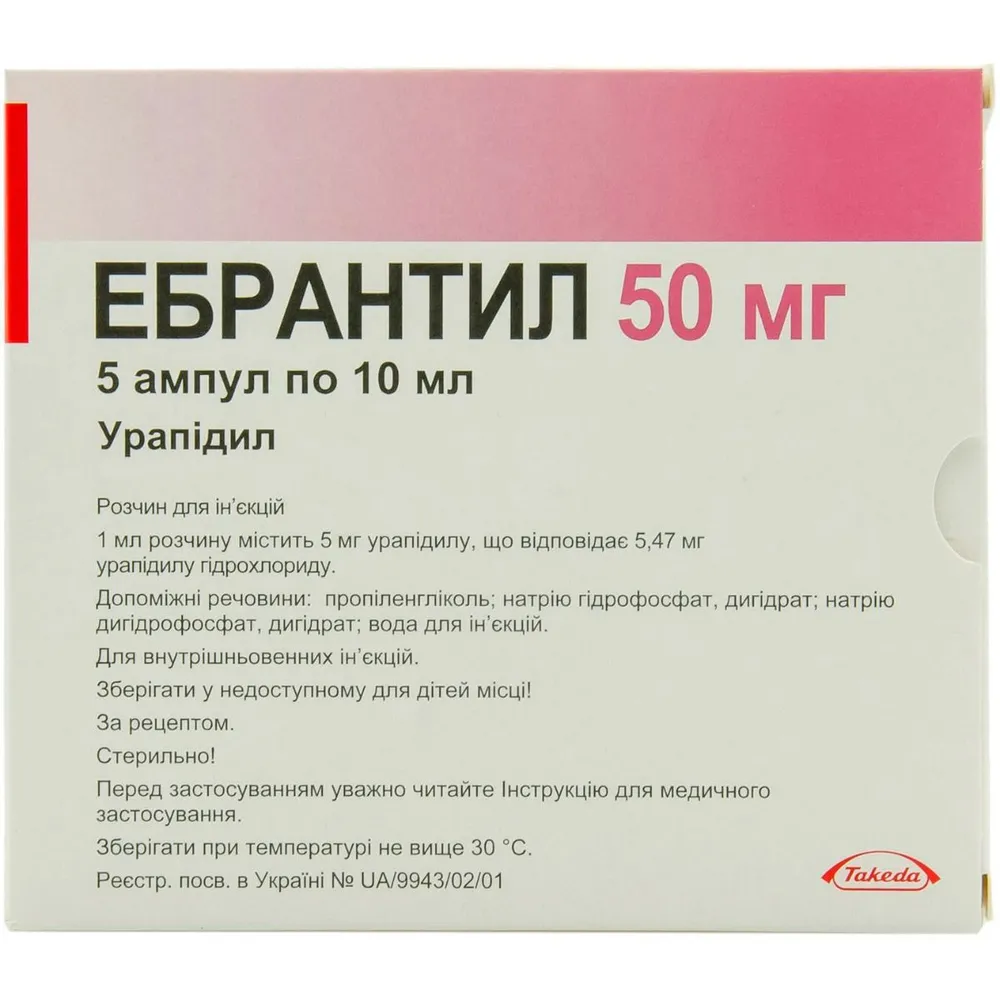
Table of Contents
INSTRUCTIONS for medical use of the medicinal product EBRANTIL (EBRANTIL®)
Composition:
active substance: urapidil;
1 ml of solution contains 5 mg of urapidil, equivalent to 5.47 mg of urapidil hydrochloride;
excipients: propylene glycol; sodium hydrogen phosphate, dihydrate; sodium dihydrogen phosphate, dihydrate; water for injections.
Pharmaceutical form. Solution for injection.
Main physicochemical properties: clear, colorless solution.
Pharmacotherapeutic group. Antihypertensive agent. Alpha-adrenoreceptor blockers. ATC code C02CA06.
Pharmacological properties.
Pharmacodynamics.
Urapidil leads to reduction of systolic and diastolic pressure by decreasing peripheral resistance.
Heart rate remains practically unchanged. Cardiac output also remains unchanged; cardiac output, which decreases due to increased afterload, may increase.
Mechanism of action. Urapidil has central and peripheral mechanisms of action.
At the peripheral level, urapidil primarily blocks postsynaptic α₁-adrenoceptors, thereby inhibiting vasoconstrictive effects of catecholamines.
At the central level, urapidil modulates the activity of the cardiovascular regulatory center, preventing reflex increase in sympathetic nervous system tone or reducing sympathetic tone.
Pharmacokinetics.
Absorption. After intravenous administration of 25 mg urapidil, a biphasic decline in plasma concentration of the drug is observed (initial distribution phase, terminal elimination phase). The distribution half-life is approximately 35 minutes. The elimination half-life of urapidil from plasma after intravenous bolus administration is 2.7 hours (1.8–3.9 hours).
Protein binding of urapidil to human plasma proteins (in vitro) is 80%. This relatively low plasma protein binding of urapidil may explain why no interactions between urapidil and drugs with strong plasma protein binding have been reported to date.
Distribution. Volume of distribution is 0.77 L/kg body weight. The substance crosses the blood-brain barrier and passes through the placenta.
Metabolism. Urapidil is mainly metabolized in the liver. The primary metabolite is hydroxylated urapidil at the 4-position of the phenolic ring, which has no significant antihypertensive activity. The O-dimethylated metabolite of urapidil has almost the same biological activity as urapidil, but is formed in very small amounts.
Excretion and elimination. Elimination of urapidil and its metabolites in humans is 50–70% renal, of which approximately 15% of the administered dose is pharmacologically active urapidil; the remainder, primarily para-hydroxylated urapidil, which lacks antihypertensive effect, is excreted in feces.
Special populations. In elderly patients, as well as in patients with progressive hepatic and/or renal impairment, volume of distribution and clearance of urapidil are reduced, and elimination half-life from plasma is prolonged.
Clinical characteristics.
Indications.
- Hypertensive crisis.
- Severe or very severe degree of arterial hypertension.
- Refractory arterial hypertension.
- For controlled reduction of arterial pressure when elevated during and/or after surgical intervention.
Contraindications.
- Hypersensitivity to any component of the drug.
- Aortic stenosis.
- Arteriovenous shunt (except for patients with hemodynamically insignificant dialysis shunt).
Interaction with other medicinal products and other forms of interaction.
The hypotensive effect of Ebrantil may be enhanced when used concomitantly with alpha-adrenoreceptor blockers, vasodilators, and other antihypertensive drugs, as well as in the presence of hypovolemia (e.g., diarrhea, vomiting) and alcohol consumption.
Concomitant use of cimetidine may increase the maximum serum concentration of urapidil by 15%.
Currently, information regarding combination therapy with ACE inhibitors is insufficient; therefore, such treatment is not recommended.
Special precautions for use.
The drug Ebrantil should be used with special caution:
- in heart failure caused by mechanical functional disorders (e.g., aortic or mitral valve stenosis), in pulmonary embolism or impaired cardiac function due to pericardial disorders;
- in children, as studies have not been conducted in this age group;
- in patients with hepatic insufficiency;
- in patients with moderate or severe renal insufficiency;
- in elderly patients;
- in patients who are concurrently using cimetidine (see section "Interaction with other medicinal products and other types of interactions").
If other antihypertensive drugs have been previously administered, urapidil injections should not be given until sufficient time has elapsed to assess the therapeutic effect of the previously administered drug. The dose of Ebrantil should be correspondingly reduced. Excessively rapid reduction in arterial pressure may lead to bradycardia or cardiac arrest.
5 ml of Ebrantil injection solution contains 500 mg of propylene glycol, equivalent to 100 mg of propylene glycol in 1 ml of injection solution.
10 ml of Ebrantil injection solution contains 1000 mg of propylene glycol, equivalent to 100 mg of propylene glycol in 1 ml of injection solution.
This medicinal product should not be used during pregnancy or breastfeeding unless recommended by a physician. Additional examinations may be performed during treatment with this drug as directed by a physician.
This medicinal product should not be used if there are liver or kidney diseases, unless recommended by a physician. Additional examinations may be performed during treatment with this drug as directed by a physician.
Propylene glycol contained in this drug may have effects similar to alcohol consumption and may increase the likelihood of adverse effects.
The drug should not be used in children under 5 years of age.
The drug should be used only as directed by a physician. Additional examinations may be performed during treatment with this drug as directed by a physician.
Ebrantil contains sodium, but less than 1 mmol (23 mg) of sodium per 5 ml of injection solution, making it nearly sodium-free.
Ebrantil contains sodium, but less than 1 mmol (23 mg) of sodium per 10 ml of injection solution, making it nearly sodium-free.
Use during pregnancy or breastfeeding.
Women of childbearing potential.
Ebrantil is not recommended for women of childbearing potential who are not using contraception.
Pregnancy.
Data on the use of urapidil in pregnant women are lacking or limited in quantity.
Animal studies have shown reproductive toxicity.
Urapidil crosses the placenta.
Ebrantil should not be used during pregnancy unless treatment with urapidil is necessary due to the woman's clinical condition.
Lactation.
It is unknown whether urapidil passes into breast milk.
Risk to the newborn/infant cannot be excluded.
Ebrantil should not be used during lactation.
Fertility.
Clinical trials on the effect on fertility in men and women have not been conducted. Animal studies have shown that urapidil affects fertility.
Ability to influence reaction speed when driving or operating machinery. In individual cases, certain adverse reactions from the central nervous system (dizziness) may affect the ability to drive or operate complex machinery. This is particularly important at the beginning of treatment, when increasing the dose/replacing the drug, or when consuming alcohol.
Method of Administration and Dosage
Hypertensive crisis, severe or very severe arterial hypertension, refractory hypertension.
- Intravenous injection: 10–50 mg of urapidil administered slowly intravenously under continuous monitoring of arterial pressure. Reduction in arterial pressure occurs within 5 minutes after injection. Parenteral therapy may be repeated if arterial pressure rises again.
- Slow intravenous infusion or continuous infusion using an infusion pump.
To prepare the infusion solution for maintaining arterial pressure at the level achieved after the injection, proceed as follows:
Add 250 mg of Ebrantil to 500 mL of a compatible infusion solution (e.g., 0.9% sodium chloride solution or 5% or 10% glucose solution).
If an infusion pump is used for administering the maintenance dose, inject 20 mL of the injection solution (100 mg of Ebrantil) into a syringe and dilute to a total volume of 50 mL with a compatible infusion solution (see above).
The maximum allowable concentration is 4 mg of urapidil per 1 mL of infusion solution.
The infusion rate should be adjusted according to the individual blood pressure response.
The recommended initial maximum rate is 2 mg/min.
Maintenance dose – on average 9 mg/hour, i.e., 250 mg of urapidil added to 500 mL of infusion solution (1 mg = 44 drops = 2.2 mL).
Controlled reduction of arterial pressure for management of hypertensive episodes during and/or after surgery.
Use continuous infusion via an infusion pump or drip infusion to maintain arterial pressure at the level achieved after the initial injection.
Dosing Schedule
| Intravenous injection of urapidil 25 mg ( = 5 ml of injection solution) |
reduction of arterial pressure within 2 min |
Stabilization of arterial pressure by infusion Initial dose up to 6 mg within 1–2 min, then reduce dose |
|
| after 2 min |
no change in arterial pressure |
||
| Intravenous injection of urapidil 25 mg ( = 5 ml of injection solution) |
reduction of arterial pressure within 2 min |
||
| after 2 min |
no change in arterial pressure |
||
| Slow intravenous administration of urapidil 50 mg ( = 10 ml of injection solution) |
reduction of arterial pressure within 2 min |
||
Ebrantil, intravenous solution, should be administered to the patient in the supine position by injection or infusion.
Single or repeated injections and intravenous drip infusions are possible.
Intravenous injection of the drug is compatible with subsequent drip infusion.
Emergency parenteral therapy may be continued by switching to long-term treatment with Ebrantil capsules with modified release (initial recommended dose 2 x 60 mg), or other oral antihypertensive agents.
A treatment period of 7 days is considered safe from a toxicological standpoint and usually not exceeded during parenteral antihypertensive therapy. Parenteral therapy may be repeated in cases of recurrent elevation of arterial pressure.
Special patient groups.
Hepatic impairment. Patients with hepatic insufficiency may require a reduced dose of Ebrantil.
Renal impairment. Patients with moderate to severe renal insufficiency may require a reduced dose of Ebrantil during long-term treatment.
Elderly patients. Antihypertensive agents should be used with caution in elderly patients and therapy should be initiated with lower doses, as sensitivity to such drugs is often altered in elderly patients.
Children. Clinical data on the efficacy and safety of the drug for treatment in children are lacking.
Overdose.
Symptoms:
- cardiovascular system: dizziness, orthostatic decrease in arterial pressure, collapse;
- central nervous system: increased fatigue and impaired reaction speed.
Treatment. Excessive reduction in arterial pressure may be alleviated by elevating the lower limbs in the supine position and blood volume replacement.
If these measures are insufficient, vasopressors may be administered slowly intravenously under arterial pressure monitoring.
In very rare cases, intravenous injection of catecholamines is necessary (e.g., 0.5–1.0 mg adrenaline, diluted in 10 ml of 0.9% sodium chloride solution).
Side effects
Most of the adverse reactions listed below are due to a rapid decrease in blood pressure. However, clinical experience shows that these reactions usually disappear within a few minutes, even during continuous intravenous infusion. If severe adverse effects occur, administration of the drug should be discontinued.
Undesirable effects are classified by frequency of occurrence as follows:
Very common (≥ 1/10), common (≥ 1/100, < 1/10), uncommon (≥ 1/1000, < 1/100), rare (≥ 1/10000, < 1/1000), very rare (< 1/10000), not known (cannot be estimated from the available data).
Cardiovascular system.
Uncommon: palpitations, tachycardia, bradycardia, sensation of pressure or pain behind the sternum (symptoms similar to angina pectoris), dyspnea, decrease in blood pressure upon change in body position, e.g. when standing up from a lying position (orthostatic dysregulation).
Gastrointestinal tract.
Common: nausea.
Uncommon: vomiting.
General disorders.
Uncommon: increased fatigue, reactions at the injection site.
Investigations.
Uncommon: irregular heartbeat.
Very rare: thrombocytopenia*.
Nervous system.
Common: dizziness, headache.
Psychiatric disorders.
Very rare: feeling of anxiety.
Reproductive system and breast.
Very rare: priapism.
Respiratory system.
Rare: nasal congestion.
Skin and subcutaneous tissue.
Uncommon: increased sweating.
Rare: hypersensitivity reactions, including itching, skin redness, rash.
Not known: angioedema, urticaria.
* – In isolated cases, a decrease in platelet count has been observed temporally associated with the use of Ebrantil, although a causal relationship with urapidil administration cannot be established, for example, by immunological testing.
If any adverse reactions occur, medical advice should be sought.
Shelf life. 2 years.
Storage conditions. Store at a temperature not exceeding 30 °C. Keep out of reach of children!
Incompatibilities. Ebrantil, solution for injection, should not be mixed with alkaline solutions for injection or infusion due to darkening or formation of a flaky precipitate in the solution caused by the acidic properties of the injection solution.
Packaging. Ampoules of 5 ml or 10 ml. Packs of 5, 10, or 50 ampoules in a cardboard box.
Prescription status. Prescription only.
Manufacturer. Takeda Austria GmbH, Austria
Manufacturer's address.
St. Peter-Strasse 25, 4020 Linz, Austria / St. Peter-Strasse 25, 4020 Linz, Austria