Dip relief
Ukraine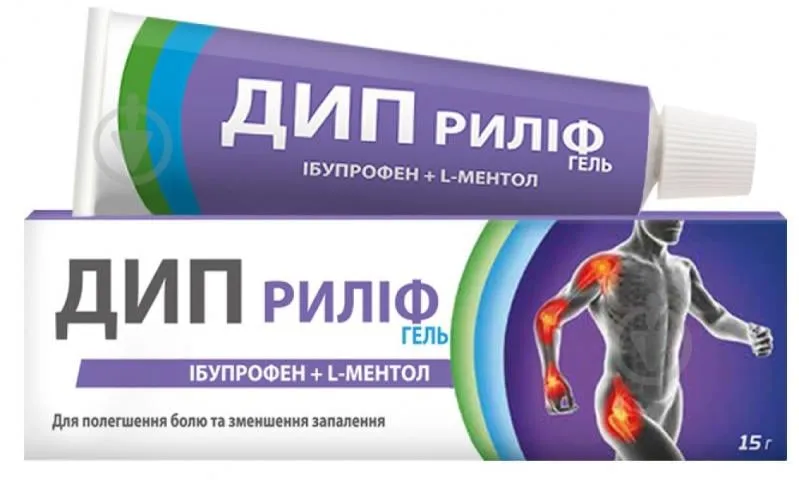
Table of Contents
INSTRUCTIONS FOR MEDICAL USE OF THE MEDICINAL PRODUCT DEEP RELIEF
Composition:
Active ingredients: ibuprofen, levomenthol;
1 g of gel contains ibuprofen 50 mg, levomenthol 30 mg;
Excipients: propylene glycol, carbomer, diisopropanolamine, ethanol 96%, purified water.
Pharmaceutical form. Gel.
Main physico-chemical properties: clear gel, free from foreign particles, with a menthol odour.
Pharmacotherapeutic group.
Topical preparations used in joint and muscular pain. ATC code M02AX10.
Pharmacological properties.
Pharmacodynamics.
Deep Relief is a combined topical preparation containing ibuprofen with naturally derived menthol. Ibuprofen, a derivative of phenylpropionic acid, is a member of the nonsteroidal anti-inflammatory drug group and exerts analgesic and anti-inflammatory effects due to inhibition of prostaglandin synthetase. The action of levomenthol, the optical isomer of menthol, is mediated by reflex responses associated with stimulation of sensitive nerve endings in the skin. Menthol stimulates skin nociceptors. As a result, vasodilatory peptides are released. The preparation produces a counterirritant and stimulating effect and relieves pain.
Pharmacokinetics.
After topical application, ibuprofen is well and rapidly absorbed through the skin. Only a very small amount reaches the systemic circulation. Maximum plasma concentration of ibuprofen is achieved 2 hours after application and amounts to 0.6 mcg/mL. The extent of ibuprofen absorption following topical administration is approximately 5% of that observed after oral administration.
Levomenthol, absorbed through the skin, is transported to the liver. Some Phase I metabolism may occur in the skin, but the majority takes place in the liver. Menthol is hydroxylated and then conjugated with glucuronic acid prior to circulation to the kidneys for urinary excretion.
Clinical characteristics.
Indications.
Deep Relief is recommended for relief of pain and reduction of inflammation associated with rheumatic, muscular, and joint pain, back pain, as well as pain and swelling due to injury, ligament sprains, and sports injuries.
Contraindications.
The medicinal product is contraindicated:
- in case of hypersensitivity to ibuprofen, levomenthol, acetylsalicylic acid, or to any component of the preparation or other nonsteroidal anti-inflammatory agents (including oral administration);
- in asthma or history of bronchial asthma attacks, urticaria, Quincke's edema, or acute rhinitis induced by acetylsalicylic acid or other nonsteroidal anti-inflammatory agents;
- for application on damaged or denuded (epithelium-free) skin;
- on open wounds, inflammatory or infectious skin diseases such as weeping eczema, and for application on mucous membranes;
- in dermatoses;
- in presence of local infection;
- for simultaneous application at the same site with other locally applied medicinal products;
- in peptic ulceration of the gastrointestinal tract;
- during the third trimester of pregnancy.
Interaction with other medicinal products and other forms of interaction.
When used concomitantly with acetylsalicylic acid or other nonsteroidal anti-inflammatory agents, the risk of adverse effects increases. Nonsteroidal anti-inflammatory drugs may interact with antihypertensive agents, may reduce the diuretic effect of furosemide, and may potentiate the effect of anticoagulants, although such likelihood is very low for topical preparations.
Special precautions for use.
The product contains propylene glycol, which may cause skin irritation; therefore, before first use, the patient's sensitivity to Dip Relief should be tested on a small area of skin.
It is known that oral ibuprofen may exacerbate renal insufficiency or aggravate active peptic ulcer disease. Patients with impaired renal function, asthma, active peptic ulcer disease of the stomach or duodenum in their medical history, and patients undergoing treatment with oral nonsteroidal anti-inflammatory drugs should consult a physician before using this product.
The gel must not be applied to mucous membranes, near mucous membranes, on the lips, nostrils, areas around the eyes, genital organs, or the anal opening, or on damaged, inflamed, or irritated skin. If the gel comes into contact with any of the aforementioned areas, it must be immediately washed off thoroughly with plenty of clean water.
After applying Dip Relief gel, hands must always be washed unless they are the area being treated.
If the product is swallowed, the patient must seek immediate medical attention at a physician's office or the nearest emergency facility.
An occlusive dressing must not be applied over the area where the gel has been applied.
Treatment must be discontinued if a rash or irritation occurs, and the patient should consult a physician.
Adverse reactions may be minimized by using the lowest effective dose for the shortest possible duration.
If any adverse effects occur, or if there is no improvement or the condition worsens, the patient must consult a physician.
The use of Dip Relief, like other drugs that inhibit cyclooxygenase/prostaglandin synthesis, may impair fertility. However, this likelihood is lower with topically administered nonsteroidal anti-inflammatory drugs compared to oral formulations. For women experiencing difficulty in conceiving or undergoing fertility investigations, discontinuation of Dip Relief may be advisable.
Patients with bronchial asthma, hay fever, chronic lung disease, or hypersensitivity to analgesics and anti-rheumatic drugs are at higher risk of developing asthma attacks, mucosal edema (angioedema), or urticaria compared to other patients. Systemic absorption of ibuprofen following topical application is lower than with oral administration; therefore, the aforementioned complications may occur only rarely. Use of this product in such patients should be under physician supervision.
Care must be taken to ensure that children do not come into contact with skin areas treated with the product.
Skin areas treated with the product should not be exposed to prolonged sunlight to avoid photosensitivity.
While using the medicinal product, safety precautions must be observed: do not smoke or approach open flames, as there is a risk of severe burns. Fabric (clothing, bed linen, dressings, etc.) that has been in contact with the medicinal product Dip Relief is more flammable and poses a serious fire hazard. Washing clothing and bed linen may reduce accumulation of the medicinal product but will not completely remove it.
Use during pregnancy or breastfeeding.
Pregnancy
Inhibition of prostaglandin synthesis may adversely affect pregnancy and/or embryonic/fetal development. Epidemiological data indicate an increased risk of miscarriage, cardiac malformations, and gastroschisis following the use of prostaglandin synthesis inhibitors during early pregnancy. The absolute risk of cardiovascular malformation increases from less than 1% to approximately 1.5%. The risk is considered to increase with higher doses and longer duration of therapy. Animal studies have shown that administration of prostaglandin synthesis inhibitors leads to increased pre- and post-implantation loss and embryonic-fetal mortality. In addition, an increased frequency of various developmental abnormalities, including cardiovascular defects, has been reported in animals treated with prostaglandin synthesis inhibitors during the organogenesis period.
There are no clinical data on the topical use of Dip Relief gel during pregnancy. Even though systemic exposure to ibuprofen following topical application is lower than with oral administration, it is unknown whether the systemic exposure to Dip Relief achieved after topical use could be harmful to the embryo/fetus. Dip Relief should not be used during the first and second trimesters of pregnancy unless clearly necessary. If used, the dose should be as low as possible and the duration of treatment as short as possible.
During the third trimester of pregnancy, systemic use of prostaglandin synthetase inhibitors, including Dip Relief, may cause cardiovascular and renal toxicity in the fetus. Use of ibuprofen near the end of pregnancy may delay labor and lead to prolonged bleeding in both mother and child. Therefore, Dip Relief is contraindicated during the last trimester of pregnancy (see section "Contraindications").
Breastfeeding
Ibuprofen is excreted in breast milk in minimal amounts, and no effects on the breastfed infant are expected. Topically applied ibuprofen as a single ingredient may be used during breastfeeding. However, there is insufficient information regarding the excretion of levomenthol and its metabolites into breast milk. In the absence of sufficient data, use during breastfeeding is not recommended.
Ability to affect reaction speed when driving or operating machinery.
Not established.
Method of Administration and Dosage
For external use only.
Pierce the sealed opening of the tube with the spike located on the upper outer part of the cap.
With each application, use a strip of gel 1–4 cm from a tube containing 50 g or 100 g of gel, or 4–10 cm from a tube containing 15 g of gel.
Apply the gel to the affected area and gently rub in until completely absorbed. May be used up to 3 times daily, but no more frequently than every 4 hours. If there is no improvement after two weeks, consult a physician.
A bandage must not be applied over the area where the gel has been applied.
Children
Dip Relief is contraindicated for use in children under 12 years of age.
Overdose
The likelihood of overdose when using ibuprofen in the form of a topical gel is low. However, in case of overdose, adverse effects associated with systemic ibuprofen use may occur (dyspeptic symptoms: nausea, heartburn, vomiting, flatulence; skin allergic reactions; headache, drowsiness, dizziness; arterial hypotension). If symptoms of overdose occur, discontinue use of the medication and consult a physician.
In case of exceeding the recommended dose, wash off the gel with water. There is no specific antidote. Electrolyte balance correction is indicated.
Adverse Reactions.
Skin and subcutaneous tissue disorders: hypersensitivity reactions, which may manifest as skin purpura, angioedema, bullous dermatoses (including epidermal necrolysis and erythema multiforme); skin redness, skin irritation. Most commonly observed skin disorders include: rash, urticaria, pruritus, dry skin, burning sensation, contact dermatitis. Photosensitivity reaction – frequency unknown.
Respiratory, thoracic and mediastinal disorders: hypersensitivity reactions such as bronchial asthma attacks or worsening of asthma, dyspnea, shortness of breath, and bronchospasm may occur in patients with a history of bronchial asthma or allergic diseases.
Gastrointestinal disorders: depending on the amount of applied gel, application area, skin integrity, duration of treatment, and use of occlusive dressing, the following may occur, although unlikely: abdominal pain, dyspepsia.
Renal and urinary disorders: impaired kidney function in patients with a history of kidney disease.
Immune system disorders: hypersensitivity reactions, including anaphylactic shock, angioneurotic edema, and non-specific allergic reactions.
Other systemic adverse reactions to nonsteroidal anti-inflammatory drugs depend on the amount of applied gel, size of application area, skin integrity, duration of treatment, and use of occlusive dressing.
Reporting suspected adverse reactions
Reporting suspected adverse reactions after marketing authorization is important. It allows continuous monitoring of the benefit-risk balance of the medicinal product. Healthcare professionals and patients, as well as their legal representatives, should report all suspected adverse reactions and lack of efficacy via the Automated Pharmacovigilance Information System at the following link: https://aisf.dec.gov.ua
Shelf life.
3 years.
Storage conditions.
Store at temperatures not exceeding 25°C in a place inaccessible to children.
Incompatibilities.
Do not use simultaneously with other topical medicinal products.
Packaging.
15 g, 50 g, or 100 g of gel in a tube; one tube per cardboard box.
Supply category.
Over-the-counter.
Manufacturer.
Mentholatum Company Limited / The Mentholatum Company Limited.
Manufacturer's address and place of business.
1 Redwood Avenue, Peel Park Campus, East Kilbride, G74 5PE, United Kingdom / 1 Redwood Avenue, Peel Park Campus, East Kilbride, G74 5PE, United Kingdom.