Dimedrol
Ukraine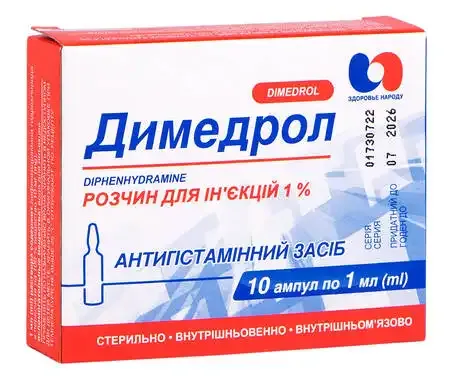
Table of Contents
INSTRUCTIONS FOR MEDICAL USE OF THE MEDICINAL PRODUCT DIMEDROL (DIMEDROL)
Composition:
Active substance: diphenhydramine;
1 ml of solution contains 10 mg of diphenhydramine hydrochloride, calculated as 100% substance;
Excipient: water for injections.
Pharmaceutical form. Injection solution.
Main physicochemical properties: clear, colorless liquid.
Pharmacotherapeutic group.
Antihistamines. ATC code R06AA02.
Pharmacological Properties.
Pharmacodynamics.
A first-generation H1-histamine receptor blocker that counteracts the effects of histamine mediated through this type of receptor. Its action on the central nervous system (CNS) is due to blockade of brain H3-histamine receptors and inhibition of central cholinergic structures. It has pronounced antihistamine activity, reducing or preventing histamine-induced spasms of smooth muscle, increased capillary permeability, tissue edema, itching, and hyperemia. It produces a local anesthetic effect (after oral administration, transient numbness of oral mucosa may occur), blocks ganglionic cholinoreceptors (reducing arterial pressure (AP)) and CNS cholinoreceptors, exerting sedative, hypnotic, anti-parkinsonian, and antiemetic effects. Antagonism with histamine is more pronounced regarding local vascular reactions in inflammation and allergy than regarding systemic effects, such as lowering of arterial pressure. However, in patients with circulating blood volume deficiency, parenteral administration may lead to a decrease in AP and exacerbation of existing hypotension due to ganglionic blockade. In individuals with localized brain damage and epilepsy, it may activate (even at low doses) epileptic discharges on EEG and may provoke epileptic seizures. It is more effective in bronchospasm induced by histamine liberators (e.g., tubocurarine, morphine) and less effective in bronchospasm of allergic origin. Sedative and hypnotic effects are more pronounced with repeated administration.
Pharmacokinetics.
Plasma protein binding is 98–99%. The majority is metabolized in the liver; a smaller portion is excreted unchanged in urine within 24 hours. Elimination half-life (T1/2) is 1–4 hours. It distributes well throughout the body and penetrates the blood-brain barrier.
It is mainly metabolized in the liver via hydroxylation and conjugation to glucuronides; metabolites are eliminated in urine. It is excreted in breast milk and may cause a sedative effect in nursing infants. Maximum activity develops within 1 hour; duration of action is 4 to 6 hours.
Clinical characteristics.
Indications.
Anaphylactic shock, urticaria, hay fever, serum sickness, hemorrhagic vasculitis (capillary toxemia), polymorphic exudative erythema, angioedema (Quincke's edema), pruritic dermatoses, pruritus, allergic conjunctivitis and other allergic eye disorders, allergic reactions associated with medication intake, chorea, Ménière’s disease, postoperative vomiting.
Contraindications.
Hypersensitivity to the drug. Bronchial asthma attack, pheochromocytoma, epilepsy, congenital long QT-interval syndrome or prolonged use of drugs that may prolong the QT interval, closed-angle glaucoma, benign prostatic hyperplasia, stenosing peptic ulcer of the stomach and duodenum, bladder neck obstruction, bradycardia, cardiac arrhythmias. Porphyria.
Interaction with other medicinal products and other forms of interactions.
Diphenhydramine potentiates the effects of anesthetics, hypnotics, sedatives, narcotic analgesics, and local anesthetics. Concomitant use with tricyclic antidepressants may enhance cholinergic blockade and central nervous system depression. Seizures may occur when used together with analeptics. Concurrent use of monoamine oxidase inhibitors (MAO inhibitors) and diphenhydramine may lead to increased arterial pressure, as well as affect the central nervous and respiratory systems. Concomitant use of diphenhydramine with antihypertensive agents may intensify feelings of fatigue. The drug enhances the effects of ethanol and reduces the efficacy of apomorphine as an emetic agent in poisoning treatment. It should not be prescribed together with products containing diphenhydramine, including those intended for topical use.
Special precautions for use.
Not recommended for subcutaneous administration. Since dimenhydramine has atropine-like effects, it should be used with caution in patients with a history of recent respiratory diseases (including asthma), increased intraocular pressure, hyperthyroidism, cardiovascular disorders, or arterial hypotension. It may worsen the course of obstructive lung diseases, severe cardiovascular disorders, ileus, and conditions involving obstruction of the biliary tract. Dimenhydramine may cause drowsiness, as well as lead to excitation, hallucinations, and seizures, particularly in cases of overdose. Use with caution in patients aged 60 years and older due to increased risk of dizziness, sedation, and arterial hypotension.
Use with caution in patients with impaired liver or kidney function.
During treatment with this medicinal product, exposure to UV radiation and alcohol consumption should be avoided. Patients should inform their physician about using this drug, as its antiemetic effect may complicate the diagnosis of appendicitis and recognition of symptoms of overdose with other medicinal products.
Use during pregnancy or breastfeeding.
Dimenhydramine is contraindicated during pregnancy, as there are no adequate data on the safety and efficacy of its use.
If use of the drug is necessary, breastfeeding should be discontinued.
Ability to influence reaction speed when driving or operating machinery.
Since Dimenhydramine has sedative and hypnotic effects, patients should refrain from potentially hazardous activities requiring heightened attention and rapid psychomotor reactions during treatment.
Dosage and Administration.
Administer the drug intramuscularly and intravenously by drip to adults.
Do not administer subcutaneously due to its irritant effect.
For intramuscular administration, the single dose is 10–50 mg (1–5 ml); the maximum single dose is 50 mg (5 ml), and the maximum daily dose is 150 mg (15 ml). For intravenous administration, administer the drug by drip infusion at a dose of 20–50 mg (2–5 ml) in 100 ml of 0.9% sodium chloride solution. The duration of treatment depends on the therapeutic effect achieved and the patient's tolerance to the drug.
Children.
The drug is not intended for use in pediatric practice.
Overdose.
Symptoms: dry mouth, respiratory depression, persistent mydriasis, facial flushing, central nervous system depression or excitation, depression, confusion, hyperkinesis, seizures, delirium, tachycardia, arrhythmia. A case of rhabdomyolysis development after diphenhydramine overdose has been reported.
Treatment: symptomatic and supportive therapy with careful monitoring of respiratory function and arterial pressure. Epinephrine and analeptics must not be used. Intravenous drip infusion of plasma substitutes and oxygen therapy. Physostigmine (0.02–0.06 mg/kg body weight administered intravenously) may be used as an antidote in cases of diphenylhydramine hydrochloride overdose, repeated as necessary if anticholinergic symptoms worsen. In cases of physostigmine overdose, atropine administration is recommended. In the event of seizures or CNS excitation symptoms, diazepam should be administered parenterally.
Adverse Reactions.
Central nervous system and sensory organs: general weakness, fatigue, sedative effect, reduced attention, dizziness, drowsiness, headache, impaired motor coordination, decreased speed of psychomotor reactions, anxiety, increased excitability, fear of death, irritability, nervousness, insomnia, euphoria, confusion, tremor, neuritis, seizures, paresthesia, pupil dilation, increased intraocular pressure, visual disturbances, diplopia, acute labyrinthitis, tinnitus. In patients with focal brain lesions and epilepsy, the drug may trigger (even at low doses) seizure activity on EEG and provoke epileptic seizures.
Cardiovascular system: arterial hypotension, palpitations, tachycardia, extrasystoles.
Blood system: agranulocytosis, thrombocytopenia, hemolytic anemia.
Gastrointestinal tract: dry mouth, transient numbness of the oral mucosa, anorexia, nausea, epigastric pain, vomiting, diarrhea, constipation.
Urinary and reproductive system: frequent and/or difficult urination, urinary retention, early menstruation.
Respiratory system: dryness of nasal and pharyngeal mucosa, nasal congestion, bronchial secretion thickening, chest tightness, labored breathing, dyspnea.
Skin and its derivatives: hyperemia, pruritus, polymorphic skin rashes, cyanosis of skin and mucous membranes.
Allergic reactions: rash, urticaria, anaphylactic shock.
Local reactions at the injection site: local necrosis following subcutaneous or intradermal administration.
Other: increased sweating, chills, fever, hyperthermic syndrome, photosensitization.
Shelf life.
4 years.
Storage conditions.
Store in original packaging at a temperature not exceeding 25 °C.
Keep out of reach of children.
Incompatibility.
Do not mix with other medicinal products in the same container.
Use only the recommended solvent.
Packaging.
1 ml in an ampoule; 10 ampoules per box;
5 ampoules in a blister pack; 2 blisters per box;
10 ampoules in a blister pack; 1 blister per box.
Prescription status.
Prescription only.
Manufacturer.
Limited Liability Company "Kharkiv Pharmaceutical Enterprise "Zdorovya Narodu".
LIMITED LIABILITY COMPANY "CORPORATION "ZDOROVYA".
Manufacturer's address and location of business activity.
Ukraine, 61002, Kharkiv region, city of Kharkiv, Kulikovska Street, 41.
(Limited Liability Company "Kharkiv Pharmaceutical Enterprise "Zdorovya Narodu")
Ukraine, 61013, Kharkiv region, city of Kharkiv, Shevchenka Street, 22.
(LIMITED LIABILITY COMPANY "CORPORATION "ZDOROVYA")