Diclofenac-zdorovya ultra
Ukraine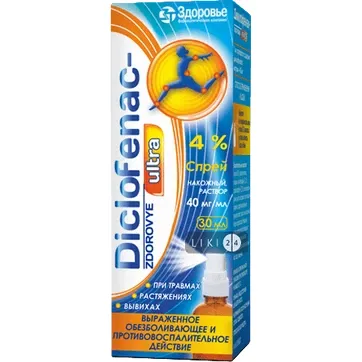
Instructions for Use
INSTRUCTIONS FOR MEDICAL USE OF THE MEDICINAL PRODUCT DICLOFENAC-ZDOROV'YE ULTRA (DICLOFENAC-ZDOROVYE ULTRA)
Composition:
Active substance: diclofenac;
1 ml of the preparation contains 40 mg of sodium diclofenac;
Excipients: 96% ethanol; propylene glycol; glycerin; methylparaben (E 218); propylparaben (E 216); methylpyrrolidone; hydrogenated polyethoxylated castor oil; peppermint oil; disodium edetate; anhydrous sodium hydrogen phosphate; anhydrous sodium dihydrogen phosphate; sodium hydroxide or concentrated hydrochloric acid; purified water.
Pharmaceutical form. Topical spray, solution.
Main physicochemical characteristics: clear solution from light yellow to yellow in color with a specific odor.
Pharmacotherapeutic group. Agents used locally for joint and muscle pain. Non-steroidal anti-inflammatory agents for topical use. Diclofenac.
ATC code M02A A15.
Pharmacological properties.
Pharmacodynamics. Diclofenac is a non-steroidal anti-inflammatory drug (NSAID) with pronounced anti-rheumatic, analgesic, anti-inflammatory, and antipyretic effects. The main mechanism of action is inhibition of prostaglandin biosynthesis.
In inflammation caused by injuries or rheumatic diseases, the drug reduces pain, tissue swelling, and shortens the recovery period of impaired functions of joints, ligaments, tendons, and muscles. The drug reduces acute pain within 1 hour after the initial application. Due to its water-alcohol base, the drug also produces a local anesthetic and cooling effect.
Pharmacokinetics. The amount of diclofenac absorbed through the skin is proportional to the application area and depends on both the total applied dose of the drug and the degree of skin hydration.
After application of 1.5 g of the drug to the skin, rapid onset of diclofenac absorption can be observed, leading to measurable plasma levels of approximately 1 ng/mL within 30 minutes, and reaching maximum levels of about 3 ng/mL approximately 24 hours after application.
Systemic concentrations of diclofenac achieved are approximately 50 times lower than those achieved after oral administration of equivalent amounts of diclofenac.
Diclofenac is highly bound to plasma proteins (approximately 99%).
In renal or hepatic insufficiency, metabolism and elimination of diclofenac from the body remain unchanged.
Clinical characteristics.
Indications. Local treatment of pain and inflammation of joints, muscles, ligaments, and tendons of rheumatic or traumatic origin.
Contraindications. Hypersensitivity to diclofenac or to other components of the drug. History of asthma attacks, urticaria, or acute rhinitis induced by acetylsalicylic acid or other NSAIDs; third trimester of pregnancy.
Interaction with other medicinal products and other forms of interaction. Since systemic absorption of diclofenac after topical application of the drug is very low, the occurrence of interactions is unlikely.
Special precautions for use.
The medication should be used externally only.
Avoid contact of the medication with the eyes and other mucous membranes. The medication must not be taken orally. It is recommended to apply the medication only to intact areas of skin, avoiding application to damaged or infected skin and open wounds. The patient should avoid direct sunlight exposure to the treated skin area in order to minimize the risk of photosensitivity. If a rash develops after application, treatment should be discontinued.
Use with caution in combination with other oral NSAIDs, as the frequency of systemic adverse reactions may increase.
When applying the medication to relatively large areas (e.g., over 600 cm² of body surface) or for prolonged periods (over 3 weeks), the possibility of systemic adverse effects cannot be ruled out. For example, there is a potential for hypersensitivity, asthmatic, or renal adverse reactions. The medication should not be used under airtight occlusive dressings; however, application under non-occlusive dressings is permitted.
Use with caution in patients with peptic ulcer, hepatic or renal insufficiency, hemorrhagic diathesis, or inflammatory bowel disease.
The medication contains propylene glycol, which may cause skin irritation.
The medication contains methylparaben (E 218) and propylparaben (E 216), which may cause allergic reactions (possibly delayed).
The medication contains polyoxylated hydrogenated castor oil, which may cause skin reactions.
Use during pregnancy or breastfeeding. There are no clinical data on the use of diclofenac during pregnancy. Even though systemic effects are lower compared to oral administration, it is unknown whether the systemic exposure to diclofenac achieved after topical application could be harmful to the embryo/fetus. During the first and second trimesters of pregnancy, diclofenac should not be used unless clearly necessary. If used, the dose should be as low as possible and the duration of treatment as short as possible.
During the third trimester of pregnancy, systemic use of prostaglandin synthesis inhibitors, including diclofenac, may cause cardiopulmonary and renal toxicity in the fetus. At late stages of pregnancy, prolonged bleeding may occur in both mother and child, and labor may be delayed. Therefore, diclofenac is contraindicated during the last trimester of pregnancy (see section "Contraindications").
In animal studies, no evidence of harmful effects of the drug on pregnancy or embryonic development, parturition, or postnatal development of the offspring has been observed.
If there are strong medical reasons for using the medication during breastfeeding, and the expected benefit outweighs the potential risk, the medication should not be applied to the breasts or large skin areas and should not be used for prolonged periods.
Effect on ability to drive vehicles or operate machinery. No effect.
Method of Administration and Dosage.
The required amount of the medicinal product should be applied to the skin at the affected site. Depending on the size of the area, treat the skin surface by 2–3 actuations of the spray (0.8–1.2 mL of spray containing 32–48 mg of diclofenac sodium). The product should be applied 3 times daily at equal intervals. The single dose should not exceed 1.2 mL (3 actuations) of the product. The maximum daily dose is 9 actuations (3.6 mL of spray containing 144 mg of diclofenac sodium).
The product should be gently rubbed into the skin. Afterwards, hands should be thoroughly washed, except when they are the site being treated.
When symptoms (pain and swelling) have subsided, treatment may be discontinued. Treatment should not be continued for longer than 7 days without consulting a physician. If no improvement is observed after 3 days of treatment, a physician should be consulted.
Children. The product is not recommended for use in children under 14 years of age. When used in children aged 14 years and older for longer than 7 days, or if symptoms worsen, medical advice should be sought.
Overdose. Overdose is unlikely due to the low systemic absorption of diclofenac following topical application. However, in case of accidental ingestion, the potential for systemic adverse reactions should be considered.
In case of accidental ingestion, the stomach should be emptied immediately and an adsorbent administered. Symptomatic treatment should be provided, using therapeutic measures appropriate for NSAID poisoning.
Side effects.
The product is generally well tolerated. Adverse reactions include mild, transient skin reactions at the site of application. Allergic reactions may occur rarely.
Infections and infestations: pustular rashes.
Immune system disorders: hypersensitivity reactions, angioedema.
Respiratory system disorders: bronchial asthma.
Skin and connective tissue disorders: rash, urticaria, eczema, erythema, dermatitis (including contact, bullous), photosensitivity reactions, skin burning sensation, pruritus.
Shelf life. 2 years.
Storage conditions. Store in the original packaging at a temperature not exceeding 25 °C.
Keep out of reach of children.
Packaging. 30 ml or 50 ml in bottles equipped with a pump dispenser, spray nozzle, and protective cap in a box.
Supply category. Over-the-counter.
Manufacturer. LIMITED LIABILITY COMPANY "CORPORATION "ZDOROVYA".
Manufacturer's address and place of business. 22, Shevchenka Street, Kharkiv, Kharkiv region, 61013, Ukraine.
Frequently Asked Questions
What is Diclofenac-zdorovya ultra prescribed for?
The drug is used for the topical treatment of pain and inflammation of joints, muscles, ligaments, and tendons resulting from injuries or rheumatic diseases.
How should Diclofenac-zdorovya ultra be used correctly?
The spray should be applied to the affected area of the skin (usually 2–3 sprays) and rubbed in gently. The drug should be used 3 times a day at regular intervals. Do not apply the product to broken, infected skin or open wounds.
What is the maximum dose of the drug?
A single dose of 1.2 ml (3 sprays) should not be exceeded. The maximum daily dose is 3.6 ml (9 sprays).
Who should not use this product?
The drug is contraindicated in case of hypersensitivity to the components, a history of asthma, urticaria, or rhinitis caused by NSAIDs, as well as during the third trimester of pregnancy. The drug is not recommended for children under 14 years of age.
What are the possible side effects of Diclofenac-zdorovya ultra?
Mild, temporary skin reactions are most commonly observed. In rare cases, rashes, itching, burning, eczema, dermatitis, as well as allergic reactions (swelling, urticaria) or manifestations of asthma may occur.
Can this spray be combined with other medicines?
Be cautious if you are taking other anti-inflammatory drugs (NSAIDs) in tablet or capsule form, as this may increase side effects. Interaction during topical application is generally unlikely.
Should sun exposure be avoided during treatment?
Yes, direct sunlight should be prevented from reaching the area of the skin where the product has been applied to reduce the risk of photosensitivity.
Similar Medications
-
Argette spray
Form: spray, topical solution
Active substance Dosage diclofenac 40 mg/g Manufacturer: Farbil Waltrup GmbH
This page has been machine-translated and may contain inaccuracies. The original data is available in the manufacturing country's language.
Last data check: July 21, 2026 · Data source: Державний реєстр лікарських засобів України