Argette spray
Ukraine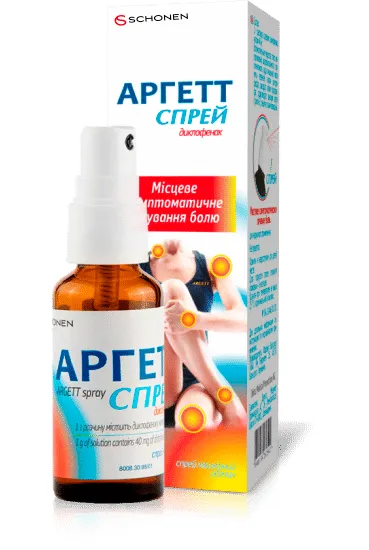
Table of Contents
INSTRUCTIONS FOR MEDICAL USE OF THE MEDICINAL PRODUCT ARGETT SPRAY (ARGETT spray)
Composition:
Active ingredient: diclofenac sodium;
1 g of solution contains 40 mg of sodium diclofenac;
Excipients: isopropyl alcohol; ascorbyl palmitate; propylene glycol; purified water; peppermint oil; sodium dihydrogen phosphate dihydrate; disodium hydrogen phosphate dodecahydrate; disodium edetate (EDTA); lecithin; anhydrous ethanol.
Pharmaceutical form. Topical spray, solution.
Main physicochemical properties: clear golden-yellow solution with the odor of isopropyl alcohol and peppermint.
Pharmacotherapeutic group. Agents used locally for joint and muscle pain. Topical non-steroidal anti-inflammatory agents. Diclofenac. ATC code M02A A15.
Pharmacological Properties.
Pharmacodynamics.
Sodium diclofenac is a non-steroidal anti-inflammatory drug (NSAID) that has analgesic, anti-inflammatory, and antipyretic effects. The mechanism of action is believed to be primarily due to inhibition of prostaglandin synthesis.
Pharmacokinetics.
After application to the skin of 1.5 g of ARGETTE spray, rapid absorption of diclofenac begins, leading to measurable plasma levels of approximately 1 ng/mL as early as 30 minutes, reaching maximum levels of approximately 3 ng/mL at about 24 hours after application.
Systemic concentrations of diclofenac achieved are approximately 50 times lower than those achieved after oral administration of equivalent doses of diclofenac.
Diclofenac is highly bound to plasma proteins (approximately 99%).
Clinical characteristics.
Indications.
Local symptomatic treatment of pain and inflammatory processes resulting from injuries of joints and periarticular tissues.
Contraindications.
- Hypersensitivity to the active substance, peanut, soy, or to any of the excipients of the drug.
- Increased sensitivity to acetylsalicylic acid or to other nonsteroidal anti-inflammatory drugs (NSAIDs).
- History of bronchial asthma attacks, urticaria, or acute rhinitis induced by intake of acetylsalicy游戏副本
Special precautions for use
ARGETT spray should be used externally only.
Care should be taken to avoid contact of the product with the eyes and other mucous membranes. The product must not be taken orally. The product is recommended to be applied only to intact skin areas, avoiding application to damaged or infected skin and open wounds. The patient should avoid direct sunlight exposure to the treated skin area in order to reduce the risk of photosensitivity. If a rash develops after application, treatment should be discontinued.
ARGETT spray should be used with caution in combination with other oral NSAIDs, as the frequency of systemic adverse effects may increase.
If ARGETT spray is applied to relatively large areas (e.g., over 600 cm² of body surface) or for prolonged periods (i.e., longer than 3 weeks), the possibility of systemic adverse effects cannot be excluded. For example, there is a potential for hypersensitivity, asthmatic, or renal adverse reactions.
ARGETT spray should be used cautiously in patients with peptic ulcer, hepatic or renal impairment, hemorrhagic diathesis, or inflammatory bowel disease, as described in individual cases with topical diclofenac use.
ARGETT spray contains propylene glycol, which may cause mild local skin irritation in some patients.
ARGETT spray contains peppermint oil, which may cause allergic reactions.
Use during pregnancy or breastfeeding
There are inadequate data on the use of ARGETT spray in pregnant and breastfeeding women.
Animal studies have demonstrated reproductive toxicity. However, there is no evidence of diclofenac causing developmental abnormalities. The potential risk to humans is unknown.
Pregnancy
Clinical data on the use of ARGETT spray during pregnancy are lacking. Even though systemic exposure is lower compared to oral administration, it is unknown whether the systemic effect of ARGETT spray achieved after topical application could be harmful to the embryo/fetus. During the first and second trimesters of pregnancy, ARGETT spray should not be used unless clearly necessary. If used, the dose should be as low as possible and the duration of treatment as short as possible.
During the third trimester of pregnancy, systemic use of prostaglandin synthesis inhibitors, including ARGETT spray, may cause cardiopulmonary and renal toxicity in the fetus. At late stages of pregnancy, prolonged bleeding may occur in both the mother and the fetus, and labor may be delayed. Therefore, ARGETT spray is contraindicated during the last trimester of pregnancy (see section "Contraindications").
Breastfeeding period
There is no reason to assume that any measurable amount of diclofenac passes into breast milk after topical application. However, since NSAIDs are excreted in breast milk, ARGETT spray is not recommended for use in breastfeeding women. Application of the product to the area of the mammary glands during lactation is contraindicated.
Ability to influence the speed of reactions while driving or operating machinery
Patients who experience dizziness or other central nervous system disturbances while taking NSAIDs should refrain from driving or operating machinery. However, such symptoms are highly unlikely with topical preparations.
Method of Administration and Dosage
Apply the required amount of ARGETT spray to the skin at the affected site. Depending on the size of the area, treat the skin surface by 4–5 actuations of the bottle (0.8–1 g of spray containing 32–40 mg of diclofenac sodium). The medication should be applied 3 times daily at regular intervals. The single maximum dose of 1 g (5 actuations) of the spray should not be exceeded. The maximum daily dose is 15 actuations (3 g of spray containing 120 mg of diclofenac sodium).
ARGETT spray should be gently rubbed into the skin. Afterwards, hands should be thoroughly washed, except when the hands themselves are the treated area.
When symptoms (pain and swelling) have subsided, treatment may be discontinued. Do not continue treatment for longer than 7 days without consulting a physician. If no improvement is observed after 3 days of treatment, consult a doctor.
Children
There is insufficient documented evidence regarding the efficacy and safety of use in children and adolescents under 14 years of age.
If children aged 14 years and older require treatment for longer than 7 days for pain relief, or if symptoms worsen, medical advice should be sought.
Overdose
When used at the recommended dose, the risk of overdose is practically nonexistent. In case of accidental oral ingestion of ARGETT spray, symptomatic treatment should be administered.
Adverse Reactions
The following frequency categories are used to assess adverse reactions:
Very common (≥ 1/10); common (from ≥ 1/100 to < 1/10); uncommon (from ≥ 1/1000 to < 1/100); rare (from ≥ 1/10,000 to < 1/1000); very rare (< 1/10,000); frequency not known (cannot be estimated from the available data).
Skin and subcutaneous tissue disorders:
Uncommon – mild and transient skin reactions at the application site, pruritus, dryness, hyperemia, burning sensation, contact dermatitis (e.g., localized skin rash, pruritus, erythema, papules);
Rare – generalized skin reactions, urticaria, angioedema, photosensitization;
Very rare – bullous dermatitis.
Gastrointestinal disorders:
Abdominal pain, dyspepsia, gastrointestinal disturbances may occur.
Respiratory system disorders:
Rare – bronchospasm;
Very rare – bronchial asthma.
Immune system disorders:
Very rare – allergic reactions.
Adverse effects can be minimized by using the lowest effective dose for the shortest possible duration of treatment. However, during prolonged treatment and/or when treating large areas (i.e., more than 600 cm²), systemic adverse effects are possible.
Shelf life. 3 years.
Shelf life after opening the packaging – 6 months.
Storage conditions.
Store at temperatures not exceeding 25 °C in the original packaging. Keep out of the reach of children.
Packaging.
12.5 g or 25 g in a bottle with a dosing device and protective cap; 1 bottle per cardboard box.
Availability classification. Over-the-counter (without prescription).
Manufacturer.
Pharbil Waltrop GmbH.
Manufacturer's address.
Im Wirrigen 25, 45731 Waltrop, Germany.
Marketing Authorization Holder.
Delta Medical Promotions AG.
Address of the Marketing Authorization Holder.
26 Oetenbachgasse, Zurich CH-8001, Switzerland.