Dutasteride
Ukraine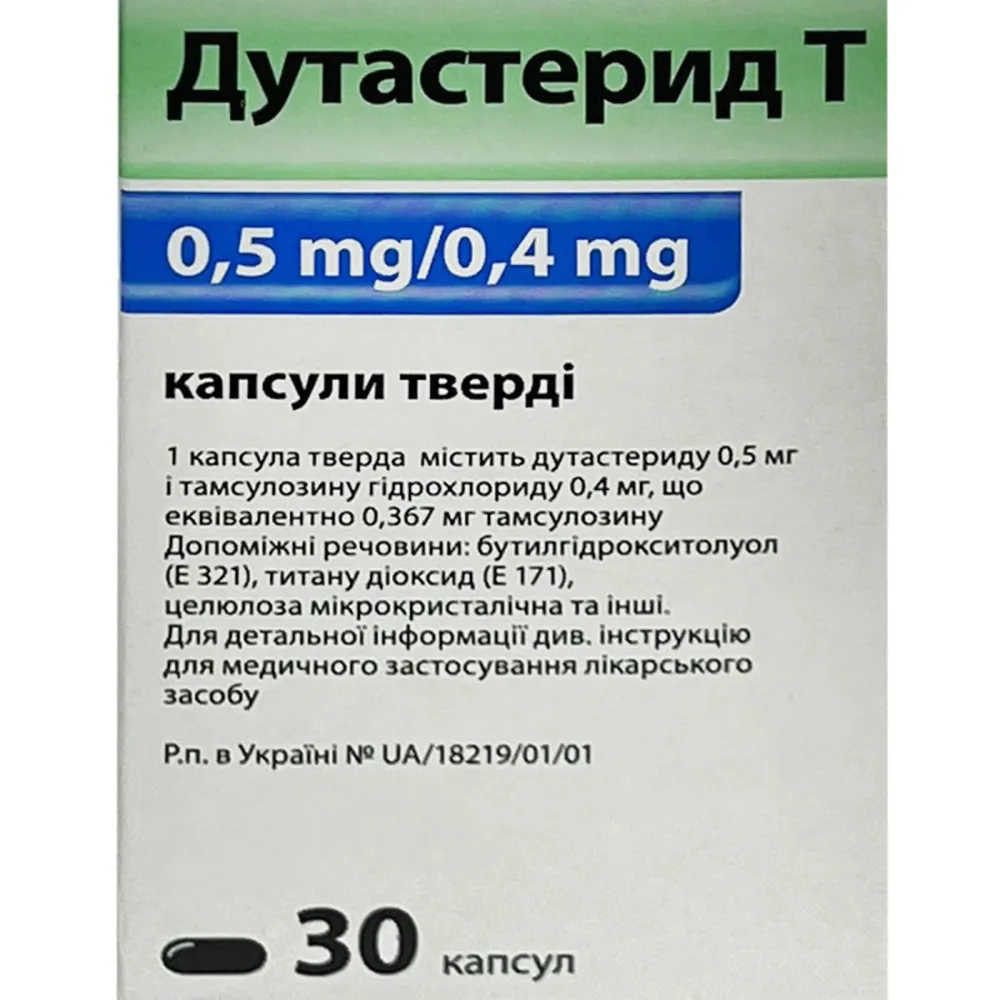
Table of Contents
INSTRUCTIONS FOR MEDICAL USE OF THE MEDICINAL PRODUCT DUTASTERID T (DUTASTERID T)
Composition:
Active substances: dutasteride, tamsulosin hydrochloride;
1 hard capsule contains 0.5 mg of dutasteride, 0.4 mg of tamsulosin hydrochloride, equivalent to 0.367 mg of tamsulosin;
Excipients:
Soft gelatin capsule shell: propylene glycol monocaprylate type II, butylhydroxytoluene (E 321), gelatin (gelling type B, 150 Bloom), glycerol, titanium dioxide (E 171), medium-chain triglycerides, soy lecithin;
Modified release granules: methacrylic acid – ethyl acrylate copolymer (1:1), 30% dispersion (sodium lauryl sulfate 0.7%, polysorbate 80 2.3%), microcrystalline cellulose, dibutyl sebacate, polysorbate 80, colloidal anhydrous silica, calcium stearate;
Hard gelatin capsule: iron oxide black (E 172), iron oxide red (E 172), titanium dioxide (E 171), iron oxide yellow (E 172), gelatin;
Ink composition (for printing): black ink containing shellac (E 904), iron oxide black (E 172), propylene glycol (E 1520), ammonium hydroxide, concentrated (E 527), potassium hydroxide (E 525).
Pharmaceutical form. Hard capsules.
Main physicochemical properties: elongated hard gelatin capsule size № 0EL, approximately 24.2 × 7.7 mm, capsule body brown in color, cap beige with "C001" printed in black ink. Capsule contents: an elongated soft gelatin capsule (approximately 16.5 × 6.5 mm), light yellow in color, filled with a clear liquid; granules of tamsulosin, white to almost white in color.
Pharmacotherapeutic group.
Agents used in benign prostatic hyperplasia. α1-adrenoreceptor antagonist. ATC code G04CA52.
Pharmacological Properties
Pharmacodynamics
Dutasteride T is a combination of two medicinal agents: dutasteride, a dual inhibitor of 5α-reductase, and tamsulosin hydrochloride, an α1a and α1d adrenoceptor antagonist. These agents have complementary mechanisms of action, resulting in rapid relief of urinary symptoms, reduced risk of acute urinary retention, and decreased need for surgical intervention due to benign prostatic hyperplasia (BPH).
Dutasteride
Dutasteride inhibits the activity of both type 1 and type 2 isoenzymes of 5α-reductase, which are responsible for converting testosterone into dihydrotestosterone (DHT). DHT is an androgen primarily responsible for prostate growth and the development of benign prostatic hyperplasia.
Tamsulosin
Tamsulosin inhibits α1a and α1d adrenoceptor activity in the stromal smooth muscle of the prostate and bladder neck. Approximately 75% of α1 receptors in the prostate are of the α1a subtype. Tamsulosin selectively and competitively binds to postsynaptic α1-adrenoceptors, particularly the α1a and α1d subtypes, leading to relaxation of smooth muscles in the prostate and urethra.
Tamsulosin increases the maximum urinary flow rate by reducing smooth muscle tone in the urethra and prostate, thereby relieving obstruction. The drug also reduces the severity of irritative and obstructive symptoms, in which urinary urgency and contractions of the lower urinary tract smooth muscles play a significant role. This effect is achieved during long-term therapy. The need for surgical intervention or catheterization is significantly reduced.
α1-Adrenoceptor antagonists may reduce blood pressure by decreasing total peripheral resistance. However, in clinical studies with tamsulosin, no clinically significant reduction in blood pressure was observed.
Dutasteride in combination with tamsulosin
Clinical trials have demonstrated superior efficacy of combined therapy using the 5α-reductase inhibitor dutasteride and the α1-adrenoceptor blocker tamsulosin, compared to monotherapy with either agent alone.
Pharmacokinetics
Administration of the dutasteride-tamsulosin combination and concomitant administration of dutasteride and tamsulosin in separate capsules at corresponding doses demonstrated bioequivalence.
Bioequivalence studies of single doses were conducted under both fasting conditions and after food intake. Compared to fasting, administration after food resulted in a 30% reduction in the maximum concentration (Cmax) of tamsulosin as part of the dutasteride-tamsulosin combination. Food did not affect the area under the pharmacokinetic curve (AUC) of tamsulosin.
Absorption
Dutasteride
After a single oral dose of 0.5 mg dutasteride, the time to reach peak serum concentrations was 1–3 hours. Absolute bioavailability was approximately 60%. Food intake did not affect the bioequivalence of dutasteride.
Tamsulosin
Tamsulosin is absorbed from the intestine and is almost completely bioavailable. Both the rate and extent of tamsulosin absorption are reduced when administered within 30 minutes after a meal. Consistent absorption is ensured by taking the drug at the same time each day after a similar meal. Plasma concentrations of tamsulosin are dose-proportional.
After a single dose of tamsulosin taken after food, peak plasma concentrations are reached approximately 6 hours later. Steady-state concentrations are achieved by day 5 of repeated dosing. The average steady-state concentration in patients is approximately two-thirds higher than after a single dose. Although this phenomenon was observed in elderly patients, similar results are expected in younger patients.
Distribution
Dutasteride
Dutasteride has a large volume of distribution (300–500 L) and high plasma protein binding (>99.5%). After daily dosing, dutasteride serum concentrations reach 65% of steady-state levels within 1 month and approximately 90% within 3 months.
Steady-state serum concentrations of approximately 40 ng/mL are achieved after 6 months of 0.5 mg daily dosing. The mean transfer rate of dutasteride from serum into seminal fluid is 11.5%.
Tamsulosin
In men, tamsulosin is approximately 99% bound to plasma proteins. The volume of distribution is small (approximately 0.2 L/kg).
Metabolism
Dutasteride
Dutasteride is actively metabolized in vivo. In vitro, dutasteride is metabolized by cytochrome P450 3A4 and 3A5, forming three monohydroxylated metabolites and one dihydroxylated metabolite.
After oral administration of 0.5 mg/day dutasteride to steady-state, 1.0–15.4% (mean 5.4%) of the administered dose is excreted unchanged in feces. The remainder is excreted in feces as four major metabolites, accounting for 39%, 21%, 7%, and 7% of drug-related substances, respectively, and six minor metabolites (each <5%). Only negligible amounts of unchanged dutasteride (<0.1% of dose) are found in human urine.
Tamsulosin
Enantiomeric bioconversion of tamsulosin hydrochloride [R(-) isomer] to the S(+) isomer does not occur in humans. Tamsulosin hydrochloride is extensively metabolized by hepatic cytochrome P450 enzymes, with less than 10% of the dose excreted unchanged in urine. However, the pharmacokinetic profile of metabolites in humans has not been established. In vitro studies indicate that CYP3A4 and CYP2D6 are involved in tamsulosin metabolism, with minor contributions from other CYP isoenzymes.
Inhibition of enzymes involved in hepatic metabolism may lead to enhanced tamsulosin effects. Before excretion in urine, tamsulosin hydrochloride metabolites undergo extensive conjugation with glucuronide or sulfate.
Elimination
Dutasteride
Dutasteride elimination is dose-dependent and follows two parallel pathways: one saturable at clinically relevant concentrations and the other nonsaturable. At low serum concentrations (<3 ng/mL), dutasteride is rapidly eliminated via both concentration-dependent and independent pathways. After single doses of 5 mg or lower, signs of rapid clearance were observed, with elimination half-life ranging from 3 to 9 days.
At therapeutic concentrations following repeated 0.5 mg/day dosing, the slower, linear elimination pathway predominates, with an elimination half-life of approximately 3–5 weeks.
Tamsulosin
Tamsulosin and its metabolites are primarily excreted in urine, with approximately 9% of the dose present as unchanged active substance.
After intravenous or oral administration of immediate-release formulations, the plasma elimination half-life of tamsulosin ranges from 5 to 7 hours. Due to absorption-rate-limited pharmacokinetics, when tamsulosin is administered in modified-release capsules after food, the apparent elimination half-life is approximately 10 hours, and at steady-state in patients, approximately 13 hours.
Elderly Patients
Dutasteride
Dutasteride pharmacokinetics were evaluated in 36 healthy men aged 24 to 87 years after a single 5 mg dose. No significant age-related effect on dutasteride was observed, although the elimination half-life was shorter in men under 50 years of age. No statistically significant differences in elimination half-life were observed when comparing subjects aged 50–69 years with those over 70 years.
Tamsulosin
Cross-comparative studies of total tamsulosin hydrochloride exposure (AUC) and elimination half-life suggest that the pharmacokinetic effect of tamsulosin hydrochloride may be slightly prolonged in elderly patients compared to younger healthy male volunteers. Intrinsic clearance is not dependent on tamsulosin hydrochloride binding to α1-acid glycoprotein but decreases with age, resulting in a 40% greater overall exposure (AUC) in patients aged 55–75 years compared to those aged 20–32 years.
Renal Impairment
Dutasteride
The effect of renal impairment on dutasteride pharmacokinetics has not been studied. However, less than 0.1% of a 0.5 mg dose of dutasteride is excreted in urine at steady-state, so clinically significant increases in plasma dutasteride concentrations in patients with renal impairment are not expected (see section "Dosage and Administration").
Tamsulosin
Tamsulosin hydrochloride pharmacokinetics were compared in 6 patients with mild to moderate (30 ≤ creatinine clearance (CrCl) < 70 mL/min/1.73 m²) or moderate to severe (10 ≤ CrCl < 30 mL/min/1.73 m²) renal impairment and 6 subjects with normal clearance (CrCl < 90 mL/min/1.73 m²). While total plasma concentrations of tamsulosin hydrochloride varied due to altered binding to α1-acid glycoprotein, the concentration of unbound (active) tamsulosin hydrochloride and intrinsic clearance remained relatively stable. Therefore, dose adjustment of tamsulosin hydrochloride capsules is not required in patients with renal impairment. However, patients with end-stage renal disease (CrCl < 10 mL/min/1.73 m²) have not been studied.
Hepatic Impairment
Dutasteride
The effect of hepatic impairment on dutasteride pharmacokinetics has not been studied (see section "Contraindications"). Since dutasteride is primarily eliminated via metabolism, plasma dutasteride levels in these patients are expected to be elevated, and the elimination half-life prolonged (see sections "Special Warnings" and "Dosage and Administration").
Tamsulosin
Tamsulosin hydrochloride pharmacokinetics were compared in 8 patients with moderate hepatic impairment (Child-Pugh classification: grades A and B) and 8 subjects with normal liver function. While total plasma concentrations of tamsulosin hydrochloride varied due to altered binding to α1-acid glycoprotein, the concentration of unbound (active) tamsulosin hydrochloride did not change significantly, with only a moderate (32%) change in intrinsic clearance of unbound tamsulosin hydrochloride observed. Therefore, patients with moderate hepatic impairment do not require dose adjustment of tamsulosin hydrochloride. The effect of tamsulosin hydrochloride has not been studied in patients with severe hepatic impairment.
Safety and Clinical Studies
Heart Failure
In a 4-year clinical trial evaluating dutasteride in combination with tamsulosin for the treatment of benign prostatic hyperplasia in 4844 men (CombAT study), the incidence of heart failure (a preferred term) was higher in the combination therapy group (14/1610, 0.9%) than in either monotherapy group receiving dutasteride (4/1623, 0.2%) or tamsulosin (10/1611, 0.6%).
In a separate 4-year placebo-controlled trial of dutasteride for chemoprevention in 8231 men aged 50–75 years with prior negative prostate biopsy and baseline PSA levels between 2.5 ng/mL and 10.0 ng/mL in men aged 50–60 years or 3.0–10.0 ng/mL in men over 60 years (REDUCE study), the incidence of heart failure was higher in patients receiving dutasteride 0.5 mg once daily (30/4105, 0.7%) compared to placebo (16/4126, 0.4%). In a retrospective analysis of this study, a higher incidence of heart failure was observed in patients receiving dutasteride and an alpha-blocker concurrently (12/1152, 1.0%) compared to those receiving dutasteride without an alpha-blocker (18/2953, 0.6%), placebo with an alpha-blocker (1/1399, <0.1%), or placebo without an alpha-blocker (15/2727, 0.6%). A causal relationship between dutasteride use (alone or in combination with alpha-blockers) and heart failure has not been established (see section "Special Warnings").
Prostate Cancer and High-Grade Tumors
In a 4-year study evaluating dutasteride versus placebo in 8231 men aged 50–75 years with prior negative prostate biopsy and baseline PSA levels between 2.5 ng/mL and 10.0 ng/mL in men aged 50–60 years or 3.0–10.0 ng/mL in men over 60 years (REDUCE study), 6706 subjects underwent mandatory core needle prostate biopsy per protocol, with Gleason grading used for tumor differentiation analysis. A total of 1517 patients were diagnosed with prostate cancer. Most prostate tumors (70%) detected by biopsy in both treatment groups were well-differentiated (Gleason score 5–6).
A higher incidence of high-grade prostate cancer (Gleason score 8–10) was observed in the dutasteride group (n=29, 0.9%) compared to placebo (n=19, 0.6%) (p=0.15). During the first 2 years, the number of patients with Gleason score 8–10 prostate cancer was similar in the dutasteride (n=17, 0.5%) and placebo (n=18, 0.5%) groups. From years 3 to 4, more cases of Gleason score 8–10 prostate cancer were diagnosed in the dutasteride group (n=12, 0.5%) compared to placebo (n=1, <0.1%) (p=0.0035). There are no data on prostate cancer risk beyond 4 years of dutasteride use. The percentage of patients with Gleason score 8–10 prostate cancer remained constant over time (years 1–2 and 3–4) in the dutasteride group (0.5% in each period), whereas in the placebo group, the percentage of high-grade prostate cancer was lower in years 3–4 than in years 1–2 (<0.1% vs. 0.5%, respectively) (see section "Special Warnings"). There was no difference in the incidence of Gleason score 7–10 prostate cancer (p=0.81).
In a 4-year clinical trial of BPH treatment (CombAT), where mandatory biopsy was not required by protocol and all prostate cancer diagnoses were biopsy-confirmed based on clinical indications, the incidence of Gleason score 8–10 prostate cancer was 0.5% (n=8) in the dutasteride group, 0.7% (n=11) in the tamsulosin group, and 0.3% (n=5) in the combination therapy group.
The relationship between dutasteride use and the occurrence of high-grade prostate cancer remains unclear.
Breast Cancer in Men
Two case-control epidemiological studies—one conducted in the USA (n=339 breast cancer cases and n=6780 controls) and another in the UK (n=398 breast cancer cases and n=3930 controls) using healthcare databases—did not show an increased risk of male breast cancer with 5α-reductase inhibitor use. The first study found no positive association with breast cancer (relative risk for ≥1 year of use before diagnosis vs. <1 year: 0.70; 95% CI 0.34, 1.45). The second study reported a relative risk of 1.08 (95% CI 0.62, 1.87) for breast cancer associated with 5α-reductase inhibitor use compared to non-use.
A causal relationship between male breast cancer and long-term dutasteride use has not been established.
Clinical characteristics.
Indications.
The medicinal product is indicated for patients in whom administration of its individual components − tamsulosin and dutasteride at appropriate doses − has been effective in the treatment of moderate to severe symptoms of benign prostatic hyperplasia.
Treatment of moderate to severe symptoms of benign prostatic hyperplasia.
Reduction of the risk of developing acute urinary retention and the need for surgical intervention in patients with moderate to severe symptoms of benign prostatic hyperplasia.
Contraindications.
The medicinal product is contraindicated:
- for treatment of women and children (see section "Use during pregnancy or breastfeeding");
- in patients with hypersensitivity to dutasteride, other 5α-reductase inhibitors, tamsulosin (including tamsulosin-induced angioneurotic edema), other components of the medicinal product, or to soy and peanuts;
- in patients with a history of orthostatic hypotension;
- in patients with severe hepatic impairment.
Interaction with other medicinal products and other forms of interaction.
Available information on interactions is provided for the active substances of the medicinal product separately.
Dutasteride
For information on the reduction of serum prostate-specific antigen (PSA) levels during treatment with dutasteride and recommendations regarding detection of prostate cancer, see section "Special precautions for use".
Effect of other medicinal products on the pharmacokinetics of dutasteride
Concomitant use with CYP3A4 and/or P-glycoprotein inhibitors
Dutasteride is primarily eliminated via metabolism. In vitro studies indicate that CYP3A4 and CYP3A5 are the main catalysts of its metabolism. Formal interaction studies with potent CYP3A4 inhibitors have not been conducted. However, in a population pharmacokinetic study, serum concentrations of dutasteride were on average 1.6–1.8 times higher in a small number of patients who were concurrently treated with verapamil or diltiazem (moderate CYP3A4 inhibitors and P-glycoprotein inhibitors) compared to other patients.
With long-term concomitant use of dutasteride and medicinal products that are potent inhibitors of the CYP3A4 enzyme (such as ritonavir, indinavir, nefazodone, itraconazole, ketoconazole administered orally), serum concentrations of dutasteride may increase. Further inhibition of 5α-reductase due to enhanced effect of dutasteride is unlikely. However, dose reduction of dutasteride may be considered if adverse effects are observed. It should be noted that in case of enzyme inhibition over a prolonged period, the long half-life may become even longer, and concomitant therapy may need to continue for more than 6 months before a new steady-state concentration is achieved.
Administration of 12 g of cholestyramine one hour after a single 5 mg dose of dutasteride did not affect the pharmacokinetics of dutasteride.
Effect of dutasteride on the pharmacokinetics of other medicinal products
In a small (N=24), two-week study involving healthy men, dutasteride (0.5 mg daily) did not affect the pharmacokinetics of tamsulosin or terazosin. No evidence of pharmacodynamic interaction was observed in this study.
Dutasteride does not affect the pharmacokinetics of warfarin or digoxin. This indicates that dutasteride does not inhibit or induce the activity of the CYP2C9 enzyme or the P-glycoprotein transporter. In vitro interaction studies data indicate that dutasteride does not inhibit the enzymes CYP1A2, CYP2D6, CYP2C9, CYP2C19, or CYP3A4.
Tamsulosin
Concomitant administration of tamsulosin hydrochloride with medicinal products that may lower blood pressure, including analgesics, phosphodiesterase-5 inhibitors, and other alpha-1-adrenergic blockers, may theoretically lead to enhanced hypotensive effects. Dutasteride T should not be used in combination with other alpha-1-adrenergic blockers.
Concomitant use of tamsulosin hydrochloride and ketoconazole (a potent CYP3A4 inhibitor) increases the Cmax and AUC of tamsulosin hydrochloride by 2.2 and 2.8 times, respectively.
Concomitant use of tamsulosin hydrochloride and paroxetine (a potent CYP2D6 inhibitor) increases the Cmax and AUC of tamsulosin hydrochloride by 1.3 and 1.6 times, respectively. A similar increase is expected in patients with poor CYP2D6 metabolism compared to those with extensive metabolism when tamsulosin is used concomitantly with potent CYP3A4 inhibitors.
The clinical effect of concomitant use of both CYP3A4 and CYP2D6 inhibitors with tamsulosin has not been clinically studied, but may potentially lead to a significant increase in tamsulosin concentration (see section "Special precautions for use").
Concomitant administration of tamsulosin hydrochloride (0.4 mg) and cimetidine (400 mg every 6 hours for 6 days) resulted in a 26% decrease in clearance and a 44% increase in AUC (area under the pharmacokinetic curve) of tamsulosin hydrochloride. Dutasteride T should be used with caution in combination with cimetidine.
A comprehensive investigation of the interaction between tamsulosin hydrochloride and warfarin has not been conducted. Results from limited in vitro and in vivo studies are insufficient. Concomitant treatment with warfarin and tamsulosin hydrochloride should be performed with caution.
No interaction was observed when tamsulosin hydrochloride was administered concomitantly with atenolol, enalapril, nifedipine, or theophylline. Concomitant use of furosemide leads to reduced serum levels of tamsulosin, but since these levels remain within the normal range, dose adjustment is not required.
In vitro, diazepam, propranolol, trichlormethiazide, cyproterone, amitriptyline, diclofenac, glyburide, or simvastatin did not alter the free fraction of tamsulosin in human plasma. Tamsulosin also did not alter the free fractions of diazepam, propranolol, trichlormethiazide, or cyproterone.
No interaction at the level of hepatic metabolism was observed during in vitro studies using liver microsomal fractions (the cytochrome P450 enzyme system involved in drug metabolism) with amitriptyline, salbutamol, and glyburide. However, diclofenac may increase the elimination rate of tamsulosin.
Special precautions for use
Combination therapy should be prescribed only after careful analysis of the benefit-risk ratio due to the potential increased risk of adverse reactions (including heart failure) and consideration of alternative treatment options, including monotherapy.
Cardiovascular adverse reactions
Data from two 4-year clinical trials showed a higher incidence of heart failure (a combined term for all reported events, primarily heart failure and congestive heart failure) in subjects treated with a combination of dutasteride and an alpha-blocker, mainly tamsulosin, compared to subjects not receiving this combination. The incidence of heart failure was low (≤1%) and variable across these trials. No imbalance in the frequency of cardiovascular adverse events was observed in any of the studies. A causal relationship between the use of dutasteride (alone or in combination with α-blockers) and the development of heart failure has not been established (see section "Pharmacological properties").
A meta-analysis of 12 randomized, placebo- or active-controlled clinical trials (n=18,802) evaluated the risk of cardiovascular adverse reactions with dutasteride compared to control groups. No consistent statistically significant increase in the risk of heart failure (RR 1.05; 95% CI 0.71–1.57), acute myocardial infarction (RR 1.00; 95% CI 0.77–1.30), or stroke (RR 1.20; 95% CI 0.88–1.64) was demonstrated.
Prostate cancer and high-grade Gleason score tumors (poorly differentiated)
In a 4-year clinical study involving over 8,000 men aged 50 to 75 years with a prior negative prostate biopsy and baseline PSA levels between 2.5 ng/mL and 10.0 ng/mL (REDUCE study), prostate cancer was diagnosed in 1,517 men. A higher incidence of Gleason score 8–10 prostate cancer was observed in the dutasteride group (n=29, 0.9%) compared to the placebo group (n=19, 0.6%). A causal relationship between dutasteride use and the development of poorly differentiated prostate cancer has not been established. The clinical significance of this numerical imbalance is unclear.
Men taking this medication should undergo regular evaluations for prostate cancer risk, including prostate-specific antigen (PSA) testing.
In an additional 2-year follow-up study of the original REDUCE trial participants receiving dutasteride for chemoprevention, a low incidence of new prostate cancer cases was observed (dutasteride group [n=14, 1.2%] vs. placebo group [n=7, 0.7%]), with no new cases of Gleason score 8–10 prostate cancer identified.
Long-term follow-up (up to 18 years) of patients from a clinical trial using another 5α-reductase inhibitor (finasteride) for chemoprevention showed no statistically significant difference between the finasteride and placebo groups in overall survival (HR 1.02, 95% CI 0.97–1.08) or survival after prostate cancer diagnosis (HR 1.01, 95% CI 0.85–1.20).
Effect on prostate-specific antigen
Before initiating treatment with Dutasteride T, patients should be evaluated to exclude other conditions that may cause symptoms similar to benign prostatic hyperplasia. Digital rectal examination should be performed before starting treatment and periodically during therapy, along with PSA testing as clinically indicated.
Serum prostate-specific antigen (PSA) concentration is an important component of prostate cancer screening. Dutasteride T reduces serum PSA levels by approximately 50% within 6 months of treatment.
Patients receiving Dutasteride T should have a new baseline PSA level established 6 months after starting treatment. This level should then be monitored regularly. Any confirmed increase in PSA from the lowest level during Dutasteride T therapy may indicate the presence of prostate cancer or non-adherence to treatment and requires thorough evaluation, even if PSA levels remain within the normal range observed in men not treated with 5α-reductase inhibitors (see section "Pharmacological properties"). When interpreting PSA levels in patients treated with Dutasteride T, previous PSA values should be used for comparison.
The use of Dutasteride T does not affect the utility of PSA levels for diagnosing prostate cancer once a new baseline has been established (see section "Pharmacological properties").
Total serum PSA returns to baseline levels within 6 months after discontinuation of treatment. The ratio of free PSA to total PSA remains unchanged during Dutasteride T therapy. If a physician decides to use the free PSA percentage to evaluate for prostate cancer in a patient receiving Dutasteride T, no adjustment of the free PSA value is necessary.
Heart failure
According to data from two 4-year clinical trials, the incidence of heart failure (a combined term for all reports, primarily heart failure and congestive heart failure) was higher in individuals treated with a combination of dutasteride and an alpha-blocker, mainly tamsulosin, compared to those not receiving this combination. The incidence of heart failure was lower in the group receiving the study drug compared to placebo. Other available data on dutasteride use do not demonstrate its effect on the risk of cardiovascular disease (see section "Pharmacological properties").
Renal impairment
Treatment of patients with severe renal impairment (CrCl <10 mL/min) should be performed with caution, as the pharmacokinetics of dutasteride have not been studied in such patients.
Arterial hypotension
As with other α1-adrenoblockers, orthostatic hypotension may occur in patients treated with tamsulosin and, rarely, may lead to syncope.
Patients starting treatment who experience initial signs of orthostatic hypotension (dizziness, weakness) should be seated or laid down until symptoms resolve.
Caution should be exercised when co-administering α-adrenoblockers, including tamsulosin, with phosphodiesterase-5 inhibitors. Both α-adrenoblockers and phosphodiesterase-5 inhibitors are vasodilators and may lower blood pressure. Concomitant use of these two drug classes may potentially cause symptomatic hypotension (see section "Interaction with other medicinal products and other forms of interaction").
Intraoperative floppy iris syndrome
During cataract and glaucoma surgery, intraoperative floppy iris syndrome (IFIS, a variant of small pupil syndrome) has been observed in some patients previously treated with tamsulosin. IFIS may increase the risk of ocular complications during or after surgery. Therefore, treatment with tamsulosin is not recommended in patients scheduled for cataract surgery.
During preoperative evaluation, the ophthalmic surgeon and surgical team should determine whether the patient is currently or has previously been prescribed tamsulosin, to anticipate the possible occurrence of intraoperative floppy iris syndrome during surgery.
Isolated reports suggest potential benefit from discontinuing tamsulosin 1–2 weeks before cataract or glaucoma surgery; however, the optimal timing and benefits of discontinuation prior to surgery have not been established.
Leaking capsules
Dutasteride is absorbed through the skin; therefore, women and children should avoid contact with leaking capsules. If capsule contents come into contact with the skin, the area should be washed immediately with soap and water.
CYP3A4 and CYP2D6 inhibitors
Concomitant use of tamsulosin hydrochloride with strong CYP3A4 inhibitors (e.g., ketoconazole) or, to a lesser extent, with strong CYP2D6 inhibitors (e.g., paroxetine) may increase tamsulosin concentrations (see section "Interaction with other medicinal products and other forms of interaction"). Therefore, tamsulosin is not recommended in patients receiving strong CYP3A4 inhibitors, and caution is advised in patients receiving moderate CYP3A4 inhibitors (e.g., erythromycin), strong or moderate CYP2D6 inhibitors, combined inhibitors of both CYP3A4 and CYP2D6, or in patients who are poor metabolizers of CYP2D6.
Hepatic impairment
The effect of hepatic impairment on the pharmacokinetics of dutasteride has not been studied. Due to the extensive metabolism of dutasteride and its long elimination half-life (3–5 weeks), treatment with dutasteride in patients with mild or moderate hepatic impairment should be performed with caution (see sections "Pharmacological properties", "Posology and method of administration", "Contraindications").
Breast cancer in men
Rare cases of male breast cancer have been reported during clinical trials and in the post-marketing period. However, epidemiological studies have not shown an increased risk of male breast cancer with 5α-reductase inhibitors. Physicians should inform patients of the need to promptly report any changes in breast tissue, such as nipple discharge or lumps.
Allergic reactions to tamsulosin have been reported in patients with a history of sulphonamide allergy. Caution should be exercised when administering tamsulosin hydrochloride to patients with a prior history of sulphonamide allergy.
Use during pregnancy or breastfeeding
The medication is contraindicated for use in women. Studies on the effects of the drug on pregnancy, lactation, and fertility have not been conducted. The following information refers to the use of each component separately.
Fertility
During short- and long-term clinical studies of tamsulosin, ejaculation disorders were observed. Cases of ejaculation disorder, retrograde ejaculation, and insufficient ejaculation have been reported in the post-marketing period. Dutasteride affects semen characteristics (reduced sperm count, semen volume, and sperm motility). A potential risk of reduced male fertility cannot be excluded.
No assessment of the effect of tamsulosin hydrochloride on sperm count or sperm function has been performed.
Pregnancy
Like other 5α-reductase inhibitors, dutasteride inhibits the conversion of testosterone to dihydrotestosterone, which may impair the development of external genitalia in male fetuses. A small amount of dutasteride has been detected in semen in clinical studies. It is unknown whether dutasteride transferred to a woman via semen from a treated male partner may affect a male fetus (this risk is highest during the first 16 weeks of pregnancy).
As with other 5α-reductase inhibitors, the use of condoms during sexual intercourse is recommended if the female partner is pregnant, to prevent exposure of the woman to semen from a man being treated with this medication.
There is no evidence that administration of tamsulosin hydrochloride to pregnant animals at doses exceeding therapeutic levels has a negative effect on the fetus.
Breastfeeding
It is unknown whether dutasteride and tamsulosin pass into human breast milk.
Effects on ability to drive and use machines
No studies on the effect of the medication on the ability to drive or operate machinery have been conducted. However, patients should be informed about the possible occurrence of symptoms related to orthostatic hypotension, such as dizziness, during treatment.
Method of Administration and Dosage
Adults (including elderly patients)
The recommended dose of the drug is 1 capsule (0.5 mg/0.4 mg) once daily. The drug should be taken orally 30 minutes after food intake, at the same time each day. The capsule should be swallowed whole without opening or chewing, as contact with the capsule contents may irritate the mucous membranes of the mouth and throat.
Dutasteride-T should be used as a replacement for combination therapy with dutasteride and tamsulosin hydrochloride to facilitate treatment.
Substitution with dutasteride or tamsulosin hydrochloride as monotherapy may be considered if clinically justified.
Renal Impairment
The pharmacokinetics of dutasteride-tamsulosin in patients with renal impairment have not been studied. Dose adjustment is not required for treating such patients (see sections "Pharmacokinetics" and "Special Warnings and Precautions for Use").
Hepatic Impairment
The pharmacokinetics of dutasteride-tamsulosin in patients with hepatic impairment have not been studied; therefore, the drug should be used with caution in patients with mild to moderate hepatic impairment (see sections "Pharmacokinetics" and "Special Warnings and Precautions for Use"). The drug is contraindicated in patients with severe hepatic impairment (see section "Contraindications").
Children
Use in children is contraindicated.
Overdose
There are no data on cases of overdose with this drug. Below is information regarding overdose of each component individually.
Dutasteride
Clinical studies in healthy volunteers showed that single doses of dutasteride up to 40 mg/day (80 times higher than therapeutic doses) administered for 7 days did not raise safety concerns. During clinical trials, doses of dutasteride up to 5 mg/day were administered for 6 months without additional adverse reactions compared to doses of 0.5 mg/day.
There is no specific antidote; therefore, in case of possible overdose, symptomatic and supportive therapy should be administered.
Tamsulosin
Cases of acute tamsulosin hydrochloride overdose at a dose of 5 mg have been reported, resulting in acute arterial hypotension (systolic blood pressure 70 mm Hg), vomiting, and diarrhea. These symptoms were managed with fluid infusion, after which the patient improved the same day. In cases of acute arterial hypotension following tamsulosin hydrochloride overdose, cardiovascular support should be provided. The patient should be placed in a horizontal position to restore blood pressure and normalize heart rate. If this is ineffective, plasma expanders should be administered, and, if necessary, vasoconstrictors. Renal function should be monitored, and general supportive therapy should be provided. Dialysis may be ineffective, as tamsulosin hydrochloride is almost completely bound to plasma proteins.
In cases of overdose, vomiting should be induced to prevent absorption. If large doses have been ingested, gastric lavage, activated charcoal, and a laxative such as sodium sulfate should be administered.
Adverse reactions.
Clinical studies with the administration of the drug were not conducted; however, bioequivalence of the drug and the concomitant use of dutasteride and tamsulosin has been demonstrated. Information on concomitant use was obtained from the CombAT study, in which combinations of dutasteride 0.5 mg and tamsulosin 0.4 mg once daily for 4 years were compared with monotherapy using these drugs.
Information on adverse reactions to each component separately (dutasteride and tamsulosin) is also provided below. Not all adverse reactions observed during administration of each component separately were reported during administration of the drug; therefore, information on adverse reactions during administration of individual components of the drug is also included in this instruction.
According to the 4-year CombAT study (comparing administration of dutasteride 0.5 mg (n=1623) and tamsulosin 0.4 mg (n=1611) once daily, as well as combination therapy (n=1610)), the percentage of adverse reactions identified by investigators during the first, second, third, and fourth years of treatment varied as follows: 22%, 6%, 4%, and 2% respectively in the combination therapy group (dutasteride + tamsulosin); 15%, 6%, 3%, and 2% in the dutasteride monotherapy group; and 13%, 5%, 2%, and 2% in the tamsulosin monotherapy group. The higher percentage of adverse reactions in the combination therapy group during the first year of treatment was due to higher incidences of reproductive disorders, specifically ejaculation disorders, observed in this group.
Adverse reactions occurring at a frequency ≥1% during the first year of administration, based on investigator analyses from the CombAT, REDUCE, and clinical monotherapy component studies of Dutasteride T, are listed in the table.
| Organs and systems |
Adverse reaction |
Frequency during treatment period |
|||
| Combinationa (n) Dutasteride Tamsulosin |
Year 1 (n = 1610) (n=1623) (n=1611) |
Year 2 (n = 1428) (n=1464) (n=1468) |
Year 3 (n = 1283) (n=1325) (n=1281) |
Year 4 (n = 1200) (n=1200) (n=1112) |
|
| Neurological disorders |
Dizziness Combinationa Dutasteride Tamsulosin |
1.4% 0.7% 1.3% |
0.1% 0.1% 0.4% |
<0.1% <0.1% <0.1% |
0.20% <0.1% 0% |
| Cardiovascular disorders |
Heart failure (composite termb) Combinationa Dutasteride Tamsulosin |
0.2% <0.1% 0.1% |
0.4% 0.1% <0.1% |
0.2% <0.1% 0.4% |
0.2% 0% 0.2% |
| Disorders of the reproductive system and breast |
Impotencec Combinationa Dutasteride Tamsulosin |
6.3% 5.1% 3.3% |
1.0% |
0.9% 0.6% 0.6% |
0.4% 0.3% 1.1% |
| Libido disorders (decreased)c Combinationa Dutasteride Tamsulosin |
5.3% 3.8% 2.5% |
0.8% 1.0% 0.7% |
0.2% 0.2% 0.2% |
0% 0% <0.1% |
|
| Ejaculation disordersc Combinationa Dutasteride Tamsulosin |
9.0% 1.5% 2.7% |
1.0% 0.5% 0.5% |
0.5% 0.2% 0.2% |
<0.1% 0.3% 0.3% |
|
| Breast disordersd Combinationa Dutasteride Tamsulosin |
2.1% 1.7% 0.8% |
0.8% 1.2% 0.4% |
0.9% 0.5% 0.2% |
0.6% 0.7% 0% |
|
- Combination = dutasteride 0.5 mg and tamsulosin 0.4 mg once daily.
- The umbrella term "heart failure" includes congestive heart failure, heart failure, left ventricular failure, acute heart failure, cardiogenic shock, acute left ventricular failure, right ventricular failure, acute right ventricular failure, ventricular failure, cardiopulmonary insufficiency, and congestive cardiomyopathy.
- Adverse reactions related to sexual function disorders are associated with dutasteride treatment (including monotherapy and combination with tamsulosin). These adverse reactions may persist after discontinuation of treatment. The influence of dutasteride on their duration is unknown.
- Including hyperesthesia and breast enlargement. Also includes adverse reactions to individual components as listed in relevant medical resources. The frequency of adverse reactions may be higher with combination therapy.
- Adverse reactions related to sexual function disorders are associated with dutasteride treatment (including monotherapy and combination with tamsulosin). These adverse reactions may persist after discontinuation of treatment. The influence of dutasteride on their duration is unknown.
- The umbrella term "heart failure" includes congestive heart failure, heart failure, left ventricular failure, acute heart failure, cardiogenic shock, acute left ventricular failure, right ventricular failure, acute right ventricular failure, ventricular failure, cardiopulmonary insufficiency, and congestive cardiomyopathy.
In addition, relevant medical resources provide information on adverse reactions to individual components. The frequency of adverse reactions may be higher with combination therapy.
Information on adverse reactions associated with tamsulosin is based on data available from relevant medical resources. The frequency of occurrence may increase when dutasteride and tamsulosin are used concomitantly.
Frequency of adverse reactions observed in clinical studies: common (≥ 1/100, < 1/10), uncommon (≥ 1/1,000, < 1/100), rare (≥ 1/10,000, < 1/1,000), very rare (< 1/10,000). Adverse reactions classified by system organ classes are listed in order of decreasing severity.
| System organ class |
Adverse reactions |
Dutasteride + tamsulosin |
Dutasteride |
Tamsulosin |
| Nervous system disorders |
Syncope |
- |
- |
Uncommon |
| Dizziness |
Common |
- |
Common |
|
| Headache |
- |
- |
Uncommon |
|
| Cardiac disorders |
Heart failure (combined term1) |
Uncommon |
Uncommond |
- |
| Pounding heartbeat |
- |
- |
Uncommon |
|
| Vascular disorders |
Postural hypotension |
- |
- |
Uncommon |
| Respiratory, thoracic and mediastinal disorders |
Rhinitis |
- |
- |
Uncommon |
| Gastrointestinal disorders |
Constipation |
- |
- |
Uncommon |
| Diarrhea |
- |
- |
Uncommon |
|
| Nausea |
- |
- |
Uncommon |
|
| Vomiting |
- |
- |
Uncommon |
|
| Skin and subcutaneous tissue disorders |
Angioneurotic edema |
- |
- |
Uncommon |
| Stevens-Johnson syndrome |
- |
- |
Very rare |
|
| Urticaria |
- |
- |
Uncommon |
|
| Rash |
- |
- |
Uncommon |
|
| Pruritus |
- |
- |
Uncommon |
|
| Reproductive system and breast disorders |
Priapism |
- |
- |
Very rare |
| Impotence3 |
Common |
Commonb |
- |
|
| Libido disorders3 (decreased) |
Common |
Commonb |
- |
|
| Ejaculation disorders3 |
Common |
Commonb |
Common |
|
| Breast disorders2 |
Common |
Common b |
- |
|
| General disorders |
Asthenia |
- |
- |
Uncommon |
a Dutasteride+tamsulosin: in the CombAT study, the incidence of these adverse reactions decreases with each subsequent year from the 1st to the 4th.
b From monotherapy studies of benign prostatic hyperplasia with dutasteride.
c From the European Union summary of product characteristics for tamsulosin.
d REDUCE study.
1 The preferred term "heart failure" includes congestive heart failure, heart failure, left ventricular failure, acute heart failure, cardiogenic shock, acute left ventricular failure, right ventricular failure, acute right ventricular failure, ventricular failure, cardiopulmonary failure, and congestive cardiomyopathy.
2 Including hyperesthesia and breast enlargement.
3 Adverse reactions related to sexual dysfunction are associated with dutasteride treatment (including monotherapy and combination with tamsulosin). These adverse reactions may persist after discontinuation of treatment. The role of dutasteride in their persistence is unknown.
^ Including decreased semen volume.
Post-marketing surveillance data
In post-marketing surveillance, adverse reactions have been reported via spontaneous reports; therefore, the exact frequency of such reactions is unknown.
Dutasteride monotherapy
Immune system disorders: Frequency unknown – allergic reactions, including rash, pruritus, urticaria, localized swelling, and angioedema.
Psychiatric disorders: Frequency unknown – depression.
Skin and subcutaneous tissue disorders: Rare – alopecia (mainly loss of body hair), hypertrichosis.
Reproductive system disorders: Frequency unknown – testicular pain and swelling.
Tamsulosin monotherapy
Post-marketing surveillance data indicate that during cataract and glaucoma surgery, some patients previously treated with α1-adrenoblockers, including tamsulosin, experienced intraoperative floppy iris syndrome (IFIS, a variant of the small pupil syndrome) (see section "Special warnings and precautions for use").
During post-approval use, additional cases have been reported of atrial fibrillation, arrhythmia, tachycardia, dyspnea, epistaxis, visual disturbances including decreased visual acuity, Stevens-Johnson syndrome, erythema multiforme, exfoliative dermatitis, and dry mouth associated with tamsulosin use.
Other data
During a clinical trial (the REDUCE study), men treated with dutasteride showed a higher incidence of high-grade prostate cancer (Gleason score 8–10) compared to the placebo group (see sections "Pharmacological properties" and "Special warnings and precautions for use"). A causal relationship between dutasteride use and the occurrence of high-grade (Gleason score 8–10) prostate cancer has not been established.
Based on clinical trials and post-marketing surveillance, cases of male breast cancer have been reported (see section "Special warnings and precautions for use").
Reporting of suspected adverse reactions
It is important to report suspected adverse reactions after the medicine is authorized. This allows continued monitoring of the benefit-risk balance of the medicinal product.
In case of adverse events, adverse reactions, or lack of therapeutic effect, please report to Zentiva Ukraine LLC, 5I Brovarskyi Avenue, Kyiv, 02660, Ukraine; tel./fax +38 044 517-75-00; e-mail: [email protected], and through the national reporting system.
Shelf life. 2 years.
Use within 90 days after opening the bottle.
Storage conditions.
Store at temperatures not exceeding 25 °C.
Keep out of reach and sight of children.
Packaging.
30 or 90 capsules in a bottle. 1 bottle per cardboard box.
Prescription status.
Prescription only.
Manufacturer.
Laboratorios Leon Farma S.A.
Manufacturer's address and place of business.
C/ La Valina s/n, Poligono Industrial Navatejera, Villacilambre, 24193 Leon, Spain.