Duotrav®
Ukraine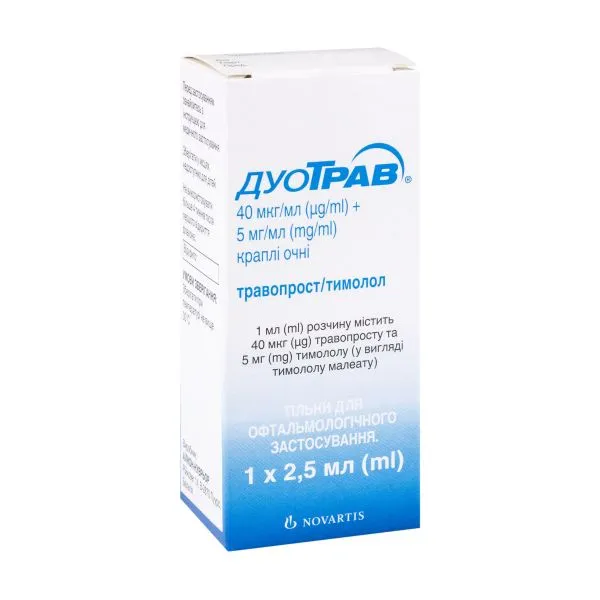
Table of Contents
INSTRUCTION FOR MEDICAL USE OF THE MEDICINAL PRODUCT DUOTRAV® (DUOTRAV®)
Composition:
Active substances: travoprost, timolol;
1 ml of solution contains 40 mcg of travoprost and 5 mg of timolol (as timolol maleate);
Excipients: poliquad, propylene glycol, mannitol (E 421), boric acid, sodium chloride, polyoxyl 40 hydrogenated castor oil (HCO-40), sodium hydroxide and/or hydrochloric acid (for pH adjustment), purified water.
Pharmaceutical form.
Eye drops.
Main physicochemical characteristics: clear, colorless to light yellow solution.
Pharmacotherapeutic group. Antiglaucoma preparations and miotics.
ATC code S01ED51.
Pharmacological Properties
Pharmacodynamics. Duotrav® contains two active components: travoprost and timolol maleate. These two substances reduce intraocular pressure through a complementary mechanism of action and a combined effect, resulting in an additional reduction in intraocular pressure (IOP) compared to the effect achieved with either component used as monotherapy.
Travoprost, a prostaglandin F2α analog, is a full agonist with high selectivity and high affinity for prostaglandin FP receptors. It reduces intraocular pressure by increasing outflow of aqueous humor through the trabecular meshwork and uveoscleral pathways. Reduction in intraocular pressure in humans begins 2 hours after administration of the drug, with maximum effect achieved within 12 hours. A significant reduction in IOP persists for 24 hours after a single dose.
Timolol is a non-selective beta-adrenergic receptor blocker that lacks significant sympathomimetic and local anesthetic (membrane-stabilizing) activity, as well as direct myocardial depressant effects. Tonographic and fluorometric studies have confirmed that its primary action in humans is associated with reduced production of aqueous humor and a slight increase in its outflow.
Secondary Pharmacology
Travoprost significantly increased blood flow in the optic nerve head in rabbits 7 days after local ocular administration (1.4 mcg once daily).
Clinical Pharmacology
In a 12-month controlled clinical study in patients with open-angle glaucoma or ocular hypertension and a mean IOP of 25 to 27 mm Hg, the mean reduction in IOP with once-daily morning administration of Duotrav® ranged from 8 to 10 mm Hg. During the study, the IOP-lowering effect of the combination latanoprost 50 mcg/mL + timolol 5 mg/mL did not exceed that of Duotrav®.
In a 3-month controlled clinical study in patients with open-angle glaucoma or ocular hypertension and a mean IOP of 27 to 30 mm Hg, the mean reduction in IOP with once-daily morning administration of Duotrav® ranged from 9 to 12 mm Hg, exceeding the effect of once-daily evening administration of travoprost 40 mcg/mL by 2 mm Hg and the effect of twice-daily administration of timolol 5 mg/mL by 2–3 mm Hg. During the study, a statistically significant reduction in mean morning IOP (measured at 8 a.m., i.e., 24 hours after the last dose of Duotrav®) was observed compared to travoprost monotherapy.
In two 3-month controlled clinical studies in patients with open-angle glaucoma or ocular hypertension and a mean IOP of 23 to 26 mm Hg, the mean reduction in IOP with once-daily morning administration of Duotrav® ranged from 7 to 9 mm Hg. The mean IOP reduction was not inferior, although numerically lower, compared to the effect observed in patients receiving concomitant therapy with travoprost 40 mcg/mL once daily in the evening and timolol 5 mg/mL once daily in the morning.
In a 6-week controlled clinical study in patients with open-angle glaucoma or ocular hypertension and a mean IOP of 24 to 26 mm Hg, the mean reduction in IOP with once-daily morning administration of Duotrav® containing poliquaternium-1 as a preservative was 8 mm Hg, which was equivalent to the effect of Duotrav® containing benzalkonium chloride as a preservative.
Inclusion criteria were consistent across all studies, except for baseline IOP and response to prior IOP-lowering therapy. Both treatment-naïve patients and those previously treated participated in the clinical development of Duotrav®. Inadequate response to monotherapy was not an inclusion criterion.
The data obtained confirm that evening administration of the drug may offer some advantage in reducing IOP. When recommending morning rather than evening dosing, patient convenience and compliance should be considered.
Nonclinical Safety Data
Studies in monkeys demonstrated that twice-daily administration of Duotrav® caused increased palpebral fissure size and enhanced pigmentation, similar to that observed with ocular prostaglandin administration.
Duotrav® with poliquaternium-1 as a preservative showed minimal toxic effects on the ocular surface in human corneal cell cultures and after topical ocular administration in rabbits, compared to Duotrav® with benzalkonium chloride as a preservative.
Travoprost
Local administration of travoprost at concentrations of 0.012% and higher into the right eye of monkeys twice daily for one year did not cause systemic toxicity.
Toxic effects on reproductive function were studied in rats, mice, and rabbits following systemic administration. The findings were related to FP receptor agonist activity in the uterus, manifesting as early embryonic lethality, impaired fetal implantation, and fetal toxicity. Systemic administration of travoprost to pregnant rats during organogenesis at doses 200 times higher than the therapeutic dose resulted in increased incidence of developmental abnormalities. Low levels of radioactivity were detected in amniotic fluid and fetal tissues of pregnant rats administered 3H-travoprost. Reproductive and developmental studies demonstrated significant fetal mortality at plasma concentrations of 180 pg/mL in rats and 30 pg/mL in mice (1.2–6 times the therapeutic concentration of >25 pg/mL).
Timolol
Nonclinical data indicate no risk to humans with timolol use, as demonstrated by safety pharmacology studies, repeated-dose toxicity studies, genotoxicity, and carcinogenic potential assessments. Studies on timolol’s reproductive toxicity showed delayed fetal skeletal formation in rats (at doses 7,000 times higher than the clinical dose) without adverse postnatal development effects, and increased fetal resorption in rabbits (at doses 14,000 times higher than the clinical dose).
Pharmacokinetics
Absorption
Travoprost and timolol are absorbed through the cornea. Travoprost is a prodrug that undergoes rapid ester hydrolysis in the cornea to its active free acid form. After single-dose administration of Duotrav® (with poliquaternium-1 as preservative) for 5 days to healthy volunteers (N = 22), the free acid was not quantifiable in plasma samples in the majority of participants (94.4%) and was generally undetectable 1 hour after administration. When measured (> 0.01 ng/mL, limit of quantification), concentrations ranged from 0.01 to 0.03 ng/mL. The mean Cmax of timolol after single-dose administration of Duotrav® was 1.34 ng/mL, with a Tmax of approximately 0.69 hours.
Distribution
The free acid of travoprost can be quantified in aqueous humor within the first 5 hours in animals, but only within the first hour in human plasma after ocular administration of Duotrav®. Timolol can be detected in aqueous humor and human plasma up to 12 hours after ocular administration of Duotrav®.
Metabolism
Metabolism is the primary route of elimination for both travoprost and its active free acid. Systemic metabolic pathways are similar to those of endogenous prostaglandin F2α, involving reduction of the 13–14 double bond, oxidation of the 15-hydroxyl group, and β-oxidative cleavage of the upper side chain.
Timolol is metabolized via two pathways. The first involves formation of an ethanolamine side chain in the thiadiazole ring, and the second involves formation of an ethanolic side chain at the morpholine nitrogen and another similar side chain adjacent to the nitrogen with a carbonyl group. The plasma elimination half-life of timolol is 4 hours after ocular administration of Duotrav®.
Excretion
Travoprost, in the form of free acid, and its metabolites are primarily excreted via the kidneys. Less than 2% of the ophthalmic dose of travoprost is recovered in urine as free acid after ocular administration. Timolol and its metabolites are predominantly excreted by the kidneys. Approximately 20% of the timolol dose is excreted unchanged in urine, with the remainder excreted in urine as metabolites.
Clinical characteristics.
Indications.
Duotrav® is indicated to reduce intraocular pressure (IOP) in adult patients with open-angle glaucoma or ocular hypertension who have an insufficient response to topical beta-blockers or prostaglandin analogs.
Contraindications.
Hypersensitivity to the active substances or to any of the excipients of the medicinal product.
Hypersensitivity to other beta-blockers.
Conditions associated with hyperreactive airways, including bronchial asthma or a history of bronchial asthma, severe chronic obstructive pulmonary disease.
Sinus bradycardia, sick sinus syndrome, including sinoatrial block, second- or third-degree atrioventricular block not controlled by a pacemaker.
Severe heart failure, cardiogenic shock.
Severe allergic rhinitis and corneal dystrophy.
Interaction with other medicinal products and other forms of interaction.
No specific interaction studies with travoprost and timolol have been conducted.
There is a potential for additive effects leading to arterial hypotension and/or marked bradycardia when ophthalmic solutions containing a beta-blocking agent are administered concomitantly with oral calcium channel blockers, beta-blockers, antiarrhythmics (including amiodarone), digitalis glycosides, parasympathomimetics, or guanethidine. The manifestations of arterial hypertension may be exacerbated by abrupt withdrawal of clonidine in patients receiving beta-blockers.
Enhanced systemic effects of beta-blockers (including decreased heart rate, depression) have been reported during concomitant use of CYP2D6 inhibitors (such as quinidine, fluoxetine, paroxetine) and timolol.
Rarely, mydriasis has been reported as a result of concomitant use of beta-blocker ophthalmic solutions and adrenaline (epinephrine).
Beta-blockers may potentiate the hypoglycemic effect of antidiabetic agents. Beta-blockers may mask the symptoms of hypoglycemia (see section «Special precautions»).
Special precautions for use.
Systemic effects
Like other ophthalmic medicinal products for topical use, travoprost and timolol are absorbed systemically. Due to the presence of the beta-adrenergic active component, timolol, the same adverse reactions affecting the cardiovascular system, lungs, and other side effects as with systemic administration of beta-adrenergic receptor blockers may occur during use. The frequency of systemic adverse reactions with topical ophthalmic administration is lower than with systemic administration. For information on reducing systemic absorption, see section "Dosage and administration".
Cardiac disorders
Beta-blocker therapy should be critically evaluated in patients with arterial hypotension and cardiovascular disorders (such as ischemic heart disease, Prinzmetal's angina, and heart failure), and if necessary, alternative treatment options should be considered.
Patients with cardiovascular disorders should be closely monitored to avoid missing worsening symptoms or adverse reactions.
Due to the negative effect on impulse conduction time, beta-blockers should be administered with caution only to patients with first-degree heart block.
Vascular disorders
Treatment of patients with severe peripheral circulatory disorders (such as severe forms of Raynaud's disease or Raynaud's syndrome) should be performed with caution.
Respiratory disorders
Reactions affecting the respiratory system, including fatal outcomes due to bronchospasm, have been reported in patients with asthma following the use of certain topically administered ophthalmic beta-adrenergic receptor blockers.
Duotrav® should be used with caution in patients with mild to moderate chronic obstructive pulmonary disease (COPD) and only when the expected benefit outweighs the potential risk.
Hypoglycemia/diabetes
Beta-adrenergic receptor blockers should be used with caution in patients prone to spontaneous hypoglycemia or in patients with decompensated diabetes, as beta-adrenergic receptor blockers may mask symptoms of acute hypoglycemia.
Muscle weakness
Exacerbation of muscle weakness associated with myasthenic symptoms (such as diplopia, ptosis, and generalized weakness) has been reported during treatment with beta-adrenergic receptor blockers.
Corneal disorders
Topical ophthalmic use of beta-blockers may cause dry eyes. The product should be used with caution in patients with corneal disorders.
Retinal detachment
Choroidal detachment has been reported during therapy aimed at reducing intraocular fluid secretion (e.g., with timolol, acetazolamide) following trabeculotomy.
Other beta-adrenergic receptor blockers
The effect on intraocular pressure or other known systemic effects of beta-blockers may be enhanced if timolol is administered to patients already receiving systemic beta-blockers. Patients should be closely monitored.
Concomitant topical use of two beta-adrenergic receptor blockers is not recommended (see section "Interaction with other medicinal products and other forms of interaction").
Surgical anesthesia
When beta-adrenergic receptor blockers are applied locally to the eye, they may block systemic beta-agonist effects, such as those of adrenaline. If a patient is receiving timolol, the anesthesiologist must be informed.
Hypertension
Beta-blockers may mask symptoms of hyperthyroidism.
Skin contact
Prostaglandins and their analogs are biologically active substances that can be absorbed through the skin. Therefore, pregnant women or women who intend to become pregnant should take appropriate precautions to avoid contact of the drug with the skin. In case of accidental skin contact with a significant amount of the solution from the bottle, the affected area should be immediately and thoroughly washed.
Anaphylactic reactions
Patients with atopic disorders or a history of severe anaphylactic reactions to various allergens may be more sensitive to re-exposure to such allergens and may not respond to usual doses of adrenaline in the treatment of anaphylactic reactions when receiving beta-adrenergic receptor blockers.
Concomitant therapy
Timolol may interact with other medicinal products (see section "Interaction with other medicinal products and other forms of interaction").
Concomitant topical use of two prostaglandins is not recommended.
Ophthalmic effects
Travoprost may gradually change eye color by increasing the number of melanosomes (pigment granules) in melanocytes. Patients should be informed before starting treatment about the possibility of irreversible eye color change. Treating one eye may lead to irreversible heterochromia. The long-term effects and consequences of melanocyte stimulation are currently unknown. Iris pigmentation changes occur slowly and may go unnoticed for months or years. Color changes were first observed in patients with mixed iris color, such as blue-brown, gray-brown, yellow-brown, and green-brown; however, this phenomenon has also been observed in patients with brown eyes. Typically, brown pigmentation spreads concentrically from around the pupil toward the periphery of the iris of the treated eye, although the entire iris or part of it may become more intensely brown. No further increase in brown iris pigmentation has been observed after discontinuation of treatment.
In controlled clinical trials, darkening of the eyelid skin and/or periorbital area was reported following the use of travoprost.
Changes in the periorbital area and eyelid skin, including deepening of the eyelid groove, have been observed with prostaglandin analogs.
Travoprost may gradually alter the structure of eyelashes in the treated eye; such changes were observed in half of patients in clinical trials and included increased length, thickness, pigmentation, and/or number of eyelashes. The mechanism of eyelash structural changes and their long-term consequences are still unknown.
Studies in monkeys demonstrated a minor ability of travoprost to increase the palpebral fissure. However, this effect was not observed in clinical trials and is considered species-specific.
There is no experience with the use of Duotrav® in inflammatory eye diseases, neovascular glaucoma, narrow-angle glaucoma, angle-closure glaucoma, or congenital glaucoma. Limited experience exists in exophthalmos associated with thyroid disorders, open-angle glaucoma in pseudophakic patients, and pigmentary or pseudoexfoliative glaucoma.
Macular edema has been reported during treatment with prostaglandin F2α analogs.
Duotrav® should be prescribed with caution to patients with aphakia, pseudophakia, posterior lens capsule rupture with anterior chamber lenses, or patients with known risk factors for cystoid macular edema.
Duotrav® should be used with caution in patients with active ocular infections and in those with known risk factors for iritis/uveitis.
Excipients
Duotrav® contains propylene glycol, which may cause skin irritation.
Duotrav® contains polyoxyl 40 hydrogenated castor oil, which may cause skin reactions.
Patients should be informed that contact lenses must be removed before using Duotrav® and reinserted only 15 minutes after instillation of the drops (see section "Dosage and administration").
Use during pregnancy or breastfeeding.
Women of childbearing potential / contraception
Duotrav® must not be used in women of childbearing potential who are not using adequate contraceptive measures (see section "Pharmacological properties").
Pregnancy
Travoprost has harmful pharmacological effects in pregnant women and/or on the fetus/newborn.
There are insufficient data on the use of Duotrav® or its individual components in pregnant women. Timolol must not be used during pregnancy unless clearly necessary. Epidemiological studies have not shown developmental abnormalities but have demonstrated a risk of intrauterine growth retardation with oral administration of beta-blockers. Additionally, newborns exposed to beta-blockers during late pregnancy have shown beta-receptor blockade symptoms (such as bradycardia, arterial hypotension, respiratory depression, and hypoglycemia). If Duotrav® is administered before delivery, newborns must be closely monitored during the first days of life.
Duotrav® must not be used during pregnancy unless clearly necessary. For information on reducing systemic absorption, see section "Dosage and administration".
Breastfeeding
It is unknown whether travoprost passes into breast milk when administered as eye drops. Animal studies have shown that travoprost and its metabolites can pass into breast milk. Timolol passes into breast milk and may cause serious adverse effects in the infant. However, considering the dose of timolol in eye drops, it is unlikely that sufficient amounts of timolol would be present in breast milk to cause beta-receptor blockade symptoms. For information on reducing systemic absorption, see "Dosage and administration".
The use of Duotrav® in women during breastfeeding is not recommended.
Reproductive function
There are no data on the effect of Duotrav® on human reproductive function. Animal studies showed that travoprost and timolol at a dose 75 times higher than the maximum recommended human ocular dose did not have harmful effects on reproductive function.
Ability to influence reaction speed when driving or operating machinery.
Duotrav® has a minor influence on the ability to drive or operate machinery.
As with other eye drops, transient blurred vision or other visual disturbances may occur. If blurred vision occurs after instillation, the patient should wait until vision clears before driving or operating machinery.
Duotrav® may also cause hallucinations, dizziness, nervousness, and/or fatigue (see section "Adverse reactions"), which may affect the ability to drive or operate machinery. It is recommended not to drive or operate machinery if these symptoms occur.
Method of administration and dosage.
For use in adults, including elderly patients.
The dose is 1 drop of Duotrav® in the conjunctival sac of the affected eye(s) once daily – in the morning or evening. The medication should be used every day at the same time.
If a dose is missed, treatment should be continued by administering the next dose according to the prescribed schedule. The dose must not exceed 1 drop per day in the affected eye(s).
Special patient groups
Use in hepatic and renal impairment
Studies on the use of Duotrav® or timolol at a dose of 5 mg/mL in the form of eye drops in patients with hepatic or renal impairment have not been conducted.
Studies on the use of travoprost in patients with mild to severe hepatic impairment, as well as in patients with mild to severe renal impairment (creatinine clearance less than 14 mL/min), have shown that dosage adjustment is not necessary in these patients. It is unlikely that dosage adjustment of Duotrav® is required in patients with hepatic or renal impairment (see section "Pharmacological properties").
Children
The safety and efficacy of Duotrav® in children and adolescents (under 18 years of age) have not been established. Data are lacking.
Method of administration.
For ophthalmic use.
Remove the outer protective packaging immediately before first use. To prevent contamination of the dropper tip and solution, care must be taken not to touch the eyelids, surrounding areas, or other surfaces with the tip of the dropper bottle.
Systemic absorption may be reduced by applying pressure to the lacrimal sac (nasolacrimal occlusion) or gently closing the eyelids for 2 minutes. This may reduce systemic adverse effects and increase local activity (see section "Special instructions for use").
If more than one ophthalmic agent is used locally, the interval between their administration should be at least 5 minutes (see section "Interaction with other medicinal products and other forms of interaction").
When replacing another ophthalmic anti-glaucoma agent with Duotrav®, discontinue the previous medication and start Duotrav® the following day.
Patients should be advised to remove contact lenses before administering Duotrav® and to wait 15 minutes after instillation before reinserting contact lenses (see section "Special instructions for use").
Children.
The safety and efficacy of Duotrav® in children and adolescents (under 18 years of age) have not been established; therefore, the product is not used in pediatric practice.
Overdose.
Local overdose is unlikely to cause or be associated with toxic effects. However, if the contents of the bottle are accidentally ingested (depending on the amount), systemic symptoms of beta-blocker overdose may occur, such as cardiac arrhythmias (e.g., bradycardia), arterial hypotension, bronchospasm, and heart failure.
In case of Duotrav® overdose, treatment should be symptomatic and supportive. Timolol is not effectively removed by dialysis.
Adverse reactions
In clinical studies involving 2170 patients treated with Duotrav®, the most common treatment-related adverse event was ocular hyperemia (12.0%). The adverse reactions listed below were observed during clinical studies or in the post-marketing period.
Adverse reactions are classified by system organ class and frequency as follows: very common (≥ 1/10), common (≥ 1/100 to < 1/10), uncommon (≥ 1/1,000 to < 1/100), rare (≥ 1/10,000 to < 1/1,000), very rare (< 1/10,000), or frequency not known (cannot be estimated from available data). Adverse reactions are listed by frequency in order of decreasing severity.
Table 1
| Immune system disorders |
Uncommon |
Hypersensitivity |
| Psychiatric disorders |
Rare |
Nervousness |
| Psychiatric disorders |
Frequency unknown |
Depression, hallucinations* |
| Nervous system disorders |
Uncommon |
Dizziness, headache |
| Nervous system disorders |
Frequency unknown |
Stroke, transient loss of consciousness, paresthesia |
| Ophthalmological disorders |
Very common |
Ocular hyperemia |
| Ophthalmological disorders |
Common |
Punctate keratitis, eye pain, visual disturbance, blurred vision, dry eyes, eye pruritus, eye discomfort, eye irritation |
| Ophthalmological disorders |
Uncommon |
Keratitis, iritis, conjunctivitis, anterior chamber inflammation, blepharitis, photophobia, decreased visual acuity, asthenopia, eye swelling, increased lacrimation, eyelid erythema, increased eyelash growth, eye hypersensitivity, conjunctival edema, eyelid edema |
| Ophthalmological disorders |
Rare |
Corneal erosion, meibomitis, conjunctival hemorrhages, scaling of eyelid margins, trichiasis, distichiasis |
| Ophthalmological disorders |
Frequency unknown |
Macular edema, eyelid ptosis, deepening of eyelid sulcus, increased pigmentation of the iris, corneal disorders |
| Cardiac disorders |
Uncommon |
Bradycardia |
| Cardiac disorders |
Rare |
Arrhythmia, irregular heartbeat |
| Cardiac disorders |
Frequency unknown |
Heart failure, tachycardia, chest pain, palpitations |
| Vascular disorders |
Uncommon |
Increased blood pressure, decreased blood pressure |
| Vascular disorders |
Frequency unknown |
Peripheral edema |
| Respiratory, thoracic and mediastinal disorders |
Uncommon |
Dyspnea, excessive nasopharyngeal secretion |
| Respiratory, thoracic and mediastinal disorders |
Rare |
Dysphonia, bronchospasm, cough, throat irritation, sore throat, nasal congestion |
| Respiratory, thoracic and mediastinal disorders |
Frequency unknown |
Asthma |
| Gastrointestinal disorders |
Frequency unknown |
Altered taste sensations |
| Hepatobiliary disorders |
Rare |
Elevated alanine aminotransferase, elevated aspartate aminotransferase |
| Skin and subcutaneous tissue disorders |
Uncommon |
Contact dermatitis, hypertrichosis, skin hyperpigmentation (periorbital area) |
| Skin and subcutaneous tissue disorders |
Rare |
Urticaria, skin discoloration, alopecia |
| Skin and subcutaneous tissue disorders |
Frequency unknown |
Rash |
| Musculoskeletal and connective tissue disorders |
Rare |
Limb pain |
| Renal and urinary disorders |
Rare |
Chromaturia |
| General disorders and administration site conditions |
Rare |
Thirst, fatigue |
- Adverse reactions observed during the use of timolol.
Additional adverse effects observed during the use of one of the active components, which may potentially occur during the use of Duotrav®:
Travoprost
Table 2
| Immune system disorders |
Seasonal allergy |
| Psychiatric disorders |
Anxiety, insomnia |
| Eye disorders |
Uveitis, conjunctival follicle, eye discharge, periorbital edema, eyelid pruritus, ectropion, cataract, iridocyclitis, ophthalmic herpes, eye inflammation, photopsia, ocular hypoesthesia, pigmentation of anterior chamber, mydriasis, hyperpigmentation of eyelashes, eyelash thickening, visual field defect |
| Ear and labyrinth disorders |
Dizziness, tinnitus |
| Vascular disorders |
Decreased diastolic blood pressure, increased systolic blood pressure |
| Respiratory, thoracic and mediastinal disorders |
Asthma exacerbation, allergic rhinitis, epistaxis, respiratory tract disorder, nasal congestion, dryness of nasal mucosa |
| Gastrointestinal disorders |
Peptic ulcer reactivation, gastrointestinal disorder, diarrhea, constipation, dry mouth, abdominal pain, nausea, vomiting |
| Skin and subcutaneous tissue disorders |
Skin exfoliation, abnormal hair texture, allergic dermatitis, hair color changes, madarosis, pruritus, abnormal hair growth, erythema |
| Musculoskeletal and connective tissue and bone disorders |
Musculoskeletal pain, arthralgia |
| Renal and urinary disorders |
Dysuria, urinary incontinence |
| General disorders and administration site conditions |
Asthenia |
| Investigations |
Increased prostate-specific antigen level |
Timolol
Like other ophthalmic medicinal products for topical use, timolol is absorbed into the systemic circulation. This may cause adverse effects similar to those commonly observed with systemic beta-adrenergic receptor blockers. Additionally, the listed adverse effects include reactions reported with topical ophthalmic use of beta-adrenergic receptor blockers. The frequency of adverse effects with topical ophthalmic administration is lower than with systemic administration. For measures to reduce systemic absorption, see section "Dosage and administration".
Table 3
| Immune system disorders |
Systemic allergic reactions, including angioneurotic edema, urticaria, localised and generalised rash, pruritus, anaphylaxis |
| Metabolism and nutrition disorders |
Hypoglycaemia |
| Psychiatric disorders |
Hallucinations, insomnia, nightmares, memory loss |
| Nervous system disorders |
Cerebral vascular ischaemia, worsening of signs and symptoms of myasthenia gravis |
| Eye disorders |
Signs and symptoms of ocular irritation (e.g. burning, stinging, itching, lacrimation, redness), retinal detachment after trabeculotomy (see section "Special precautions"), corneal hypoesthesia, diplopia |
| Cardiac disorders |
Oedema, congestive heart failure, atrioventricular block, cardiac arrest |
| Vascular disorders |
Raynaud's phenomenon, feeling of cold extremities |
| Gastrointestinal disorders |
Nausea, dyspepsia, diarrhoea, dry mouth, abdominal pain, vomiting |
| Skin and subcutaneous tissue disorders |
Psoriasiform rash or exacerbation of psoriasis |
| Musculoskeletal and connective tissue disorders |
Myalgia |
| Reproductive system and breast disorders |
Sexual dysfunction, decreased libido |
| General disorders and administration site conditions |
Asthenia |
Reporting of suspected adverse reactions.
It is very important to report suspected adverse reactions to a registered medicinal product. This allows continuous monitoring of the benefit-risk balance of the medicinal product. Healthcare professionals are requested to report any suspected adverse reactions in accordance with current legislation.
Shelf life. 2 years. Do not use for more than 4 weeks after first opening the bottle.
Storage conditions. Store at temperatures not exceeding 30 °C. Keep out of the reach and sight of children.
Packaging. 2.5 ml in a dropper bottle; 1 dropper bottle in a secondary packaging placed in a cardboard box.
Prescription status. Prescription only.
Manufacturer.
Novartis Manufacturing NV / Novartis Manufacturing NV.
Manufacturer's address and location of operations.
Rijksweg 14, Puurs-Sint-Amands, 2870, Belgium / Rijksweg 14, Puurs-Sint-Amands, 2870, Belgium.