Droperidol 2.5 mg/1 ml
Ukraine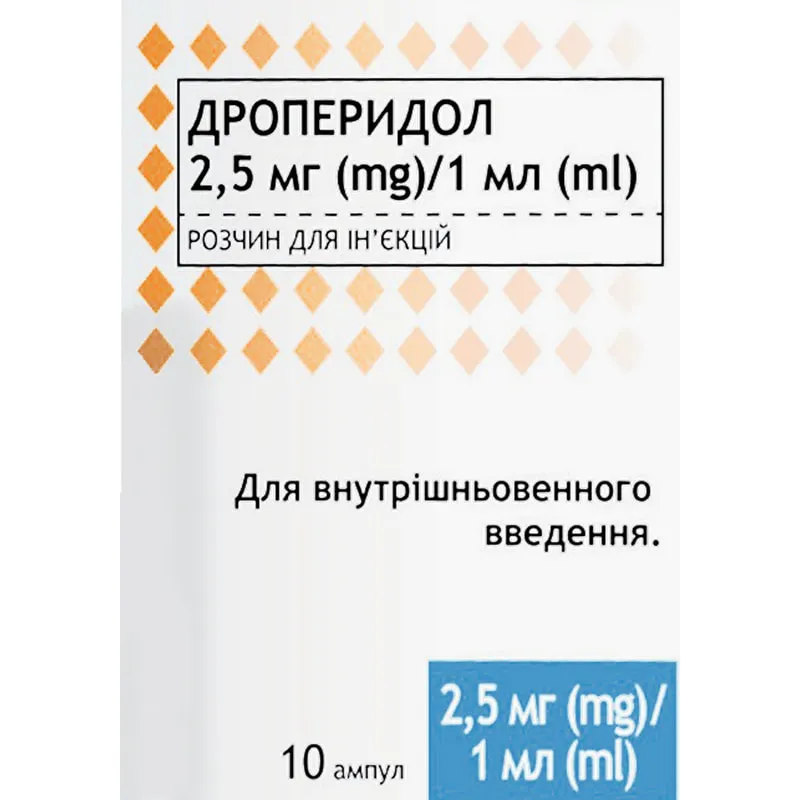
Table of Contents
INSTRUCTION FOR MEDICAL USE OF THE MEDICINAL PRODUCT DROPERIDOL 2.5 mg/1ml (DROPERIDOL 2.5 mg/1ml)
Composition:
Active substance: droperidol;
1 ampoule (1 ml) of injection solution contains droperidol 2.5 mg;
Excipients: mannitol (E 421), tartaric acid, sodium hydroxide, water for injections.
Pharmaceutical form. Injection solution.
Main physicochemical properties: clear solution, colorless to slightly yellow.
Pharmacotherapeutic group. Antipsychotic agents. Butyrophenone derivatives.
ATC code N05AD08
Pharmacological Properties
Pharmacodynamics
Droperidol is a neuroleptic agent belonging to the butyrophenone derivative group. It blocks dopamine receptors and has weak α1-adrenergic blocking activity. Droperidol does not exhibit anticholinergic or antihistaminic activity.
Droperidol provides a potent antiemetic effect, which is particularly important in the prevention and treatment of nausea and vomiting, including that induced by opioid analgesics. These properties are due to droperidol's inhibitory action on dopaminergic receptors in the chemoreceptor trigger zone of the vomiting center, the area postrema.
At a dose of 0.15 mg/kg, droperidol reduces arterial pressure by decreasing cardiac output and cardiac preload. These changes occur independently of myocardial contractility or vascular resistance. Droperidol does not affect myocardial contractility or heart rate (i.e., it has no negative inotropic effect). Its weak α1-adrenergic blocking activity may cause a moderate reduction in arterial pressure, decrease peripheral vascular resistance, and lower pulmonary arterial pressure (particularly if it is abnormally elevated). Droperidol also reduces the incidence of adrenaline-induced arrhythmias, although it does not prevent arrhythmias of other etiologies.
Clinical Efficacy and Safety
Postoperative Nausea and Vomiting (PONV). Based on results from 222 clinical studies on PONV prophylaxis, droperidol reduces the risk of PONV in patients compared to placebo: RR (relative risk) for nausea occurrence — 0.65 (95% CI [confidence interval]: 0.60–0.71), for vomiting — 0.65 (95% CI: 0.61–0.70), and for nausea and vomiting combined — 0.62 (95% CI: 0.58–0.67).
A combined analysis of data from 2061 patients at high risk of PONV demonstrated superior efficacy of 1.25 mg droperidol in preventing nausea compared to 4 mg ondansetron or 0.625 mg droperidol (p < 0.05; absence of nausea: 43%, 29%, 29%, respectively), in preventing vomiting (complete response [0–24 h]: 56%, 53%, 48%, respectively), and in reducing the need for rescue medication (26%, 34%, 32%, respectively).
Monotherapy. A meta-analysis of outcomes from 74 clinical trials involving 5351 patients who received droperidol according to 24 different regimens and 3372 patients who received placebo or no treatment summarized the frequency of early (0–6 h) and late (0–24 h) episodes of PONV in adults and children (see table below).
Early and delayed outcomes of PONV prevention following droperidol administration compared to placebo or no treatment
| Parameters assessed |
Droperidol (mean value, %) |
Placebo or no treatment (mean value, %) |
|
| Early treatment outcomes (0–6 hours) after administration |
Nausea |
16 (3–41) |
33 (15–80) |
| Vomiting |
14 (0–56) |
29 (6–86) |
|
| Late treatment outcomes (0–24 hours) after administration |
Nausea |
45 (1–86) |
58 (11–96) |
| Vomiting |
28 (4–83) |
46 (12–97) |
|
Droperidol was more effective than placebo or no treatment in preventing PONV in adults and children.
Combination therapy. A randomized study evaluated the efficacy of monotherapy versus combined antiemetic therapy in 4,123 patients at high risk of PONV. The results of using 1.25 mg droperidol, 4 mg ondansetron, and 4 mg dexamethasone were compared with no treatment. The combination of antiemetic agents reduced the relative risk of PONV by approximately 26%. All tested drugs were equally effective.
Patient-controlled analgesia (PCA). Results from 14 studies involving 1,117 patients were analyzed. In 6 studies, droperidol 0.017–0.33 mg was administered as a bolus together with morphine 0.017–0.17 mg/mg. The incidence of vomiting was 66% in patients receiving placebo compared to 30% in those receiving droperidol.
QTc interval. In a placebo-controlled study, droperidol administration was associated with QT interval prolongation 3–6 minutes after intravenous injection of 0.625 and 1.25 mg droperidol (15 ± 40 and 22 ± 41 ms, respectively), but these changes did not differ significantly from those observed in the placebo group (12 ± 35 ms). There was no statistically significant difference between the droperidol and placebo groups in the number of cases with QTc prolongation exceeding 10% from baseline values.
In a second study involving intravenous administration of 0.75 mg droperidol and 4 mg ondansetron, significant QTc prolongation was observed (17 ± 9 ms in the droperidol group, 20 ± 13 ms in the ondansetron group), which significantly decreased by the 90th minute.
A study combining ondansetron (4 mg) and droperidol (1 mg) showed that each drug alone increased the QTc interval (17 ± 10 ms for ondansetron, 25 ± 8 ms for droperidol), but this effect was not additive when the drugs were administered together (28 ± 10 ms).
Pharmacokinetics
The onset of action occurs within 2–3 minutes after a single intravenous dose. Muscle relaxant and sedative effects may last from 2 to 4 hours, although increased drowsiness may persist for over 12 hours.
Distribution. After intravenous administration, plasma concentration rapidly declines within the first 15 minutes. Plasma protein binding ranges from 85–90%. The volume of distribution is approximately 1.5 L/kg.
Biotransformation. Droperidol is extensively metabolized in the liver. It undergoes oxidation, dealkylation, demethylation, and hydroxylation by cytochrome P450 isoenzymes 1A2 and 3A4, and to a lesser extent by isoenzyme 2C19. The metabolites lack neuroleptic activity.
Elimination. Elimination occurs primarily through metabolism; 75% of the dose is excreted by the kidneys; only 1% of the dose is excreted unchanged in urine and 11% in feces. Plasma clearance is 0.8 (0.4–1.8) L/min, and the elimination half-life (t1/2β) is 134 ± 13 minutes.
Drug interaction. A study combining ondansetron (4 mg) and droperidol (1 mg) showed no pharmacokinetic interaction between these two drugs when administered concomitantly.
Pediatric patients. In a study involving 12 children (aged 3.5 to 12 years), volume of distribution and clearance were lower than in adults (0.58 ± 0.29 L/kg and 4.66 ± 2.28 mL/kg⁎min, respectively). The elimination half-life (101.5 ± 26.4 minutes) was similar to that observed in adults.
Preclinical safety studies
Preclinical data from conventional repeated-dose toxicity, genotoxicity, carcinogenic potential, and reproductive toxicity studies do not indicate any special hazard of droperidol for humans.
Electrophysiological studies in vitro and in vivo indicate a general risk of QT interval prolongation in humans.
In humans, free plasma concentrations of droperidol range from approximately >4-fold to <25-fold compared to the concentration of droperidol used to assess its effect on cardiac repolarization in various in vitro and in vivo test systems.
Clinical Characteristics
Indications. Administer to adults:
- for prevention of postoperative nausea and vomiting (PONV) in patients with moderate or high risk of developing PONV, i.e., with at least two risk factors according to the simplified Apfel score;
- for treatment of postoperative nausea and vomiting;
- for prevention of nausea and vomiting induced by morphine derivatives during postoperative patient-controlled analgesia.
Administer to children:
- for prevention of postoperative nausea and vomiting in patients aged 2 to 18 years with moderate or high risk of PONV — as second-line treatment and within a multimodal treatment approach;
- for treatment of postoperative nausea and vomiting.
Contraindications
- Hypersensitivity to the active substance or to any of the excipients.
- Hypersensitivity to butyrophenones.
- Known or suspected QT interval prolongation (QTc > 450 ms in women and > 440 ms in men). In particular, congenital long QT syndrome, family history of congenital QT prolongation, concomitant use of medicinal products that may cause torsades de pointes tachycardia due to QT prolongation: class Ia and III antiarrhythmics (amiodarone, amisulpride, disopyramide, dronedarone, hydroquinidine, quinidine, sotalol), citalopram, escitalopram, cocaine, domperidone, intravenous erythromycin, hydroxyzine, mequitazine, moxifloxacin, piperaquine, spiramycin, toremifene, vincamine, vandetanib.
- Hypokalemia or hypomagnesemia.
- Bradycardia (heart rate [HR] <55 beats per minute).
- Concomitant therapy causing bradycardia.
- Pheochromocytoma.
- Comatose states.
- Parkinson's disease.
- Severe depression.
- Combination with dopaminergic agents (amantadine, apomorphine, bromocriptine, cabergoline, entacapone, lisuride, piribedil, pramipexole, quinagolide, rasagiline, ropinirole, rotigotine, selegiline, tolcapone).
- Use with levodopa.
Interaction with other medicinal products and other forms of interaction
Contraindicated combinations
Medicinal products that cause torsades de pointes due to QT interval prolongation must not be used concomitantly with droperidol. In particular:
- class IA antiarrhythmics, e.g., quinidine, disopyramide, procainamide;
- class III antiarrhythmics, e.g., amiodarone, sotalol;
- macrolide antibiotics, e.g., erythromycin, clarithromycin;
- fluoroquinolone antibiotics, e.g., sparfloxacin;
- antihistamines, e.g., astemizole, terfenadine;
- certain antipsychotics, e.g., chlorpromazine, haloperidol, pimozide, thioridazine;
- antimalarials, e.g., quinine, chloroquine, halofantrine;
- cisapride, domperidone, methadone, pentamidine.
Combinations not recommended
Concomitant use of medicinal products that cause extrapyramidal symptoms, such as metoclopramide and other neuroleptics, may increase the frequency of these symptoms and should therefore be avoided.
Alcoholic beverages and medicinal products containing alcohol should not be consumed.
Combinations requiring precautions
Caution is required when administering droperidol with any other medicinal product that prolongs the QT interval.
To reduce the risk of QT interval prolongation, caution should be exercised in patients taking medicinal products that may cause electrolyte imbalances (hypokalemia and/or hypomagnesemia), such as potassium-sparing diuretics, laxatives, and glucocorticoids.
Droperidol may potentiate the effects of sedatives (barbiturates, benzodiazepines, morphine derivatives). It may also enhance the effects of antihypertensive agents and lead to orthostatic hypotension.
Like all other sedatives, droperidol may intensify respiratory depression caused by opioids.
Droperidol blocks dopamine receptors and may therefore inhibit the action of dopamine agonists such as bromocriptine, lisuride, and L-dopa.
Substances that inhibit the activity of cytochrome P450 isoenzymes CYP1A2 and/or CYP3A4 may slow down the metabolism of droperidol and prolong its pharmacological effect. Therefore, droperidol should be used cautiously in combination with strong CYP1A2 inhibitors (e.g., ciprofloxacin, ticlopidine), CYP3A4 inhibitors (e.g., diltiazem, erythromycin, fluconazole, indinavir, itraconazole, ketoconazole, nefazodone, nelfinavir, ritonavir, saquinavir, verapamil), or inhibitors of both CYP1A2 and CYP3A4 (e.g., cimetidine, mibefradil).
Special precautions for use
Central nervous system. Droperidol may enhance central nervous system (CNS) depression caused by other medicinal products. Careful monitoring is required in any patient undergoing anaesthesia and receiving potent CNS depressants, or in patients with signs and symptoms indicating CNS depression.
Concomitant use of metoclopramide and other neuroleptics may lead to increased extrapyramidal symptoms and should therefore be avoided (see section "Interaction with other medicinal products and other forms of interaction").
Use with caution in patients with epilepsy (including history of epilepsy) or conditions that may precipitate epilepsy or seizures.
Cardiovascular system. Mild or moderate arterial hypotension and occasional (reflex) tachycardia have been observed after droperidol administration. These reactions usually resolve spontaneously. However, if arterial hypotension persists, hypovolemia should be considered and fluid replacement initiated.
Droperidol should be prescribed only after careful consideration in patients with known or suspected risk factors for cardiac arrhythmia, such as:
- History of serious cardiac disease, including severe ventricular arrhythmia, second- or third-degree atrioventricular block, sinus node dysfunction, congestive heart failure, ischemic heart disease, and left ventricular hypertrophy;
- Family history of sudden death;
- Renal impairment (especially if the patient is on chronic dialysis);
- Chronic obstructive pulmonary disease and respiratory insufficiency;
- Predisposition to electrolyte disturbances in patients taking laxatives, glucocorticosteroids, or non-potassium-sparing diuretics, particularly when combined with emergency insulin administration, or in patients with prolonged vomiting and/or diarrhoea.
In patients at risk of developing cardiac arrhythmia, serum electrolyte and creatinine levels should be measured and QT interval prolongation excluded before administering droperidol.
Continuous pulse oximetry should be performed during and for 30 minutes after a single intravenous injection in patients at risk of ventricular arrhythmia.
To prevent QT interval prolongation, caution is advised when patients are taking medicinal products that may cause electrolyte imbalances (hypokalaemia and/or hypomagnesaemia), such as non-potassium-sparing diuretics, laxatives, and glucocorticosteroids.
Concomitant use of medicinal products known to cause disturbances in cardiac rhythm, particularly torsades de pointes, is not recommended (see section "Interaction with other medicinal products and other forms of interaction"): arsenic trioxide, antiparasitic agents that may cause torsades de pointes (chloroquine, halofantrine, lumefantrine, pentamidine), neuroleptics that may cause torsades de pointes (chlorpromazine, tiamemazine, flupentixol, fluphenazine, haloperidol, levomepromazine, pimozide, pipamperone, pipotiazine, sulpiride, tiapride, zuclopenthixol), delamanid, crizotinib, hydroxychloroquine, methadone, sulfamethoxazole with trimethoprim.
Other precautions. The use of droperidol with sodium oxybate is not recommended (see section "Interaction with other medicinal products and other forms of interaction").
Substances that inhibit the activity of cytochrome P450 (CYP) isoenzymes CYP1A2 or CYP3A4 may reduce the metabolism rate of droperidol and prolong its pharmacological effect. Therefore, caution is required when droperidol is used concomitantly with strong inhibitors of CYP1A2 and CYP3A4 (see section "Interaction with other medicinal products and other forms of interaction").
Alcoholic beverages or medicinal products containing alcohol should not be consumed (see section "Interaction with other medicinal products and other forms of interaction").
A thorough evaluation should be performed before administering droperidol to patients with a history of alcohol abuse, suspected current alcohol abuse, or who have recently consumed large amounts of alcohol, due to increased risk of arrhythmia.
If unexplained hyperthermia occurs, treatment should be discontinued, as this sign may indicate neuroleptic malignant syndrome.
Cases of venous thromboembolism (VTE) have been reported with the use of antipsychotic agents. Since patients receiving antipsychotics often have acquired risk factors for VTE, all possible VTE risk factors should be identified before and during treatment with droperidol, and appropriate preventive measures taken.
Dosage should be reduced in elderly patients (aged 65 years and older) and in patients with impaired renal and/or hepatic function (see section "Method of administration and dosage").
This medicinal product contains less than 1 mmol (23 mg) of sodium per dose, i.e. essentially "sodium-free".
Use during pregnancy or breastfeeding
Pregnancy. Limited clinical data do not indicate an increased risk of congenital malformations. Droperidol was not teratogenic in rats; however, animal studies are insufficient to fully determine effects on pregnancy, embryonic/fetal development, labour, or postnatal development.
Transient extrapyramidal neurological disorders have been reported in newborns whose mothers received high doses of neuroleptics over a prolonged period.
Droperidol is not recommended during pregnancy. If droperidol is considered essential in late pregnancy, neurological function in the newborn should be monitored.
Breastfeeding. Butyrophenone-type neuroleptics are excreted in breast milk; therefore, treatment with droperidol should be limited to a single dose. Repeated administration is not recommended.
Fertility. Studies conducted in male and female rats revealed no effect of droperidol on fertility. The effect of droperidol on human fertility has not been established.
Ability to affect reaction speed when driving or operating machinery. Droperidol has a marked effect on the ability to drive or operate machinery.
Patients should not drive or operate machinery for 24 hours after administration of droperidol.
Method of Administration and Dosage
Dosage
The medicinal product should be used only under hospital conditions. This medicinal product must be prescribed by qualified healthcare professionals.
Dosage should be individually adjusted for each patient based on age, body weight, concomitant medications, type of anesthesia, and surgical procedure.
Prevention and treatment of postoperative nausea and vomiting (PONV)
Adults: 0.625 mg to 1.25 mg (0.25 to 0.5 mL).
Elderly patients (aged 65 years and older): 0.625 mg (0.25 mL).
Patients with impaired renal/hepatic function: 0.625 mg (0.25 mL).
Children:
Children (aged 2 to 18 years): 10 to 50 mcg/kg (maximum dose – 1.25 mg).
Children (under 2 years of age): not recommended.
Due to its antiemetic properties, droperidol is indicated for prophylaxis in patients with moderate to high risk of developing PONV. Risk should be assessed using standard validated scales or scores, such as the simplified Apfel score.
It is recommended to administer droperidol 30 minutes before the expected end of surgery. If necessary, administration may be repeated every 6 hours.
In adults, the prevention of early vomiting and late nausea is improved when doses from 0.75 mg up to the maximum of 1.25 mg are used.
Higher doses in adults and children increase the risk of sedative effects and somnolence.
Prevention of nausea and vomiting induced by morphine and its derivatives administered during postoperative patient-controlled analgesia
Adults: 15 to 50 micrograms of droperidol per milligram of morphine — do not exceed the maximum daily dose of droperidol 5 mg.
Elderly patients (aged 65 years and older) and patients with impaired renal or hepatic function: no data available.
Children:
Droperidol is not indicated in children (aged 2 to 18 years) for postoperative patient-controlled analgesia.
In patients at risk of ventricular arrhythmia, pulse oximetry should be performed during and for 30 minutes after a single intravenous injection.
Method of Administration
Administer intravenously.
The medicinal product is for single use only. Any unused solution should be discarded.
Visually inspect the solution before administration. Use only clear, colorless solutions without visible particles.
For use in postoperative patient-controlled analgesia: draw droperidol and morphine into a syringe and dilute to the required volume with 0.9% sodium chloride injection solution.
After opening, the diluted medicinal product should be used immediately.
Any unused product or waste material should be disposed of in accordance with current requirements.
See also sections "Contraindications" and "Pharmacodynamics".
Children. The medicinal product is not recommended for use in children under 2 years of age. In children aged 2 years and older, the drug is indicated for the prevention and treatment of postoperative nausea and vomiting. Droperidol should not be used in children for other indications.
Overdose
Symptoms. Overdose of droperidol manifests as an intensification of its pharmacological effects. Symptoms of accidental overdose range from mental indifference to a state of sleep, sometimes associated with decreased arterial pressure.
With higher doses or in sensitive patients, extrapyramidal disorders (salivation, abnormal movements, sometimes muscle rigidity) may occur. At toxic doses, seizures may develop.
Rare cases of QT interval prolongation, ventricular arrhythmias, and sudden death have been reported.
Treatment. There is no specific antidote. However, if extrapyramidal effects occur, an anticholinergic agent should be administered. Careful monitoring for signs of QT interval prolongation is required in cases of droperidol overdose. Factors predisposing to the development of torsades de pointes, such as electrolyte disturbances (particularly hypokalemia or hypomagnesemia) and bradycardia, should be considered.
Pronounced arterial hypotension should be treated with fluid replacement and other appropriate measures.
Maintain airway patency and adequate oxygenation; insertion of an oropharyngeal airway or endotracheal tube may be indicated. If necessary, patients should be monitored for at least 24 hours, with monitoring of body temperature and fluid intake.
Adverse Reactions
The most commonly reported adverse events during clinical use of droperidol were somnolence and sedation. Less frequently reported were arterial hypotension, cardiac arrhythmias, neuroleptic malignant syndrome (NMS) and symptoms associated with NMS, as well as abnormal movements such as dyskinesia, anxiety, or restlessness.
| Organ systems |
Frequency categories |
||||
| Common |
Uncommon |
Rare |
Very rare (<1/10,000) |
Frequency not known (cannot be estimated from available data) |
|
| Blood and lymphatic system |
Dyscrasia |
||||
| Immune system |
Anaphylactic reactions, angioneurotic edema, hypersensitivity |
||||
| Metabolism and nutrition |
Inadequate secretion of antidiuretic hormone |
||||
| Psychiatric |
Anxiety, restlessness/agitation |
Confusion, agitation |
Dysphoria |
Hallucinations |
|
| Pregnancy, postpartum and perinatal period |
Neonatal withdrawal syndrome |
||||
| Nervous system |
Somnolence |
Dystonia, oculogyria |
Extrapyramidal disorders, convulsions, tremor |
Epileptic seizures, Parkinson's disease, psychomotor hyperactivity, coma |
|
| Heart |
Tachycardia, dizziness |
Cardiac arrhythmias, including ventricular |
Cardiac arrest, torsades de pointes, QT interval prolongation on ECG |
||
| Vascular |
Hypotension |
Syncope |
|||
| Respiratory, thoracic and mediastinal |
Bronchospasm, laryngospasm |
||||
| Skin and subcutaneous tissue |
Skin rashes |
||||
| General disorders and administration site conditions |
Malignant neuroleptic syndrome (MNS) |
Sudden death |
|||
Sometimes certain possible CNS symptoms have been reported, including changes in body temperature, rigidity, and fever. Altered mental status with confusion or agitation and changes in consciousness have been observed. Autonomic instability may occur in the form of tachycardia, fluctuations in blood pressure, excessive sweating/salivation, and tremor. In extreme cases, NMS may lead to coma, renal and/or hepatobiliary complications.
Prolonged use for psychiatric indications has been associated with isolated cases of amenorrhea, galactorrhea, gynecomastia, hyperprolactinemia, oligomenorrhea, and neonatal withdrawal syndrome.
Cases of venous thromboembolism, including pulmonary embolism and deep vein thrombosis, have been reported with the use of antipsychotic medicinal products—frequency unknown.
Reporting suspected adverse reactions
Reporting of suspected adverse reactions after medicinal product authorization is important. It allows continued monitoring of the benefit-risk balance of the medicinal product. Healthcare and pharmaceutical professionals, as well as patients or their legal representatives, should report all suspected adverse reactions and lack of efficacy via the Automated Pharmacovigilance Information System at: https://aisf.dec.gov.ua.
Shelf life: 36 months.
After opening: the medicinal product should be used immediately.
After dilution in 0.9% sodium chloride solution or 5% glucose solution, physicochemical stability has been demonstrated for 48 hours at 25°C. However, from a microbiological standpoint, the medicinal product should be used immediately.
Storage conditions: This medicinal product does not require special storage temperature conditions. Store in the original packaging to protect from light. Keep out of the reach and sight of children.
Incompatibilities. The medicinal product is incompatible with barbiturates. Must not be mixed with other medicinal products except those specified in the section “Method of administration”.
Packaging: 1 ml in a glass ampoule; 5 ampoules in a blister; 2 blisters in a cardboard box.
Prescription status: Prescription only.
Manufacturer: Laboratoire Agetan, France.
Manufacturer’s address: 1, rue Alexander Fleming, Lyon, 69007, France.