Dorzoptic eco
Ukraine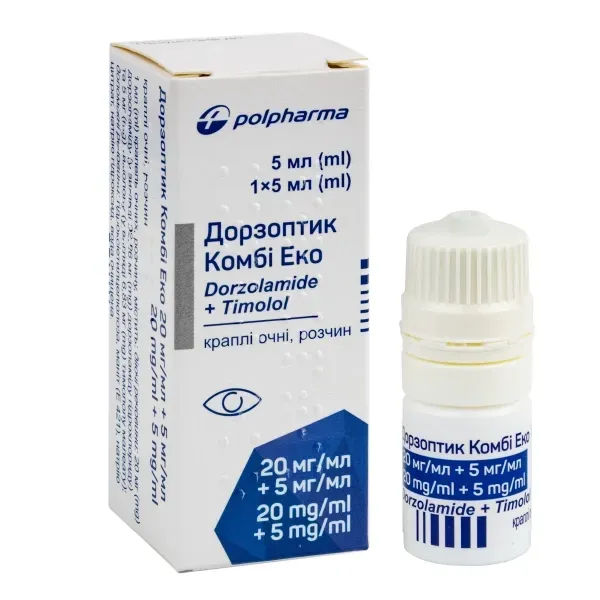
Table of Contents
INSTRUCTION FOR MEDICAL USE OF THE MEDICINAL PRODUCT DORZOPTIK ECO (DORZOPTIK ECO)
Composition:
Active substance: dorzolamide;
1 ml of eye drops, solution, contains 20 mg of dorzolamide (as 22.26 mg of dorzolamide hydrochloride);
Excipients: hydroxyethylcellulose, mannitol (E 421), sodium citrate, sodium hydroxide, water for injections.
Pharmaceutical form. Eye drops, solution.
Main physicochemical properties: clear, colorless, viscous solution.
Pharmacotherapeutic group. Medicinal products used in ophthalmology. Antiglaucoma preparations and miotics. Carbonic anhydrase inhibitors. Dorzolamide.
ATC code S01EC03.
Pharmacological Properties
Pharmacodynamics
Mechanism of Action
Carbonic anhydrase (CA) is an enzyme present in many tissues of the body, including the eyes. In humans, carbonic anhydrase exists in several isoenzyme forms, the most active of which is carbonic anhydrase II (CA-II), predominantly found in red blood cells (erythrocytes) as well as in other tissues. Inhibition of carbonic anhydrase in the ciliary processes of the eye reduces the secretion of aqueous humor. The result is a reduction in intraocular pressure (IOP).
Dorzoptic ECO contains dorzolamide hydrochloride, a potent inhibitor of human carbonic anhydrase II. After topical ocular administration, dorzolamide reduces elevated IOP, whether or not associated with glaucoma. Elevated IOP is a major risk factor in the pathogenesis of optic nerve damage and visual field loss. Dorzolamide does not cause miosis and reduces intraocular pressure without side effects such as night blindness or accommodation spasm. Dorzolamide has minimal or no effect on pulse rate or blood pressure.
Topical application of beta-adrenergic blockers also reduces intraocular pressure by decreasing aqueous humor secretion, but through a different mechanism of action. Studies have shown that adding dorzolamide to topical beta-adrenergic blockers results in an additional reduction in IOP; these findings are consistent with reports of additive effects between beta-adrenergic blockers and oral carbonic anhydrase inhibitors.
Clinical Effects
Adult Patients. In patients with glaucoma or ocular hypertension, the efficacy of dorzolamide administered either as monotherapy three times daily (baseline IOP ≥23 mmHg) or twice daily as adjunctive therapy to topical beta-adrenergic blockers (baseline IOP ≥22 mmHg) has been demonstrated in large-scale clinical trials lasting up to one year. The IOP-lowering effect of dorzolamide, both as monotherapy and as adjunctive therapy, was maintained throughout the day and persisted during long-term use. The efficacy of long-term monotherapy was similar to that of betaxolol and slightly less than that of timolol.
When used as adjunctive therapy to topical beta-adrenergic blockers, dorzolamide demonstrated an additional IOP reduction comparable to that of 2% pilocarpine administered four times daily.
In a controlled, crossover, double-masked, multicenter study with multiple dosing of active treatment (dorzolamide with preservative) and two periods involving 152 patients with elevated baseline intraocular pressure (baseline IOP ≥22 mmHg) in one or both eyes, preservative-free dorzolamide showed an IOP-lowering effect equivalent to that of dorzolamide with preservative. The safety profile of preservative-free dorzolamide was similar to that of dorzolamide with preservative.
Pediatric Patients. A 3-month, double-masked, active-controlled, multicenter study was conducted in children aged 1 week to <6 years with glaucoma or elevated intraocular pressure (baseline IOP ≥22 mmHg) to evaluate the safety of dorzolamide (preserved formulation) when administered topically three times daily. Approximately half of the patients in both treatment groups had congenital glaucoma; other common causes of elevated intraocular pressure included Sturge-Weber syndrome, mesenchymal dysgenesis of the iris and cornea; there were also patients with aphakia.
Overall, this study did not reveal additional safety concerns in children. Treatment-related adverse events were observed in approximately 26% (20% with dorzolamide monotherapy) of children, most of which were mild, local ocular reactions such as burning and stinging, prickling, and eye pain. Corneal edema or clouding was observed in less than 4% of patients. The frequency of local reactions was similar to that of the comparator drug. Post-marketing reports have described metabolic acidosis in very young children, particularly those with immature or impaired renal function.
Efficacy results in pediatric patients indicate that the mean reduction in IOP observed in the dorzolamide group was comparable to the mean reduction observed in the timolol group, although a slight quantitative advantage was seen with timolol.
Long-term efficacy data (>12 weeks) are lacking.
Pharmacokinetics
Unlike oral carbonic anhydrase inhibitors, topical administration of dorzolamide hydrochloride allows the active substance to act directly on the eye, even at low doses, thereby minimizing systemic effects. In clinical studies, dorzolamide produced IOP reduction without the acid-base imbalances or electrolyte changes typical of oral carbonic anhydrase inhibitors.
After topical administration, dorzolamide enters the systemic circulation. To assess the potential for systemic carbonic anhydrase inhibition following topical use, concentrations of the active substance and its metabolite were measured in erythrocytes and plasma, along with carbonic anhydrase inhibition in erythrocytes. Dorzolamide accumulates in erythrocytes during chronic administration due to selective binding to CA-II, while free drug concentrations in plasma remain extremely low. A single N-desethyl metabolite is formed from the parent compound, which inhibits CA-II to a lesser extent than the parent drug but also inhibits the less active isoenzyme (CA-I). The metabolite also accumulates in erythrocytes, where it binds primarily to CA-I. Dorzolamide is moderately bound to plasma proteins (approximately 33%). Dorzolamide is primarily excreted unchanged in urine; the metabolite is also excreted in urine. After discontinuation, dorzolamide is eliminated from erythrocytes nonlinearly: initially, there is a rapid decline in active substance concentration, followed by a slow elimination phase with a half-life of approximately four months.
When dorzolamide was administered orally to simulate maximum systemic exposure following chronic topical ocular administration, steady state was reached within 13 weeks. At steady state, free active substance or metabolite was practically undetectable in plasma; carbonic anhydrase inhibition in erythrocytes was less than that considered necessary to affect renal or respiratory function pharmacologically. Similar pharmacokinetic results were obtained after chronic topical administration of dorzolamide.
In some elderly patients with impaired renal function (creatinine clearance estimated at 30–60 mL/min), higher concentrations of metabolites in erythrocytes were observed, but this was not associated with significant differences in carbonic anhydrase inhibition and did not lead to clinically significant systemic adverse effects directly related to this increase.
Clinical characteristics
Indications
Elevated intraocular pressure in patients with:
- ocular hypertension;
- open-angle glaucoma;
- pseudoexfoliative glaucoma.
Dorzoptic ECO should be used as adjunctive therapy to beta-blockers or as monotherapy when treatment with beta-blockers has not been successful or beta-blockers are contraindicated.
Contraindications
Hypersensitivity to dorzolamide or to any of the excipients of the medicinal product.
Severe renal impairment (creatinine clearance less than 30 mL/min).
Hyperchloremic acidosis.
Interaction with other medicinal products and other forms of interaction
No specific interaction studies of dorzolamide with other agents have been conducted.
In clinical studies, dorzolamide was used concomitantly with timolol and betaxolol in the form of eye drops, and with systemically administered drugs: angiotensin-converting enzyme (ACE) inhibitors, calcium channel blockers, diuretics, and nonsteroidal anti-inflammatory drugs (NSAIDs), including acetylsalicylic acid, as well as with hormonal agents (e.g., estrogens, insulin, thyroxine) — without any occurrence of drug interactions.
The interaction of dorzolamide with miotics and adrenergic agents during glaucoma treatment has not been sufficiently studied.
Special precautions for use
Special features of dorzolamide use in patients with impaired liver function have not been established (it should be used with caution).
When treating patients with acute angle-closure glaucoma, in addition to using agents that reduce intraocular pressure, other therapeutic measures should also be applied. The use of dorzolamide in patients with acute angle-closure glaucoma has not been studied.
Dorzolamide contains a sulfonamide group and, although administered locally, undergoes systemic absorption. Therefore, when used as eye drops, adverse reactions typical of sulfonamides may occur, including Stevens-Johnson syndrome and toxic epidermal necrolysis (Lyell's syndrome). If serious adverse reactions or signs of hypersensitivity occur, the drug should be discontinued.
The use of oral carbonic anhydrase inhibitors has been associated with the development of urinary tract stones due to water-electrolyte disturbances, particularly in patients with a history of nephrolithiasis. Although water-electrolyte disturbances have not been observed with dorzolamide use, rare cases of urolithiasis have been reported. Since dorzolamide is a locally acting carbonic anhydrase inhibitor that enters systemic circulation, patients with a history of nephrolithiasis belong to a high-risk group for developing urolithiasis during dorzolamide treatment.
If allergic reactions occur (e.g., conjunctivitis and eyelid reactions), the drug should be discontinued and medical advice should be sought.
There is a potential risk of additive systemic effects in patients receiving both oral carbonic anhydrase inhibitors and dorzolamide. Concomitant use of dorzolamide and oral carbonic anhydrase inhibitors is not recommended.
Corneal edema and irreversible corneal decompensation have been reported in patients with chronic corneal defects and/or a history of intraocular surgery during treatment with dorzolamide (preserved formulation). Dorzolamide for topical use should be administered with caution in such patients.
Cases of choroidal detachment have been observed during treatment with agents that suppress aqueous humor production following filtration procedures.
Contact lens use
The effect of dorzolamide has not been studied in patients wearing contact lenses. Patients should be advised to remove contact lenses before administering the drug and not to reinsert them earlier than 15 minutes after administration.
Children
The effect of dorzolamide has not been studied in patients with a gestational age of less than 36 weeks and age under 1 week. Patients with significant immaturity of renal tubules should receive dorzolamide only after careful risk-benefit assessment due to the potential risk of metabolic acidosis.
Use during pregnancy or breastfeeding
Pregnancy
Dorzoptic ECO should not be used during pregnancy.
There are no adequate clinical data on the effects during pregnancy. In rabbits, dorzolamide showed teratogenic effects when administered at doses toxic to the mother.
Breastfeeding
It is unknown whether dorzolamide is excreted in human breast milk. In rat studies during lactation, dorzolamide administration was associated with reduced body weight in rat pups.
If treatment with Dorzoptic ECO is necessary, breastfeeding is not recommended.
Fertility
Animal studies do not indicate an effect of dorzolamide treatment on male or female fertility. Data on the effect on human fertility are insufficient.
Ability to affect reaction speed when driving or operating machinery
Studies on the effect of the medicinal product on the ability to drive or operate machinery have not been conducted. Possible adverse reactions such as dizziness and blurred vision may negatively affect the ability of some patients to drive or operate machinery.
Method of Administration and Dosage
In monotherapy, administer 1 drop into the affected eye 3 times daily.
In combination with beta-adrenergic blocking agents for local application, administer 1 drop into the affected eye 2 times daily.
When switching from treatment with another ophthalmic medication to Dorzoptic ECO, discontinue the previous medication after its last regular daily dose and initiate treatment with Dorzoptic ECO the following day.
If several topical ophthalmic agents are used, they should be administered at intervals of at least 10 minutes. Ophthalmic ointments should be applied last.
Method of Administration
The medicinal product is intended for topical ophthalmic use.
Dorzoptic ECO is a sterile solution that does not contain preservatives.
Before instilling eye drops:
- At first use, before administering a drop into the eye, the patient should first practice using the dropper bottle: slowly squeeze the bottle to dispense one drop into the air, away from the eye.
- Once the patient feels confident in administering single drops, they should choose a comfortable position for instillation (sitting, lying on the back, or standing in front of a mirror).
Administration Procedure
- Wash hands thoroughly before using the medicinal product.
- Check the integrity of the packaging. Do not use the product if the packaging is damaged.
- At first use, unscrew the cap of the dropper bottle, ensuring that the tamper-evident ring on the cap is intact. A slight resistance should be felt during unscrewing until the tamper-evident ring breaks.
- If the tamper-evident ring is compromised, the medicinal product should be discarded, as its use may cause eye injury.
- Tilt the head backward and gently pull down the lower eyelid to create a space between the eye and the eyelid.
- Instill one drop into this space by gently pressing the bottle. Squeeze the bottle carefully in the middle and allow the drop to fall into the eye. There may be a delay of several seconds between squeezing and the drop falling. Do not press too hard. If the patient is uncertain about the correct administration technique, they should consult a physician, pharmacist, or nurse.
- After instillation, close the eye and press with a finger on the inner corner of the eye for approximately 2 minutes—this helps prevent systemic absorption of the medicinal product.
- Avoid contact between the tip of the dropper bottle and the eyes, eyelids, or fingers.
- If necessary, repeat steps 5, 6, and 7 for the other eye, as directed by a physician.
- After use, before replacing the cap, tap the dropper bottle once with the tip pointing downward, without touching the tip, to remove residual liquid from the tip. This ensures the ability to administer the next drop. Then replace the cap.
If the drop does not enter the patient's eye, attempt instillation again.
The use of nasolacrimal occlusion or eyelid closure for 2 minutes after instillation reduces systemic absorption of the medicinal product. This helps minimize systemic adverse effects and enhances local action.
Children. Dorzoptic ECO should not be used in children.
Overdose
Limited data are available on overdose in humans following accidental or intentional ingestion of dorzolamide hydrochloride.
Symptoms
Somnolence has been reported after oral ingestion. With topical administration, nausea, dizziness, headache, weakness, unusual dreams, and dysphagia (difficulty swallowing) have been observed.
Treatment
Treatment is symptomatic and supportive.
Electrolyte imbalance, development of acidosis, and possible central nervous system disturbances cannot be ruled out. Serum electrolyte levels (especially potassium) and blood pH should be monitored.
Adverse Reactions
The undesirable effects listed below have been reported during clinical trials or post-marketing use of dorzolamide.
Frequency is defined according to the following categories: very common (≥ 1/10); common (≥ 1/100 to < 1/10); uncommon (≥ 1/1,000 to < 1/100); rare (≥ 1/10,000 to < 1/1,000); frequency not known (cannot be estimated from available data).
Nervous system disorders:
common — headache;
rare — dizziness, paraesthesia.
Eye disorders:
very common — stinging and burning;
common — superficial punctate keratitis, lacrimation, conjunctivitis, blepharitis, eye pruritus, eyelid irritation, blurred vision;
uncommon — iridocyclitis;
rare — irritation and redness, pain, eyelid desquamation, transient myopia (which resolves after discontinuation of treatment), corneal edema, ocular hypotony, uveitis following filtration surgery;
frequency not known — sensation of foreign body in the eye.
Cardiac disorders:
frequency not known — palpitations, tachycardia.
Vascular disorders:
frequency not known — arterial hypertension.
Respiratory, thoracic and mediastinal disorders:
rare — epistaxis;
frequency not known — dyspnoea.
Gastrointestinal disorders:
common — nausea, bitter taste;
rare — throat irritation, dry mouth.
Skin and subcutaneous tissue disorders:
rare — contact dermatitis, Stevens-Johnson syndrome, toxic epidermal necrolysis.
Renal and urinary disorders:
rare — urolithiasis.
General disorders and administration site conditions:
common — asthenia/fatigue;
rare — hypersensitivity symptoms: local-palpebral reactions, systemic allergic reactions including angioneurotic edema, urticaria, pruritus, rash, dyspnoea;
rare — bronchospasm.
Laboratory test results:
Administration of dorzolamide has not been associated with clinically significant disturbances in electrolyte levels.
Reporting of adverse reactions
Reporting adverse reactions after drug authorization is important. It allows continued monitoring of the benefit-risk balance of the medicinal product. Healthcare professionals, pharmacists, as well as patients or their legal representatives are encouraged to report all suspected adverse reactions and lack of efficacy through the Automated Pharmacovigilance Information System at the following link: https://aisf.dec.gov.ua.
Shelf life: 2 years.
Shelf life after first opening of the container: 90 days, provided the product is stored at a temperature not exceeding 25 °C.
Storage conditions
Store at a temperature not exceeding 30 °C.
Keep out of reach and sight of children.
Packaging
5 ml of solution in a 5 ml low-density polyethylene dropper bottle with a tamper-evident cap. One bottle per cardboard box.
Prescription status: Prescription only.
Manufacturer: Rafarm S.A.
Manufacturer's address and place of business
Tesi Pousi Agiou Luka, Payania, 190 02, Greece