Dolobene
Ukraine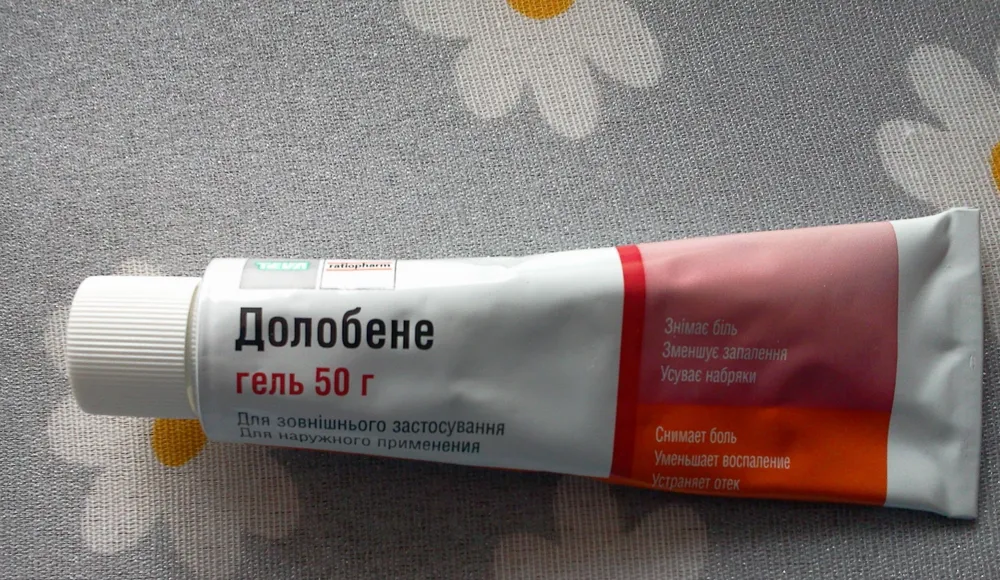
Table of Contents
INSTRUCTION FOR MEDICAL USE OF THE MEDICINAL PRODUCT Dolobene (Dolobene®)
Composition:
Active substances: sodium heparin, dimethyl sulfoxide, dexpanthenol;
100 g of gel contains 50,000 IU of sodium heparin, 15 g of dimethyl sulfoxide, 2.5 g of dexpanthenol;
Excipients: carbomer, tromethamine, polyglycolysed glycerides, isopropyl alcohol, rosemary oil, alpine pine oil, citronella oil, purified water.
Pharmaceutical form. Gel.
Main physicochemical characteristics: transparent or slightly opalescent, homogeneous, colorless or yellowish gel with a characteristic odor.
Pharmacotherapeutic group. Topical agents for joint and muscular pain. ATC code M02AX.
Pharmacological properties.
Pharmacodynamics.
Dimethyl sulfoxide (DMSO)
DMSO exerts anti-inflammatory, local analgesic, and anti-edematous effects. The anti-inflammatory effect is based on several pharmacological actions, the main of which is inactivation of hydroxyl radicals that are produced in large amounts during inflammation and lead to tissue destruction.
DMSO exerts local analgesic action by reducing the conduction velocity of excitatory impulses in peripheral neurons. The anti-edematous effect is explained by inactivation of hydroxyl radicals and, consequently, improvement of metabolic processes at the site of inflammation. The hygroscopic properties of DMSO also partially contribute to this effect.
Heparin
Heparin competitively inhibits the activity of hyaluronidase, thereby preventing excessive degradation of connective tissue during inflammation. Thus, heparin exerts an anti-inflammatory effect and promotes healing. In addition, heparin exerts a dose-dependent antithrombotic effect by significantly enhancing the inhibitory effect of antithrombin III on the activation of prothrombin and thrombin.
Dexpanthenol
When applied topically, dexpanthenol is converted in the skin into pantothenic acid – a vitamin of the B group. Dexpanthenol has the same biological efficacy as pantothenic acid. Pantothenic acid, a component of coenzyme A, participates in various synthetic and catabolic reactions in all tissues and supports regeneration processes during wound healing and epithelialization.
Pharmacokinetics.
Dimethyl sulfoxide (DMSO)
DMSO is present in human plasma as a natural substance at a concentration of approximately 40 ng/mL. After a single application of 1.5 g of Dolobene gel to a skin surface area of 400 cm², DMSO is absorbed with a half-life of 3–4 hours. Six hours after application, the plasma concentration reaches a plateau (approximately 120 ng/mL) and remains at this level until 12 hours after application. The elimination half-life of DMSO from plasma is 11–14 hours. Sixty hours after application, endogenous plasma concentration is restored.
12–25% of DMSO is excreted within the first 24 hours, and 37–48% within 7 days, unchanged in urine as DMSO or in the form of its main metabolite, dimethyl sulfone (DMSO₂). 3.5–6% of the total dose of DMSO is exhaled via the lungs within 6–12 hours after application as dimethyl sulfide (DMS).
Heparin
Penetration of heparin through intact skin is dose-dependent and has been confirmed for concentrations of 300 IU/g. Pharmacokinetic data on heparin after topical application are not available.
Dexpanthenol
Dexpanthenol is absorbed more rapidly than pantothenic acid. The rapid absorption of dexpanthenol has been experimentally confirmed.
Clinical characteristics.
Indications.
Dolobene, gel, is indicated for the treatment of:
- injuries (including sports injuries), bruises, injuries of muscles, periarticular structures or joints (without skin damage);
- tendinitis and tenosynovitis, bursitis, periarthritis of the shoulder and elbow (pathological basis of the clinical syndrome "tennis elbow");
- acute neuralgia.
Contraindications.
Hypersensitivity to any component of the drug; severe impairment of liver and/or kidney function; bronchial asthma; unstable hemodynamics, severe cardiovascular disorders (severe angina pectoris, myocardial infarction, stroke, severe generalized atherosclerosis); bleeding leg ulcers, open and/or infected wounds, hemorrhagic diathesis, purpura, thrombocytopenia, hemophilia, tendency to bleeding; comatose states, glaucoma, cataract; concomitant use with medicinal products containing sulindac; pregnancy or breastfeeding.
Interaction with other medicinal products and other forms of interactions.
Concomitant use of other topical medicinal products may lead to enhanced absorption. Due to the ability of dimethyl sulfoxide to enhance both the specific activity and the toxicity of certain medicinal products, simultaneous application of other topical medicinal products should be avoided.
Dolobene, containing dimethyl sulfoxide, must not be used concomitantly with sulindac (a non-steroidal anti-inflammatory drug) due to the risk of severe toxic reactions (peripheral neuropathy).
Heparin application may contribute to prolonged prothrombin time in patients receiving oral anticoagulants. Dimethyl sulfoxide enhances the effects of ethanol (alcohol inhibits drug elimination) and insulin, acetylsalicylic acid, butadione; digitalis preparations, quinidine, nitroglycerin, antibiotics (streptomycin, monomycin, etc.), and increases organism sensitivity to anesthetic agents.
Special precautions for use
Dolobene should not be used in patients who may be allergic to dimethyl sulfoxide and/or heparin (history of allergy).
The product contains isopropyl alcohol; therefore, to avoid painful reactions, it should not be applied to mucous membranes, open wounds, or damaged skin (e.g., following radiation therapy, in cases of dermatitis, dermatoses, postoperative scars, or burns).
Other medicinal products should not be applied to the treated skin areas for several hours before and after application of Dolobene gel. To prevent adverse effects, the product should be applied only to skin that is clean and free from other medicinal products, cosmetics, and contaminants. Contact with the eyes should be avoided.
Application of dimethyl sulfoxide may cause photosensitization. Therefore, exposure to sunlight and use of tanning beds should be avoided during treatment with Dolobene gel. If hypersensitivity reactions occur, use of the product should be discontinued. Dolobene should not be used in patients with systemic lupus erythematosus.
Use during pregnancy or breastfeeding
There have been reports of potential teratogenic effects of DMSO in animals.
Experience with the use of dimethyl sulfoxide in pregnant women is currently insufficient. Therefore, the use of Dolobene during pregnancy or breastfeeding is contraindicated.
Dimethyl sulfoxide passes into breast milk; therefore, the use of Dolobene during breastfeeding is contraindicated.
Ability to influence reaction speed when driving or operating machinery
No specific studies on the effect of Dolobene on the ability to drive or operate machinery have been conducted. However, it is known that Dolobene generally does not affect the ability to drive or operate machinery.
Method of administration and dosage.
Apply the gel in a thin layer (e.g., a 3 cm strip of gel should be applied to an area corresponding to the size of the knee joint projection) to affected areas and/or around them (in case of bruises). The gel should not be rubbed in; it should be applied gently and spread evenly over the entire affected area. Repeat the procedure 1–2 times daily.
When applying dressings with Dolobene, use air-permeable wound material. Apply the dressing after most of the gel has penetrated into the skin and the alcohol contained in the preparation has evaporated (i.e., after several minutes).
When administering the drug via iontophoresis, apply the gel under the cathode, taking into account the anionic properties of heparin contained in Dolobene.
During phonophoresis, due to its excellent contact properties and content of active substances, the preparation enhances the physiotherapeutic effect of ultrasound waves.
The duration of treatment with Dolobene gel is determined individually by a physician, depending on the severity and course of the disease, as well as on the efficacy of therapy.
Children.
The drug should not be administered to children due to limited experience of use.
Overdose.
No cases of overdose have been observed with the use of Dolobene.
Cases of enhanced bruising and increased risk of bleeding have been reported following topical application of heparin in doses exceeding 180,000 IU. Gastrointestinal absorption of heparin is negligible; therefore, signs of overdose after accidental ingestion are unlikely.
Side effects.
Immune system side effects: allergic skin reactions; in individual cases, immediate-type allergic reactions such as urticaria and Quincke's edema are possible.
Cardiovascular system side effects: in individual cases, when applied to large areas of skin, cardiac disorders are possible (causal relationship not established).
Respiratory system side effects: in individual cases, when applied to large areas of skin, respiratory disorders are possible (causal relationship not established).
Gastrointestinal tract side effects: temporary garlic-like breath odor (due to dimethyl sulfide – a metabolite of dimethyl sulfoxide); altered taste sensations, which resolve within several minutes; in individual cases, when applied to large areas of skin – stomach discomfort, nausea, vomiting, diarrhea, constipation, or anorexia (causal relationship not established).
Skin side effects: photosensitivity reactions.
General disorders: erythema, itching, burning, blisters, urticaria at the application site. These reactions usually disappear during treatment. Otherwise, the use of the medicinal product should be discontinued. In individual cases, when applied to large skin areas, increased fatigue, headache, and chills are possible (causal relationship not established).
Due to the action of dimethyl sulfoxide: dizziness, insomnia, adynamia, dermatitis, bronchospasm, vomiting.
Due to the action of dexpanthenol: contact dermatitis, allergic dermatitis, eczema, rash, skin irritation.
Due to the action of heparin: skin swelling, skin rash, hemorrhages; occasionally, small pustules, vesicles, or bullae may develop, which rapidly resolve after discontinuation of the medicinal product.
Shelf life. 3 years.
Storage conditions. Store at a temperature not exceeding 25 °C. Keep out of reach of children.
Packaging. 20 g, 50 g, or 100 g of gel in a tube. 1 tube per carton.
Availability. Over-the-counter.
Manufacturer. Merckle GmbH.
Manufacturer's address and place of business.
Ludwig-Merckle-Strasse 3, 89143 Blaubeuren, Germany.