Dolgit® mountain pine
Ukraine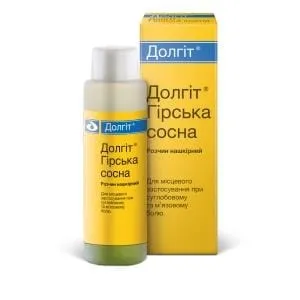
Table of Contents
INSTRUCTIONS FOR MEDICAL USE OF THE MEDICINAL PRODUCT DOLGIT® MOUNTAIN PINE
Composition:
Active substances: mountain pine oil (Dwarf pine oil), racemic camphor, levomenthol;
100 g of solution contains mountain pine oil (Dwarf pine oil) 1.4 g, racemic camphor 0.87 g, levomenthol 0.7 g;
100 ml (91 g) of solution contains mountain pine oil (Dwarf pine oil) 1.274 g, racemic camphor 0.7917 g, levomenthol 0.637 g;
Excipients: ethanol 96% (v/v), purified water, polyethylene glycol-60-glycerol hydroxystearate, isobornyl acetate, sage oil, rosemary oil, herb oil, food colorant green (quinoline yellow (E 104), orange-yellow S (E 110), patent blue V (E 131), Ponceau 4R (E 124)).
Pharmaceutical form. Cutaneous solution.
Main physicochemical properties: transparent green liquid with a characteristic aromatic odor.
Pharmacotherapeutic group. Agents used locally for joint and muscle pain. ATC code M02A X10.
Pharmacological properties.
Pharmacodynamics.
A combined medicinal product whose action is determined by the components contained in its composition. Pine nut oil (from Pinus sylvestris) exerts an antioxidant effect and has antimicrobial properties. Camphor, when applied locally, exerts antimicrobial, anti-inflammatory, counterirritant, and analgesic effects. Levomenthol produces local anesthetic and anti-inflammatory actions. The preparation exerts a local irritant effect.
Pharmacokinetics.
Pharmacokinetic studies have not been conducted.
Clinical characteristics.
Indications.
Prevention of pressure ulcers. Bruises, dislocations, tendon strains, muscle pain.
Contraindications.
Hypersensitivity to the active substances or to any of the excipients. Cough, bronchial asthma, pseudocroup and other respiratory disorders associated with increased airway sensitivity; skin diseases and childhood illnesses with exanthema, open wounds, inflammation or superficial infections, eczema; diabetic microangiopathy, peripheral venous or arterial insufficiency; predisposition to seizures (febrile or other).
Interaction with other medicinal products and other forms of interaction.
Interaction with other medicinal products has not been studied; however, the product should not be used concomitantly with other topical agents.
Special precautions for use
The medicinal product should not come into contact with skin wounds, eyes, or mucous membranes. Hands should be thoroughly washed after each application.
Ensure that children do not touch with their hands the areas of skin to which the product has been applied.
When used externally as a compress, air-impermeable dressing materials should not be used. The medicinal product should not be used for wet compresses.
The medicinal product contains camphor. Inhalation of essential oils and camphor may cause laryngeal constriction, associated with severe respiratory distress or apnea in infants and children. Therefore, the medicinal product should not be used in children.
Polyglycol (macrogol)-60-glycerol hydroxystearate may cause skin reactions.
This medicinal product contains flavorings (sage oil, rosemary oil, savin oil) with amyl cinnamyl alcohol, benzyl alcohol, benzyl benzoate, benzyl cinnamate, benzyl salicylate, citral, citronellol, coumarin, eugenol, farnesol, geraniol, isoeugenol, d-limonene, and linalool, which may cause allergic reactions.
This medicinal product contains 50% (w/w) alcohol (ethanol). This may cause a burning sensation on damaged skin. In neonates (preterm and full-term newborns), the high concentration of ethanol may cause severe local reactions and systemic toxicity due to significant absorption through immature skin (especially under occlusion).
Use during pregnancy or breastfeeding
As there are no data on use during pregnancy or breastfeeding, the medicinal product should not be used during these periods.
Ability to affect reaction speed when driving vehicles or operating machinery
No studies have been conducted on the ability of the medicinal product to affect reaction speed when driving vehicles or operating machinery; however, the possibility of adverse reactions involving the nervous system should be taken into account.
Method of Administration and Dosage
Apply a thin layer to affected, unbroken skin areas 1–3 times daily and gently rub in with massage movements until the liquid dries.
If applying a dressing, allow the liquid to dry on the skin for several minutes before application. The use of an air-impermeable (occlusive) dressing is not recommended.
Concomitant use with cryotherapy (cold therapy) is not recommended due to possible additional skin irritation.
Application of the medication to large skin areas is not recommended.
Treatment duration is determined individually by a physician depending on the course of the disease and the patient's condition. Usually, it is about 7 days.
Instruction. In acute conditions, such as redness, swelling, burning sensation in joints, persistent joint pain, severe back pain radiating to legs, for example with numbness or tingling, or if no improvement occurs within 3 days of use, consult a physician.
Children. Do not use.
Overdose.
In case of overdose, a strong sensation of heat and burning at the application site may occur.
When applied to large skin areas or open wounds, significant absorption of the medicinal product may occur, potentially leading to seizures, respiratory depression, and hepatotoxic effects. In such cases, symptomatic treatment should be administered. Under no circumstances should milk or alcoholic beverages be consumed, as they may promote the absorption of essential oils.
Excessive dosage may cause skin irritation.
Incorrect use.
Accidental ingestion of the solution may cause gastrointestinal disturbances such as vomiting and diarrhea. Treatment is symptomatic.
Following accidental ingestion of a large amount of the product, acute poisoning has been observed with symptoms including nausea, vomiting, abdominal pain, headache, dizziness, sensation of warmth/flushing, seizures, respiratory depression, and coma. Patients with serious gastrointestinal or neurological symptoms of poisoning should be observed and treated symptomatically. Do not induce vomiting.
Side effects.
Possible manifestations of hypersensitivity reactions on the skin and mucous membranes; bronchospasm may be intensified. In rare cases, inhalation of essential oils may lead to coughing attacks. Allergic contact eczema is observed very rarely.
Immune system side effects: skin redness, itching, burning sensation, skin rash, including the formation of papules and pustules, urticaria, contact dermatitis.
Respiratory system side effects: throat irritation, airway obstruction, bronchospasm.
Nervous system side effects: headache; dizziness; excitation; seizures caused by camphor; increased photosensitivity.
Possible burns at the site of application of the medicinal product.
If redness, burning, or skin irritation occurs, the affected areas should be thoroughly rinsed with water.
If signs of hypersensitivity reactions occur, treatment must be discontinued and the product must not be used again.
Shelf life. 3 years.
Storage conditions. Store in the original packaging at a temperature not exceeding 25 °C. Keep out of reach of children.
Packaging. 100 mL, 250 mL, 500 mL, or 1000 mL in a polyethylene bottle. One bottle per cardboard box.
Prescription category. 100 mL – available without prescription; 250 mL, 500 mL, 1000 mL – available by prescription only.
Manufacturer/Marketing Authorisation Holder. Dr. Theiss Naturwaren GmbH.
Manufacturer's address and place of business.
Michelinstreet 10, 66424 Homburg, Germany
Date of last review.