Doxycycline hydrochloride
Ukraine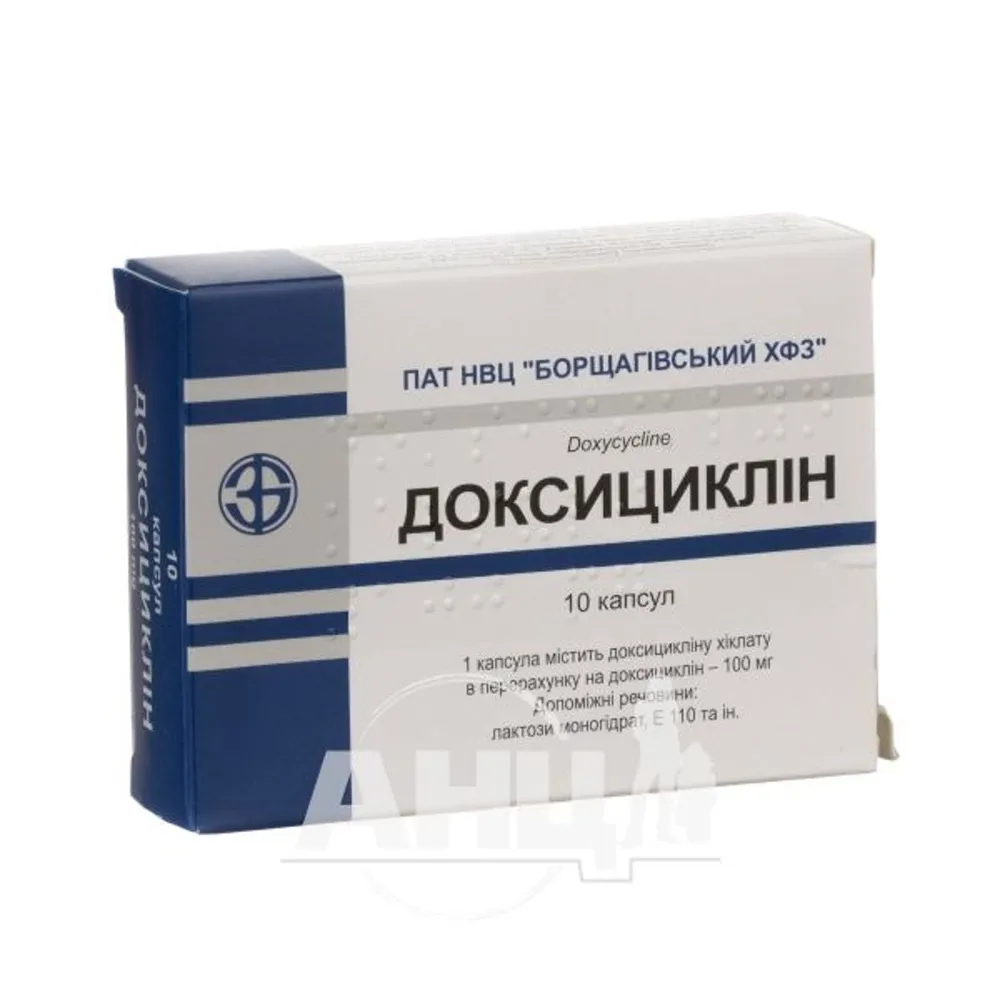
Table of Contents
INSTRUCTIONS FOR MEDICAL USE OF THE MEDICINAL PRODUCT DOXYCYCLINE HYDROCHLORIDE (Doxycycline hydrochloride)
Composition:
Active substance: doxycycline;
1 capsule contains 100 mg of doxycycline hyclate, equivalent to 100 mg of doxycycline;
Excipients: lactose monohydrate; magnesium stearate;
Hard gelatin capsule No. 3 contains:
gelatin, titanium dioxide (E 171), quinoline yellow (E 104), erythrosine (E 127) or gelatin, titanium dioxide (E 171), erythrosine (E 127), indigo carmine (E 132), iron oxide (E 172).
Pharmaceutical form. Capsules.
Main physicochemical characteristics: hard gelatin capsules No. 3 with a body of dark red, white or grey color and a cap of black, yellow or green color, with hemispherical ends. The capsule contents are a yellow powder.
Pharmacotherapeutic group.
Antibacterials for systemic use. Tetracyclines. ATC code J01AA02.
Pharmacological properties.
Pharmacodynamics.
Doxycycline exerts a bacteriostatic effect; its antimicrobial action is achieved by inhibition of protein synthesis. The drug is effective against a broad spectrum of Gram-positive and Gram-negative bacteria and some other microorganisms.
Pharmacokinetics.
After oral administration, the drug is rapidly and almost completely absorbed from the gastrointestinal tract. Food intake has a negligible effect on the absorption of doxycycline. The drug penetrates well and is widely distributed in all tissues and body fluids, but poorly penetrates into cerebrospinal fluid. Plasma protein binding ranges from 80% to 95%. It is slowly eliminated, with a half-life of 12–22 hours. It is excreted significantly in unchanged form in urine (40%), but the majority of the dose is excreted unchanged in feces via biliary excretion. With repeated administration, accumulation of the drug is possible.
Clinical characteristics.
Indications.
The drug is indicated for the treatment of various infections caused by susceptible strains of gram-positive and gram-negative microorganisms, as well as some other microorganisms, namely:
-Respiratory tract infections: pneumonia and other lower respiratory tract infections caused by susceptible strains of Streptococcus pneumoniae, Haemophilus influenzae, Klebsiella pneumoniae. Pneumonia caused by Mycoplasma pneumoniae. Treatment of chronic bronchitis, sinusitis.
-Urinary tract infections: infections caused by susceptible strains of Klebsiella, Enterobacter, as well as Escherichia coli, Streptococcus faecalis.
-Sexually transmitted diseases: infections caused by Chlamydia trachomatis, including uncomplicated urethral and endocervical infections and rectal infections. Nongonococcal urethritis caused by Ureaplasma urealyticum (T-mycoplasma). Chancroid, granuloma inguinale, lymphogranuloma venereum. Doxycycline hydrochloride is an alternative drug for the treatment of gonorrhea and syphilis.
-Skin infections: acne when antibiotic therapy is required.
Since doxycycline hydrochloride belongs to the group of tetracycline antibiotics, it can be used in infections caused by microorganisms susceptible to tetracyclines, namely:
-Ophthalmological infections: infections caused by susceptible bacteria such as gonococci, staphylococci, and Haemophilus influenzae. Infection causing trachoma is not always eliminated, as confirmed by immunofluorescence testing. For the treatment of trachoma, doxycycline hydrochloride can be used either as monotherapy or in combination with other medicinal agents.
-Rickettsial infections: Rocky Mountain spotted fever, typhus group fevers, Q fever, Coxiella-induced endocarditis, tick-borne fever.
-Other infections: ornithosis, brucellosis (when used in combination with streptomycin), cholera, bubonic plague, epidemic relapsing fever, tick-borne relapsing fever, tularemia, melioidosis, chloroquine-resistant tropical malaria, and acute intestinal amoebiasis (when used in combination with an amebicide).
Doxycycline hydrochloride is an alternative drug for the treatment of leptospirosis, gas gangrene, and tetanus.
Doxycycline hydrochloride is indicated for the prophylaxis of the following conditions: Japanese river fever (scrub typhus), traveler’s diarrhea (caused by enterotoxigenic Escherichia coli), leptospirosis, malaria. Malaria prophylaxis should be conducted according to current guidelines due to the potential development of resistance.
Contraindications.
Hypersensitivity to doxycycline or tetracyclines, or to any excipient of the drug.
Pregnancy or breastfeeding (see section "Use during pregnancy or breastfeeding").
Children under 12 years of age (see section "Children").
Interaction with other medicinal products and other forms of interaction.
The absorption of doxycycline may be reduced when administered concomitantly with antacids containing aluminum, calcium, magnesium, or other preparations containing these cations, as well as with oral zinc, iron salts, or bismuth preparations. Administration of doxycycline together with such agents should be separated in time as much as possible.
Bacteriostatic agents may interfere with the bactericidal action of penicillin; therefore, concomitant use of doxycycline with penicillin is not recommended.
There have been reports of prolonged prothrombin time in patients taking warfarin and doxycycline. Tetracyclines reduce plasma prothrombin activity; therefore, a reduction in anticoagulant dosage may be necessary.
When barbiturates, carbamazepine, and phenytoin are used concomitantly, the elimination half-life of doxycycline may be reduced; therefore, consideration should be given to increasing the daily dose of doxycycline hydrochloride.
Alcohol may reduce the elimination half-life of doxycycline.
There have been reports of pregnancies and breakthrough bleeding occurring during concomitant use of tetracycline antibiotics and oral contraceptives.
Doxycycline may increase plasma concentrations of cyclosporine. Concomitant use of these drugs should be accompanied by careful monitoring.
There have been reports of fatal nephrotoxicity associated with concomitant use of tetracyclines and methoxyflurane.
Concomitant use of isotretinoin or other systemic retinoids with doxycycline should be avoided. Each of these agents alone has been associated with the development of benign intracranial hypertension (pseudotumor cerebri) (see section "Special precautions").
Laboratory parameters.
False elevations in urinary catecholamine levels may occur due to interference with fluorescent tests.
Cholestyramine reduces the absorption of doxycycline.
Special precautions for use
Patients with hepatic impairment. Doxycycline hydrochloride should be used with caution in patients with impaired liver function and in those concurrently receiving potentially hepatotoxic medicinal products. Alterations in liver function parameters have been reported rarely during oral as well as parenteral administration of tetracyclines, including doxycycline.
Patients with renal impairment. In patients with normal renal function, renal excretion of doxycycline accounts for approximately 40% over 72 hours. This value may decrease to 1–5% over 72 hours in patients with severe renal impairment (creatinine clearance below 10 mL/min). Studies have shown no significant difference in the serum elimination half-life of doxycycline between patients with normal renal function and those with severe renal impairment. Haemodialysis does not influence the serum elimination half-life of doxycycline.
The anti-anabolic effect of tetracyclines may increase blood urea levels. Studies have shown that this anti-anabolic effect does not occur when doxycycline hydrochloride is administered to patients with impaired renal function.
Serious skin reactions. Serious skin reactions such as exfoliative dermatitis, erythema multiforme, Stevens-Johnson syndrome, toxic epidermal necrolysis, and drug reaction with eosinophilia and systemic symptoms (DRESS) have been reported in patients receiving doxycycline (see section "Adverse reactions"). If serious skin reactions occur, doxycycline should be discontinued immediately and appropriate therapy initiated.
Photosensitivity. This effect manifests as an exaggerated response to sunlight exposure and has been observed in some patients receiving tetracyclines, including doxycycline. Patients who are to be exposed to direct sunlight or ultraviolet radiation should be informed of the possibility of this reaction and advised to discontinue treatment at the first sign of erythema. Cases of photo-onycholysis have been reported in patients receiving doxycycline (see section "Adverse reactions").
Benign intracranial hypertension. Bulging of the fontanelle has been reported in infants receiving tetracycline therapy. Benign intracranial hypertension (pseudotumour cerebri) has been associated with the use of tetracyclines, including doxycycline. Benign intracranial hypertension (pseudotumour cerebri) is usually transient, but cases of irreversible vision loss due to benign intracranial hypertension (pseudotumour cerebri) have been reported during tetracycline (including doxycycline) therapy. Ophthalmological examination should be performed urgently if visual disturbances occur during treatment. Since intracranial pressure may remain elevated for several weeks after discontinuation of the drug, patients should be monitored until their condition stabilizes. Concomitant use of isotretinoin, as well as other systemic retinoids, with doxycycline should be avoided, as isotretinoin is also known to cause benign intracranial hypertension (pseudotumour cerebri) (see section "Interaction with other medicinal products and other forms of interaction").
Overgrowth of microorganisms. Antibiotic use may occasionally lead to overgrowth of non-susceptible microorganisms, including those of the genus Candida. If resistance develops, antibiotic use should be discontinued and appropriate therapy initiated.
Pseudomembranous colitis has been reported in patients receiving antibacterial agents, including doxycycline. The severity of the condition ranged from mild to life-threatening. This diagnosis should be considered in patients who develop diarrhoea following antibacterial therapy.
Diarrhoea associated with Clostridium difficile (CDAD) has been reported with the use of antibacterial agents, including doxycycline, with severity ranging from mild to fatal colitis. Antibacterial agents alter the normal gut flora, leading to overgrowth of C. difficile.
C. difficile produces toxins A and B, which contribute to the development of CDAD.
Toxin-producing strains of C. difficile may increase morbidity and mortality, as these infections may be refractory to antibacterial therapy and may require colectomy. This diagnosis should be considered in patients who develop diarrhoea following antibacterial therapy. Careful medical history is necessary, as cases of CDAD have been reported up to two months after completion of antibacterial therapy.
Oesophagitis. Oesophagitis and oesophageal ulceration have been reported with tetracyclines, including doxycycline, in capsule form. Most patients who experienced these adverse events had taken the medication immediately before going to bed or with insufficient fluid.
Porphyria. Rarely, porphyria has been reported in patients receiving tetracyclines.
Venereal diseases. During treatment of venereal diseases, appropriate diagnostic tests, including dark-field microscopy, should be performed if coexisting syphilis is suspected. In such cases, serological testing should be repeated monthly for at least four months.
Infections caused by β-haemolytic streptococci. For infections caused by group A β-haemolytic streptococci, treatment should last at least 10 days.
Myasthenia gravis. Due to the possibility of mild neuromuscular blockade, the medicinal product should be used with caution in patients with myasthenia gravis.
Systemic lupus erythematosus. The use of tetracyclines may exacerbate the course of systemic lupus erythematosus.
Methoxyflurane. Methoxyflurane should be used with caution in combination with tetracyclines.
The medicinal product contains lactose and therefore should not be administered to patients with rare hereditary forms of galactose intolerance, lactase deficiency, or glucose-galactose malabsorption syndrome.
Use during pregnancy or breast-feeding.
The use of tetracyclines during tooth development (i.e., during pregnancy) may cause permanent discoloration of teeth (yellow-brown-grey). This adverse reaction is more commonly associated with prolonged use, but may also occur with repeated short courses of treatment. Hypoplasia of the enamel has also been reported.
Animal studies indicate that tetracyclines cross the placenta, affect fetal tissues, and may have toxic effects on the developing fetus (often associated with delayed skeletal development).
Therefore, the medicinal product is contraindicated during pregnancy.
Tetracyclines are excreted in breast milk; therefore, the use of the medicinal product is contraindicated during breast-feeding (see above information regarding use during tooth development).
Ability to influence the ability to drive and use machines.
The effect of doxycycline on the ability to drive or operate machinery has not been studied. If adverse reactions such as arterial hypotension, tinnitus, blurred vision, scotoma, diplopia, or prolonged loss of vision occur, patients should refrain from driving or operating machinery.
Method of Administration and Dosage
Capsules should be taken regularly every morning, with breakfast or another meal, and with sufficient fluid. Administration with food reduces the risk of gastrointestinal disturbances. It is not recommended to take capsules immediately before bedtime.
Adults and children aged 12 years and older with body weight over 45 kg. The usual dose of Doxycycline hydrochloride for adults in the treatment of acute infections is 200 mg on the first day of treatment (as a single dose or 100 mg every 12 hours), followed by 100 mg daily in subsequent days. In the treatment of severe infections, the drug should be administered at a dose of 200 mg daily throughout the entire treatment period.
Exceeding the recommended dose may increase the frequency of adverse reactions. Therapy should be continued for 24–48 hours after the disappearance of symptoms and fever.
In streptococcal infections, treatment should be continued for 10 days to prevent the development of rheumatic fever or glomerulonephritis.
Children. For children aged 12 years and older with body weight up to 45 kg, the recommended dose is 4.4 mg/kg body weight (on the first day of treatment, the recommended dose may be administered as a single dose or in two divided doses); in subsequent days, the dose is 2.2 mg/kg body weight (in one or two doses). In more severe infections, the dose may be increased up to 4.4 mg/kg body weight.
Use of the drug for the treatment of specific infections.
Sexually transmitted diseases: for the treatment of uncomplicated gonococcal infections (except anorectal infections in men), uncomplicated urethral and endocervical infections, and rectal infections caused by Chlamydia trachomatis, and non-gonococcal urethritis caused by Ureaplasma urealyticum, the recommended dose is 100 mg twice daily for 7 days.
For the treatment of acute epididymo-orchitis caused by Chlamydia trachomatis or Neisseria gonorrhoeae, the drug should be administered at 100 mg twice daily for 10 days.
For the treatment of primary and secondary syphilis, the recommended dose for patients without confirmed pregnancy and with penicillin allergy is 200 mg orally twice daily for 2 weeks (as an alternative to penicillin therapy).
Epidemic relapsing fever, tick-borne relapsing fever: the recommended dose of the drug is 100–200 mg as a single dose, depending on the severity of the disease.
Chloroquine-resistant tropical malaria: the recommended dose is 200 mg daily for at least 7 days due to the potentially severe course of the infection.
Always, as an adjunctive therapy to Doxycycline hydrochloride, a fast-acting schizonticide (e.g., quinine) should be used, with dosage varying depending on the case, due to the potentially severe course of the infection.
Acne: the drug should be prescribed at a dose of 50 mg daily for 6–12 weeks.
Malaria prophylaxis: the recommended dose for adults is 100 mg daily. For children aged 12 years and older, the recommended dose is 2 mg/kg daily, up to a total dose of 100 mg daily. Prophylaxis may be initiated 1–2 days before travel to a malaria-endemic region. Prophylactic use of the drug should continue daily during the stay in the malaria-endemic region and for 4 weeks after leaving the region. Current guidelines for malaria treatment should also be considered.
Prophylaxis of Japanese encephalitis: the recommended dose is 200 mg as a single dose.
Traveler's diarrhea prophylaxis in adults: the recommended dose is 200 mg on the first day of travel (administered as a single 200 mg dose or 100 mg every 12 hours), followed by 100 mg daily on subsequent travel days. Information on the use of the drug for more than 21 days for prophylaxis is lacking.
Leptospirosis prophylaxis: the recommended dose is 200 mg once weekly throughout the stay in a leptospirosis-endemic region and 200 mg at the end of the trip. Information on the use of the drug for more than 21 days for prophylaxis is lacking.
Use in elderly patients: the drug can be used at standard doses without special precautions. Dose adjustment is not necessary in renal impairment. Doxycycline hydrochloride may be the drug of choice for elderly patients, as its use is less associated with esophageal irritation and ulceration.
Use in patients with hepatic impairment – see section "Special Warnings and Precautions for Use".
Use in patients with renal impairment – studies have shown that administration of the drug at recommended doses does not lead to antibiotic accumulation in this patient group (see section "Special Warnings and Precautions for Use").
Children.
The drug is contraindicated for use in children under 12 years of age.
Like other tetracyclines, Doxycycline hydrochloride forms stable calcium complexes in any calcifying tissue. Decreased growth of the tibia has been observed in premature infants receiving tetracyclines orally at a dose of 25 mg/kg every 6 hours. This adverse reaction is reversible upon discontinuation of the drug.
The use of tetracyclines during tooth development (in children under 12 years of age) may cause permanent discoloration of teeth (yellow-brown-gray). This adverse reaction is more common with prolonged use but may also occur during repeated short courses of treatment. Cases of enamel hypoplasia have also been reported.
Overdose.
Acute overdose of antibiotics is rare. In case of overdose, administration of the drug should be discontinued, gastric lavage should be performed, and supportive and symptomatic therapy should be initiated.
Dialysis does not affect the elimination half-life of the drug from plasma and is therefore ineffective in overdose.
Adverse reactions.
The following adverse reactions have been observed in patients receiving tetracyclines, including doxycycline.
Classification of adverse reaction frequency according to CIOMS III (III Working Group of the Council for International Organizations of Medical Sciences): very common — ≥ 1/10 (≥ 10%); common — from ≥ 1/100 to < 1/10 (≥ 1% and < 10%); uncommon — from ≥ 1/1000 to < 1/100 (≥ 0.1% and < 1%); rare — from ≥ 1/10000 to < 1/1000 (≥ 0.01% and < 0.1%).
Infections and infestations. Uncommon: vaginal infection; rare: Candida fungal infection.
Blood and lymphatic system disorders. Rare: hemolytic anemia, neutropenia, thrombocytopenia, eosinophilia.
Immune system disorders. Common: anaphylactic reaction (including angioneurotic edema, systemic lupus erythematosus exacerbation, pericarditis, hypersensitivity, serum sickness, Henoch-Schönlein purpura, hypotension, dyspnea, tachycardia, peripheral edema, and urticaria); rare: drug reaction with eosinophilia and systemic symptoms (DRESS syndrome).
Endocrine disorders. Rare: brown-black discoloration of thyroid gland microslides.
Metabolism and nutrition disorders. Rare: porphyria, decreased appetite.
Nervous system disorders. Common: headache; rare: benign intracranial hypertension (pseudotumor cerebri) (symptoms included blurred vision, scotoma, and diplopia; irreversible vision loss has been reported), bulging of the fontanelle.
Ear and labyrinth disorders. Rare: tinnitus.
Vascular disorders. Rare: flushing.
Gastrointestinal disorders. Common: nausea/vomiting; uncommon: dyspepsia (heartburn/gastritis); rare: pancreatitis, pseudomembranous colitis, Clostridium difficile-induced colitis, esophageal ulcer, esophagitis, enterocolitis, inflammatory lesions (with monilial overgrowth) in the anogenital area, dysphagia, abdominal pain, diarrhea, glossitis, stomatitis.
Hepatobiliary disorders. Rare: hepatic failure, hepatitis, hepatotoxicity, jaundice, abnormal liver function tests.
Skin and subcutaneous tissue disorders. Common: photosensitivity reaction, rash including maculopapular and erythematous; rare: toxic epidermal necrolysis, Stevens-Johnson syndrome, erythema multiforme, exfoliative dermatitis, photo-onycholysis.
Musculoskeletal and connective tissue disorders. Rare: arthralgia, myalgia.
Renal and urinary disorders. Rare: increased blood urea nitrogen.
Tetracyclines may cause tooth discoloration and enamel hypoplasia, but usually only after prolonged use.
Shelf life. 3 years.
Storage conditions.
Store in the original packaging at a temperature not exceeding 25 °C.
Keep out of reach of children.
Packaging.
Capsules of 100 mg, 10 capsules in a blister, 1 blister per box.
Prescription category.
Prescription only.
Manufacturer.
Limited Liability Company "Kharkiv Pharmaceutical Enterprise "Zdorov'ya Narodu".
LIMITED LIABILITY COMPANY "CORPORATION "ZDOROV'YA".
Manufacturer's address and location of business activity.
Ukraine, 61002, Kharkiv region, city of Kharkiv, Kulikivska Street, 41.
(Limited Liability Company "Kharkiv Pharmaceutical Enterprise "Zdorov'ya Narodu")
Ukraine, 61013, Kharkiv region, city of Kharkiv, Shevchenka Street, 22.
(LIMITED LIABILITY COMPANY "CORPORATION "ZDOROV'YA")